

search expand

Back from Lahore: Terror and Open Access

shalamar gardenShalamar Gardens, Lahore

I have been back from Lahore, Pakistan’s cultural center and “City of Poets”, for a while now. It was one of the most inspiring journeys I’ve been to.

Just a few weeks ago we’ve been at the same place where – a few days ago – six policemen were killed and several cricket players from Sri Lanka wounded in a terrorist attack. We were also constantly under police protection. Our hosts were very concerned for our safety.

I went to Lahore to document the conference “Covering Each Other In An Era Of Imagined Clashes Of Civilizations” (see summary in Norwegian), part of the Global Inter-Media Dialogue). Journalists and media researchers from Norway, Pakistan, Indonesia and Bangladesh participated.

Terrorism was one of the main topics during the whole stay – both during and outside the conference. Among other things, the impact of the so-called “war on terror” on global journalism was discussed. Being an journalist in conflict areas has become much more dangerous if you are not willing to let you embedd – and censor – by the military: Not only in Gaza, but also in Iraq and in Pakistan, journalists are hindered in doing their job.

Every Pakistani we met was worried about the “talibanisation” of Pakistan, but also about the drone attacks by the USA in the semi-autonomous “tribal areas” along the Afghan border. The drones are supposed to target Al-Qaida and Taliban terrorists, but mainly kill innocent children, men and women.

Before my departure I wrote about a Pakistani anthropologist who fights for young girls’ right to education in Taliban-controlled Swat in the North. In the same region, a few days ago, Taliban killed journalist Musa Khankhel, a colleague of one of the speakers at the conference, Hamid Mir. ‘He saved me, but I could not save him‘, Mir commented on rediff.com. One day before the recent attack in Lahore, Mir wrote the piece “Don’t create another Swat in Punjab“.

All these issues are debated in the newspapers, several of them are written in English as f.ex The News, Dawn, The Nation or Daily Times. They are of high quality, especially the opinion section where many academics contribute regularily with comments and analysis. Some of the interesting texts are Such is life… in Swat written by a history teacher who had to flee from Taliban, or Forget Gaza, care about Swat and Missing the essence of Talibanism

People in Lahore are troubled about the recent development – something that Imran Khan, Al Jazeera’s correspondent in Lahore, captures very well in the article Lahoris lament ‘shameful’ attack – an aspect that is often missing from mainstream “Western” coverage. When talking with Lahoris, we were often confronted with the negative images that “Western media” spread about Pakistan.

So due to the security situation and Pakistan’s negative image, I suppose, we hardly saw any tourists. Everywhere we went, we became an attraction. People approached us, said hi and shook hands and started a conversation. Some even wanted to be photographed together with us. Needless to say, we only met friendly people.

I was very impressed by the two universities we’ve been at. I have never seen such a huge campus before as at the University of the Punjab in Lahore. At the University of Gujrat they are building seven spectacular “ships of knowledge”. 70% of the students are women. Something I found strange is the role of religion: The conference started with Qur’an recitations and some speakers started their lectures with a short prayer. “That would have been impossible in Indonesia”, the delegates from Jakarta commented.

Interesting for us who engage for open access to scholarship is the icon “Journals” on the front page of the website of the University of the Punjab. A click on it leads us to a list of departments that edit and publish their own journals. And most of them are available online as pdf’s (the current and the previous issue). Journals in Pakistan do not seem to be commercialised as it is the case in Europe and America.

Among the journals with online content we find Journal of Political Studies (including an issue about the “war on terror”), the philosophy journal Al-Hikmat, the Journal of Pakistan Vision, the Oriental College Magazine and the Oriental College Research Journal
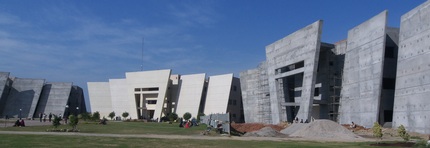
Ships of KnowledgeShips of Knowledge, University of Gujrat
shalamar garden

Shalamar Gardens, Lahore

I have been back from Lahore, Pakistan's cultural center and "City of Poets", for a while now. It was one of the most inspiring journeys I've been to.

Just a few weeks ago we've been at the…

Read more

Boycott Israel? – More anthropologists on Gaza (II)

LINKS UPDATED 26.10.2023 (text changed, name removed, see comments below) Four anthropologists are among a long list of scholars who in The Guardian call for a boycott of Israel:

We must do what we can to stop Israel from winning its war. Israel must accept that its security depends on justice and peaceful coexistence with its neighbours, and not upon the criminal use of force.

We believe Israel should immediately and unconditionally end its assault on Gaza, end the occupation of the West Bank, and abandon all claims to possess or control territory beyond its 1967 borders. We call on the British government and the British people to take all feasible steps to oblige Israel to comply with these demands, starting with a programme of boycott, divestment and sanctions.

Sarah at Once Upon a Time an Anthropologist Wrote reports about more protests at British Universities in her post How Academic World Reacted Toward the War on Gaza

Maximilian Forte at Open Anthropology has posted more info on boycott activities in Canada and university protests in Britain.

In the US on the other hand 3 students, who protested against Israel’s attacks, were arrested (one of them an anthropologist).

The question of academic boycott was also discussed at a seminar that Thomas Hylland Eriksen organized with his colleages at the research project Culcom. Personally, I am not sure if boycott is the way to go, but I liked the “smart boycott” that political scientist Nils Butenschøn suggested. If you collaborate with Israel you should be sure that the Israeli institution does not discriminate or support acts that breache international law.

What role should academics play in situations like these in Gaza? Theologian Anne Hege Grung said that the conflict is held up by myths. Our job is to deconstruct these myths.

Israeli anthropologist Jeff Halper is one of those intellectuals who does exactly that, she said. Last year he arranged a boat trip to Gaza in order to break the Israeli blockade. There, he formulated a message to his fellow Israelis:

(1) Despite what our political leaders say, there is a political solution to the conflict and there are partners for peace. If anything, we of the peace movement must not allow the powers-that-be to mystify the conflict, to present it as a “clash of civilizations.” The Israeli-Palestinian conflict is political and as such it has a political solution;

(2) The Palestinians are not our enemies. In fact, I urge my fellow Israeli Jews to disassociate from the dead-end politics of our failed political leaders by declaring, in concert with Israeli and Palestinian peace-makers: We refuse to be enemies. And

(3) As the infinitely stronger party in the conflict and the only Occupying Power, we Israelis must accept responsibility for our failed and oppressive policies. Only we can end the conflict.

His report of the trip can be read on the blog by Ted Swedenburg, another blogging anthropologist. Swedenburg is professor at the University of Arkansas and editorial committee member of the Middle East Report. He has blogged a lot about the Gaza-conflict.

In an earlier post I’ve mentioned several antropologists who try to do something similar. In a more recent post, Maximilian Forte analyzes and criticizes the myths spread by American media:

So THE WORLD trembles with love at the mere mention of “Obama,” while all those who oppose Israeli genocide and demonstrated against it were “Muslims.” In the meantime, the only real threat to peace is Hamas, and its bottle rockets.

Palestinians, not being white, European, privileged allies of the U.S., unlike Israelis, are less than human, and less than important, except as “obstacles.” All that Israel ever does is respond and get provoked, it never initiates — a pristine white victim of irrational brown people, you can almost hear its maiden-like screams across the white Atlantic.

With “reporting” like this, the media will keep anthropologists in business for a long time to come, as we try to clean up the damage they cause in creating a deranged culture of war and hatred. And it is hatred, a subtle, insidious, and racist hatred that motivates and encourages AP to write the kind of articles about Gaza as it has.

Then, I found a post by Palestinian anthropologist Khalil Nakhleh who concludes:

The only future for us, as an indigenous national minority that can exercise our inherited basic human rights on our land and that can achieve true justice and equality, is to reclaim and re-assert our narrative. (…) Our repossessed narrative cannot be a reinterpretation of our history as a dull shadow of Jewish-Zionist narrative. Our repossessed narrative must be based on the deconstruction of the racist Zionist-Ashkenazi system, which itself is a precondition for such a just solution. The existing Israeli system is, by definition, racist and exclusivist, and it is inherently and structurally incapable of providing justice and genuine equality to my Palestinian people.

Today, Anthropologist Smadar Lavie emailed me a link to her text Sacrificing Gaza to revive Israel’s Labor party. She reminds us of the different groups within the Israeli society and writes that it was mostly was the Mizrahim (Jews with origin in the Arab and Muslim World) who have been hit by the Hamas missiles. The Israeli European elite “imported” them “as a demographic shield against the Arab enemy”.

Smadar Lavie has put lots of papers online.

Finally, the anthropologists Kerim Friedman and Kiven Strohm have set up the wikipage “Understanding Gaza”

For more comments by anthropologists see my first posts: Anthropologists on the war on Gaza

LINKS UPDATED 26.10.2023 (text changed, name removed, see comments below) Four anthropologists are among a long list of scholars who in The Guardian call for a boycott of Israel:

We must do what we can to stop Israel from winning its…

Read more

What is good applied anthropology?

Most anthropologists work outside the university where they don’t enjoy academic freedom. These anthropologists must be better prepared for the perils of non-academic applied work, Brian McKenna writes in Counterpunch. For good applied anthropology is being troublesome:

He quotes Robert Lynd who in 1939 wrote:


[T]he role of the social sciences to be troublesome, to disconcert the habitual arrangements by which we manage to live along, and to demonstrate the possibility of change in more adequate directions . . . like that of a skilled surgeon, [social scientists need to] get us into immediate trouble in order to prevent our present troubles from becoming even more dangerous. In a culture in which power is normally held by the few and used offensively and defensively to bolster their instant advantage within the status quo, the role of such a constructive troublemaker is scarcely inviting.

Too often, applied anthropologists say “Yes, sir”:

Some years back Harvard anthropologist Kris Heggenhougen argued that the strength of anthropology in collaborating with other disciplines lies in saying, “yes, but. . . and to critically examine the decisive factors affecting peoples’ health including power, dominance and exploitation.” (Heggenhougen 1993)

Yes, but. . . . while that sounds good, more needs to be said.


First of all, we spend much more time saying “yes, sir” than “yes, but” in paid employment. This is necessary if we wish to stay employed. The workplace is a not a democracy but a hierarchy in which academic freedom does not apply. (…) (A)pplied anthropologists have to be prepared to travel the road from “yes, but,” to “no, sir” in order to better serve the public interest.

Brian McKenna mentions several applied anthropologists who were “troublesome”. One of them is Barbara Johnston who has worked with environmental justice. She warns about associated risks:

Environmental justice work “requires confronting, challenging and changing power structures.” When someone is involved in this work, says Johnston, “backlash is inevitable.” Because most anthropologists usually enter organizations as change agent s of some kind they need to be aware that they are especially at risk of being labeled a “troublemaker” at any time. If the label sticks it can lead not only to getting fired; it also can lead to a vicious form of bullying that can make one’s life unbearable.

According to Johnston, academic culture “trivializes the importance of this work,” while, at the same time, the engaged anthropologist struggles to find disciplinary support. 


Another example is Ted Downing who worked for the World Bank. In 1995, he wrote about the potential social and environmental impacts a proposed World Bank dam project will have on Chile’s Pehuenche Indians. The result: The report was censored:

After his report was censored Downing demanded that the World Bank publicly disclose his findings. The Bank responded by threatening “a lawsuit garnering Downing’s assets, income and future salary if he disclosed the contents, findings and recommendations of his independent evaluation.” (Johnson and Garcia Downing). As a result of his whistleblowing, Downing was blacklisted from the World Bank after 13 years of consulting service.


In his case, “yes, but” didn’t work. He progressed, reluctantly, to “no, sir”:

In fact this happens to many applied anthropologists but most do not have the resources, support or disciplinary guidance to assist them in their struggles. They might become whistleblowers but their careers suffer. And their stories are untold. We do not have a good accounting of how often this happens to anthropologists, but we need to learn more about this. In any case, resisting censorship is, as Downing says, “good applied” anthropology.

>> read the whole article in Counterpunch

SEE ALSO:

Neoliberal applied anthropology: Who owns the research — the anthropologist or the sponsor?

When applied anthropology becomes aid – A disaster anthropologist’s thoughts

Bush, “war of terror” and the erosion of free academic speech: Challenges for anthropology

USA: Censorship threatens fieldwork – A call for resistance

Examples of engaging anthropology – New issue of “Anthropology Matters”

Omertaa – Open access journal for Applied Anthropology

Most anthropologists work outside the university where they don't enjoy academic freedom. These anthropologists must be better prepared for the perils of non-academic applied work, Brian McKenna writes in Counterpunch. For good applied anthropology is being troublesome:

He quotes Robert…

Read more

Do we (still) need journals?

“Journals? Who cares?” anthropologist George Marcus said recently. Journals as we know them are a thing of the past, and the last to understand this fact are universities and academics, philosopher Mark C. Taylor says in an interview with E. Efe Çakmak in the new Eurozine issue:

For the most part, presses and journals as they now exist do not serve the interests of intellectual or cultural development. To the contrary, their proliferation is symptomatic of increasing hyper-specialization in which there is more and more about less and less. This is going in the opposite direction of history, in which there is increasing interconnectedness.

So my advice is to forget journals – I no longer read any academic journals and I stopped publishing in them years ago. The only function presses and journals serve is to authorize those who write for them among a dwindling group of peers. If ideas are to matter – and I believe it is crucial that they do – we must completely change the way in which they are communicated.

Taylor is critical of the “tyranny of the word”:

What I want to stress is that language in today’s world is not primarily verbal but is, more importantly, visual. The problem is that we are visually illiterate – and nowhere is this more evident than in the university. In the “real” world, image trumps word every time; in the academic world, word represses image all the time.

If communication is going to become effective on a global scale, we must liberate the image from the tyranny of the word. This does not mean giving up reading and writing as they have been known in the past. But it is no longer enough. The multilingualism of young people today is multimedia. If we do not learn to communicate in this language, we will have nothing to say.

>> read the whole interview in Eurozine (link updated 18.8.2020)

Already in the early 90s, Taylor has experimented with new information technologies according to Wikipedia. See also his comprehensive website.

SEE ALSO:

George Marcus: “Journals? Who cares?”

Anthropology blogs more interesting than journals?

"Journals? Who cares?" anthropologist George Marcus said recently. Journals as we know them are a thing of the past, and the last to understand this fact are universities and academics, philosopher Mark C. Taylor says in an interview with E.…

Read more

Open access to all doctoral dissertations at Temple University

(via Open Access News) Temple University has decided to provide open access to all its doctoral dissertations, starting with those completed August 2008 as Steven Bell, Associate University Librarian announced only a few days ago.

You can browse and search the archive on the Temple University Electronic Dissertations website. A quick search revealed that there are already two anthropology dissertations available:

Carolyn P. Merritt (2008): Locating the Tango: Place and the Nuevo Social Dance Community [link removed upon request by author]

Jay F. Gabriel (2008): Objectivity and Autonomy in the Newsroom: A Field Approach

Bell explains:

Many other leading research universities have created similar “open-access” electronic dissertation repositories and have found that cutting-edge doctoral research is more frequently read and cited as a result of making dissertations globally available in an open-access repository. For example, the University of Nebraska-Lincoln recently reported their open-access dissertations are downloaded sixty times more frequently than are restricted versions offered through the institutional subscription to Digital Dissertations.

He writes that the Libraries will no longer add paper copies of Temple dissertations to the Library stacks nor will it collect dissertations on microfilm.

>> see the official announcement by Temple University

“I hope that all universities will consider an Open Access mandate for electronic theses and dissertations”, comments Peter Suber from Open Access News. Furthermore, Temple should consider an Open Access mandate for peer-reviewed journal articles by faculty, for example, like the Harvard policy.

SEE ALSO:

Anthopology and open access to scholarship. New alliances threaten the American Anthropological Association

2006 – The Year of Open Access Anthropology?

ScientificCommons.org – The Open Access Search Engine

essays.se: Open access to Swedish university papers

A year ago, I wrote Already lots of publications in the open access anthropology repository Mana’o but it seems that the project is dead as the website has been down for several weeks now.

(via Open Access News) Temple University has decided to provide open access to all its doctoral dissertations, starting with those completed August 2008 as Steven Bell, Associate University Librarian announced only a few days ago.

You can browse and search…

Read more