search expand

The Cairo massacre and How to invent “religious conflicts”


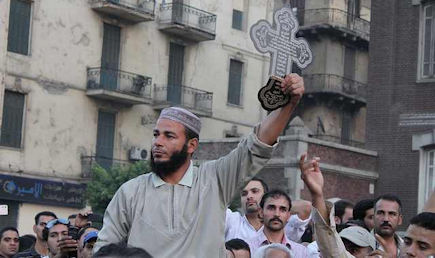
“Muslims, Christians, One Hand”: A Salafi is leading chants at funeral march of murdered protestors. Photo: Omar Robert Hamilton, flickr (via Hossam el-Hamalawy, facebook)

(preliminary notes, still in progress, last updated 16.10., 00:30 ) As everybody else, I am trying to make sense of Sunday night’s outbreak of violence in Cairo. While I was – unsuspectingly – walking through the streets of Cairo, trying to find the pasta stand I stumbled upon a week ago, the military was massacring protesters less than ten minutes by foot away from me at the Maspero State-TV building. At least 27 people were killed, more than 300 were wounded during a protest against religious discrimination and a recent destruction of a church in Upper Egypt.


Army vehicles run over protesters

It is both interesting and disturbing to see how the event has been covered by international mainstream media in comparison to local and social media.

International media has framed the clashes mainly as a religious conflict while they also could have chosen a totally different perspective: instead of “Muslims against Christians”, they could have chosen “the army against the people”. They could have described the clashes as conflict between forces who support the pro-democracy revolution (the people) and those that rather oppose it (the ruling Supreme Council of the Armed Forces, SCAF), as a conflict more of power than of religion.

UPDATE:“The atrocious killings in Maspero are not so much sectarian as a staging point in a full-scale counterrevolution“, writes sociologist Mona Abaza in Ahram Online

UPDATE: This sectarian language in Western media is, as Paul Sedra explains on Jadaliyya, not only inappropriate but dangerous.

As several local commentators stated, the protesters who were attacked by the military were not exclusively Christians.

Journalist, blogger and activist Hossam El-Hamalawy writes in his eyewitness account:

Many Muslims joined the clashes, and fought against the army and police. At one point a Muslim cleric carried a cross over the 6 October Bridge, leading Coptic protesters in marching on Maspero [the TV-building].

The demonstrators chanted repeatedly: “Muslims, Christians.. One hand!” and denounced Mubarak’s minister of defence, who is controlling the country now – Field Marshal Tantawi.

El-Hamalawy sees the current attacks on the Copts as an “attempt by the ruling military generals to split the ranks of the Egyptian poor and pit them against one another”. The presence of Muslim protesters alongside Copts are according to him “a hopeful sign”.

Al-Jazeera’s Sherine Tadros has made similar observations:

“There were people on the streets from all different sectors of society. Copts, Muslims, other Christians, secularists, even Salafists. ”What united them was not anything to do with sectarian issues or demands but actually a frustration directed at the army for what they feel is the army’s betrayel of the revolution."


Al Jazeera's Sherine Tadros reports from Cairo

Social justice for all, including religious minorities, was one of the demands of the january revolution.

Omar Tarek, an activist and journalist, was one of the Muslim protesters. Around 300 Muslim and Coptic protesters were gathered at state TV-building Maspero, holding candles, chanting and calling for unity according to Daily News Egypt .

Omar Tarek told the newspaper that the Coptic cause is the same as the Muslim cause.

You can’t demolish a house of worship. (…) I am here as an Egyptian, supporting an Egyptian cause.

Headlines like BBC’s Copts mourn victims of Cairo unrest suggest that Muslims or secularists don’t care which is not true. Many muslims joined the Copts at funerals.

Amira Abdel Hamid was one them. He said to Daily News Egypt:

I am here supporting the families of the martyrs and I was hoping that a lot of Muslims would make it to show the whole world that it is not sectarian strife, but an army against its people.

During their march from the Coptic Hospital to the largest Coptic cathedral in Cairo, protesters chant, “Muslims and Christians are one hand!”, reports newspaper Al-Masry Al-Youm. And: “Down with military rule!” “This is not a sectarian conflict, this is a military massacre.”

Ahram Online writes about the funeral for Mina Daniel, a young Christian revolutionary “who never forgot the importance of Muslim-Christian unity”:

Hundreds of Egyptians who had never met Mina Daniel – or, in many cases, had even heard of him before his death – attended the young man’s funeral, chanting, “We are all Mina Daniel.” (…)

Following the funeral, hundreds of mourners, including both Christians and Muslims, solemnly headed to Tahrir Square bearing Mina’s coffin.
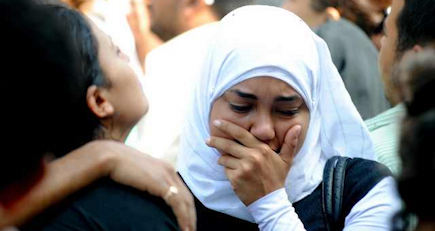

A Muslim girl who came to support her Christian friend after her brother was killed during the battles Sunday night. Photo: Lilian Wagdy, flickr

There is no doubt that Reuters and others are right when they write that Copts are discriminated. Even tourists like me are realising that the Muslim-Christian relationship is a sensitive issue. But the news agencies neglect to mention that many conflicts have been initiated and provoked by the regimes in power (“Divide and rule”).

Tom Heneghan, Religion Editor at Reuters, for example went so far to claim the following:

The clashes, in which Christians say they were fired on and charged down by armored vehicles, highlighted an irony of the Arab Spring that the region’s dictatorships may have been better guardians of minorities than budding democracies.

But in Egypt, many believe the recent clashes are a result of ousted president Hosni Mubarak’s policies, which nurtured sectarian strife, writes Heba Fahmy in Daily News Egypt.

As Omnia Al Desoukie stresses in another Daily News Egypt article::

While many are quick to point out the marginalization of Egypt’s Copts, less are inclined to label the country as a sectarian state.

Many observers have said that these underlying issues are often manipulated by authorities seeking to cling to power, an accusation often leveled against the Mubarak regime. Incidents such as Sunday night’s events are usually followed by widespread calls for national unity and shows of solidarity between Muslims and Christians.

“We now know a previous massacre, the bombing of the Church of the Two Martyrs in Alexandria in December, in which 21 were killed, was the work of Mubarak’s ministry of the interior”, explains Egyptian short story writer Ahdaf Soueif in the Guardian.

It was beyond sickening that a government would kill its citizens in an attempt to turn them against each other – and Muslims flocked to stand with their Christian friends at Christmas mass.

The attack on Egyptian Christians last Sunday “was not sectarian”, she writes, “this was the army murdering citizens.”

Egypt's Copts vent their rage during funerals

So instead of accompanying their articles with background information about Christians in the Middle East (BBC) or Christians under siege in post-revolution Egypt (AP / ABC News), international media could have chosen to highlight the role of the military generals in Egypt as for example CBS’ 60 minutes did. As bonus track one could add a feature about the role of the West, especially the U.S. as sponsor.

Here, the media, especially state media, seems to play a crucial role.

Zeinab El Gundy writes in Ahram Online:

A number of critics say that Egyptian state television not only failed to help resolve the crisis, but actually played a role in aggravating the already-tense situation.

In an unprecedented move, broadcasters on state television at one point called on the Egyptian public to head to Maspero en masse to defend Egyptian soldiers from angry Christian protesters, thereby further fuelling the sectarian flare-up.

On top of this, Issandr El Amrani writes at the Arabist, the military cut off the live TV feeds of several satellite TV stations, including Al Jazeera.

Some more observations at the end

  • Foreign media relied largely on accounts by the large international news agencies like Reuters and ap. Few journalists bothered to launche their web browser and do some research on their own. Egypt has an impressively large English language blogger og twitter scene, but only few of their accounts make it into mainstream news. One of them who took a look – Robert Mackey from the New York Times had to conclude “Social Media Accounts of Violence in Cairo Challenge Official Narrative

  • International media treated Egyptian state and military officials as trustworthy sources. Manar Ammar from the Egyptian news site BikyaMasr had to conclude that "international media outlets largely reported on Sunday night Cairo what state television was reporting.

At the end of this already too long post, I’d especially like to recommend the analysis The Last Choice by Mahmoud Salem aka Sandmonkey, one of Egypts best English language bloggers I’ve read so far. He not only analyses the massacre but also discusses possible local and global consequences. Sandmonkey is ending optimistically with an account from the Sunday night clashes:

After engaging in a street brawl where not a single person could tell who is with who or against who, they stopped a started chanting. One team started chanting “The People and the Army are one hand” and the others started chanting “Muslims and Christians are one hand”, thus providing us with the choices that we as Egyptians were told to make yesterday.

And then, strangely, both sides at the same time changed their chants to “One hand”, and both sides started chanting that fiercely, stopped fighting each other, and joined each other into one big marsh chanting “One hand, One hand”, and thus showing us that they made the right choice. They were presented with the choice between the Army and National Unity, and they refused to make that choice and collectively and organically made the only correct choice: Each Other. Egypt.

In the midst of the battle, they realized on a very basic level that they can’t chose one over the other, and that, even if they have prejudices, they really do not want to fight each other. There is a lesson in that incident for all of us, and it may just hold the key to our salvation.

MORE UPDATES

SEE ALSO:

Saba Mahmood: Democracy is not enough – Anthropologists on the Arab revolution part II

Thesis: That's why there is peace

Thesis: Neoliberal policies, urban segregation and the Egyptian revolution

Muslim Christmas Parties in Egypt = Celebration of religious diversity?

Extremism: "Authorities -and not Imams – can make the situation worse"

The dubious behaviour of Western researchers sightseeing the “Arab Spring”

“Muslims, Christians, One Hand”: A Salafi is leading chants at funeral march of murdered protestors. Photo: Omar Robert Hamilton, flickr (via Hossam el-Hamalawy, facebook)

(preliminary notes, still in progress, last updated 16.10., 00:30 ) As everybody else, I am trying…

Read more

(updated) The dubious behaviour of Western researchers sightseeing the “Arab Spring”

Egyptian sociologist Mona Abaza has written an interesting article about “growing inequalities” between researchers from the Middle East and the West.

“While the Arab Spring has enhanced global interest in the Arab world, local academics have often been reduced to service providers for Western ”experts“ who jet in and jet out”, she writes in the Egyptian news site Ahram Online.

Many belonging to our scientific community have recently felt somehow “misused” through being overwhelmed by Western tourist-revolutionary academics in search of “authentic” Tahrir revolutionaries, needing “service providers” for research assistants, for translating, and newspaper summaries, for first hand testimonies, and time and again as providers of experts and young representatives for forthcoming abounding conferences on the Arab Spring in the West.

These Western experts “typically make out of no more than a week’s stay in Cairo, a few shots and a tour around Tahrir, the ticket to tag themselves with the legitimacy and expertise of first hand knowledge”:

Many overnight Middle East experts show a remarkable tendency to pursue sensational and market-driven topics and readily switch interest as the market forces fluctuate. One day they are self-proclaimed experts on “political Islam” or “Islam and gender” and another, they are authority on “the Arab Spring” and “pro-democracy revolutions”. This superficial and business-oriented handling of crucial developments and changes in the area affects how the peoples of the region are perceived and how policies are shaped in the West.

She adds that “there is nothing wrong with providing services, had the relationship been equal, which was unfortunately never the case”:

Without sounding xenophobic, which is a growing concern that personally worries me more than ever, there is much to say about the ongoing international academic division of labour whereby the divide between the so called “theoreticians” of the North and the “informants” who are also “objects of study” in the South continues to grow.

There’s still a lot of orientalism in sociological textbooks as Malaysian sociologist S Farid Alatas pointed out, Abaza stresses:

Namely, that European thinkers remain pervasively as the “knowing subjects” whereas non-Europeans continue to be the “objects of observations and analyses of European theorists”.

Unless these issues are not brought up on the table of research agendas I am afraid that much will be said in the name of the revolution while perpetrating the same inequalities and Orientalist attitudes that are mostly felt in the job market, and in evaluating “whose knowledge counts more” in academe.

PS: “Service providers” is a term she borrowed from her colleague, political scientist Emad Shahin

>> read the whole text in Ahram Online

UPDATE: Interesting comment by a reader at Ahram Online:

Thank you Mona Abaza for having the courage to speak on behalf of local academics like yourself and journalists as well who are expected to offer their insight, information, years of hard work with the western tsunami that’s bombarding them (us). I’m personally sick and tired of having to do their homework for them. Where where they before the revolution and why do I have to give them my ideas?

Her article about this dubious academic tourism was also published in the magazine Jadaliyya. A Egyptian-American researcher writes she has “mixed feelings about this article” and notes among others:

Judith Orr, a British leftist academic said earlier this year that the Egy revolution is a monumental historic event that will be studied for generations. So whatever difficulties in the relationship with Western academics exist, they will need to be worked out somehow. Or maybe not.

UPDATE 2 (30.9.11): “The frustrations expressed by Mona Abaza and her colleagues in Egypt are also shared by a good number of scholars from the region who currently live and teach in Western universities” according to a commenter on Ahram Online

Great comment by Kevin at the Arabist blog. Kevin, a “(white) PhD candidate in History at the University of Michigan working on modern Iraq, suggests the following to American/European academics working on the Middle East:

(1) Reject the practice of organizing your bibliography around the three categories of archival sources, Arabic/Persian/Turkish sources, and secondary sources in European languages. Arabic sources should not all be lumped together – the primary sources of Arab ‘subjects’ should be listed alongside those of European subjects and the secondary/theoretical writing of Arabs should be listed alongside that of Europeans and Americans, not in its own special category.

(2) Take Arabs seriously as not only ‘informants’ but also ‘theoreticians.’ As Chakrabarty said, Indians feel compelled to site the authority of Western theorists (Marx, Gramsci, etc.) while Westerners writing on India never feel the need to site Indians AS theorists. For my part, I’ve learned a great deal by seriously reading the work of Iraqi historians and thinking about what their insights can add to the historiography in English and French. (I’ve been particularly struck by the significance of poetry as an historical source and the poet as an historical agent – something totally elided by white men and women.)

Another commenter linked to a text on academic freeloaders that was posted on the Arabist blog four years ago.

UPDATE 3 (1.10.2011): Anthropologist Mark Allen Peterson comments on Ahram Online. He writes that he agrees with Abaza’scomments, but adds that not all “experts” are “self-appointed”:

What expertise I have was won by extended research in the country over time–but I’ve not been back since 2010. Yet because my book (set in pre-revolution times) just came out, and because I maintain a blog in which I speculate on what’s going on in Egypt, the media contacts me and asks me to pontificate as an expert. It’s one thing when it’s local news media–many companies are trying to survive by “localizing” even the international news–but just this week I was contacted by a European journalist stationed IN CAIRO calling me to speak as an “expert.” I did redirect her to AUC [American University in Cairo] and to a colleague at Cairo University, but clearly many in the media privileges our academic affiliations in North America above people with greater immediate expertise in the region.’

UPDATE 4 (3.10.11): David Judson comments on Abaza from a Turkish journalism perspective in the Hürriyet Daily News: Citing the sightseers ogling the Arab Spring

Similar points about inequalities can be made about anthropology. As Brazilian antropologist Gustavo Lins Ribeiro pointed out six years ago:

Globalisation in anthropology has mirrored unequal relations existing within larger structural processes. Theory, for instance, has flown from metropolitan centers to non-metropolitan centers while the flow of “raw data” makes the opposite movement.

In order to trancend ethnocentrism and orientalism, he and several others edited the the book World Anthropologies. Disciplinary Transformations within Systems of Power .

Kenyan anthropologist Mwenda Ntarangwi discusses similar questions in his book Reversed Gaze. An African Ethnography of American Anthropology.

Egyptian sociologist Mona Abaza has written an interesting article about “growing inequalities” between researchers from the Middle East and the West.

“While the Arab Spring has enhanced global interest in the Arab world, local academics have often been reduced to…

Read more

The misconceptions of slum life

More and more people are living in slums. What can be done about it?

A few weeks ago I blogged about Safaa Marafi’s thesis about neoliberal policies, urban segregation and the Egyptian revolution. Now she has published a newspaper article that is a good example of public anthropology: Living in Slums … A Historic Dilemma that Needs to be Resolved!.

Here she explains one of the most important anthropological insights. If you work with people, you need to understand their point of view. In order to solve the problems of slum life one needs to listen to the voices of the people who live there.

Efforts to develop Egypt’s slums have been going on for several years, yet without tangible change. The key aspect that is missing in these projects is getting close to these people, understanding their priorities and way of life and meeting their expectations, she writes:

Understanding their culture, needs and way of life is essential to help provide them with the necessary resources they need, whether proper education, job, medical assistance. Moreover, do they need small shops, kiosks, or commercial areas?

From this stand point, I stress on the need to conduct serious research by social scientists to understand the culture of these people through one-to-one interviews and giving them the chance to express their needs and voice their concerns. Thus, this will assist in tackling the slumization phenomenon from its grass-roots.

>> read the whole article in Al-Masry Al-Youm

Anthropologists have stressed the importance of the “native’s point of view” in development projects for many years. Nevertheless, not only in Egypt, but also in Europe, people living in poorer neighborhoods are often stigmatized. Politicians and mainstream media tend to portray them as lazy and often criminal people that have to be “civilized”. So therefore, the poor are in policymakers’ view not worth to be listened to?

Marafi’s piece reminded me of some articles about slum life that have been published recently. All of them attack these misrepresentations.

One of them is the fascinating but sad story The life and death of Khanoufa: A personal account of Cairo’s “most dangerous thug”, written by Mohamed Elmeshad.

Egyptian police claim to have captured a man they called “Cairo’s most dangerous criminal”. Elmeshad questions these and gives us the perspective from his neighborhood where some of them see him as a victim of the system he was born into. A system where being associated with a slum area limits your opportunities in life.

“He turned out how he did because the police left him no other path in life,” Khaled, one of Khanoufa’s neighbors, said. At the age of 14, after participating in a neighborhood brawl, Khanoufa spent the first of a series of six-month stints in juvenile hall for youth misdemeanors. He became “marked” by police as someone they could pin crimes on or extort for money with the threat of imprisonment.

When his father, Abdel Shakour, passed away, Khanoufa’s family could no longer afford to pay-off the police, and he began spending more and more desperate nights in prison.

“That is when he turned to a life of crime. When he realized that he would be treated as a criminal for the rest of his life, no matter what. He reached a level of despair and said, ‘They’d take me in and put me in prison, regardless,’” Khaled said. He ended up spending half of his life in prison, from his teenage years until his death.

Mohamed Elmeshad has written another article from the same neighborhood (Ezbet Abu Qarn): Cairo’s poorest residents help the less fortunate in Somalia – a powerful story about cosmopolitanism from below.

A group of young men were moved by the images they saw in the media, and decided that the famine in Somalia must become a priority during Ramadan. Within four days, they were able to gather a large sum money among the poor people to the relief effort in Somalia.

“There are old widows who rely solely on charity to stay alive, who donated what I know is a really large amount for them,” said Sayed Kamal, one of the organizers.

“We don’t have people dying from hunger in our parts, but we do know poverty better than anyone else in Egypt, and we know about the fear of going hungry,” said Gamal Abdel Maqsood, a scrap metal dealer.

People in poor areas are no passive victims but do fight for their rights. In her story Popular committees bring true spirit of democracy to the streets, political scientist Rana Khazbak describes a campaign in another poor area in Cairo, Imbaba. Ehab Ali, a member in the popular committee in Imbaba, sounds like an anthropologist when he explains their campaign:

“We wanted to do field work in the streets among people. The piece of bread we eat every day is politics, the traffic congestion is politics, and the garbage in the streets is politics. That’s why in order to solve these problems and for Egypt to become a better place, we have to start from the bottom at the grassroots level.”

The popular committees were formed during the Januar revolution to protect neighborhoods when police withdrew from the streets in the midst of nationwide protests that toppled former President Mubarak.

Alia Mossallam, PhD student at the London School of Economics, explains in her article Popular committees continue the revolution:

Born out of a moment of chaos and fear, [the popular committes] proved themselves to be capable of self-organization in the days that followed. But most importantly, they proved to people that the end of “government” did not mean the end of the world.
(…)
In this surge of grassroots activism lie potential forms for popular governance. The committees not only teach us about the specific issues facing each neighborhood, but together they can teach us something about how political representation, accountability and local governance work on the ground.

Finally, just one week ago, Amnesty International has released a report about Egypt’s slums: ‘We are not dirt’: Forced evictions in Egypt’s informal settlements.

SEE ALSO:

Slum research: "Anthropology needs to engage in an activist way"

Poverty and health policies: Listening to the poor in Bangladesh

Anthropologist calls for a greater appreciation of child labor

Urban anthropologist: "Recognize that people want to come to the big cities"

Owen Sichone: Poor African migrants no less cosmopolitan than anthropologists

Why social scientists failed to see the Egyptian revolution coming

Thesis: Neoliberal policies, urban segregation and the Egyptian revolution

More and more people are living in slums. What can be done about it?

A few weeks ago I blogged about Safaa Marafi’s thesis about neoliberal policies, urban segregation and the Egyptian revolution. Now she has published a newspaper article that…

Read more

Deadly migration: The ignored health crisis on the US-Mexican border

A multi-dimensional public health crisis is unfolding on the U.S.-Mexico border that few seem ready to acknowledge, anthropologists Rachel Stonecipher & Sarah Willen write on the Access Denied blog.

The complexity of this crisis came to light during a recent study tour to Tucson, Arizona, in which Rachel Stonecipher took part.

Dehydration and heat-related illness claim hundreds of lives annually, and many of these deaths go unrecorded. No uniform system exists to count or repatriate remains. “We can only imagine the impact of these missed opportunities for identification on family members searching for their loved ones”, Stonecipher and Willen write.

For migrants who do reach their destination but face subsequent arrest, “interception” itself can involve serious health risks:

What happens to migrants after they are arrested and detained often remains shrouded from both the public eye and, to a great extent, the eyes of the human rights community. This is a particularly grave concern when arrested individuals already are sick or injured. (…) One especially serious concern involves the deportation of injured individuals who have not yet been medically stabilized. (…)

Detainees are also at risk of abuse – physical and mental – at the hands of police and Border Patrol officers. Despite official denials, No More Deaths, the Border Action Network, and other NGOs have collected and responded to numerous reports of abuse.

Through water stations, humanitarian aid camps, and desert patrols, a handful of NGOs provide assistance to migrants in need. But this cross-border health crisis is “far too vast for activists to address alone”, the anthropologists note:

Both human rights principles and contemporary realities demand that we hold countries with porous borders – including but not only the U.S. – accountable. Not only must such countries recognize migration as an enduring global phenomenon with complex causes and share accountability for both lives and deaths, but they must also engage in transnational public health efforts to develop the kind of multi-layered interventions needed to protect human life in border regions. (…)

Like the humanitarian organizations that work along the border, we all must insist on an expansive understanding of “public health” that recognizes people in transit as members of a common moral community: as people who are connected to us, and whose lives matter. Whether or not we understand or agree with the choice to migrate, activists along the U.S.-Mexico border remind us that border crossers are human beings who – like all other members of our moral community – are deserving of health-related attention, investment, and care.

>> read the whole post at Access Denied

SEE ALSO:

The "illegal" anthropologist: Shahram Khosravi’s Auto-Ethnography of Borders

"Human smugglers fight global apartheid"

No more conferences in Arizona: Anthropologists condemn Immigration Law

Why borders don’t help – An engaged anthropology of the US-Mexican border

Online: On the Margins – An Ethnography from the US-Mexican Border

Migration: Paperless underclass exposes dark side of Europe

"Ethnographic perspectives needed in discussion on public health care system"

A multi-dimensional public health crisis is unfolding on the U.S.-Mexico border that few seem ready to acknowledge, anthropologists Rachel Stonecipher & Sarah Willen write on the Access Denied blog.

The complexity of this crisis came to light during a recent study…

Read more

Fighting stigma and police brutality with theater – Anthrofilm needs support

Pioneer anthropology blogger and one of the founders of Savage Minds, Kerim Friedman has together with Shashwati Talukdar made a film about young Chhara actors who are using theater to fight the stigma of criminality and police brutality.

[video:vimeo:27718057]

The Chhara are one of 198 communities in India, whose grandparents were labeled “born criminals” by the British. The British labeled them criminals because they pursued a nomadic way of life. Although the British are long gone, the stigma still remains. They have become scapegoats and usual suspects for police. Youth find it very difficult to acquire and retain employment.

The film Please Don’t Beat Me, Sir! has recently been selected to have its world premiere at the 2011 Busan International Film Festival (BIFF) in October. The Independent listed BIFF (“Asia’s largest film festival”) as one of the top twelve film festivals of 2011.

The filmmakers’ goal is to have as many people see the film as possible. For a documentary film that means trying to get on TV. To make this possible, they need our help, Kerim Friedman writes on his blog:

That means having the best-quality exhibition master we can afford, attending the film festivals in person to meet with potential buyers, and even hiring a professional publicist and graphic designer to help promote the film. We can’t do any of this without your help.

For every level of donation they have some special rewards. For a donation of 35 USD, they offer a a special “Sneak Preview” of the film online (including a download link).

Their film is an example of “crowd-sourced filmmaking”. A significant portion of the film’s budget came from individual donations collected over the internet. People have also helped out in other ways: translating subtitles, recording music, designing the poster, etc. They also received some grants.

>> read more about the film and how to support it

SEE ALSO:

Anthropological activism in Pakistan with lullabies

What anthropologists and artists have in common

How filmmaking is reviving shamanism

Book review: How the Ganges boatmen resist upper-caste and state domination

UK Riots: Let’s talk about class and oppressive states

Pioneer anthropology blogger and one of the founders of Savage Minds, Kerim Friedman has together with Shashwati Talukdar made a film about young Chhara actors who are using theater to fight the stigma of criminality and police brutality.

[video:vimeo:27718057]

The Chhara…

Read more