
search expand

The cultural nationalism of citizenship in Japan and other places

As in several European countries, Japanese citizenship is still defined by decent. Inspired by the recent immigration debates in the US, anthropologist Sawa Kurotani reflects about the “cultural nationalism” of Japanese citizenship and concludes: “As long as this biologically and culturally produced Japaneseness continues to be the basis of Japanese citizenship, the mobility between citizen and noncitizen categories will be minimal.”

He explains:

Japanese self-analysis of their national character is widely known as nihonjinron (literally, discussion or theory about the Japanese), which centers on the unique characteristics shared among the Japanese that are the product of both biology and culture. The essence of Japanese identity is passed down through the “blood,” and is nurtured through the early process of socialization to make one truly “Japanese,” so the theory goes. This is why so many Japanese stubbornly refuse to accept a non-Japanese who attains near-native fluency in Japanese or who are able to grasp subtle cultural nuances: How can a gaijin (foreigner) without blood ties or proper upbringing possibly understand anything Japanese?

(…)

When Japan began to admit a large number of foreign workers into the country in the 1980s, the overwhelming preference was given to descendants of Japanese who emigrated to Brazil and Peru. Japanese seemed to believe that their Japanese blood made them “Japanese,” despite their socialization as Brazilians and Peruvians, and they were truly surprised when they later found out otherwise. This instance gives us a sense of how powerful the belief in “Japanese blood” is.

(…)

Japan is now one of the few developed countries that do not allow dual citizenship. This is not a major problem in the world of “one citizenship per person per lifetime,” which is, perhaps, the world in which the majority of my compatriots still live. But, it is about time that we acknowledge that the myth of “homogeneous society” is just a myth, and that an increasing number of Japanese nationals are experiencing transnational/multicultural lives outside Japan, while more and more non-Japanese are choosing to live and work in Japan.

>> read the whole article in The Daily Yomiuri (updated with copy)

SEE ALSO:

Chris Burgess: Maintaining Identities. Discourses of Homogeneity in a Rapidly Globalizing Japan

Kenichi Mishima: Japan: Locked in the Self-assertive Discourse of National Uniqueness?

“Germans stick to the ethnic definition more than any other European nation”

“Germans&Japanese less sensitive about race”

“Anthropologists Should Participate in the Current Immigration Debate”

As in several European countries, Japanese citizenship is still defined by decent. Inspired by the recent immigration debates in the US, anthropologist Sawa Kurotani reflects about the "cultural nationalism" of Japanese citizenship and concludes: "As long as this biologically and…
Read more

Is the Football World Cup a peacemaker?

Does the World Cup put a stop to war? It is undeniable that football has the power to unite – but its power to divide should not be underestimated, Daniel W Drezner writes in a Washington Post article where he quotes a 1973 article by Richard Sipes in the journal American Anthropologist. Sipes distilled the debate into two arguments: One is that combative sports and war are substitutes for aggressive behaviour. The other is that sports induce a warlike attitude. Sipes tentatively concluded that sports foster aggression.

Drezner discusses several interesting examples from the history of football and concludes:

The problem is that historically, football has been just as likely to be the trigger for war as the trigger for peace. Football will never bring about peace on its own. The flip side is also true-by itself, Football cannot start a war. The World Cup, like the Olympics, suffers from a case of overblown rhetoric.

>> read the article

>> Danel D. Rezbers own blog post about his article inkl comments

PS: It might be interesting to find out under which conditions football may trigger either war – or which conditions may trigger peace

UPDATE

Global Voices on World Cup: Iran and Mexico

Does the World Cup put a stop to war? It is undeniable that football has the power to unite - but its power to divide should not be underestimated, Daniel W Drezner writes in a Washington Post article where he…

Read more

Brewing Cultures: Craft Beer and Cultural Identity

beer

By studying beer cultures, you may learn lot about identity. In the United States, German-American identity is rarely marked. But given the association between Germany and beer, craft beer allows for the active negotiation of German-American identity, anthropologist Alexandre Enkerli writes in a draft of his paper Brewing Cultures: Craft Beer and Cultural Identity in North America, that he ‘s published on his blog.

“Craft beer” refers to barley malt beer brewed locally by a small commercial brewery. The “craft beer movement”, Enkerli explains, is oriented against the beer globalization. Slogans like “Think Global, Drink Local” are popular in the craft beer world.

Enkerli also discusses gender aspects:

Not only is the overwhelming majority of craft beer people male but masculinity and even virility are significant aspects of craft beer culture.

The negotiation of gender identity is an especially significant dimension of homebrewing, Enkerli writes. It often relates to the gender differentiation of food in general:

Historically, alewives and other brewsters have been responsible for domestic beer production. Contemporary (male) brewers often acknowledge the importance of women in the history of brewing. Yet the passage from a woman-centric domestic brewing practice to a male-dominated brewing industry and then to an overwhelmingly male craft beer culture rarely seems to represent a continuous process. It is as if male brewers, and especially homebrewers, were saying that despite their presence in the kitchen, they were still men.

Enkerli is both anthropologist and a craft beer enthusiast and has been homebrewer for several years.

>> read the whole paper

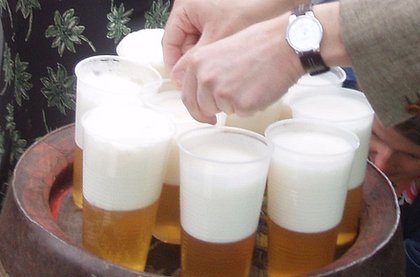
PS: The picture was taken at a Norwegian-German wedding. For the wedding, two barrels of Bavarian beer were transported by the couple from Bavaria to Norway by car. Enkerli’s point about negotion of German identity in the US might also be true for Norway.

beer

By studying beer cultures, you may learn lot about identity. In the United States, German-American identity is rarely marked. But given the association between Germany and beer, craft beer allows for the active negotiation of German-American identity, anthropologist Alexandre Enkerli…

Read more

“Standard model of the acculturation process is inadequate for understanding immigrant identity”

The magazine India New England writes about a psychologist who has been doing ethnographic fieldwork for two years! :

Sunil Bhatia, associate professor of human development at Connecticut College, uses the tools of ethnography to explore the unspoken, invisible experiences beneath the successful exterior of middle-class Indian immigrants, sometimes referred to as the “model minority.” He conducted two years of research as a participant-observer at community and family events among members of the Indian Diaspora in southern Connecticut.

His research shows that the standard model of the acculturation process is inadequate for understanding changes in immigrant identity:

In the standard model that Bhatia has questioned, an immigrant successfully deals with the new culture of his adopted country by integrating it with the old culture of his native land, shedding values and practices that no longer work, or providing space, often in the home, for the old values to live alongside the new. (…) He notes that the standard model ignores the particular historical and economic circumstances that lead people to move to a new culture. It also treats both old and new cultures as fixed entities practically synonymous with nation states, and its heavy emphasis on assimilation misses intriguing personal struggles where individuals adopt or reject values.

(…)

Bhatia says focusing on the immigrant’s own role in constructing both old and new identities, “changes the notion of what it means to assimilate or to be multicultural, shifting the question of what ‘otherness’ means.”

Bhatia sees the modern Indian immigrant constructing a home culture or “Indian identity” in the new country that is markedly different from life in the old. The family that shunned television in India as a waste of time may now have any of seven Indian satellite or cable channels in their American home to be sure their children are exposed to the language, news, and entertainment from “home.” Mothers often have dual roles: college-educated wage earners during the day, and cultural care-takers at night, cooking Indian meals, supervising their children’s Hindi language education, and dutifully securing a distinctly Indian home life — though often without the presence and counsel of their own mothers or the extended family.

These identity-building projects undertaken by Indians — what Bhatia calls “creating a space for themselves” in newspapers, celebrations, temples — require time, energy, individual choice, and struggle.

>> read the whole article in India New England

The magazine India New England writes about a psychologist who has been doing ethnographic fieldwork for two years! :

Sunil Bhatia, associate professor of human development at Connecticut College, uses the tools of ethnography to explore the unspoken, invisible experiences…

Read more

"Germans stick to the ethnic definition more than any other European nation"

Germany’s real problem isn’t “honor” killers or skinheads. Instead, what keeps this increasingly diverse nation from gaining a strong sense of social cohesion is its self-made confusion over what it means to be German in the first place, Gregory Rodriguez writes in a great article in the Los Angeles Times.

He quotes Barbara John, professor of European anthropology at Humboldt University in Berlin, who says: “We stick to the ethnic definition probably more than any other European nation.” He writes:

Indeed, long before Germany’s terrible experiment with ethnic supremacy during the Nazi years, Germans had a narrow view of themselves as a people. Unlike, say, the French, who acknowledge that their culture and language derive from the Romans and that they are akin to other Latin peoples, the Germans see themselves as unique.

What he (and many others as well) wonder about: Have the Germans learned from the nazi-period and World war II?:

Even after World War II, when West Germans did everything in their power to rid their culture of chauvinism and racism, they left intact a citizenship law that was based on blood kinship rather than on place of birth. That meant that the children of Turkish guest workers, born in Germany, were not automatic citizens, yet an ethnic German from Romania whose family had never resided in contemporary Germany was.

(…)

It wasn’t until 2000 that a more open citizenship law took effect. In arguing for a territory-based notion of citizenship, then-Interior Minister Otto Schily proclaimed that Germany needed to rise above “the destructive principle of ethnocracy.”

Six years on, Germans are only beginning to differentiate between their ethnic and civic identities. Ethnic Germans still tend to look on non-ethnic Germans as auslander, or foreigners. Even the media, when they acknowledge minorities as German citizens, use tortured phrases, describing someone as a “Turk who carries a German passport,” for example. Not surprisingly, such marginalization has negative consequences.

Rodriguez believes that the shaping of Germany’s future identity lies in popular culture. He mentions a popular sitcom “Turkish for Beginners,” and Turkish-German novelist Feridun Zaimoglu who says:

“The truth is you can’t talk anymore of a foreign population and a native population, as if they were enemies. As I understand myself, I am a German,” Zaimoglu says. “I love my country, but I don’t make a Wagner opera out of it. I don’t try to define what it means to be German. I just live it.”

>> read the whole article in the Los Angeles Times (link updated 14.10.2019)

SEE ALSO:

For Turks, Germany is home

French versus Germanic national identity

What’s all this fuss about national identity?

What’s a German? The Search for Identity Continues

Germany Survival Bible – a cultural guide for visitors by Spiegel Online

Germany's real problem isn't "honor" killers or skinheads. Instead, what keeps this increasingly diverse nation from gaining a strong sense of social cohesion is its self-made confusion over what it means to be German in the first place, Gregory Rodriguez…

Read more