search expand

Motstandsdyktige vestlandsdialektar

Forbedret kommunikasjon og globalisering fører ikke nødvendigvis til ensretting. Det har antropologisk forskning vist gang på gang. Enda et eksempel leverer språkvitere. Professor i nordisk, Gunnstein Akselberg holder på med å studere dialekten til 120 ungdommer ved Voss gymnas. Han har funnet ut at verken Oslo- eller Bergensdialekten hadde stor påvirkning på vestlandsdialekten, skriver På Høyden:

“Det er vanleg at eldre og vaksne på Voss klagar på at dei unge får ein utvatna dialekt, men Vossaungdommen viser få teikn på at dei tek til seg bergensuttrykk i dialekten. Tvert i mot ser ein at dialektane på Vest- og Sørlandet held seg forbausande bra. Dette gjeld til dømes både i områda rundt Bergen, Stavanger og Kristiansand. Når det gjeld Vestlandet som region er eg av den oppfatning at den gode utviklinga framfor alt skuldast at folk her er mykje stoltare av dialekten sin enn dei var før. Dette er nok ikkje tilfeldig, og kan mellom anna knyttast til at vestlandsidentiteten har blitt styrka.”

>> les hele saken

SE OGSÅ:

For 10–15 år siden trodde en at dialektene ville forsvinne i Norge. Nyere studier viser at vi tvert imot er i ferd med å utvikle nye regionale talemål. (forskning.no)

Stolte bygdefolk held på dialekten (forskning.no)

Forbedret kommunikasjon og globalisering fører ikke nødvendigvis til ensretting. Det har antropologisk forskning vist gang på gang. Enda et eksempel leverer språkvitere. Professor i nordisk, Gunnstein Akselberg holder på med å studere dialekten til 120 ungdommer ved Voss gymnas. Han…

Read more

Den vite mannens norm: Hur mordet på Fadime Sahindal debatterades i svensk offentlighet

Anita Goldman anmelder boka I varje trumslag Jordens puls av kulturantropologen Mikael Kurkiala. Den handler blant annet om den svenske debatten om Fadima-drapet. Goldmann skriver begeisteret om Kurkialas bok:

Den som skiljer sig från den vite mannens norm (som kvinna, icke-europé etcetera) har utsatts för förakt och förtryck och har då haft att välja mellan att hävda den egna särarten och att förneka själva existensen av skillnader. Det senare har kommit att uppfattas som ett radikalt och de som vågar uttrycka ett annat synsätt som reaktionära. Författaren gör med denna utgångspunkt en djupanalys av hur mordet på Fadime Sahindal debatterades i svensk offentlighet.

(…)

I boken blandas skarpt akademiskt analytiska texter med innerligt personliga och poetiska, en kombination vi är ovana vid i svensk sakprosa, men som jag ofta funnit – och inspirerats av – i amerikansk.

Antropologen tar også et krtitisk oppgjør med (post-)modernismen:

Det moderna projektet handlar om att ta kontroll över naturen och det har resulterat i en människosyn enligt vilken vi finner det närmast oacceptabelt att vi själva inte skulle ha kontroll. Detta tänkande menar Kurkiala, “är en logisk förlängning av den nu månghundraåriga ambitionen att förjaga eller härska över det som vi känner oss hotade av. Det måste vara “vilden”, naturen, kroppen eller könet. I grunden är alltså detta tänkande besläktat med det koloniala.”

>> les hele anmeldelsen i Aftonbladet

>> Informasjon om Mikael Kurkiala i Svensk bokhandel

Anita Goldman anmelder boka I varje trumslag Jordens puls av kulturantropologen Mikael Kurkiala. Den handler blant annet om den svenske debatten om Fadima-drapet. Goldmann skriver begeisteret om Kurkialas bok:

Den som skiljer sig från den vite mannens norm (som kvinna, icke-europé…

Read more

More and more anthropologists, but they’re absent from public debates – “Engaging Anthropology” (1)

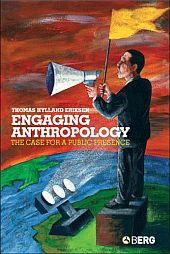
book “Anthropology is exceptionally relevant as a tool for understanding the contemporary world, yet it is absent from nearly every important public debate in the Anglophone world. In fact, it has almost gone underground in the English-speaking world. Paradoxically, as the discipline has grown, its perceived wider relevance has diminished. There are more of us anthropologists than ever before, yet fewer reach out to communicate with a wider world”, Thomas Hylland Eriksen writes in his new book “Engaging Anthropology”.

I’ve just started reading the book and am going to blog more about it the following days. Some of the questions raised in the book are: How can anthropology become more relevant for the “outside world”? What has anthropology to offer? Why do anthropologists fail to engage a wider public?

Thomas Hylland Eriksen takes up issues that have been widely discussed in the anthropological blogosphere before, f.ex. the unwillingness to share knowledge:

Anthropologists have an enormous amount of knowledge about human lives and most of them know something profound about what it is that makes people different and what makes us all similar. Yet there seems to be a professional reluctance to share this knowledge with a wider readership. Translating from other cultures is what we are paid to do; translating for the benefit of readers outside the in-group seems much less urgent.

Anthropologists, he criticizes, present their research findings in a way “that turns almost the entire potential readership off”:

The problem is that all these fine analytic texts, often brimming with insights and novel angles, rarely build bridges connecting them with the concerns of nonspecialists. Also, they are far too rarely supplemented by writings aimed at engaging a wider readership. (…) When did you last read a proper page-turner written by an anthropologist?

It was not always like this, he goes on. In the mid-twentieth century, in the days of Mead, Montagu and Evans-Pritchard, anthropologists were engaged in general intellectual debate and occasionally wrote popular, yet intellectually challenging texts. But as the discipline has grown, its perceived wider relevance has diminished. Since the Second World War, Hylland Eriksen writes, anthropology has shrunk away from the public eye in almost every country where it has an academic presence (Norway is an exception):

Scholarly works of great and enduring importance were published from the 1960s to the 1980s by Claude Lévi-Strauss, Mary Douglas, Victor Turner etc. Yet, the response from the nonacademic world was negligible, and this generation seemed to have no Margaret Mead to take current ideas and run with them. The discipline had become almost self-contained.

There are many possible ways of engaging a readership, he writes and gives some examples. He encourages anthropologists to write more personally engaged ethnographies. There is no contrast between professionalism and engagement:

I suspect that not a few anthropologists have lost their original motivation for studying the subject – understanding Humanity, or changing the world – on the way, replacing it with the intrinsic values of professionalism. And yet, just as the anthropological travelogue may be complementary to the monograph, the engaged pamphlet can often be a necessary complement to the analytical treatise. However, that pamphlet is written too rarely. It gives no points in the academic credit system, it may cause embarrassment among colleagues and controversy to be sorted out by oneself. The easy way out, and the solution most beneficial to one’s career, consists in limiting oneself to scholarly work.

Another suggestion: Anthropologists should write more essays:

Assuming that Leach was right in claiming that most anthropologists were failed novelists, here is a chance to become a truly creative writer without having to invent persons and events. The essay, unlike the article, is inconclusive. It plays with ideas, juxtaposing them, trying them out, discarding some ideas on the way, following others to their logical conclusion. In the essay, the writer sees the reader as an ally and fellow-traveller, not as an antagonist to be defeated or persuaded. The essay appeals to the reader’s common sense, it may occasionally address him directly, and the essayist tries to ensure that the reader follows her out on whichever limb she is heading for.

Strangely enough for us behind the screens: Hylland Eriksen doesn’t mention blogging. Blogs are as experimental as the essay form (or rather more). Additionally, blogs invite the reader to discuss with the anthropologist.

You can read the whole first chapter on Thomas Hylland Eriksens homepage.

UPDATE – MORE ON THIS BOOK:

Why anthropology fails to arouse interest among the public – Engaging Anthropology (2)

The Secret of Good Ethnographies – Engaging Anthropology (3)

UPDATE: Alun Salt writes:

Engaging Anthropology looks like it will be a fascinating book to read. There’s a post about it on antropologi.info. One of my favourite books is Popularizing Anthropology by McClancy and McDonaugh which makes a strong argument that if anthropology (and science) is publically funded then there is an obligation to make your results accessible to the public. They also make the argument that popular does not automatically mean unscholarly.

SEE ALSO:

Marshall Sahlins wants to make the Internet the new medium for traditional pamphleteering

Open Source Anthropology : Are anthropologists serious about sharing knowledge?

“Minimal willingness to post one’s own work online”, survey by the American Anthropological Association reveals

The Future of Anthropology: “We ought to build our own mass media”

book

"Anthropology is exceptionally relevant as a tool for understanding the contemporary world, yet it is absent from nearly every important public debate in the Anglophone world. In fact, it has almost gone underground in the English-speaking world. Paradoxically, as the…

Read more

Samfunnsforskning: Forskningsrådet har fordelt 19 mill. kroner til 19 prosjekter

183 søknader kom inn, 19 heldige søkere ble nå plukket ut, skriver Norges Forskningsråd. Blant de sosialantropologiske prosjektene finner vi:

  • Christianity, Gender and the dynamics of Community beyond the State. A study of urban Christian movements in Vanuatu (UiB )
  • Informal Child Migration in Europe (UiO)

>> last ned listen over alle prosjekter (Excel-fil)

Slik så fordelingen av midlene ut:

  • 107 søknader om forskerprosjekter – 13 innvilget
  • 39 søknader om personlig postdoktorstipend – 5 innvilget
  • 11 søknader om personlig doktorgradsstipend i utlandet – 1 innvilget
  • 15 søknader om støtte til forskerkonferanser – 11 innvilget

>> les Forskningsrådets pressemelding

183 søknader kom inn, 19 heldige søkere ble nå plukket ut, skriver Norges Forskningsråd. Blant de sosialantropologiske prosjektene finner vi:

Christianity, Gender and the dynamics of Community beyond the State. A study of urban Christian movements in Vanuatu (UiB…

Read more

Neuer dtv-Atlas Ethnologie verhöhnt die Leserschaft?

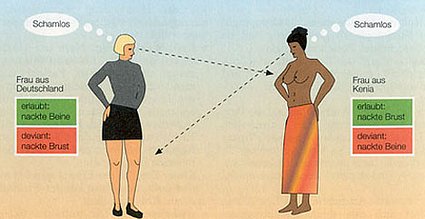
(via ethno::log) “Die universitäre Bildung ist durch PowerPoint-Denken und infantilisierende Veranschaulichung gefährdet”, schreibt die Sueddeutsche in ihrem Text ueber den neuen dtv-Atlas Ethnologie.

illustration

Die Sueddeutsche geht nicht gnaedig mit dem Buch um:

Man muss kein platonischer Bilderhasser sein, um in der Art und Weise, wie hier Theorien und Methoden des Faches in Was-ist-was-Bildchen umgesetzt werden, eine groteske Verhöhnung der Studierfähigkeit der vorgestellten Zielgruppe zu sehen.

illustration

Nachdem ich die beiden Abbildungen aus dem Buch in der Sueddeutschen gesehen habe, war mein erster Gedanke: Stammt das Buch aus dem 19. Jahrhundert? Soll Kolonialbeamten mit geringer Schulbildung das Verhalten der “Wilden” naehergebracht werden? Doch man soll ein Buch nicht beurteilen, ohne es gelesen zu haben. Vielleicht sind die anderen Illustrationen gluecklicher gewaehlt. Und vielleicht ist der Text ja annehmbar (deutsche Ethnologie-Lehrbuecher sind in der Regel schlecht und veraltet). Das Inhaltsverzeichnis sind z.T vielversprechend aus. Hervorzuheben ist die Behandlung nationaler Fachtraditionen (Frankreich, Russland, Brasilien, Japan, Indien, Native Anthropology etc). Im Vorwort wird viel Wert auf eine interdisziplinaere Perspektive gelegt.

Skeptisch macht einem jedoch das Titelblatt – in Zeiten wo Ethnologen ihre Feldarbeit in Shoppingzentren, Computerfirmen und Fussfallvereinen machen, ziert dennoch einer jener “edlen Wilden” das Cover.

>> zur Besprechung des Buches in der Sueddeutschen

Der Autor – Dieter Haller – hat uebrigens eine eigene Homepage mit nuetzlicher Linksammlung

illustration

(via ethno::log) "Die universitäre Bildung ist durch PowerPoint-Denken und infantilisierende Veranschaulichung gefährdet", schreibt die Sueddeutsche in ihrem Text ueber den neuen dtv-Atlas Ethnologie.

Die Sueddeutsche geht nicht gnaedig mit dem Buch um:

Man muss kein platonischer Bilderhasser sein, um in der Art…

Read more