search expand

Why anthropologists should study news media

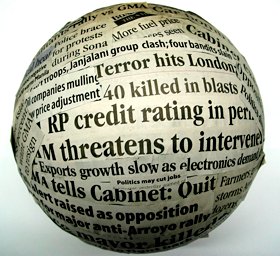
Bad News. Photo: Stitch, flickr

The time is right for more anthropologists to engage with news media – with their creation, reception and content, writes S Elizabeth Bird in the recent issue of Anthropology News that was published today.

Anthropological engagement with media was long rare and discouraged – and in some quarters still is, Bird criticizes. The main focus has in her view been on topics like the role of television in family life, or the maintenance of diaspora connections through digital media but not on news production or reception.

This neglect is according to her important because “news is the one popular genre that claims to describe reality for the public”. Most of what people know about the world is mediated in one way or another:

Throughout the world, people argue, fight and die for stories in which they believe. So it is important to dissect and interpret them: the use of language, the choice of words, the images, the entire frame of the news coverage.

She suggests following research questions:

  • Which stories are being told and which are not?
  • Whose stories are being told, whose are not, and why?
  • How do journalistic routines and values vary across cultural contexts, and how does that produce different kinds of news?
  • How does the choice of images take the story in one direction or another?
  • How does the story then become part of the common-sense reality in specific cultural contexts?

High profile issues like war, she continues, illustrate these questions dramatically:

We all know, for instance, that the story of the Iraq war is deeply contested. If we have a lot of time, we can scour the Internet, sift through multiple accounts, and reach a conclusion. Most people have neither the time nor the resources to do that; they have little choice but to attend to the stories that predominate.

If we understand better how journalism works, she concludes, not only will we better understand our mediated global cultures, but we will also become more adept at working with journalists to tell anthropology’s stories more effectively.

>> download the whole article: Anthropological Engagement with News Media: Why Now?

I have to admit I’m a bit surprised about her analysis. Is the study of news really so much neglected? But that’s maybe because I tend to read more anthropology blogs than journals? It’s in blogs this kind of media anthropology is happening?

There are six more articles on anthropology and journalism online, among others Reviewing Books in Popular Media Anthropologists as Authors and Critics by Barbara J King.

“Merging book reviewing with journalism”, she writes, “opens up a space in which we may fling our fierce book-engagement out into the wider world, and see what comes back to us:

When reviewing, the single greatest joy for me is the oppor- tunity to showcase our colleagues’ brilliance. I look for books that bring alive people’s patterns of meaning-making as they flourish and struggle in their daily lives, books that make us see with new eyes behaviors familiar and strange to our own society or at times even to our own species.

There have been many debates on the similarities of anthropology and journalism in the blogosphere, both here on antropologi.info and on Savage Minds (see Why is there no Anthropology Journalism? and Anthropology Journalism HOWTO)

In Divergent Temporalities. On the Division of Labor between Journalism and Anthropology, Dominic Boyer shares some interesting observations about the borders between anthropology and journalism that seem to overlap more and more.

The contemporary market and labor conditions pressure anthropologists to adopt faster modes of research and writing than ever before:

Even doctoral candidates report feeling enormous pressure to publish their research findings well in advance of receiving their PhDs. Not unlike the desk journalists of old, we find ourselves increasingly concerned with “getting the story” (Peterson in Anthropological Quarterly 74[4]), that is, with chasing the next publication opportunity to keep up with market expectations and the demands of institutional audit cultures.

>> overview over all articles in Anthropology News April 2010

The best source on media anthropology might be the website http://media-anthropology.net with mailing list and a long list of working papers and the blog media/anthropology by John Postill

A good example of an anthropology of news can be found in the february issue of Anthropology Today (free access!!). In Heart of darkness reinvented? A tale of ex-soldiers in the Democratic Republic of Congo, Sindre Bangstad and Bjørn Enge Bertelsen analyze Norwegian media’s representation of Congo.

SEE ALSO:

Why anthropologists should become journalists

Nancy Scheper-Hughes: Public anthropology through collaboration with journalists

The end of one-way communication – Anthropologists help news providers and advertisers

In Norwegian TV: Indian tribe paid to go naked to appear more primitive

John Postill on media anthropology and internet activism in Malaysia

Introduction to “Media Worlds”: Media an important field for anthropology

Bad News. Photo: Stitch, flickr The time is right for more anthropologists to engage with news media - with their creation, reception and content, writes S Elizabeth Bird in the recent issue of Anthropology News that was published today.

Anthropological engagement…
Read more

Anthropologist uncovers how global elites undermine democracy

Janine Wedel has done something that far too few anthropolologists do: She studied powerful people. Those who rule the world.

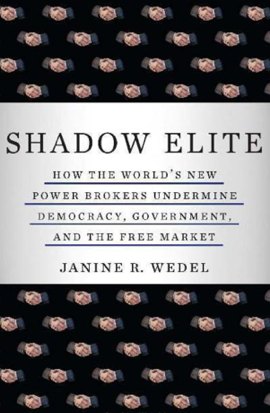
In her book “Shadow Elite“, she shows how a new system of power and influence has taken hold globally, one that undermines democracy, government, and the free market.

Why went America to war against Iraq? More and more “government work” is performed by “shadow elites”: consulting firms, companies, nongovernmental organizations, think tanks etc, rather small circles of powerful people (she calls them “flexians”) who use their interlocking relationships to control public policy without public input. “Flexians” work often for private interests, academia and government at the same time.

The flexians form “Flex nets”. They cannot be reduced to lobbyists or interest groups. They are according to a review in the Financial Times defined by four features:

1) personalizing bureaucracy, or using personal connections and loyalties to realize goals;
2) privatizing information while branding conviction, or branding the information available only to insiders in this game;
3) juggling roles and representations, or changing spots frequently, wearing the pelt of military leader one day, analyst the next, and concerned citizen the next;
4) relaxing rules at the interstices of official and private institutions, or adjusting accountability and rules that apply to one or more of their pelts from the safety of a seemingly non-aligned position.

One of those flexians is the retired US general Barry McCaffrey, who has been simultaneously a commentator for the media, a consultant to the defence industry and professor. According to a 2008 exposé in the New York Times, he was one of several former military men who helped to shape public opinion on the Iraq war, while simultaneously having undisclosed ties to the Pentagon.

Wedel’s book has received quite a lot of media attention since it was released earlier this year. It was book of the month at Huffington Post (where she has started writing a weekly column) and was also reviewed in mainstream media. She was interviewed both by BBC, Russia Today, MSNBC and Al Jazeera.

Riz Khan - Shadow Elite - 15 dec 09 - Pt 1

Riz Khan - Shadow Elite - 15 dec 09 - Pt 2

It would be interesting to know how she studied the “shadow elites”. Has she been on fieldwork? I haven’t read all her texts. But in her newest article in Huffington Post, she explains how she came to understand the game: through her experience studying the mechanisms of power and influence in post-Cold War eastern Europe for about 30 years:

(E)xamining eastern Europe up close–through its transformations away from communism over the last quarter century–has been excellent preparation for making sense of how a small group of power brokers helped engineer the invasion of Iraq, and more broadly, how a new system of power and influence has taken hold globally, one that, as I write in my book Shadow Elite, undermines democracy, government, and the free market.

In communist Poland, the necessity of getting around the state-controlled system created a society whose lifeblood–just beneath the surface–was vital information, circulated only among friends and trusted colleagues, information that was not publicly available. Under-the-radar dealings that often played on the margins of legality – this was the norm, not the exception.
(…)
I began to recognize a familiar (to me) architecture of power and influence. I started to follow the networks and overlapping connections in government, foundations, think tanks, and business of a tiny set of neoconservatives – just a dozen or so players I call the “Neocon core”.
(…)
The playbook of the Neocon core seemed to come straight from that of the top players of transitional eastern Europe. In both cases, players who already knew each other set up a host of organizations–organizations that seemed more like an extended family franchise than think tank, populated by the same set of individuals. (…) And despite a new administration in Washington, not to mention the damage done to their credibility since the Iraq invasion, the Neocon core lives on, because networks like it are self-propelling, multipurpose, and enduring.

And she adds that as a social anthropologist, her “focus is not on whether the U.S. should have invaded Iraq, but rather how that decision was made, who made it, and what mechanisms of power and influence were used to make it”.

Exactly!

And in Anthropology News february 2010 (pdf) she explains why we need an “ethnographic focus” on power:

I have concluded that an ethnographic focus is indispensable to sorting out power and influence amid transforming federal governance in the United States, not only under change-of-system conditions such as those found in transitional eastern Europe.

The ethnographic sensibility that enabled scholars of communist and post-communist societies to deal with the complexity, ambiguity and messiness of political and policy processes is ideally suited to examine the interactions between public policy and private interests and the mixing of state, nongovernmental, and business forms that are increasingly preva- lent in the United States and around the world.

By focusing on players and their networks as drivers of governing and policy decisions, these ethnographers have laid the groundwork for badly needed critiques of social science categories such as “state” versus “private,” “top-down versus bottom-up,” and “centralized” versus “decentralized.” They have provided a basis for reexamining conventional models that guide so much thinking about politics, policy and power, and yet obfuscate, rather than illuminate, the real system of power and influence.

Her work is a good example of public anthropology. Her website is really impressive. There you find a great amount of her publications, both newspaper articles and papers (even back to pre-internet and pre-computer times), a collection of book reviews, TV and radio interviews, interviews related to Shadow elites etc

It is popular to lament about the lack of public anthropology, but anthropologists have been highly visible in matters regarding global financial and power issues, see earlier posts Anthropologist Explores Wall Street Culture, Financial crisis: Anthropologists lead mass demonstration against G20 summit and Used anthropology to predict the financial crisis.

Studies on elites are still not as common as studies on marginalized people, though. This is not only true for anthropology. I have to think of a series of great programs at BBC Thinking aloud about white collar crime – a rather neglected topic among sociologists and criminologists as well.

Janine Wedel has done something that far too few anthropolologists do: She studied powerful people. Those who rule the world.

In her book "Shadow Elite", she shows how a new system of power and influence has taken hold globally, one…

Read more

Hvor “farlig” er cannabis virkelig?

– Å si at alle som bruker cannabis per definisjon er misbrukere, blir det samme som å si at alle som drikker, er alkoholikere, mener antropolog Flore Singer Åslid. Norsk politikk overfor rus er svært moralistisk. I sitt post-doc-prosjekt ønsker NTNU-forskeren å bidra til en mer nyansert cannabisdebatt, melder forskning.no.

Antropologen ser ut til å fortsette der hun slapp da hun leverte doktoravhandlingen om “lørdagsnarkomaner”. I sitt post.doc-prosjekt skal hun studere cannabisbruken blant personer over 30 år med et høyt forbruk av stoffet over tid: Hvilke faktorer bidrar til problematisk bruk og avhengighet?

Her er erfaringene til cannabisbrukerne viktig:

– Jeg vil bidra til at vi får en dypere innsikt i problemstillingen bygd på brukererfaringer. Det er de som faktisk bruker stoffet, som har mest kunnskap om hvorfor de bruker det, når de bruker det, sammen med hvem og hvor mye. Men de har sjelden blitt hørt.

Stigmatiseringen av cannabisbrukerne gjør det ofte vanskelig å fange opp de som har problemer. Det er nemlig ikke slik at cannabis alltid skaper avhengighet og må behandles. Mange bruker stoffet for å slappe av og ha det artig, akkurat som alkohol, noen for å håndtere smerte, mens andre bare er nysgjerrige.

>> les hele saken på forskning.no

SE OGSÅ:

For et mindre svart/hvit bilde av rusbruk – Doktorgrad på hobbynarkomaner

Vil avmystifisere forestillinger om rus – Doktorgrad på lørdagsnarkomaner

Klarer urbefolkninger ikke å håndtere alkohol?

– Helgefylla skyldes kristendom

– Anti-rus kampanjer har ofte motsatt effekt

Antropolog hjelper bedrifter med å kartlegge ruskulturen

Antropolog disputerer om yngre innvandrere i rusmiljøer

Hasjselgere langs Akerselva i Oslo: – Heller gate- enn æreskultur

Fieldwork among homeless heroin and crack users – new book by Philippe Bourgois

Study: Drug smuggling as vehicle for female empowerment?

– Å si at alle som bruker cannabis per definisjon er misbrukere, blir det samme som å si at alle som drikker, er alkoholikere, mener antropolog Flore Singer Åslid. Norsk politikk overfor rus er svært moralistisk. I sitt post-doc-prosjekt ønsker…

Read more

Beware: No Pecha Kucha allowed without consent from Tokyo

My post Pecha Kucha – the future of presenting papers? received much attention and inspired others to arrange such sessions where papers are not read but presented through 20 images displayed for 20 seconds each. But I’m no longer sure if I would recommend Pecha Kucha after having received this email a few days ago:

To Lorenz Khazaleh,

This is Jean from PechaKucha HQ here in Tokyo. It has come to our attention that you recently organized a PechaKucha event without our consent.

Pecha Kucha – the future of presenting papers?

The PechaKucha name, logo, and format are all trademarked concepts, and as we clearly indicate on our site, we ask that anyone who is interested in running a PK event get in touch, as we have a review and agreement process that we go through.

http://pecha-kucha.org/night/start-a-city

We do support one-off events as well, but again, they are all officially sanction.

http://pecha-kucha.org/events/

We hope to hear back from you very shortly to prevent this from happening again.


Jean Snow

PechaKucha Night
founded by Astrid Klein and Mark Dytham in Tokyo

http://pecha-kucha.org

I first couldn’t believe what I read. A review and agreement process? Trademarking an idea? Is there a dubious commercial corporation behind Pecha Kucha? (And apart from that – I did not arrange a PK session, but only interviewed two participants.)

As I learnt on their website, you will need to go through a lot of bureaucracy, especially if you intend to arrange Pecha Kucha Nights. You’ll have to meet a lot of requirements and be prepared for providing lots of details about yourself and your team.

Timothy from Bluish Barn tried to start a Pecha Kucha Night and quotes an email from Klein Dytham architecture:

As we are now inundated with similar requests from across the world, we would love to know more about you!!! – your design background, design connections, events experience, ideas about venues, designers you would approach to present their work etc….Once we receive [your background/plans] we can review everything and get back in touch! KDa own the Registered Trademark for Pecha Kucha Night, 20 x 20 in the UK, Europe and US and if we decide to proceed we can provide you with the logos, templates and formats and our standard handshake agreement in order for you to get started!

As the Pecha Kuchs trademark owners explain on their website, they “sometimes say yes and sometimes say no – so be prepared for both answers”. And normally it takes them “a month or so” to grant PKN “handshake” agreements.

Nevertheless, the Pecha Kucha format is great. So the best thing might be to call it something different, like speed presentations or so, a term that Greg Downey introduced last year at Neuroanthropology.net, create your own logos etc Good luck!

See also Greg Downey’s brilliant round-up Thoughts on Conference Organizing

UPDATE First reaction on this post: Marc Oehlert: Pech* Kuch* (evidently Japanese for “full of yourself”). He analyses and comments the Pecha Kucha website more thouroughly than I did and has already received lots of comments! Great post!

My post Pecha Kucha - the future of presenting papers? received much attention and inspired others to arrange such sessions where papers are not read but presented through 20 images displayed for 20 seconds each. But I'm no longer sure…

Read more

Globale Rechte statt “Integration”

Es gilt es Abschied zu nehmen von der Vorstellung einer homogenen nationalen Gesellschaft als Grundlage friedlichen Zusammenlebens. Das ist eine der Botschaften des Sammelbandes “No integration?! Kulturwissenschaftliche Beiträge zur Integrationsdebatte in Europa“, mitherausgegeben von der Ethnologin Sabine Hess.

“No Integration” ist bereits im letzten Jahr herausgekommen. Holger Moos vom Goethe-Institut stellt das bislang wenig beachtete Buch nun auf Qantara.de vor.

Migranten, so die Forscher, sollten nicht primär als Menschen mit Defiziten betrachtet werden, die es in “Integrationskursen” auszugleichen gelten. Ein Perspektivwechsel sei notwendig. Wir brauchen transnationale Perspektiven:

Im Zeitalter der Mobilisierung von Menschen, Gütern und Ideen seien Lebensläufe über nationalstaatliche Grenzen hinweg längst Normalität. Deshalb müsse die migrantische Perspektive, die spezifischen Interessen, Lebensbedingungen und Leistungen von Migranten, stärker berücksichtigt werden. Diese transnationale Perspektive mündet in die Forderung nach globalen sozialen Rechten und Bürgerrechten. (…) Ziel von Integration müsse Chancengleichheit durch Teilhabe am gesellschaftlichen, wirtschaftlichen, politischen und kulturellen Leben sein. Und das verlange außer den Zuwanderern eben auch den “Nicht-Zugewanderten” etwas ab.

Die meisten Artikel thematisieren die Integrationsdebatte in Deutschland:

Der aktuellen Integrationsdebatte liegt nach Ansicht der Herausgeber ein essenzialistischer Kulturbegriff zugrunde. Die aufnehmende Gesellschaft und die Einwanderungsgruppen würden als abgeschlossene Container betrachtet. Diese Vorstellung sei desintegrierend und betone das Trennende zwischen den Kulturen statt das Verbindende zu identifizieren.

>> weiter bei Qantara.de

Eine längere Besprechung gibt es auch auf H-Soz-u-Kult. Beim Transcript-Verlag kann man die Einleitung als pdf runterladen.

SIEHE AUCH:

Ausstellung “Crossing Munich”: Ethnologen für neue Perspektiven in der Migrationsdebatte

How to challenge Us-and-Them thinking? Interview with Thomas Hylland Eriksen

Neuperlach: Wie Schule, Eltern und Medien “Ausländerprobleme” schaffen

Kosmopolitismus statt Multikulturalismus!

Werner Schiffauer: Wie gefährlich sind “Parallelgesellschaften”?

Wider den Kulturenzwang, für mehr Transkulturalität

Populärethnologie von Christoph Antweiler: Heimat Mensch. Was uns alle verbindet

“Projekt Migrationsgeschichte”: Kulturwissenschaftler in Container in Innenstadt

Erforschte das Leben illegalisierter Migranten

Ethnologen, raus aus der Kulturfalle!

“No Pizza without Migrants”: Between the Politics of Identity and Transnationalism

Es gilt es Abschied zu nehmen von der Vorstellung einer homogenen nationalen Gesellschaft als Grundlage friedlichen Zusammenlebens. Das ist eine der Botschaften des Sammelbandes "No integration?! Kulturwissenschaftliche Beiträge zur Integrationsdebatte in Europa", mitherausgegeben von der Ethnologin Sabine Hess.

"No Integration"…

Read more