search expand

The Open Anthropology Cooperative – A Worldwide Anthro-Community in the Making

(updated)What about creating A worldwide community for anthropological discussion and collaboration away from the restrictions of formal academic structures has been created at http://openanthcoop.ning.com/ (already more than 140 members Thursdag night!) It started as a twitter-conversation, now the debate also takes place on Keith Hart’s website.

In some way, this community already exists – in the anthropological blogosphere. But also non-bloggers shall be included, and The Open Anthropology Cooperative – that’s what it is supposed to called – is actually much more. Maybe we can call it the web 2.0 version of the conventional (mostly national) anthropological associations.

More than 30 comments have been posted so far. They include following ideas and suggestions about the new community:

* A place to share ideas

* A place to find like-minded anthropologists

* A place to collaborate

* A place to hold virtual conferences

* A place to host podcasts

* A place to ask questions

* A place to learn about new tools for anthropology (online tools, field tools, etc.)

* a place to find resources (e.g. databases, good grad programs, upcoming colloquia, software, field opportunities)

* A place to publish
* The idea of an engaged anthropology for the 21st century in relation to the digital revolution
* Group blog with posts from both Keith and others
* Forum for discussion
* Online press to publish longer pieces
* The incorporation of Twitter, social bookmarking, wiki, etc

>> read the whole discussion

>> follow the debate on twitter

Anthropologist “Fran” at http://ethblography.blogspot.com likes to see the Open Anthropology Cooperative “become a comfortable channel for discussion which does not intimidate amateurs or first-year undergraduates, yet remains useful for doctoral students, fieldworkers, lecturers and specialists in all fields”. She also hopes “that it will become truly international (and multilingual)”.

She continues:

In my opinion, there is no reason for an invented divide that reduces web-based academic content to a second-rate substitute for formal (read: expensive, elaborate, bureaucratic) channels. Why not overlap “open” and “official” academia until they are one and the same? If the technology and demand can sustain it – which I believe they can – making anthropological and ethnographic knowledge freely available should be a priority. This can reflect back heavily upon the academic method itself, both in theory and in practice.

>> read the whole post

SEE ALSO:

How can we create a more plural anthropological community?

World Anthropologies Network – Working towards a global community of anthropologists

The Future of Anthropology: “We ought to build our own mass media”

Keith Hart and Thomas Hylland Eriksen: This is 21st century anthropology

(updated)What about creating A worldwide community for anthropological discussion and collaboration away from the restrictions of formal academic structures has been created at http://openanthcoop.ning.com/ (already more than 140 members Thursdag night!) It started as a twitter-conversation, now the debate also…

Read more

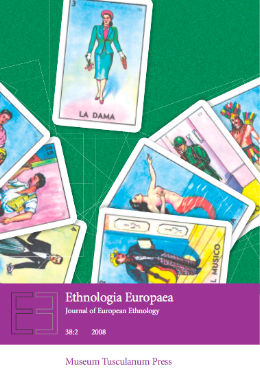
Journal of European Ethnology is going (a little bit) Open Access

cover

Is Open Access the new buzz-word? Do we see some change in the world of anthropology journals? Angels Trias i Valls recently announced the birth of a new open access journal, Anthropology Reviews: Dissent and Cultural Politics.

And last week, I received an email by Thomas Mogensen, the editor of Ethnologia Europaea. Journal of European Ethnology. He promoted his journal among other things by informing that they support open access publishing. Back issues (older than three volumes) are open access.

And he wrote:

As part of our policy in support of open access publishing, we also would like to offer you a free copy of one of the articles from the latest issue (vol. 38:2). You can access and distribute the article free of charge by using this link: http://www.mtp.dk/pdf/Is_East_Going_West-Or_is_the_West_Moving_East

If we take a look at the previously published volumes, we’ll find out that only back issues from 2004 and newer are freely available. Marketing Manager Niels Stern explains that they only had funds to digitize volumes published since 2001 (they were digitized in 2004). “But of course we would like to go further back”, he writes in an email to me. Being a non-profit publisher, they are still looking for funding initiatives that could aid in this respect.

At the same time, one of the larger commercial publishers is involved in a scandal. Elsevier has been lobbying against the open access movement for a long time on the grounds that open access journals can’t be trusted. Now they confirm that they have put out six fake journals. They look like peer reviewed but were sponsored by unnamed pharmaceutical companies. >> more info at Open Access News

Is East Going West – Or Is The West Moving East is the title of the open access article in the most recent issue og the Journal of European Ethnology.

For her doctoral thesis on (East) German identity-formation in today’s unified Germany, Sofi Gerber has conducted biographic interviews with persons who were born and grew up in the GDR and who now live in unified Germany.

She writes:

The most striking thing in the interviewees’ picture of the Eastern parts of Germany is their general de- scription of a society falling into decay. Contradictory to the hopes invested in the program Aufbau Ost (Re-Build the East), which has invested enormous amounts in the New Federal Republics’ infrastructure and buildings, the interviewees seem, rather, to describe an Abbau Ost (Dismantling the East). My interviewees’ narrations include an othering of big parts of Eastern Germany, as a place in which it is impossible or undesirable to live.

But the East–West boundary is not only reified, but also transcended by the interviewees:

This is articulated both implicitly, in that the interviewees stress other identifications, and explicitly, in that the dichotomisation is described as irrelevant or outdated. (…)
The identification with a region or a town can be described as superior to the East–West identification (…).
Most of the interviewees now living in Berlin identify themselves with the city, mostly because of what they describe as its openness, rawness and charm. Berlin is then not only a geographical place, but also a way of living, which is contrasted with the narrow-minded life in the countryside or the superficial life in other cities.
As described earlier, both of these contrasts can be associated with the East and the West respectively, but the special aura of Berlin can also be described as something extraordinary, transcending this dichotomisation. Even when the interviewees identify themselves with one district, this identification is often described as independent of the former border.

>> visit Ethnologia Europaea. Journal of European Ethnology

SEE ALSO:

New overview over open access anthropology journals

Open Access Anthropology in Africa – an introduction

Open access to all doctoral dissertations at Temple University

Why Open Access?

cover

Is Open Access the new buzz-word? Do we see some change in the world of anthropology journals? Angels Trias i Valls recently announced the birth of a new open access journal, Anthropology Reviews: Dissent and Cultural Politics.

And last week, I…

Read more

Marianne Gullestad and How to be a public intellectual

Today I’ve been at symposium in memory of one of Norway’s greatest anthropologists, Marianne Gullestad who died last year.

She was a public intellectual. She often took part in public debates and sometimes after she had published an article in a scientific journal, she sent a short version of her paper to a local or national newspaper. It must be because of her (and a few others later) that most people in Norway know what anthropology is or have a better understanding of it than in many other countries.

One of the speakers was Richard Jenkins (University of Sheffield). Later in the discusson, he made interesting points about being a public intellectual. He actually questioned the term “public intellectual”. For is there something like a “private intellectual”?

You can also be a public intellectual in the classroom – it might even be a more lasting contribution to the society than writing articles in newspapers, he said:

The term public intellectual presumes that during the rest of the academic work we’re doing something else, that we are private intellectuals. The point is that we are communicating to the public. We are teaching or we are writing. Sometimes we forget how many people who are reading our papers and books around the world, including students.

Being in the public sphere is not just writing for newspapers and being on television. Being a public intellectual is actually a core part of our practice.

We systematically neglect that responsibility, partly by virtue of the way many of us write. We write as if we are writing to a very small circle of people who can understand sentences that are 26 lines long. We have the responsibility to write in a different way when we are doing our academic work. We should not make this distinction between writing for the public and writing academically.

We have a responsibility for intellectual democracy. It does not mean that we have to simplify what we say. One of the many nice things about Marianne Gullestad is that she did not make this distinction. She wrote always in a very clear and straight format, and she did it in both Norwegian and English. This is a responsibility that many of us not take seriously. We should take Marianne Gullestad as an example.

The role of the intellectual doesn’t stop when you walk into the lecture room. It starts there. And it is probably a more lasting contribution to the society out there than writing articles in newspapers.

(edited quote, based on my low quality recording)

For more information on Marianne Gullestad including links to her papers online, see my earlier posts: Marianne Gullestad has passed away and Marianne Gullestad: The Five Major Challenges for Anthropology.

SEE ALSO:

“Discuss politics!” – How anthropologists in Indonesia engage with the public

More and more anthropologists, but they’re absent from public debates – “Engaging Anthropology” (1)

Why anthropology fails to arouse interest among the public – Engaging Anthropology (2)

The Secret of Good Ethnographies – Engaging Anthropology Part III

Why is anthropological writing so boring? New issue of Anthropology Matters

Six reasons for bad academic writing

The most compelling ethnographies

Nigel Barley: “Fiction gives better answers than anthropology”

Open Source Anthropology : Are anthropologists serious about sharing knowledge?

Today I've been at symposium in memory of one of Norway's greatest anthropologists, Marianne Gullestad who died last year.

She was a public intellectual. She often took part in public debates and sometimes after she had published an article…

Read more

Når foreldre migrerer: Hva er barnas beste?

Hva skjer med barn som har foreldre som har migrert til utlandet? Kan vi snakke om omsorgssvikt når foreldrene forlater barna sine? I Apollon, forskningsmagasinet til Universitetet i Oslo, er det en interessant sak om forskningsprosjektet Informal Child Migration in Europe.

Magasinet har intervjuet tre antropologer. Forskerne mener at det ikke er sikkert hva som er barnas beste i slike situasjoner.

Alexander Tymczuk (som også har begynt å blogge) forsker på ukrainske arbeidsmigranter i Spania. Majoriteten velger å la barna være igjen i Ukraina, fordi de har planer om å returnere i løpet av få år. Han sier:

Diskusjonen dreier seg i hovedsak om å hva god barneomsorg er. Her inngår to viktige elementer. Det første er omsorg som fysisk nærhet, det andre er omsorg som oppfyllelse av barns materielle behov. For mange ukrainere er de to uforenlige.
Bor du sammen med barna i Ukraina, har du ikke råd til å gi dem utdanning. Velger du å finne arbeid i utlandet, må du skilles fra barna i en periode.

Migrantene selv ser derfor på arbeidsmigrasjon som en investering i barnas velferd og fremtid, og prisen som betales er at barna vokser opp uten én av eller begge foreldrene i kortere eller lengre perioder.

Som del av forskningen arrangerte han en stilkonkurranse blant barn av arbeidsmigranter:

Selv om de fremstiller adskillelsen fra foreldrene sine som noe traumatisk, føler mange at de har blitt mer voksne og selvstendige etter at foreldrene reiste. Et annet tema som går igjen, er at barna forstår at foreldrene reiser for deres skyld, samtidig som de påpeker at fysisk nærhet til foreldrene ikke kan byttes mot penger og materiell velstand.

Esben Leifsen påpeker at det ikke finnes noen felles oppfatning av hva familie er.

– På Kapp Verde er det vanlig å overlate barn til andre, mens for en del østeuropeiske familier er det et stort moralsk problem. I Norge er det å gi fra seg et barn noe av det verste du kan gjøre.

Cecilie Øien, som jobber med familiestrukturer hos angolanske migranter i Portugal, er enig:

– Jeg prøver å finne en motvekt til det norske fokuset på kjernefamilien. (…) Vi ser en frodighet i ulike måter å leve på som blir oversett i politikkutformingen.

Det er viktig å stille spørsmål om begreper, som ”barns beste”, ”barns sårbarhet” og ”barndom”, sier Espen Leifsen. Begrepene reproduseres nemlig og blir ofte tatt for gitt, uten at man kjenner grunnlaget for begrepene.

>> les hele saken i Apollon

SE OGSÅ:

Antropolog for mindre lek med barna

Flerforeldreprinsipp blant samene – Doktorgrad på rituelt slektskap

Må en ha samme foreldre for å være brødre?

To grasp the childrens’ point of view – Første notater om Childhoods-konferansen

The anthropology of children, war and violence

Anthropologist calls for a greater appreciation of child labor

Hva skjer med barn som har foreldre som har migrert til utlandet? Kan vi snakke om omsorgssvikt når foreldrene forlater barna sine? I Apollon, forskningsmagasinet til Universitetet i Oslo, er det en interessant sak om forskningsprosjektet Informal Child Migration in…

Read more

Ueber Heiler und Gesundbeter: Ethnologin schreibt Bestseller

cover

Was ist der Ursprung der Volksmedizin in der Westschweiz? Sind Heiler Scharlatane? Bücher von Ethnologen sind selten Kassenschlager. Die Schweizer Ethnologin Magali Jenny jedoch hat es geschafft: Die Startauflage von 6000 Exemplaren ihres Buches Guérisseurs, rebouteux et faiseurs de secret en Suisse romande war in weniger als einer Woche ausverkauft. In fünf Monaten druckte der Verlag sechs Auflagen. Journalisten aus der Westschweiz und Frankreich überhäuften sie mit Anfragen für Interviews, meldet die Basler Zeitung.

Die Freiburger Ethnologin wusste zwar, dass das Wirken von Heilern, Glieder-Einrenkerinnen und Gesundbetern die Leute interessiert. Dennoch wurde sie von der Erfolgswelle ihres Buchs überrollt, lesen wir.

Ihre Lizenziatsarbeit an der Universität Bern schrieb sie über die Tradition der Heiler im Kanton Freiburg. Das neue Buch keine wissenschaftliche Abhandlung. Sie geht Fragen nach wie Was ist der Ursprung der Volksmedizin in der Westschweiz? Sind Heiler Scharlatane? Wird Gott oder der Teufel angerufen?

>> weiter in der Basler Zeitung

SIEHE AUCH:

Erfolgreiche Zusammenarbeit zwischen “traditionellen” und “westlichen” Heilern

Schamanismus im Alpenraum: Uralte Praktiken wurden vom Christentum übernommen

Was haben afrikanische und appenzellische Heiler gemeinsam?

Ethnobotany in Britain: Anthropologists study social networks around plants

AIDS:”Traditional healers are an untapped resource of great potential”

cover

Was ist der Ursprung der Volksmedizin in der Westschweiz? Sind Heiler Scharlatane? Bücher von Ethnologen sind selten Kassenschlager. Die Schweizer Ethnologin Magali Jenny jedoch hat es geschafft: Die Startauflage von 6000 Exemplaren ihres Buches Guérisseurs, rebouteux et faiseurs de secret…

Read more