search expand

Doktoravhandling ble teaterstykke

“Det är troligen första gången något sådant händer med en doktorsavhandling”, skriver Karina Sundkvist i Piteå-Tidningen. “Man ska ju vara två. Män och kärlekslängtan i norrländsk glesbygd” er tittelen på Lissa Nordins avhandling i antropologi som nå ble framført som teaterstykke.

Da sjefen i Norrbottensteatern Karin Enberg leste avhandlingen (som kom ut for to år siden) tenkte hun: Dette er stoff for teateret. Hun bestilte et manus og forrige uke hadde stykket premiere.

Anmelderen er begeistret over resultatet på scenen:

I dialogerna finns lagom många och mycket väl valda citat från Lissa Nordins bok insprängda, både hennes egna formuleringar och männens. Dessa tankar kännetecknas av sunt förnuft, skönhet, och ifrågasättande av normer och ideal. Att brottstycken ur en doktorsavhandling kan vara rena poesin visste jag inte, men manusförfattaren har lyckats hitta flera guldkorn.
(…)
Ett lyckat populärvetenskapligt pionjärarbete är en bra sammanfattning på detta sätt att presentera nya forskningsrön.

>> les hele saken i Piteå-Tidningen

Også Norrländska Socialdemokraten skriver Fantastisk teater om okyssta män. Norrbottens Kuriren er enig og melder En skrattspegel om kärlekslängtan och ensamhet.

I et intervju med regissør Anna Azcáraten gir Norrländska Socialdemokraten bakgrunnsinformasjon om forestillingen. Vi får vite at regissøren aldri har vært bort i et stykke som har ført til så mange diskusjoner- om kjærlighet i dette tilfellet altså:

Vår syn på kärleken är så medelklassurban. Och möter vi människor som inte uppfyller detr rätta socaiala beteendet så fungerar det liksom inte. Männen i pjäsen är på många sätt på “rycka-i-flätan-stadiet” och därför skiter det sig.

Det var ikke lett å flytte avhandlingen fra boka til scenen:

Det har varit rätt tufft att göra pjäsen. Den akademiska världen i sig innebär per automatik inga överdrifter och absolut ingen dramatik,. Istället är den fylld av vetenskapligt pläderande; “å ena sidan, å andra sidan”. Men för att det ska kunna sättas upp en pjäs krävs det naturligtvis att det blir just dramatik.

>> les hele intervjuet

TIDLIGERE OMTALE AV AVHANDLINGEN:

Ny doktoravhandling: Nordsvenske ungkarers jakt etter kjærligheten

Den romantiske kjærlighetens vanskelige kår på glesbygda

SE OGSÅ:

Manga instead of scientific paper: How art enriches anthropology

"Det är troligen första gången något sådant händer med en doktorsavhandling", skriver Karina Sundkvist i Piteå-Tidningen. "Man ska ju vara två. Män och kärlekslängtan i norrländsk glesbygd" er tittelen på Lissa Nordins avhandling i antropologi som nå ble framført som…
Read more

Kreationismus: Der “Einzug des Aberglaubens in die Wissenschaft”

In Deutschland lehnen etwa 20 Prozent der Bundesbürger die Evolutionstheorie ab. Anlässlich einer Konferenz zu den Hintergründen des Kreationismus hat sich der Deutschlandfunk mit dem Ethnologen und Leiter der Tagung Christoph Antweiler unterhalten.

“In Universitäten und auch in Schulen macht sich ein Gedankengut breit, was sich wissenschaftlich maskiert und nicht selber als religiös ausgibt, aber de facto religiös ist”, sagt Antweiler. “Ich habe nichts gegen Religion, aber ich glaube, dass Wissenschaft und Religion zwei paar Schuhe sind.”

Er hat beobachtet, dass einige junge Studenten gar nicht mehr korrekt zwischen Wissenschaft, Glauben und Vermutungen unterscheiden können. 


Wir hätten es jedoch nicht nur mit dem Phänomen Religion versus Evolutionstheorie / Darwinismus zu tun, sondern auch mit einer breiten wissenschaftsskeptischen Strömung.

>> weiter im Deutschlandfunk

Kürzlich hat die Sueddeutsche über diesen Trend in Deutschland geschrieben, siehe Kreationismus in der Schule – Bibeltreuer Lehrplan

SIEHE AUCH:

Je mehr Wissenschaft, je mehr Okkultismus

Sind die Universitäten auf die »Wiederentdeckung der Religion« vorbereitet?

In Deutschland lehnen etwa 20 Prozent der Bundesbürger die Evolutionstheorie ab. Anlässlich einer Konferenz zu den Hintergründen des Kreationismus hat sich der Deutschlandfunk mit dem Ethnologen und Leiter der Tagung Christoph Antweiler unterhalten.

"In Universitäten und auch in Schulen macht sich…

Read more

Tote Links im Journal Ethnologie

Journal Ethnologie, eine der wenigen Ethnologiezeitschriften, die an die breite Öffentlichkeit gerichtet ist, hat seine Webseite neugestaltet und dabei vergessen an seine Leser zu denken. Bisherige Links funktionieren nicht mehr.

Wie so oft, wenn Webseiten aufgepeppt werden oder eine neue Publikationsloesung gewählt wird, ändern sich die URLs, die Webseitenadressen der Artikel. Viele Webmaster vergessen, dass Webseiten keine Inseln sind, sondern Teil eines weltweit verbundenen Netzes. Wir alle bookmarken Webseiten, linken zu ihnen, wenn wir über sie bloggen, darüber diskutieren oder in wissenschaftlichen Arbeiten sie als Quelle angeben.

Zum Beispiel führen nun alle Links in einer meiner letzten Beiträge über Journal Ethnologie nicht mehr zu den jeweiligen Artikeln, sondern, da sich die Adresse geaendert hat, auf die Vorderseite des Magazins. Viel Spass beim Suchen der Texte!

Was hätten die Webmaster von Journal Ethnologie tun sollen? Eine Weiterleitung einrichten! Es gibt zahlreiche Möglichkeiten, solche Weiterleitungen einzurichten (Beispiel).

Tote Links sind ein grosses Problem in Netz. Zum Beispiel sind meine Einführungstexte zur Wirtschaftsethnologie und den Inuit (geschrieben vor meiner Abschlusspruefung in 2001) unbrauchbar geworden, da die meisten Links ins Leere führen. Auch viele Texte, über die ich auf antropologi.info gebloggt habe, sind nicht mehr auffindbar.

Journal Ethnologie, eine der wenigen Ethnologiezeitschriften, die an die breite Öffentlichkeit gerichtet ist, hat seine Webseite neugestaltet und dabei vergessen an seine Leser zu denken. Bisherige Links funktionieren nicht mehr.

Wie so oft, wenn Webseiten aufgepeppt werden oder eine neue Publikationsloesung…

Read more

War in Iraq: Why are anthropologists so silent?

Many US-anthropologists protested against the Vietnam war in the 60s. Why have anthropologists been so reluctant to engage with the “immense tragedy” and “waste of resources by our governments” in the Iraq war, Antonius C.G.M. Robben and Marshall Sahlins ask in the current issue of Anthropology Today.

There has been much debate and protests regarding the embedding of anthropologists in Human Terrain Teams of the U.S.Army, but not about the consequences of the war for the people in Iraq. There is hardly any independent anthropological research going on in Iraq. Of the 1800 panels (11,000 papers) at the annual meetings of the American Anthropological Association (AAA) between 2006-2008, Robben writes, only one has dealt directly with the Iraq War:

We have been far too timid on the issue of the Iraq war. Rather than tackling the issue head-on, we have dealt with it on the back foot, as an issue of ethical concerns about our professional conduct in military and intelligence matters. What of the broader issues concerning Iraq under occupation and the plight of its peoples? Given the immense human and material cost of this war, why has this not been at the forefront of our professional focus?

Robben criticizes the AAA for not acting independently from the US government:

What is disconcerting is how the AAA appoints the members of the Commission on the Engagement of Anthropology with the US Security and Intelligence Communities on the basis of ‘balancing’ interests between individuals employed in intelligence-gathering capacity and independent anthropologists engaged in bona fide academic activity. Why should this commission include members from the security establishment at all?

Surely, if anthropology is to remain an independent academic discipline, it must insist on populating these important bodies with independent anthropologists free of any personal involvement in such matters. In this case, we can speak of imbalance, for two militarized anthropologists on this commission outweigh the one person representing the critics. It is disconcerting to see how panels at the AAA’s conferences also tend to have a culture of aiming for such ‘balance’.

During the Vietnam-war, anthropologists organized teach-ins, an innovation by famous anthropologist Marshall Sahlins. According to Anthropology Today,

the teach-in … unlike the strike, is a constructive process in which participants bring all their knowledge of a critical issue of public concern to the university, with the aim of generating publicity and action. The teach-in became a powerful instrument in this sense, helping to shift public opinion and eventually to change government policy on the Vietnam war.

In Anthropology Today, Sahlins quotes a footnote in a report by the a Senate Judiciary subcommittee on national security about the beginnings of the teach-ins:

The teach-in movement was born at the University of Michigan after heavy criticism of an original plan for a 1-day faculty ‘work moratorium’ to protest U.S. policies in Vietnam. The notion of a ‘strike,’ while sufficiently dramatic, was so controversial that it diverted attention away from the basic aim of the protest group. During a meeting on the night of March 17 they were batting around alternative ideas […] when Anthropologist Sahlins suddenly interrupted the discussion: ‘I’ve got it. They say we’re neglecting our responsibilities as teachers. Let’s show them how responsible we feel. Instead of teaching out, we’ll teach in – all night.’

Sahlins wonders:

Why is there not the same anti-war agitation today? The absence of a national military draft is often given as the major reason. (…) Among the other significant differences between then and now, consider only the striking fact that at present business courses constitute by far the most popular subject matter of the higher learning in America. Where the mobilization against the Vietnam War drew on a large cadre of already existing rebels without a cause, the Iraq war came upon us as a cause without the rebels. (That’s James Dean the movie, crossed with Lévi-Strauss the books.)

According to Antonius C.G.M. Robben there are lots of ways for anthropologists to take action:

We must find ways to engage issues concerning Iraq objectively and independently, without being railroaded into a partisan security agenda. Now that we have blogs and online communities, teach-ins and university protests are no longer the only instruments of opposition.

And even if fieldwork were impossible, we can surely weigh up and analyse the fragmentary information available and draw on a comparative anthropology of violence and social suffering to help make sense of current events in Iraq. Anthropologists such as Nadje Al-Ali, Keith Brown, Steven Caton, Matthew Gutmann, Allen Feldman and Catherine Lutz have done so.

The adversarial and partisan agendas of Minerva and the Human Terrain initiatives must not be the central focus of our professional engagement at our annual conferences, for they are recipes for creating security-speak elites with an interest in perpetuating war rather than finding solutions.

We must now strive to engage and disseminate our own independent anthropological studies of the military campaigns undertaken as part of the global ‘war on terror’. The teach-in remains a relevant option today, especially now that we have social networking sites such as Facebook to help.

Unfortunately, the articles are available for subscribers only.

SEE ALSO:

Bush, “war of terror” and the erosion of free academic speech: Challenges for anthropology

American Anthropologists Stand Up Against Torture and the Occupation of Iraq

Fieldwork reveals: Bush administration is lying about the “war on terror” in the Sahara

Cooperation between the Pentagon and anthropologists a fiasco?

The dangerous militarisation of anthropology

Many US-anthropologists protested against the Vietnam war in the 60s. Why have anthropologists been so reluctant to engage with the "immense tragedy" and "waste of resources by our governments" in the Iraq war, Antonius C.G.M. Robben and Marshall Sahlins ask…

Read more

Back from Lahore: Terror and Open Access

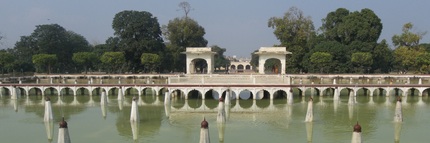
shalamar gardenShalamar Gardens, Lahore

I have been back from Lahore, Pakistan’s cultural center and “City of Poets”, for a while now. It was one of the most inspiring journeys I’ve been to.

Just a few weeks ago we’ve been at the same place where – a few days ago – six policemen were killed and several cricket players from Sri Lanka wounded in a terrorist attack. We were also constantly under police protection. Our hosts were very concerned for our safety.

I went to Lahore to document the conference “Covering Each Other In An Era Of Imagined Clashes Of Civilizations” (see summary in Norwegian), part of the Global Inter-Media Dialogue). Journalists and media researchers from Norway, Pakistan, Indonesia and Bangladesh participated.

Terrorism was one of the main topics during the whole stay – both during and outside the conference. Among other things, the impact of the so-called “war on terror” on global journalism was discussed. Being an journalist in conflict areas has become much more dangerous if you are not willing to let you embedd – and censor – by the military: Not only in Gaza, but also in Iraq and in Pakistan, journalists are hindered in doing their job.

Every Pakistani we met was worried about the “talibanisation” of Pakistan, but also about the drone attacks by the USA in the semi-autonomous “tribal areas” along the Afghan border. The drones are supposed to target Al-Qaida and Taliban terrorists, but mainly kill innocent children, men and women.

Before my departure I wrote about a Pakistani anthropologist who fights for young girls’ right to education in Taliban-controlled Swat in the North. In the same region, a few days ago, Taliban killed journalist Musa Khankhel, a colleague of one of the speakers at the conference, Hamid Mir. ‘He saved me, but I could not save him‘, Mir commented on rediff.com. One day before the recent attack in Lahore, Mir wrote the piece “Don’t create another Swat in Punjab“.

All these issues are debated in the newspapers, several of them are written in English as f.ex The News, Dawn, The Nation or Daily Times. They are of high quality, especially the opinion section where many academics contribute regularily with comments and analysis. Some of the interesting texts are Such is life… in Swat written by a history teacher who had to flee from Taliban, or Forget Gaza, care about Swat and Missing the essence of Talibanism

People in Lahore are troubled about the recent development – something that Imran Khan, Al Jazeera’s correspondent in Lahore, captures very well in the article Lahoris lament ‘shameful’ attack – an aspect that is often missing from mainstream “Western” coverage. When talking with Lahoris, we were often confronted with the negative images that “Western media” spread about Pakistan.

So due to the security situation and Pakistan’s negative image, I suppose, we hardly saw any tourists. Everywhere we went, we became an attraction. People approached us, said hi and shook hands and started a conversation. Some even wanted to be photographed together with us. Needless to say, we only met friendly people.

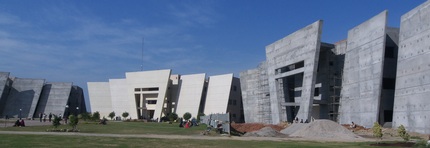
I was very impressed by the two universities we’ve been at. I have never seen such a huge campus before as at the University of the Punjab in Lahore. At the University of Gujrat they are building seven spectacular “ships of knowledge”. 70% of the students are women. Something I found strange is the role of religion: The conference started with Qur’an recitations and some speakers started their lectures with a short prayer. “That would have been impossible in Indonesia”, the delegates from Jakarta commented.

Interesting for us who engage for open access to scholarship is the icon “Journals” on the front page of the website of the University of the Punjab. A click on it leads us to a list of departments that edit and publish their own journals. And most of them are available online as pdf’s (the current and the previous issue). Journals in Pakistan do not seem to be commercialised as it is the case in Europe and America.

Among the journals with online content we find Journal of Political Studies (including an issue about the “war on terror”), the philosophy journal Al-Hikmat, the Journal of Pakistan Vision, the Oriental College Magazine and the Oriental College Research Journal

Ships of KnowledgeShips of Knowledge, University of Gujrat
shalamar garden

Shalamar Gardens, Lahore

I have been back from Lahore, Pakistan's cultural center and "City of Poets", for a while now. It was one of the most inspiring journeys I've been to.

Just a few weeks ago we've been at the…

Read more