search expand

Hva gjør masseturismen med Bali?

Antropolog Anette Fagertun disputerte nylig med en avhandling om konsekvensene av den nye økonomiske veksten på Bali. Etter turistboomen på Bali har økonomien beveget seg fra selvforsyning til lønnsarbeid. Dette har ført til nye arbeidsmuligheter for lavkastene, men også bidratt til større sosiale forskjeller, melder På Høyden.

Antropologen sier:

– Turiststrømmen har ført med seg en ny type økonomi og nye yrker. Men sosiale prinsipper som kjønn og kaste legger sterke føringer for hvordan økonomien fordeles, og hvilke typer arbeid som tillates.

– Den kollektive arbeidsmentaliteten forsvinner blant lavkastene på Bali. Etter den økonomiske veksten og privatisering av økonomien, kommer de typiske tegnene som individualisering og fremmedgjøring klart til syne.

– Selv om økonomien er forbedret er den tradisjonelle familiestrukturen intakt. Denne innebærer en strukturell undertrykning av kvinner, ved at all eiendom går i arv mellom menn. Det er mannen som i siste instans bestemmer over finansene

>> les hele saken i På Høyden

>> mer info om avhandlingen

Avhandlingen er ikke på nett (ennå?).

SE OGSÅ:

Reggae, Punk and Death Metal: An Ethnography from the unknown Bali

Antropologer kritisk til økoturisme

Studerer backpackere: Feltarbeid? Fem måneders rundtur i Sørøst-Asia!

Anthropology and tourism: Conference papers are online

Antropolog Anette Fagertun disputerte nylig med en avhandling om konsekvensene av den nye økonomiske veksten på Bali. Etter turistboomen på Bali har økonomien beveget seg fra selvforsyning til lønnsarbeid. Dette har ført til nye arbeidsmuligheter for lavkastene, men…

Read more

Ansetter antropolog for å få ned sykefraværet

Hvorfor er sykefraværet så høyt blant pleiepersonalet? Horsens kommune i Danmark har ansatt doktorgradsstudent i antropologi Kim Bartholomæussen for å finne svaret. I 13 måneder skal han jobbe som hjelpepleier på et av kommunens pleiehjem, leser vi på kommunens hjemmeside.

Kommunen håper at antropologen (som er utdannet ergoterapeut i tillegg) får et så realistisk bilde av arbeidsforholdene som mulig.

Bartholomæussen forteller:

– Fordomme om dét at være ansat i plejesektoren er med til at fastholde faget som et lavstatus fag. Projektet skal løfte sløret for, hvordan dét faktum – og mange andre – påvirker personalet. Målet er at kunne vise sammenhænge mellem plejepersonalets kulturelle og sociale arbejdsforhold og et højt sygefravær.

– Jeg vil blandt andet fokusere på, hvad man forstår ved en god omsorgsmedarbejder. Svarer dét, eleverne lærer på skolen, til de forventninger, de konfronteres med på arbejdspladsen? Og hvordan påvirker plejepersonalets arbejdsdeling og organisering deres arbejdsforhold? Alt sammen vil det danne et billede af kulturen på godt og ondt.

Der er snakk om et tre-årig såkalt “erhvervs ph.d.-projekt”, et samarbeid mellom Horsens Kommune, Århus Universitet og Institut for Antropologi, Arkæologi og Lingvistik.

>> les hele saken på Horsens kommunes hjemmeside

SE OGSÅ:

Feltarbeid på sykehus: Høy faglighet senker sykefraværet

Antropolog undersøger lederkulturen i kommunen

Antropolog skal skape liv i bygda

Kommunesammenslåinger: Hvordan skape et kulturelt fellesskap i den nye organisasjonen?

Hvorfor er sykefraværet så høyt blant pleiepersonalet? Horsens kommune i Danmark har ansatt doktorgradsstudent i antropologi Kim Bartholomæussen for å finne svaret. I 13 måneder skal han jobbe som hjelpepleier på et av kommunens pleiehjem, leser vi på kommunens…

Read more

Dissertation: Why kids embrace Facebook and MySpace

After 30 months ethnographic fieldwork on Facebook, MySpace and other social networking sites, danah boyd has finally completed her PhD-thesis and put it online. Although she is no anthropologist, she seems to have worked like an anthropologist. Her thesis is relevant reading for anybody who is interested in the anthropology of childhood – especially in children’s relations to adults.

For children spend so much time on Facebook or MySpace (“networked publics”) partly because they are marginalized in their society by adults, she explains in the concluding chapter:

One of the most notable shifts I observed in the structural conditions of today’s teens, compared to those of earlier decades, involves their limited opportunities for unregulated, unstructured social interaction.
(…)
When asked, teens consistently reported that they would prefer to socialize in physical spaces without constant parental oversight. Given that this is not an option for many of them and that many have more access to networked publics than to unmediated public spaces, social network sites are often an accepted alternative.
(…)
Their desire to connect with others is too frequently ignored or disregarded, creating a context in which many must become creative in making space for maintaining connections outside the control of adults. (…) Through the use of technology, teens are able to socialize with others from inside the boundaries of their homes. This presents new freedoms for teens, but it also provokes new fears among adults.

The teen years are marked by an interest in building new connections and socializing broadly. Online-activites are extensions of offline-activites. Teens’ engagement with social network sites reveals a continuation of earlier practices inflected in new ways, she writes.

My findings show that teens are drawn to social media collectively and that individuals choose to participate because their friends do. The appeal is not the technology itself—nor any particular technology— but the presence of friends and peers.

boyd draws many interesting parallels and comparisons:

Baudelaire’s Parisian flâneur enters the public to see and be seen. Teenagers approach publics in a similar vain. Like the flâneur, teens use fashion to convey information about their identities.
(…)
Teens have long struggled to find a place for themselves; they have consistently formed counterpublics within broader structures. Yet when they do, adults typically demonize them, the identity markers they use, and the publics they co-opt. The demonization of MySpace is akin to the demonization of malls and parking lots that took place when I was growing up.

The inability to access publics is an explicit reminder of teens’ marginalized position within society according to danah boyd:

When well-intentioned parents limit access to publics out of fear of potential dangers, they fail to provide their children with the tools to transition into adult society. This may have other unexpected consequences, including isolating teens from political life and curbing their civic engagement. I believe that the practice of maximum control and restrictions infantilizes teenagers, making them more dependent on or resentful of adults and adult society.
(…)
In learning how to make sense of publics that are different from those with which their parents are comfortable, teenagers reveal valuable techniques for interpreting and reworking publics. Their experiences provide valuable insight for understanding how publics are transformed by structural forces.
(…)
The key is for adults, and society more broadly, to engage with these issues and help guide teens in making healthy decisions that allow them to leverage social media in positive ways as part of their everyday lives.

>> download the thesis via danah boyd’s blog

Her thesis reminded me of Mari Rysst’s thesis on the (presumed) “sexualisation of childhood” and the notion of the “pure childhood”.

I’ve only read the last chapter of boyd’s thesis.

By the way: As a famous blogger, danah boyd’s blog post on her thesis has received more than 40 comments within two days. Furthermore, there a numerous blog posts about her thesis already.

SEE ALSO:

Ethnographic Study: Social Websites Important For Childhood Development

Ethnographic study: Social network sites are “virtual campfires”

Ethnographic research on Friendster’s online communities

Cyberanthropology: “Second Life is their only chance to participate in religious rituals”

Danah Boyd on Open Access: “Boycott locked-down journals”

After 30 months ethnographic fieldwork on Facebook, MySpace and other social networking sites, danah boyd has finally completed her PhD-thesis and put it online. Although she is no anthropologist, she seems to have worked like an anthropologist. Her thesis is…

Read more

Open Access Anthropology in Africa – an introduction

logo

Heard of the Sudan Open Archive? Already taken a look at the recent anthropology papers of the University of Pretoria? Many universities in Africa have set up digital libraries, repositories for papers and theses that are freely accessible for everybody.

Here is a short overview over some repositories that also feature anthropology or anthropology related papers in English.

Sudan Open Archive

The Ethnography and Linguistics section of the Sudan Open Archive (SOA) includes papers like Report of The Field Research in Lafon, Eastern Equatoria State: Assessment of the General Conditions and Livelihoods of The Pari People by Eisei Kurimoto or “Presentation on Customary Mediation in the Sudan: Past, Present and Future” by Adam Al Zain Mohammed.

There are comprehensive sections on Conflict and Peace. There are lots of scanned older publications like the 1987-study The Dhein Massacre: Slavery in the Sudan by Ushari Ahmed Mahmud and Ushari Ahmed Ali Baldo.

University of Zimbabwe

screenshot

There is no anthropology department at the University of Zimbabwe, but a department of sociology. Among the six papers we find Anatomy of Alterity: Instrumental Identies Among the San in Zimbabwe by Gillian Chomutare and Elias Madzudo and Revival of Indigenous Food Security Strategies at the Village Level: The Human Factor Implications by Claude. G Mararike.

The Institute of Development Studies has published several papers, among them Plight of children in conflict and post – conflict societies: the case of Africa and Africa and Globalisation Revisited by Donald Chimanikire.

SOUTH AFRICA

We’ll find much more anthropology papers and theses at South African universities.

Rhodes University

screenshot

The anthropology section in the Rhodes eResearch Repository consists of five items. The most recent ones are the master’s theses The resurgence of tuberculosis in South Africa: an investigation into socio-economic aspects of the disease in a context of structural violence in Grahamstown, Eastern Cape by Ida Erstad and The rural-urban interface : the ambiguous nature of informal settlements, with special reference to the Daggafontein settlement in Gauteng by Sibongiseni Kumalo.

University of Johannesburg

There are 14 items in the Anthropology & Development Studies section, among them An analysis of the livelihoods of the Muyexe community located along the Kruger National Park in Limpopo Province by Mkhacani Makamu and Livelihood activities in female-headed households: Letlhakane village by Mamedupe Maggie Kgatshe.

University of Pretoria

7 anthropology papers, for example End of culture? Some directions for anthropology at the University of Pretoria by John Sharp and How equal is equal? A legal-anthropological note on the status of African women in South Africa by J.C. Bekker and C.C.Boonzaaier

University of Western Cape

6 papers by the Department of Anthropology and Sociology, among others Positive Muslims: a critical analysis of Muslim AIDS activism in relation to women living with HIV/AIDS in Cape Town by Abdul Kayum Ahmed and A critical analysis of the effects of tourism on cultural representation: a case study from Leboeng by Masete Mamadi.

University of Witwatersrand

Searching for anthropology gives five hits as for example The silence of colonial melancholy : The Fourie collection of Khoisan ethnologica by Ann Wanless

There are of course more depositories. My selection is based on the overview at http://www.opendoar.org – a website Peter Suber at Open Access News mentioned recently.

In October, Suber pointed to an article on Open Access in Africa that was discussed at Sciencebase.

SEE ALSO:

The resurgence of African anthropology

“Focalizar o que é comum aos seres humanos” / Open Access Anthropology in Brasil

Book and papers online: Working towards a global community of anthropologists

How can we create a more plural anthropological community?

Why open access?

logo

Heard of the Sudan Open Archive? Already taken a look at the recent anthropology papers of the University of Pretoria? Many universities in Africa have set up digital libraries, repositories for papers and theses that are freely accessible for everybody.…

Read more

Dissertation: Sexualisation of childhood?

cover

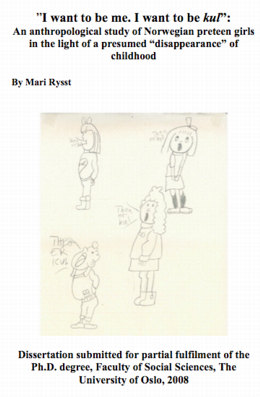
Tight jeans and short tops for seven year-old girls? When anthropologist Mari Rysst was out shopping clothes for her then seven year-old daughter she – to her dismay – mostly found clothes which imitated the teenage look. Seven years later she published her doctoral thesis “I want to be me. I want to be kul” An anthropological study of Norwegian preteen girls in the light of a presumed ‘disappearance’ of childhood.

In the introduction Rysst explains:

This study aims to explore gender constructions, sexuality and peer relationships among preteen Norwegian girls in the light of a presumed “disappearance” of childhood. The focus is on whether girls’ everyday lives are affected by what is currently expressed as the “sexualisation of childhood”. The sexualization of childhood forms part of the wider preoccupation that “childhood” is disappearing, as inferred by the above quotation.

But these fears seem to be exaggerated, she concludes:

By doing participant observation over a two year period in two school settings in Oslo, I concluded that the sexualisation of childhood exists in their social contexts and wider milieu, but does not dominate their overall everyday practices and mixed- gender relationships. These are still filled with sports activities and different forms of both traditional and particular play.

Most importantly, the ultimate indication of any (senior) sexualisation, how they “do love”, still qualifies as variants of “play”, not as older heterosexual practices. This is so because the love relationships are performed according to strict norms or rules. In the first place, they are directed and followed up by the peer community. In the second place, they are a collective rather than a private affair, and lastly, they include a minimum of physical intimacy. (…) The study shows how the subject positions of the kul and of girlfriend/boyfriend did not relate to images of the sexy before the peer group had reached puberty (being aware of individual exceptions).

The notion of the “pure childhood” is,she writes, rather Western – and paradoxical:

Understanding children and childhood in developmental terms has so far meant that children have to be protected from the “evils” of adult society (sex, drugs and violence) in order to become healthy adults. In particular, the positive potential of children can only be realized if they are not “spoiled” (too early) by the “impure” adult world.

In this lies a moral paradox: The ideal, pure childhood is not to involve a preparation for what children will inevitably be confronted with as youths and adults. The paradox is historically and culturally specific, having its roots in the Enlightenment and Rousseau’s perception of children as “pure” or “innocent” (Ariés 1962, James, Jenks and Prout 1998).

>> download the thesis

Mari Rysst has been several times in Norwegian media, see among others my post in Norwegian Doktorgrad: Barn mer opptatt av tauhopping enn G-streng

SEE ALSO:

Transforming the Anthropology of Childhood – Anthropology News April

New book critizises ethnographic methods in market research on children

“We want children to be their own ethnographers”

Anthropologist calls for a greater appreciation of child labor

Technologies of the Childhood Imagination- new text by anthropologist Mizuko Ito

Ethnographic Study: Social Websites Important For Childhood Development

cover

Tight jeans and short tops for seven year-old girls? When anthropologist Mari Rysst was out shopping clothes for her then seven year-old daughter she - to her dismay - mostly found clothes which imitated the teenage look. Seven years later…

Read more