search expand

Antropologer tjener minst

Hvilke yrkesgrupper tjener mest et halvt år etter siste eksamen? Teknisk Ukeblad har tallene klare for 32 grupper – og antropologer har havnet på 29.plass (og blir slått av sosiologene som er på 28.plass!).

Brutto-månedslønnen for en nyutdannet antropolog er 27 790 kroner som jo egentlig ikke er så verst. Antropologi er nok et fag som en ikke studerer for pengenes skyld og det tar gjerne ett eller flere år før en får en ordentlig og relevant jobb.

På toppen finner vi tannhelsefag med en månedslønn på 38 580 kroner.

Tallene er hentet fra NIFU STEPs ferske kandidatundersøkelse.

>> les hele saken i Teknisk Ukeblad

Hvilke yrkesgrupper tjener mest et halvt år etter siste eksamen? Teknisk Ukeblad har tallene klare for 32 grupper - og antropologer har havnet på 29.plass (og blir slått av sosiologene som er på 28.plass!).

Brutto-månedslønnen for en nyutdannet antropolog er…

Read more

Unni Wikan: “Få æresdrap blir straffet”

Rundt 1000 kvinner blir hvert år offer for et “æresdrap” i Punjab, men kun et fåtall av disse drapene straffes, sier antropolog Unni Wikan til Politiken.

Igår meldte avisene at en 31-årig “danskfødt kvinde med pakistansk baggrund” ble skutt og drept i en pakistansk landsby av sin svoger.

Unni Wikan sier:

Normalt bliver morderen ikke straffet. Hvis sagen kommer for retten, bliver der normalt indgået en aftale mellem den dræbte kvindes familie og morderen. Normalt giver morderen familien nogle penge i stedet for at blive straffet, eller parterne aftaler, at morderens familie giver en kvinde som brud til den dræbtes familie. Det er en anerkendt strafudmåling ved domstolene.

Drapene blir altså straffet, men på en annen måte enn i Norge. Unni Wikan er imot denne måten å straffe på når det gjelder mord:

Det er et stort problem for Pakistan, at familierne kan handle sig ud af en sag. Det burde ikke være muligt at lave en aftale om straf for mord.

>> les hele saken i Politiken

SE OGSÅ:

Muslimske kvinner slår tilbake

Æresdrap og dovaner: Kun innvandrere har kultur

Æresdrapsdebatten: Manglende kunnskap eller uttrykk for norsk nasjonalisme?

Unni Wikan: “Dansk politi har forstått hva æresdrap handler om”

Unni Wikan: “Æreskulturer” må ikke demoniseres

Ny bok: De fleste drap begås av vestlige menn med gammeldags æresbegrep

Rundt 1000 kvinner blir hvert år offer for et "æresdrap" i Punjab, men kun et fåtall av disse drapene straffes, sier antropolog Unni Wikan til Politiken.

Igår meldte avisene at en 31-årig "danskfødt kvinde med pakistansk baggrund" ble…

Read more

Parisian performance poetry: a republican space for encounters?

Another presentation which I blatantly will fail to give (see this post), were to take place at a conference in Oxford in about one week’s time, Encounters and Intersections: Religion, Diaspora and Ethnicities.

The problematics of this paper give me the opportunity to look at two other aspect of the space created during a slam session: the particular quality of the encounters taking place. While only a very few of the participants talked explicitly about the political and subversive character of the slam phenomenon (see previous post), many more will describe it as a quite unique place for encounters. This is thus more of a native’s point of view than what is treated in the previous post. The ways many people describe the soirées echoes in my opinion important values of the French Republic. This is the next aspect I’ll introduce in the analysis of the space created during a session. In the previous post, I looked in the direction of connections between the local socio-political environment of the city and the soirées, in this it’s the connections between the soirées and the Republic herself I postulate. These problematics will go into chapter 2 and Chapter 5 (see the outline at the end of this post). Here’s my abstract for the conference:

Parisian performance poetry: a republican space for encounters?
Cicilie Fagerlid

In this paper, I will explore the space for encounters created during Parisian slam poetry sessions. Many participants characterise this performance poetry scene as a medium for rencontres (encounters) of people of different backgrounds. The sessions are among the most mixed events one can find in France, in terms of social and ethnic background as well as age and gender. It can thus be seen as an arch expression of the French republican ideal of mixité sociale and the value of vivre ensemble (“living together” – a term with similarities to the British notion of “community cohesion”).
The performances treat a vide variety of issues, expressed with a variety of different artistic styles, from rap to French traditional poetry via experimental theatre. However, seen from a British multiculturally inspired paradigm, the issues of collective religious or ethnic identities are conspicuously absent.
I will place the poetry sessions within the socio-political geography of East Paris (a popular, bohemian and increasingly gentrified area shaped by immigration) and the French republican paradigm of social integration. The paper is based on 16 months of fieldwork in East Paris. In addition, I will draw on my previous research project on British Asians in London.

Contact details:
Cicilie Fagerlid
Department of Social Anthropology/Cultural Complexity in the New Norway
Postboks 1091 Blindern
N-0317 Oslo
Norway

Cicilie Fagerlid is working on her PhD thesis with the preliminary title Society in the Making: Post Colonial Paris and the Slam Poetry Scene. She is employed at the Department of Social Anthropology and Cultural Complexity in the New Norway, strategic research programme, both at the University of Oslo.

Another presentation which I blatantly will fail to give (see this post), were to take place at a conference in Oxford in about one week’s time, Encounters and Intersections: Religion, Diaspora and Ethnicities.

The problematics of this paper give me…

Read more

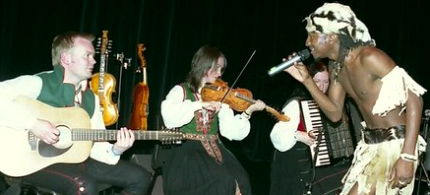
Verdensmusikk = ideologisk styrte kulturmøter?

talent

Antropolog Anne Ellingsen forsvarte nylig sin doktoravhandling Music and Ethnic Integration in Norwegian State Policies. Hun har tatt for seg Rikskonsertenes satsning på verdensmusikk som middel til
integrering. På fusion-konserter opptrer musikere fra forskjellige land samtidig. Slikt samarbeid skal gi tverrkulturell forståelse.

En fin tanke som sjelden blir realitet ifølge Ellingsens kronikk i Aftenposten. Det er først og fremst hvite mennesker som oppsøker slike konserter. Og mange musikere mente rammen er begrensende:

Mange av musikerne jeg har intervjuet, fremhevet at tverrkulturelt samarbeid i musikk kan fungere. De sa de først var positive til samarbeidsprosjekter, men at de etter hvert opplevde formen som begrensende. De var kritiske til at det ofte manglet tid til å øve sammen når musikere fra ulike tradisjoner skulle møte hverandre. De etterlyste også mulighet for et reelt valg mellom fusionprosjekter og andre konsertformer.

Både innvandrermusikere og norskættede artister uttrykker gjerne frustrasjon over ikke å få rom til å formidle sin musikk uten å delta i “integrering”. Også publikum kan reagere på noe de oppfatter som rutinemessig bruk av et “politisk korrekt” konsept.

Fokuset på etnisitet innen musikkmiljøet er tvilsomt. Musikk har alltid vært “flerkulturell”:

I internasjonalt musikkliv har utøverne ofte ulik etnisk bakgrunn. I markedsføringen av for eksempel Operaens ensembler, er allikevel artistenes etniske bakgrunn av underordnet betydning, mens musikken står i fokus.

Markedsføring av “verdensmusikk”, derimot, fremhever utøvernes etnisitet. Reklame for samarbeidsprosjekter understreker at musikere fra ulike etniske grupper opptrer sammen. Her er fokus på at artistene faktisk kan samarbeide. Konsertene fremstilles som “grenseoverskridende” fordi de krever kommunikasjon på tvers av etniske skillelinjer.

Fusjonstilen ser hun som et symbol på velferdsstaten:

Som i et slags musikkens svar på Kardemomme by samarbeider vestlige og ikke-vestlige musikere på scenen. Slike forestillinger gir inntrykk av en kompetent og effektiv integreringspolitikk i et økende fragmentert, fleretnisk samfunn.

>> les hele kronikken i Aftenposten

Bildet øverst har jeg tatt på Folkemusikkfestivalen i Førde i 2005. Jeg skrev om slike fusjonprosjekter i teksten Globalisert folkemusikk. For kritikk av begrepet “verdensmusikk”, se teksten Vi er alle fra Afrika.

talent

Antropolog Anne Ellingsen forsvarte nylig sin doktoravhandling Music and Ethnic Integration in Norwegian State Policies. Hun har tatt for seg Rikskonsertenes satsning på verdensmusikk som middel til
integrering. På fusion-konserter opptrer musikere fra forskjellige land samtidig. Slikt samarbeid skal gi tverrkulturell…

Read more

The socio-political geography of East Paris: Parisian slam poetry – a space of resistance?

The most recent paper I failed to give (see previous post) was looking at the slam poetry phenomenon from the perspective of where it is situated, – socio-politically as well as geographically. I wanted to explore the connection between the slam scene’s geographical position in the North and East (and to some extent the 13th Arrondissement in the South) and the socio-political characteristics of these parts of the city. Here’s the abstract for the presentation:

Parisian slam poetry – a space of resistance?
Cicilie Fagerlid, PhD fellow at Cultural Complexity in the New Norway (strategic research programme at the University of Oslo)

In this paper, I will explore the relationship between the Parisian slam (performance) poetry scene and the socio-political landscape of North and East Paris, where the scene is situated. This part of the city is historically popular and left-wing with an important influence of bohemians and artists, and an equally long history of regional and international immigration.

I will argue that what is created during an evening of poetry performances, is to some extent a space of biopolitical resistance. Similar forms of resistance to standardisations of everyday life and/or governmental politics overflow the urban space of the northern and eastern Parisian neighbourhoods – in terms of streetart, political and artistic posters and stickers, low-cost and “alternative” film and music festivals, readings and talks in bookshops and cultural centers, a plethora of demonstrations filling the streets with colours and noise and a general, unruly everyday streetlife. I will situate the slam poetry within this landscape and discuss to what extent Antonio Negri’s notion of a (bio)space “in-between” power relations can be a helpful analytical perspective:

“Where is exodus at home? Where is the space for those who want to go into exodus from power and its domination?” For me, exodus sometimes requires force. And this is, paradoxically, an exodus that does not seek an “outside” of power, but which affirms the refusal of power, freedom in the face of power, in the hollow of its meshes (Negri, Petcou, Petrescu and Querrien 2008).

Negri,Toni, Constantin Petcou, Doina Petrescu and Anne Querrien 2008: “What makes a biopolitical space? A discussion with Toni Negri” in Eurozine at http://www.eurozine.com/articles/2008-01-21-negri-en.html (accessed 02.05.2008)

I’ve decided to continue working on the problematics of this paper during the summer, making it into the two first chapters of my thesis (see the end of this post for a preliminary outline). In the first chapter, I will describe and analyse some of the areas where the slam soirées take place (how I’m looking forward to wander the streets of Belleville and Ménilmontant in my imagination again!). In Chapter 2, I will ask how we can understand the particular space created during a slam – thus grasping the micro-dynamics of a soirée – and secondly, making a connection to chapter 1, I will look at what might be the relations between the slam phenomenon and the particular environment of the city where it is situated.

For some reason, the summer Oslo mood certainly inspires a delve back into my memory of Parisians streets and cafés…

The most recent paper I failed to give (see previous post) was looking at the slam poetry phenomenon from the perspective of where it is situated, – socio-politically as well as geographically. I wanted to explore the connection between the…

Read more