search expand

Malaysia: Penan people threatened by demand for “green” bio-fuels

The Penan people from the jungles of Sarawak are threatened by rampant commercial logging and palm oil plantations for bio-fuel, a Malaysian government report said. European and North American demand for “green” bio-fuels made from palm oil means rainforests across the region are being replaced with plantations writes the Telegraph:

For 20 years the Penan people from the jungles of Serawak have mounted a peaceful campaign to protect their ancestral lands, only to be driven back by soldiers, police and contractors.

Earlier this year, as police firing shots in the air tore down the latest blockades of bamboo tied with grass, Penan leaders said that if the loggers were not stopped their jungle would be entirely destroyed within two years.

Now at last they have received some official backing. “Claims made [by Penans] on ancestral land are often not considered by the relevant authorities and those who clear the forest areas and commence logging and oil palm activities,” said the report, recommending that the land code be reviewed to include customary rights.

It may already be too late for the Penan. The rainforests of Serawak are millions of years old but have been decimated by the Malaysian logging companies which, campaigners say, have felled trees at a faster rate than anywhere else in the world.

>> read the whole story in the Telegraph

The Penan leaders also met with officials from the Sarawak state government to demand that it recognise their rights to their land and stop issuing logging and plantation licences on their land. Groups of Penan have set up blockades on roads through their forest to stop loggers destroying their homes according to Survival International.

>> more Penan-news by Survival International

This story reminds me of the article Eco-junk by George Monbiot. Ecological of ethical shopping is not the solution, but less shopping.

SEE ALSO:

“Help the Hadza!” – A United Arab Emirates royal family is trying to use the land of the Hadza as a “personal safari playground”

Dissertation: Survival in the Rainforest

Criticizes the “apathy of anthropologists toward the human rights situation in Balochistan”

But We Are Still Native People” – Tad McIlwraith’s dissertation is online

Arctic refuge saved from oil drillers – Inuit divided

The Penan people from the jungles of Sarawak are threatened by rampant commercial logging and palm oil plantations for bio-fuel, a Malaysian government report said. European and North American demand for "green" bio-fuels made from palm oil means rainforests across…

Read more

New York Times reviews Talal Asad’s “On Suicide Bombing”

Some weeks ago I wrote a few lines about the book On Suicide Bombing by anthropologist Talal Asad. Among other things, he questions our notions about legitimate violence.

On Sunday, the book was reviewed in the New York Times:

Asad (…) takes aim less at the Bush administration than at the rest of us, and at what he sees as our unspoken complicity in “some kinds of cruelty as opposed to others.” He hopes, he writes, to “disturb the reader sufficiently” by showing the hypocrisy of rules that permit murderous conduct by states but deny it to nonstate actors. And he is angered by scholars, theorists and journalists who don’t speak Arabic and have never set foot in the Middle East, yet sound off about why suicide bombers do what they do. He is understandably aghast that the American public has expressed so little shock over the bloodshed inflicted in its name.

And by the end of the book, his rage has overtaken him. The Bush administration’s actions in the Middle East have left him so disgusted that he declares simply, “It seems to me that there is no moral difference between the horror inflicted by state armies (especially if those armies belong to powerful states that are unaccountable to international law) and the horror inflicted by insurgents.”

It is hard to answer Asad’s argument without drifting into the distinctions he attempts to demolish. For instance, he cites the political philosopher Michael Walzer’s definition of the “peculiar evil of terrorism,” which, according to Walzer, is “not only the killing of innocent people but also the intrusion of fear into everyday life, the violation of private purposes, the insecurity of public spaces, the endless coerciveness of precaution.” Asad then asks why the United States’ war in Iraq and the Israeli cluster bombs in Lebanon do not earn the same condemnation as bombs wielded by terrorists. But if you continue to believe (as I do) that there is a moral difference between setting out to destroy as many civilians as possible and killing civilians unintentionally and reluctantly in pursuit of a military objective, you will indeed find “On Suicide Bombing” disturbing, if not always in the way he intends.

Nonetheless, Asad’s book is valuable because the legal distinctions he is challenging are especially vulnerable now.

The review is part of the article Our War on Terror.

As Savage Minds already has noted, Columbia University Press has published a mp3-interview with Talal Asad. For more information on the book and Talal Asad see my earlier entry Anthropological perspectives on suicide bombing

More information will follow. I’m currently reading this book.

Some weeks ago I wrote a few lines about the book On Suicide Bombing by anthropologist Talal Asad. Among other things, he questions our notions about legitimate violence.

On Sunday, the book was reviewed in the New York Times:

Asad (...) takes…

Read more

Obituary: Anthropologist Priscilla Reining Broke Ground on AIDS

Anthropologist Reining died July 19 at the age of 84. “Anthropologist Broke Ground on AIDS, Satellite Mapping”, writes the Washington Post in an orbituary.
Last winter I wrote about anthropological studies that showed that male circumcision reduces the risk of HIV infection. But Reining had researched this topic already 18 years ago:

In a 1989 study published in Current Science with three co-authors, Reining spelled out the unmistakable correlation: Uncircumcised African men were 86 percent more likely to get the AIDS virus than those who had been circumcised. Her findings held true across different regions, ethnic groups and religious faiths in Africa.

At first, her study was ignored or dismissed. Some African peoples had taboos against circumcision, and many scientists couldn’t believe that such a simple procedure could produce such startling results.

(…)

Yet study after study — there have now been more than 60 — supported Reining’s initial findings. She was interviewed for a BBC documentary in 2000, and one-time skeptics were convinced by years of mounting evidence that she had been right all along.

>> read the whole article in the Washington Post

SEE ALSO:

Male circumcision prevents AIDS?

“There’s no AIDS here because men and women are equal”

AIDS:”Traditional healers are an untapped resource of great potential”

Cultural values and the spreading of AIDS in Africa

AIDS and Anthropology – Papers by the AIDS and Anthropology Working Group

Anthropologist Reining died July 19 at the age of 84. "Anthropologist Broke Ground on AIDS, Satellite Mapping", writes the Washington Post in an orbituary.

Last winter I wrote about anthropological studies that showed that male circumcision reduces the risk of…

Read more

Airport lamps light only option for studious Guinea kids

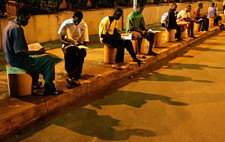
When the sun has set in Guinea, one of the world’s poorest nations, and the floodlights come on at Gbessia International Airport, the parking lot begins to fill with children. It is among the only places where they can count on finding the lights on. The long stretch of pavement has the feel of a hushed library, according to ap-writer Rukmini Callimachi in an fascinating article in USA Today:

Groups of elementary and high school students begin heading to the airport at dusk, hoping to reserve a coveted spot under the oval light cast by one of a dozen lampposts in the parking lot. Some come from over an hour’s walk away.

“I used to study by candlelight at home but that hurt my eyes. So I prefer to come here. We’re used to it,” says 18-year-old Mohamed Sharif, who sat under the fluorescent beam memorizing notes on the terrain of Mongolia for the geography portion of his college entrance test.

Eighteen-year-old Ousman Conde admits that sitting on the concrete piling is not comfortable, but says passing his upcoming exam could open doors. “It hurts,” he says, looking up from his notes on Karl Marx for the politics portion of the test. “But we prefer this hurt to the hurt of not doing well in our exams.”

Only about a fifth of Guinea’s 10 million people have access to electricity and even those that do experience frequent power cuts. With few families able to afford generators, students long ago discovered the airport.

The lack of electricity is “a geological scandal,” says Michael McGovern, a political anthropologist at Yale University, quoting a phrase first used by a colonial administrator to describe Guinea’s untapped natural wealth. Guinea has rivers which if properly harnessed could electrify the region, McGovern says. It has gold, diamonds, iron and half the world’s reserves of bauxite, the raw material used to make aluminum.

>> read the whole story in USA Today

“Although Guinea’s mineral wealth makes it potentially one of Africa’s richest countries, its people are among the poorest in West Africa” >> more information on Guinea in the BBC country guide

Michael (Mike) McGovern is / was the West Africa project director for the International Crisis Group. He has appeared quite often in the media on Guinea related issue as a google search reveals

When the sun has set in Guinea, one of the world's poorest nations, and the floodlights come on at Gbessia International Airport, the parking lot begins to fill with children. It is among the only places where they can count…

Read more

Ethnographic reports about the uses of ICT in low-income communities

Culture Matters points to “exciting” working papers by the Information Society Research Group about the social and economic benefits of Information and Communication Technology (ICT) in low-income communities in Jamaica, India, South Africa and Ghana: “These working papers strongly re-enforce the benefits of an ethnographic approach for the wider world”.

One of the most convincing papers is according to Culture Matters written by Daniel Miller and Heather: Horst juxtaposes conventional ICT policy making in Jamaica with ethnographic findings and uncovers that the assumptions concerning internet use held by the government as well as international NGOs diverge hugely from the realities.

Culture Matters juxtapose some of the current policies with Miller’s and Horst’s recommendations:

  • Instead of more computers in secondary schools invest in post-educational training for young adults
  • Instead of investing into expensive high-end computers invest in low-price computers without gaming facilities
  • Instead of creating their own content at high costs, a lot of money can be saved by creating portals which identify useful and high-quality web resources
  • Instead of investing in community computers, offer Internet access via individual mobile phones

Also fascinating according to the blog: the reports from Ghana by Don Slater and Janet Kwami:

Again, ethnography unveiled a huge gap between policy assumptions and actual usage. On the one hand there is the widespread belief amongst governments and NGOs that the Internet is a tool of development through information distribution.

Yet all Internet users in the Accra slum studied used the internet only for chat with foreigners (as well as some diasporic family members and friends). “There was exceptionally low awareness of even the existence of websites”. In internet cafes everybody is chatting with unknown foreigners, largely in the North but also in Asia, with a view of accumulating actual and symbolic goods (either on IM (Yahoo or MSN) or in Yahoo chat rooms).

Internet access, although widespread and popular in Accra, is not cheap – one hour costs much more than the average kid’s lunch money – but many teenagers come several times a week, for several hours, solely to chat with foreigners.

>> read the whole post on Culture Matters

>> all working papers by the Information Society Research Group

SEE ALSO:

How internet changes the life among the First Nations in Canada

INTEL-ethnographers challenge our assumptions of the digital divide

How Media and Digital Technology Empower Indigenous Survival

Why cellular life in Japan is so different – Interview with anthropologist Mizuko Ito

Women in Cameroon: Information technology as a way out of the cultural cul-de-sac

Now online: EASA-conference papers on media anthropology

Culture Matters points to "exciting" working papers by the Information Society Research Group about the social and economic benefits of Information and Communication Technology (ICT) in low-income communities in Jamaica, India, South Africa and Ghana: "These working papers strongly re-enforce…

Read more