“[O]ur work cannot transcend being a human endeavor, with attendant costs as well as benefits” (Wolcott 2005: 141)
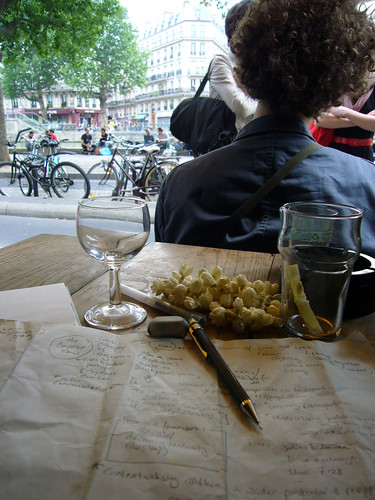 Earlier this week, I got ditched on one of my first interview rendezvous. [I later learnt that yes, he had been there, in exactly that huge, rather kitschy Indochinese colonial style bar … My incapacity to find him just proves that I’m suffering from fieldwork fatigue…]. Since it’d been a hard day after another sleepless night, I decided to neither wait longer than 25 minutes, nor phone the person, but instead walk off into the busy street at Place de Pigalle. For once, I was in a place without my bike and with nothing planned. I decided to walk back east, following a boulevard one probably cannot find anything like anywhere else in the world, through Pigalle and Anvèrs (tourists, sexshops, local Americans and ordinary inhabitants), Barbès (French Arab quarter for several generations) and La Chapelle and Stalingrad (crowded, noisy and polluted with traffic, known for its social deprivation and heroin). By quieter and gentrified Canal Saint Martin (where students and artists, tourists and homeless picnic side by side), I know a nice little bar, with three tables outside and a few more on the inside, wooden, brown and sympathetically worn down. They play mostly French music, a little bit punkish, a little bit of Mano Negra, some French Tom Waits, a little bit of Balkan-gipsy style that is so popular here… While I wouldn’t dream of drinking a glass of wine alone in public at Zorba or Les Folies 10 minutes away up in Belleville, I don’t hesitate at Café Jemmapes. After my 40 minutes stroll, I sat down quietly and listen to the chattering around me and watched the people sitting by the canal. I started on this blog post but soon realised that perhaps following an advice from The Art of Fieldwork could help me in my state of fieldwork fatigue:
[teaserbreak]
…think through your entire study in the reverse order of the way you intend to carry it out. Begin with a careful consideration of where you want to end up… Try to anticipate as specifically as you can the outcomes you want to achieve. Then back up a step to identify the kinds of data and range of experience you will need to support or illustrate those outcomes. Then back up one more step to ascertain how to get that information (Wolcott 2005: 194-5).
That morning, the first thing I did was to reschedule my return flight back home, thus shortening my stay with 16 days. I had woken up really early, after only a few hours sleep. Faubourg du Temple might be a nice street for strolling, and a perfect street for sitting down for a coffee, but it’s far from perfect to sleep five floors above. Too vibrant, too cobbled-stoned, too picturesque… In addition, I’ll have to move house again soon, since the propriétaire will move back in, after a thorough refurbishment of the worn down place. Hearsay tells that his parents bought the flat for 90 000€ in 1999, and now – even before it’s refurbished – it’s worth 270 000€. That says about it about the housing market in Paris. I’ve not had success in re-entering it for the last month of my stay, so I end up shortening my stay and spending the last ten nights in an hotel around the corner. I’m a bit tired of it all…
I’ve lived so many strange places in this city, with mice, mould, and mites, only to mention the problems starting on m. The fieldworker is his or her own worst enemy (as well as her best asset, on good days of course), as Wolcott states somewhere in his book on method. And I think he also says something about the field, with all its nuisances, getting in the way of doing fieldwork. I feel a certain fieldwork fatigue at the moment. I have realised – possibly because the end is so close – that it is “only” fieldwork. With that insight it suddenly became work more than anything else for me. Gone is the attempt to try to live it. There are many other reasons for this fatigue as well. Living conditions, the extra effort to wrap it all up and pursuing all the people and events that I haven’t come across naturally or by chance until now, my life situation, the fieldworker role (being there for everybody without anyone really being there for me… – I remember how depended I was on my flatmates back in Freemantle street in London as an outlet for this self-effacing role. Here I don’t have any such outlet, in addition my role is even more self-effacing as I’m a far better listener than a speaker when it comes to French).
At the moment, reflecting on my growing feeling of detachment, I get a sad taste of failure. Professionally, I think I’m doing fine, the failure is rather on the human side of it. I feel I’ve failed in really living here which is probably connected to my failure in improving my French as much as I hoped to. Too much of my days have disappeared at home, in front of the computer, working on the videos. I’m thinking about another quote from The Art of Fieldwork:
Every choice is also a sacrifice… Every articulation precludes not only its own alternatives but all sorts of developments they would have made viable (Susanne Langer quoted in Wolcott 2005: 257).
Whatever the reasons might be, the northern immigrant to East Paris has retreated (with a bowed head), and it’s the anthropologist that is sitting down drinking a glass of white wine at Café Jemmapes, thinking about Wolcott’s questions; where do I want to end up and what are the outcomes I want to achieve?
I started focusing on the slam poetry scene because I wanted to study a cosmopolitan milieu. (In my view, cosmopolitanism is – in contrast to the national identity craze hitting politicians in France and Britain at the moment – the future of Europe. We have no other choice.)
My preliminary main claim is that the slam soirées can be seen as an appropriation of time and space; – time through story telling (thus the creation of narratives, which is a creation of meaning) and space through being together, sharing with and listening to others, many with a very different background from your own. It is an appropriation because it is free and democratic/accessible for all. Elements of this appropriation can be termed a postcolonial re-appropriation: Spatially because the scene is uniquely cosmopolitan, and because many of the texts re-describe public space on French soil in cosmopolitan as opposed to national/monoethnic/”white”… terms. The re-appropriation is also temporal as personal history and French history are being told from various “immigrant” (or e.g. descendants of slaves’) perspectives.
The slam often seems to be a personal as well as collective response to social and personal problems. In this sense, it provides a solution to the individualising/atomising forces in our time hindering collective movements.
I will contextualise the slam phenomenon within a wider postcolonial re-appropriation or time and space that has been going on in France for a while. (What will happen now, when one of the first points in Sarkozy’s victory speech was that we will now finish with all this repentance, and a few days afterwards his Ministry of national identity and immigration was set up.) I’ll support the description of the struggles surrounding French history by the historical and theoretical framework in Eric Wolf’s Europe and the People without history: European modernity and the history of Europe itself must be viewed within the context of European expansion from the 16th century onwards. For instance, the industrial development in Britain is intrinsically tied with sugar plantation in the Caribbean. Just as French post-war economic growth must be seen in relation to labour immigration from the former colonies.
What “kinds of data and range of experience” do I need “to support or illustrate those outcomes” and how will I get that information? I must describe the soirées – the people present and the interaction and their texts. I’ve been to open microphone sessions at almost 30 different bars and cafés at least once, in addition to sessions at a museum, a mental hospital, a metro station, theatres… in addition to concerts, workshops and plays, and I’ve filmed around 35 of the sessions (so I can take it easy about the 6 hours of so with film I erased by accident the evening before the fieldwork fatigue hit with force). In addition, the slammers are kind enough to provide the foreigner with written versions of their texts, which I’ll study more in depth when I get back up north, in the wintertime I can imagine when the teaching in the autumn semester is finished, sitting at my office at the sixth floor in the social sciences building at the University of Oslo, thinking about the Parisians I for a while was living among… When I’ve written a first draft and gone through all the texts, I’ll ask for a new round of interviews and conversations to verify what I’ve come up with so far. What is left for me to do, are the interviews with as many people I can. I’ll leave that part for another blog post.
I’ve met a few parents and other family members, and I’ve been in a couple of homes, but that kind of background information has been hard to get here, and it will also be practically impossible to write about, since I’ll not anonymise any of the participants….
