search expand

– Nasjonal identitet for litauerne ikke knyttet til etnisitet og kultur

I 1990 var det viktig å distansere seg fra russerne. Slik er det ikke lenger i Litauen. Litauen er blitt et åpnere samfunn, sier antropologen Vytis Ciubrinskas til Uniforum:

Nå har vi et åpent samfunn og et mer sammensatt bilde av hva annerledeshet er for noe. Vi har nå mange andre nasjoner enn russerne å sammenlikne oss med, både i Europa og resten av verden. Nasjonal identitet for litauerne er ikke så knyttet til litauisk etnisitet og kultur, som man har trodd til nå.

På mandag 12. februar skal han holde et foredrag om endringen i litauisk nasjonalitetsfølelse etter frigjøringen fra Sovjetunionen i 1990. Seminaret finner sted kl. 14.15–16 i undervisningsrom 2, 3. etasje i Universitetsbiblioteket på Blindern (åpent og gratis for alle). Arrangør: Forskningsprogrammet Kulturell kompleksitet i det nye Norge (CULCOM).

Merkelig nok kunne jeg ikke finne noe relevant om antropologen på nettet. Men det fins en del nye antropologiske forskningsarbeider om Litauen, blant annet:

Irmina Matonytë: Elites in Soviet and post-Soviet societies

Kristina Sliavaite: When Global Becomes Local: Rave Culture in Lithuania

Kristina Sliavaite: From Pioneers to Target Group: Social Change, Ethnicity and Memory in a Lithuanian Nuclear Power Plant Community

For informasjon om Litauen se ellers Wikipedia og for nyheter Baltic News Service

Relevant også Ilze Petersone: Russeres situasjon i Latvia etter Sovjetunionens fall. Mer om antropologi i de baltiske statene se Online anthropological texts on the Baltic States og tidsskriftet Pro Ethnologica.

I 1990 var det viktig å distansere seg fra russerne. Slik er det ikke lenger i Litauen. Litauen er blitt et åpnere samfunn, sier antropologen Vytis Ciubrinskas til Uniforum:

Nå har vi et åpent samfunn og et mer sammensatt bilde av…
Read more

– Den norske innvandringsdebatten begynte på 1800-tallet

På forskning.no blir vi minnet på at Norge har vært et innvandringsland mye lenge enn mange tror. Det er vanlig å forestille seg at Norge ble flerkulturelt da de første pakistanerne kom kjørende inn på Grønland i Oslo. Men den norske innvandringsdebatten begynte på attenhundretallet, sier historiker Einar Niemi og legger til:

“Noe vi har visst om lenge, men som ikke helt har nådd offentligheten, er at desto lenger nord du bodde i Norge før i tiden, dess mer multikulturell var du. En av grunnene var selvfølgelig at Nord-Norge hadde en gammel minoritet, samene, men innflytning fra Finland og Russland førte til enestående høye prosenter av innvandrere.”

>> les hele saken på forskning.no

Innvandringshistorien er kjempespennende. Også enda tidligere finner vi et høyt antall innvandrere i norske byer. For fire hundre år siden bodde flere utlendinger enn nordmenn i Kongsberg og Bergen.

Men som Niemi sier er det de færreste som vet dette. Også fire år etter lanseringen av trebinds-verket Norsk innvandringshistorie hører en fortsatt uttalelser av politikere og forskere om at innvandring er et nytt fenomen.

En grunn til dette er at forskningen har hatt et nasjonalstatlig perspektiv og har vært preget av noe som antropologene Andreas Wimmer og Nina Glick Schiller kaller for “metodologisk nasjonalisme”. Jeg har skrevet en sak om dette i Utrop som begynner slik:

Hvorfor er politikere og journalister så redde for innvandrere? Hvorfor bygges det murer for å stenge verden ute? Hvorfor så mye snakk om integrering, hijab, tvangs- og hente-ekteskap? Hvorfor så mye selvgodhet og nasjonalisme? Et mulig svar: Det fins for mye dårlig forskning.

>> les hele teksten: Hvorfor så mye dårlig forskning?

Lite kjent er dessuten den sørnorske innvandringen til Nordnorge. Dølene er etterkommere av østnorske innvandrere og nybyggere som i slutten av 1700-tallet ble rekruttert av myndighetene for å dyrke jord og befolke strategisk viktige grenseområder, se >> Hovedoppgave om dølene i Troms: Nordmenn som innvandrere i Norge

SE OGSÅ:

Den utbredte romantiseringen av Norges homogenitet

Hvordan innvandrere bygde opp Kongsberg (egen tekst)

Kvener. Evige innvandrere. Einar Niemi kan fortelle at ordet ’kven’ først er brukt i Ottars beretning fra slutten av 800-tallet (Utropia)

Om Pomorhandelen mellom Nord-Norge, Lappland og NØ-Russland (Universitetsbiblioteket i Tromsø)

På forskning.no blir vi minnet på at Norge har vært et innvandringsland mye lenge enn mange tror. Det er vanlig å forestille seg at Norge ble flerkulturelt da de første pakistanerne kom kjørende inn på Grønland i Oslo. Men den…

Read more

Fieldblogging from Nicaragua

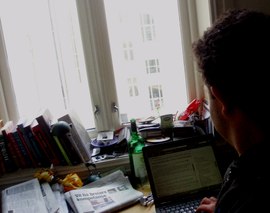
desk It’s a privilege to be an anthropologist on fieldwork. Reading Cicilie’s field blog from Paris and now also Antropyton’s field blog from Nicaragua makes me wonder: Why am I still sitting on my messy desk (picture) in Oslo?

A few weeks ago, Antropyton has arrived in Nicaragua, and has now started blogging about her experiences including her mixed feelings before she left Norway:

I was terrified by where we were supposed to live, by not understanding Nicaraguan Spanish (especially my hosts!), by not having a will to get to know them, by the scorching heat and by all my ideas dying in the shadow of volcanoes! I wasn’t on cloud nine at that time. Frankly speaking, excitement that was accompanying me for so long, disappeared as if by magic.

But then in Latin-America, everything changed:

Once I landed in San Jose in Costa Rica, I did realize that reading anthropology is something totally different than DOING anthropology.
(…)
I knew at once that this was going to be hard. But I was excited. Still, I had the will to conquer the world and carry out what I had planned the last few months. The world was new and beautiful and waiting for me.
(…)
It’s much better now, as one could suppose. I’ve started classes and tamed the city. Usually I don’t need much time to adapt myself to new environments. Albert Camus has a point in one of his essays (…) Like me, after a night in a hotel, the next morning he goes out on the street and click! you feel at home.

>> read the whole entry “Bienvenido”

Her most recent entry is about Nicaraguan conference culture:

The event was inaugurated with a national anthem, something that gave a dignity to the event. And the opening words seemed to go on endlessly. Every member of the organizing committee was welcomed and mentioned by name, academic title, organisations and institutions one belongs to and a post one has.

(…)

Every presentations was followed by a discussion that almost always ended with talk about politics, the new government and changes in policy that are essential to improve the health condition for the people. (…)What I observed was that presentations from Sweden (the conference was organized in cooperation with Lund University) were more “society friendly”. I mean that they presented not only results from their research, but also suggestions for how to apply this knowledge into society.

>> read the whole post ” III Conference on Multidisciplinary Environmental Research, Managua”

Also take a look at her pictures of volcano Cerro Negro and her new hometown Leon.

UPDATE (14.2.07): What happened? In her newest post she asks us Do we need/have to like our informants?

SEE ALSO:

New blog: Blogging anthropological fieldwork in Brazil

Open Source Fieldwork! Show how you work!

Paper by Erkan Saka: Blogging as a Research Tool for Ethnographic Fieldwork

Fieldwork in Papua New Guinea: Who are the exotic others?

On fieldwork: “Blogging sharpens the attention”

Fieldwork as cab-driver: “An amazing other world”

desk

It's a privilege to be an anthropologist on fieldwork. Reading Cicilie's field blog from Paris and now also Antropyton's field blog from Nicaragua makes me wonder: Why am I still sitting on my messy desk (picture) in Oslo?

A few weeks…

Read more

“Anthropology needs to engage in an activist way”

“Anthropology needs to develop a listening capacity and to engage in an activist way, to become involved with the problem, not just to observe it from a distance”, says Brazilian anthropologist João Biehl in a portrait on the website of his university (Princeton University).

Biehl has conducted fieldwork in Vita, a site in Porto Alegre that is populated by the sick, mentally ill and poor who have passed beyond the care of families and social institutions. He wrote about his experiences in “Vita: Life in a Zone of Social Abandonment” which revolves around an ethnographic study of Catarina, a young women who was considered by her family and various doctors to be insane. With no one to look after her, she had ended up at Vita. Se died in Vita in 2003.

Working with Catarina taught Biehl anthropology in a new way, he says.

Describing the impact of the book, Princeton anthropologist Carolyn Rouse said, “In addressing social policy and ethics, ‘Vita’ demonstrates how one person’s life can be a basis for thinking about complex issues.”

According to Biehl, places like Vita are emerging everywhere in urban Brazil, and the book shows “how economic globalization and state and medical reform coincide and impinge on a local production of social death.”

>> read the whole portrait on Princeton University’s website

Unfortunately, I couldn’t find more texts by or about Biehl. His anthropology department looks like one of the worst faculty website on the web. But you’ll find three papers on the website of Anthropology, Art, and Activism Series (Brown University).

UPDATE (9.2.07): Read the comment by Anne Galloway (Space and Culture)

SEE ALSO:

Professor studies society’s poor by picking through trash

“Discuss politics!” – How anthropologists in Indonesia engage with the public

More and more anthropologists, but they’re absent from public debates – “Engaging Anthropology” (1)

Interview: Anthropologist studied poor fast food workers in Harlem

Collaborative Ethnography: For Luke Eric Lassiter “among the most powerful ways to advance a more relevant and public scholarship”

Poverty and health policies: Listening to the poor in Bangladesh

Too engaged anthropology? The Lumpenproletariat on the US-Mexican Border

"Anthropology needs to develop a listening capacity and to engage in an activist way, to become involved with the problem, not just to observe it from a distance", says Brazilian anthropologist João Biehl in a portrait on the website of…

Read more

A subculture of hefty, hirsute gay men is attracting the attention of academics

Richard A. Kaye, associate professor of English at Hunter College in New York, writes about a new and rather unknown research area – Bear studies.

– Oh, by the way, in addition to 19th century American literature, I work on bear studies, a candidate for an academic position once said.

– Bear studies? Do you mean bears in literature — say, William Faulkner’s story ‘The Bear’, the interlocutors asked.

NO! By “bear studies,” he meant an area of academic research that explored “the subculture of hirsute, usually heavy-set gay men” — burly guys who identify with a masculine style and who shun the popular image of homosexual guys as smooth, hairless, Calvin-Klein-ish blond young men.

“What fascinates these scholars is that self-identified bears have created a kind of counterculture, with its own language, values and rituals”, he writes.

>> read the whole story in the Los Angeles Times

Richard A. Kaye, associate professor of English at Hunter College in New York, writes about a new and rather unknown research area - Bear studies.

- Oh, by the way, in addition to 19th century American literature, I work on…

Read more