search expand

Slow attempts at making sense: Oslo 22/7

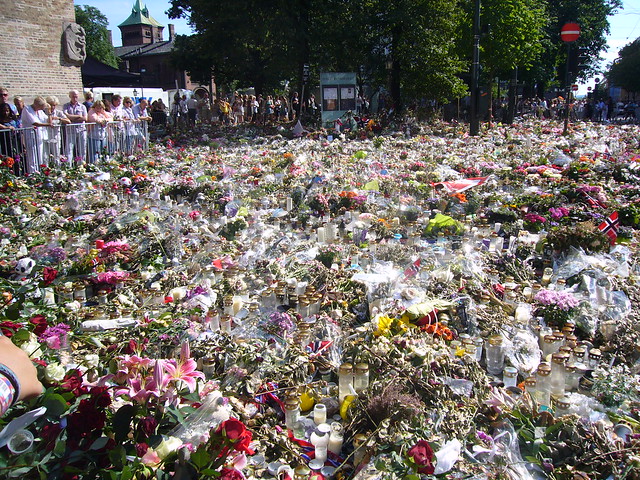
Blomsterhav
People meditating the sea of flowers outside Oslo Cathedral a week after the bomb blast and massacre

This research diary has until now exclusively treated the various facets of my PhD research project in Paris. When the numbness began to lose its grip, I started to realise why I feel so terribly concerned. Of course, I think most Norwegians, many Europeans and even many, many fellow world citizens feel deep concern when an atrocity like this strikes, even when they or their closest aren’t struck personally. This concerns us as fellow humans (of both the victims and the perpetrator…), and it concerns us as political beings. But I also realised that this concerns me profoundly in terms of the career I’ve chosen: What good is it to devote my professional life to understanding nationalism, belonging, community cohesion, conceptions of difference and the like when I have done nothing to prevent the worst thinkable acts of violence to take place in my own country? Especially since I think – or I’m sure – that I’ve felt there was a need for worry (but of course, not to this unconceivable degree…). For several days now I’ve been thinking about how I can contribute. How can I contribute in the best way with my knowledge (of living with difference in Europe), my concern (for the future of us all) and my devotion (to work for a better world)? I know need to think much more about this in the coming days and weeks, and I know that I need to act.

When I very soon finish my present project, I will – hopefully – be able to do research in Oslo. And there are few places on earth than here I’d rather do this kind of research right now. I don’ think there’s a coincidence that the last huge act of terrorism in Europe was committed by a rightwing nationalist in the name of anti-Islamism. And I even don’t think it was that big a coincidence that it happened in Scandinavia.

Now, after eight days of numbness (and reading of philosophy of difference) it’s time to get back to the main task: finishing the Paris project and get on with life. (Or rather, get on with life and finish the Paris project.)

Blomsterhav

People meditating the sea of flowers outside Oslo Cathedral a week after the bomb blast and massacre

This research diary has until now exclusively treated the various facets of my PhD research project in Paris. When the numbness began to lose…

Read more

“Difficult to read, chaotic, bothering conclusions”

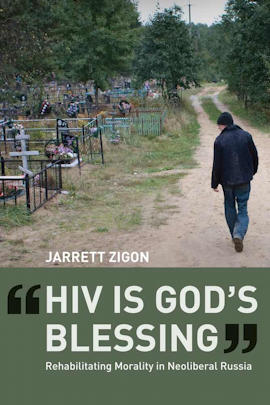
Russia has one of the fastest-growing rates of HIV infection in the world, and the Church remains its only resource for fighting these diseases.

Antropologi.info contributor Aleksandra Bartoszko reviews Jarret Zigon’s recent book „HIV Is God’s Blessing”. Zigon takes the reader into a Church-run treatment center near St. Petersburg that employs both priests and psychologists to work with the HIV-infected drug users.

—-

Review: HIV Is God’s Blessing. Rehabilitating Morality in Neoliberal Russia by Jarret Zigon, University of California Press, Berkley, 2011

Aleksandra Bartoszko, Oslo University Hospital

While I was finishing my review of Jarret Zigon’s recent book „HIV Is God’s Blessing”, Somatosphere has just published a review written by Tomas Matza.

When I read it, I was slightly surprised. I asked myself if we read the same book and why have I focused on totally different points while thinking of Zigon’s work.

I believe that one of the reasons for the huge discrepancy between what the two of us have learned from reading is our fields of research and interests we had in this book. As I am not too familiar with anthropology of morality and ethics, and many theoretical discussions in the book were pretty new to me, I must admit that this book did not invite me to further exploration of the subject. The book was difficult to read, a little bit chaotic and badly edited.

What Is this Book About?

Jarrett Zigon’s book „HIV Is God’s Blessing”, according to the publisher:

„examines the role of today’s Russian Orthodox Church in the treatment of HIV/AIDS. Russia has one of the fastest-growing rates of HIV infection in the world – 80 percent from intravenous drug use and the Church remains its only resource for fighting these diseases. Jarrett Zigon takes the reader into a Church-run treatment center where, along with self-transformational and religious approaches, he explores broader anthropological questions of morality, ethics, what constitutes a “normal” life, and who defines it as such. Zigon argues that this rare Russian partnership between sacred and political power carries unintended consequences: even as the Church condemns the influence of globalization as the root of the problem it seeks to combat, its programs are cultivating citizen-subjects ready for self-governance and responsibility, and better attuned to a world the Church ultimately opposes.”

As an ethnographic case Zigon takes a rehabilitation centre near St. Petersburg called The Mill, which is a cooperation between secular NGOs and Russian Orthodox Church, employing thus both priests and psychologists to work with the HIV-infected drug users. Zigon follows his informants both in the rehabilitation centre as well as the recruitment process in the city, and he is attending events arranged by the NGOs and Church outside the Mill.


Writing and the Art of Repetition

How the book is written and its style is usually mentioned at the end of every review. Unfortunately, when it comes to this book, the writing style was so disturbing that it influenced my overall reception of the book. I like some of the stylistic choices, like the description of the road leading to the rehabilitation centre, which I read as a metaphor for the social position of the centre and the life history of the rehabilitants (p. 33).

But unfortunately the book suffers from a very poor editorial work. There are a lot of redundancies, repetitions and the language itself creates at times confusion. It is hard to read this book. The excessive repetitiveness is most disturbing. Usually, there is nothing wrong with repeating, especially for learning purposes, but in this case this is just too heavy and achieving, in my opinion, a ludicrous dimension.

[teaserbreak]

Not to be ungrounded, I am giving an example. These sentences appeared at 3 pages:

„To live sanely in the world, then, is to a large degree to live what Russians call a normal life. But to live normal life, or a sane life, is not to live a life determined by any one discursive and authoritative structure (…) To be normal is not to adhere to one specific way of living – or one specific disciplinary and discursive tradition – but to live within an acceptable range of what counts as normal. (…) In other words, the social world is a range of possibilities, and to live it sanely is to have the sensibility for negotiating these possibilities. (…) That is, as persons work on themselves to fit themselves within the range of what counts as normal, this range is itself altered. (…) There is no one normal life. Just as in statistical analysis normal indicates a distribution, so too a normal life can be conceived of as a distribution of possibilities. (…) That is to say, responsibilized freedom as a „formula of rule“ is that which allows persons to negotiate the range of possible discursive traditions, and thus the range of possible ways of living normally in a social world“ (pp. 226-229)

Methodology and Analysis

Like most of the contemporary anthropological monographies, the book unfortunately does not offer any extensive presentation of method used during the fieldwork. The author is also sparse in presenting reflections regarding access to field, communication with informants and methodological challenges at all. We are presented with some reflections regarding the author’s presence during the activities in the centre. These are of great value.

The author presents also a good deal of quotes, so there is more «talking» from the fieldwork, than «doing», and thus description of how the rehabilitants actually are «working on themselves» (p. 196) is pretty thin. This might be a reason for the ethic/emic problem in the book.

Zigon’s normative explanations and conclusions are bothering. At times I even think that he puts words in mouths of his informants. He writes extensively on what the Church means, thinks and wants to do, but when the author does not present any sources, documents, and provides only a small number of references, it is difficult to know where the information, and thus data and conclusions, come from. This lack of methodological transparency worries me. I would also like to know how the informants themselves perceive the «Soviet times» which Zigon refers to, and what kind of change they experienced. It is often unclear where Zigon’s knowledge of the “Soviet Man” and Soviet society is taken from except from a rather uncritical use of Oleg Kharkhordin’s book „The Collective and the individual in Russia”. In this way I experienced Zigon’s text as slightly stereotypic.

I also did not like the way Zigon makes generalizations which anthropologists should try to avoid. We often read «Russian mean…» (p. 13) and we read of “American drug program” or “American context” (p. 193). We all know there are different groups of Russians, different ways of seeing the world, life and morality. We also know that there are thousands of rehabilitation programs in USA, so in my opinion speaking about American rehabilitation is not a fruitful way of comparison. Lack of nuances is also disturbing in presentation of the rehabilitation program at the Mill. I would like to know more about the relation of the rehabilitation program and the Church itself.

Rehabilitation and Normality

The book still has something to offer, although I needed to work really hard to dig up the essence of some of the most important ideas of the book. And still, I am not sure if I was able to grasp it. One of the biggest contributions which I see in this book is the processual approach to rehabilitation. Zigon writes:

”That the rehabilitation process is not simply about overcoming addiction. If this were the case, nearly all rehabilitation programs would be considered failures, since studies show that up to 60 percent of clients treated for alcohol or other drug dependence begin to actively use again within a year. There must be something more to this process” (p.3)

I believe that his understanding of rehabilitation as a process is a very important point which should be taken up not only by anthropologists and social scientists, but also by health personnel working on both physical and mental rehabilitation. The book contributes to the rehabilitation study indeed. And the approach can (and should) be applied also to the strictly (if existent) physical rehabilitation. The book adds also some interesting perspectives to normality discussion, which appears mostly in disability studies and medical anthropology. Zigon presents some interesting and new examples on the notion of normality and sane life.

Responsibility

Zigon devotes a significant part of his book to the idea of responsibility, and the changes surrounding the concept and experience of responsibility in the light of neoliberal discourses. This is an interesting idea and I was looking forward to reading Zigon’s exploration of this subject.

Nevertheless, the author’s reflections lack consequence. To me it was difficult to grasp what kind of changes in the ideas of and perception of responsibility actually had happened. As he included historical perspective and presents extensively the Soviet Man (also, a little bit unclear on what basis but Kharkhordin’s book), he also presents the “responsibilized Soviet person” (p. 103). At the same time he writes that responsibility is a neoliberal feature (intro, p. 104, 105). The difference between the „responsibilized subjects” of neoliberalism and during the Soviet period stays still unclear to me.

Neoliberalism(s)

Interested in studies of post-socialism and political changes in Eastern Europe, I was looking forward to reading this book and hoped for an intricate text on changes in neoliberal Russia in relation to church, HIV-patients, drug abusers and healing process at all. Unfortunately, the author seems to stay in rather unfruitful and uncreative thinking box: yet another text which is based on the distinction neoliberalism vs. … Yes, exactly versus what?

The author set up neoliberalism against the Russian Orthodox Church values or Soviet values (when it suits better, is my impression), but the values that he seems to define by himself. His starting point is his own opinions and taken-for-granted, almost populist visions on what neoliberalism is about. Therefore I was extremely happy to read finally (p. 181):

„Many of the values, reasonings, and practices may be quite similar across many global assemblages, but the kinds of persons and the processes by which they come to embody them locally may be quite different. For this reason it may be more appropriate to speak of neoliberalisms”.

To me, this point is the most important part of the book. And probably most innovative and brave. Anthropologists tend to work on the discourses of neoliberalism as if they forgot about the locally based communities and the different ways of dealing with the global economy, neoliberal politics and so on. I was therefore delighted to read that Zigon made this kind of reflection and pointed to the nuances in speaking of neoliberalism and neoliberal life and person. Therefore it was also a huge disappointment that on the pages following this important reflection he seems to be back to the stereotypical thinking of neoliberalism as a phenomena or term that stands for itself.

Both before this reflection appears in the book and after, Zigon seems to use the notion of neoliberalism still as a statical, encompassing and all-covering term. And he consequently uses this term in a non-dynamic and generalizing way.

His generalizations are also confusing regarding his own ideas and understanding of neoliberalism by the informants. When he quotes one of Caroline Humphrey’s informants, he concludes for example: ”Zhenia’s comments are not meant to be critical of the dominant discourse and way of life of neoberalism” (p. 151). It is difficult to not know what he means here by life of neoliberalism. And what most important, what Zhenia means by life of neoliberalism? This kind of confronting individuals with the often abstract to them discourses is difficult enterprise, and I am not sure that Zigon has managed to do it.

Punishment from God and Illness Explanatory Models

Regarding HIV/AIDS patients and understanding of the disease and illness experience, Zigon offers an interesting insight into the perception of both the drug abusers and the employees at the rehabilitation centre. As the title of the book suggests, the readers will be given an understanding of perspective that connects getting sick and believing in God. The dominating perspective amongst his informants working for the rehabilitation centre and who shared the view of the Church was that getting sick was ”punishment from God for the immoral acts that led to infection” (p. 58).

To readers who are familiar with different explanatory models regarding illness and disease, and especially models which include religion, this statement is not new, and I would like to hear more analysis around this statement than what the author offers. Unfortunately, Zigon does not challenge his informants to give other explanations. It is hard for me to believe that the informants’ own reflection on their life, life of the rehabilitants and disease was limited to the moral dimension, mostly circulating around the notion of punishment. Zigon was obviously in search of the moral dimension and thus he found morality discourse everywhere.

It would be also interesting to read more about how the rehabilitants themselves understand their disease and to what degree they share the Church view on sin. This subject is undercommunicated, in my opinion. I supposed that anthropologists interested in illness experience, would also find it interesting to read more explicitly how rehabilitating morality influences this experience. Of course, this was not main focus of Zigon’s book. Nevertheless, his ethnography and some of the theoretical discussions on rehabilitation and morality invites to see these in the broader context of illness experience as presented in medical anthropology.

Missing Theoretical Discussion

Zigon devotes also a significant space on the secular vs. sacred distinction. It is thus surprising that there is no theorizing on the subjects to be found in the book. Zigon presents his conclusion that it is not easy to separate these two and tell what kind of social action or phenomena are secular or sacred, but without any following (or preceding) discussion on the subject.

Even if not explicitly written, this book is about social change. While Zigon writes about the Soviet society, he mentions phenomena that according to him are „typical” to change from socialist to post-socialist society. And in this respect, he follows the tendencies amongst scholars of „post-socialism” who often forget that a lot of phenomena that happens, let’s say in Eastern Europe, are typical to every society in change, not only the post-socialist ones. In order to keep the comparative perspective that used to be so fundamental in anthropology, anthropologists of post-socialism need to include in their research more reflections which do not limit their research and theoretical work to post-socialist societies or Eastern Europe.

In this respect, I also felt like the discussion on continuity vs. discontinuity is completely omitted in the book. It is methodologically challenging to determine whether social phenomena are inherited from an old order or whether they are an expression of a new situation, and anthropologists should show caution so as not to find the “socialist legacy” where it does not exist. And I agree with Nancy Ries who suggests to look at the cultural systems as “’web of significance’ that is constantly woven and rewoven, continually integrating all sorts of historical changes and innovations” (Ries 1997: 22). Still, Zigon work is in a way reducing the complexity of the social process to the model continuity vs. discontinuity without mentioning the problems appearing around this way of thinking of social change.

Works cited:

Ries, N. (1997). Russian Talk. Culture and Conversation During Perestroika. London: Cornell University Press.

Aleksandra Bartoszko is anthropologist, currently working at the Section for Equitable Health Care at Oslo University Hospital and known to antropologi.info readers for her anthropological comic book and her interview about Pecha Kucha as new way of presenting papers. She’s also one of the first fieldbloggers.

The first chapter of the book can be downloaded as pdf. More papers and articles by Zigon are available on his homepage and on Open Democracy

Russia has one of the fastest-growing rates of HIV infection in the world, and the Church remains its only resource for fighting these diseases.

Antropologi.info contributor Aleksandra Bartoszko reviews Jarret Zigon’s recent book „HIV Is God’s Blessing”. Zigon takes the…

Read more

Thesis: Neoliberal policies, urban segregation and the Egyptian revolution


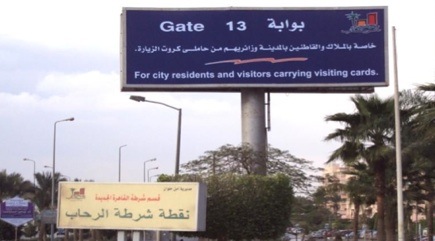
Gated communities: Access denied for outsiders. Photo: Safaa Marafi

While Cairo’s slum areas are growing, the richest layer of the society is enjoying a luxury life in privately guarded communities in safe distance from the lower classes. Hosni Mubarak’s neoliberal dream of segregation seems to have come true. But during the Egyptian revolution some of the young people have started to tear down the walls of their gated communities.

Safaa Marafi from the American University in Cairo (AUC) tells us in her well-written anthropology thesis the story of the giant segregation projects of the Mubarak regime. She has conducted fieldwork in Al-Rehab, one of those gated communities constructed on desert land, where the middle- and upperclass isolate themselves, shop in luxury malls, use private door-to-door limousine services and send their children to private schools or universities.

It’s a thesis about how neoliberal policies threaten the cohesion of a society.

The development of gated communities was part of Egypts neoliberal policies under Mubarak. In the late 1990s, Egypt underwent a process of structural adjustment guided by international financial organizations (Worldbank, IMF etc), which led to further privatization and liberalization of the economy. The most visible outcome has been land speculation, Marafi expains:

This segregation began when the Egyptian Ministry of Housing sold massive amounts of desert land, situated at the margins of Cairo, to private corporations. Approximately 320 private corporations purchased portions of this land and planned projects for a potential 600 thousand housing units (Denis 2006:52). This expansion process resulted in the construction of numerous gated communities in the suburbs of greater Cairo.

The Neoliberal Dream of Segregation

The Mubarak-government and its “clique of businessmen” were driven by a “neoliberal dream of segregation” – a term coined by sociologist Mona Abaza:

The neoliberal dream of segregation can be defined as a political-economic agenda adopted by the Egyptian government, which fostered and supported rich local and foreign investors in building gated communities in Cairo‘s suburbs. By constructing these enclaves for the richest layer of Egyptian society, these development projects created a physical segregation in Cairo‘s urban fabric. This segregation is evidenced by the way the residents of these hinterlands are protected by private security systems, walls and/or fences, gates, and private security guards.

“Neoliberal policies”, Marafi writes, “have encouraged class-based urban segregation, leading to polarization in the urban fabric.” The adoption of neoliberal polices turned the state into a private territory, where wealth is monopolized by political elites and businessmen.

Moral panic towards the lower classes

This segregation is not only related to space but also related to the mind.

Living in this gated communities intensifies the mood of moral panic felt towards the other – people from lower classes. “This is”, the anthropologist explains, “because they believe that their community is labeled as a rich one and therefore may be a target of potential criminals. State and media contributed to the fear of the other. Not only the marketing campaigns of gated communities seek to convince potential buyers that outside of the gates, fences, and walls of these closed venues lies a dangerous world. The consequence is a “culture of fear”.

Many residents, especially in recent times, moved to Rehab for class and safety reasons. They wanted to isolate themselves from the other. But soon they had to realise that they cannot live without “the uncivilized others”. They are dependent on them. For who shall clean their houses, deliver food, and patrol the streets to protect them? The supposed enemy and security threat is living among them!

Culture of fear

The residents feel a need to apply extra security measures. Despite these measures taken by the participants, the private security department of Al-Rehab, and the public police, the participants‘ fears are not alleviated, Marafi writes.

Security cameras, intrusion alarms, extra secure locks, as well as guard-dogs, can all be observed in the community. In addition, there are some shops which sell extra-large security lamps to be attached onto the roofs of villas.

In many villas, the use of such lamps as security tools makes the villas look more like military buildings at night, rather than family residences.

In addition, surveillance real and fake cameras are among other security methods implemented by other participants. Fake cameras are sold in at least one of the most popular electronics shops in the souk of Al-Rehab.

Some residents don’t even trust the security guards. Nora is one of them. Private security, she points out, relies on guards, and as they are humans they might fall asleep while on the job. Moreover, Nora claims that there are some cases where private security guards collaborated with criminals.

The private security guards themselves are aware of the distrust felt by the residents. Security guard Hanafi tells about Sara:

Madam Sara drives every night and checks the kiosks of the security guards located around her villa. If she does not find a security guard in any of these kiosks, she takes a picture of the empty kiosk with her camera and sends the picture to the security department. The security department trusts her word over the security guards and punishes those guards who were not in their positions or patrol areas. Also, she reports to the security department if she finds any of the security guards falling asleep, and she also takes pictures of them as evidence.

Being protected creates a sense of superiority

The anthropologist has noticed that classist phrases are used frequently. Being protected by private security guards and systems creates a sense of superiority.

When for example Nora explains why she moved to Rehab, she stresses that she wanted her son to live in a “clean neighborhood” when he gets married. Mohandessin, where they lived previously, “became old-fashioned”, populated by lower classes and “polluted”. In Rehab, on the contrary, reside “clean people”, their neighbors are “respectful” and “civilized people”.

Marafi comments:

The prejudicial connotations of these elitist, classist notions of newness, civilization, cleanness and decency indicate a desire for urban segregation and a keeping of distance from “the other”: the dirty, polluted, and uncivilized.

Security measures are also used to show wealth and status (“conspicouos consumption”). Some of the residents design security bars using branded logos, such as Versace. Others paint their security bars in different colors, such as white, to differentiate themselves from others (“aesthetic security”).

It is obvious to see primarily the poor as victim of neoliberal policies. Safaa Marafi suggests a different view:

While slums are stigmatized by poverty, gated communities are labeled by their richness. It is not that one group should be victimized over the other, but they both ought to be understood as victims of the implementation of the neoliberal segregation policy.

Breaking the walls

But her thesis has a somehow “happy ending” (depending on your world view of course), caused by the 25th January Revolution.

While the political participation of the residents previously has been rather low and there was a “noticeable sense of detachment” from any involvement with earlier protest movements, things have been slowling changing:

In the beginning of this unexpected revolution, none of my participants showed interest in joining the peaceful protests. (…) Yet, as I learned, a few of Al-Rehab‘s youth are active agents in this revolution. The neoliberal segregation plays a role in detaching many, but not all, of the residents of Al-Rehab. The youth especially were the ones participating in the political sphere. (…) Optimistically, this tells us that some of the youth of Al-Rehab want to be part of the world outside their gated community.

Safaa Marafi sent me a video from the youth celebration in Rehab after the announcement of the resignation of President Hosni Mubarak on 11th February 2011. “The quality is is not that good”, she admits, “but its content is very important as it shows how the youth of the gated community are breaking the walls of their gated community and want to be part of the outside world”.

[video:flow:http://www.antropologi.info/blog/anthropology/media/rehab]

Her thesis can be downloaded here on antropologi.info:

Safaa Marafi: The Neoliberal Dream of Segregation. Rethinking Gated Communities in Greater Cairo. A Case Study. Al-Rehab City Gated Community (pdf, 2.7MB)

An earlier version is available at the digital archive of the AUC (DAR)

SEE ALSO:

Ethnographic Research: Gated Communities Don’t Lead to Security

“The insecure American needs help by anthropologists”

Why borders don’t help – An engaged anthropology of the US-Mexican border

Criticizes “scholarly and political indifference toward the workers’ lives”

– Use Anthropology to Build A Human Economy

Saba Mahmood: Democracy is not enough – Anthropologists on the Arab revolution part II

Cautioning Against Security Fundamentalism

Gated communities: Access denied for outsiders. Photo: Safaa Marafi

While Cairo’s slum areas are growing, the richest layer of the society is enjoying a luxury life in privately guarded communities in safe distance from the lower classes. Hosni Mubarak’s…

Read more

Terror in Oslo: Who cares about Christian right wing extremism?

While politicians and social scientists have directed all their attention towards “islamist” terror groups, right-wing extremist milieus were able to grow unnoticed.

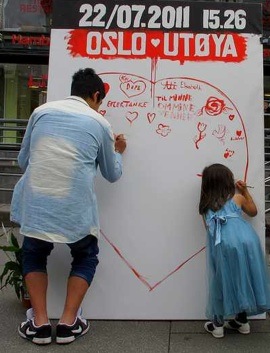
Memorial Art. Photo: Agnar Kaarbø, flickr

(draft / see update 31.7.11) Oslo like a war zone, nearly 100 people killed in the worst attack on Norway since World War II: How could this happen? Two days after the attack, the web is filled with comments and analyses. But I have to consult international media to find a discussion of the, I suppose, most important issue: Right-wing extremist and islamophobic attitudes have become mainstream, but nobody cares – neither politicians nor social scientists. Instead, all their attention is directed towards “islamistic” groups as the major threat to the West.

“Europeans have spent so much time and effort in banning veils, minarets and preventing the construction of mosques that they have forgotten their own native cancer”, writes anthropologist Gabriele Marranci on his blog.

“We can no longer ignore the far-right threat”, argues Matthew Goodwin in the Guardian. Terrorist Anders Behring Breivik is “not a Norwegian oddity, but symptomatic of a growing culture of politically motivated violence across Europe”. It “is important to note that some of Breivik’s core concerns have also played a prominent role within Norwegian and European politics more generally.”

Nicolas Kulish provides us the details in his New York Times article:

Friday’s attacks were swiftly condemned by leaders from across the political spectrum in Europe. Germany’s Chancellor Angela Merkel was particularly sharp in speaking out against what she called an “appalling crime.” The sort of hatred that could fuel such an action, she said, went against “freedom, respect and the belief in peaceful coexistence.”

Yet some of the primary motivations cited by the suspect in Norway, Anders Behring Breivik, are now mainstream issues. Mrs. Merkel, President Nicolas Sarkozy of France and Prime Minister David Cameron in Britain all recently declared an end to multiculturalism. (…) While the parties themselves generally do not condone violence, some experts say a climate of hatred in the political discourse has encouraged violent individuals.

Therefore it is somehow correct when Ahmed Moor writes at Al Jazeera that Breivik did not act alone. He “acted within a cultural and political context that legitimises his fearful and hate-infested worldview.”

In this context, it is not surprising that the first speculations about who might be responsible for the attack centered around muslims. When I watched the BBC few hours after the attack, islam was the main topic.

Gabriele Marranci has observed the same in Italy:

Immediately the newscasters told us that it may be an Al-Qaeda attack in revenge of Norway’s marginal role in Iraq and Afghanistan, and the more recent Libyan air campaign. Islamic terrorism has hit Europe again. Immediately a flurry of comments about the high number of Muslims living in Oslo appeared – yet these were quickly substituted, upon confirmation that the culprit behind the bloodshed was a tall blonde man, with comments about the danger of ‘converts’.

Generally, the words ‘terrorist’ and ‘Christian’, he adds, are infrequently used together. Shooter is now the preferred word for Europeans committing terrorist actions as part of their political or religious beliefs.  

“Tragic Day for Norway; Shameful Day for Journalism”, summarizes Shiva Balaghi in the magazine Jadaliyya. Among others, she mentions the New York Times that “let the story become one of Muslim terrorists wreaking the worst destruction on Norway since World War Two”:  

As it turns out, the worst attack on Norway since Hitler’s invasion was actually carried out by a neo-Nazi. This attack was about Europe’s own ghosts.

The Colbert Report: Norwegian Muslish Gunman’s Islam-Esque Atrocity: CNN: – Nordic looking terrorist? Maybe it was a good disguise

If those journalists and analysts had been paying attention, they would not be surprised at all about this attack, writes Juan Cole:

Europol reports have long made it clear that the biggest threat of terrorism in Europe comes from separatist movements, then from the fringe left, then from the far right.

But, as it is noted on the blog Cultural Meanings, “the Islamophobic current in Europe and North America is so strong that it seems very difficult to swim against it.”

These views have also made it into academia. Two years ago I wrote about the Centre for Studies in Islamism and Radicalisation at the University in Aarhus, Denmark that views “Islamism” as “the primary enemy of the democratic world”.

Looking at the guide Terrorism: Anthropological Perspectives by Rutgers University Libraries shows similar bias. When they recommend “relevant subject headings” that you can use to find books on the topic “Terrorists Groups and Incidents”, then it is Al-Qaeda and Hamas.

The syllabus Anthropology 255: Terror and Violence in Anthropological Perspective at Washington and Lee University (Spring 2004 by Sascha L. Goluboff), while also providing examples from Ireland, deals mostly with Islam and the Middle East.

Far right extremism is a complex topic, as the case in Oslo shows. Breivik was “far from what we might term a traditional rightwing extremist”, Matthew Goodwin writes. Within the Far Right, the researcher has observed broader changes:

Rather than oppose immigration and Islam on racial grounds (an argument that would attract little support), the emphasis shifts on to the more socially acceptable issue of culture: Muslims are not biologically inferior, but they are culturally incompatible, so the argument goes. The aim is to open modern far right groups up to a wider audience.

As I also noticed during a public debate with racists in Oslo, the belief that they are engaged in a battle for racial or cultural survival is quite common.

“It is not simply about jobs or social housing”, Goodwin stresses. It is a profound sense of concern that a set of values, way of life and wider community are under threat, and that only the most radical forms of action can remove this threat.

In his manifesto that was put online before his attack, Breivik also calls for suicidal operations in service of the larger cause. He claims to be a follower of the Knights Templar – a medieval Christian organisation involved in the Crusades, and sometimes revered by white supremacists.

The Labor Party (Arbeiderpartiet), is the main target for this war, as it is commonly seen by these ”antiislamists” as ”worse than the Quslingparty in the WW2″ according to Torbjörn Jerlerup who presents Breiviks worldview in his text Antiislamists with World War Two rethoric and iconography.

I’ll close this post with wise words by Wilfred Hildonen who on his blog writes:

It is about time to realise that to be born and to have grown up within a certain geographical area, do not bestow us with a certain kind of personality; that being human is something universal, which implies that all of us carry both heaven and hell within and that we all are capable of inconceivable evil at the same time as we can show up an incredible degree of compassion and kindness. It doesn’t matter whether we are Muslims or Christians, Jews or French or Greek, Somalis or Norwegians.


He reminds us on the possibly explosive power of words:

Some of us will perhaps have to realise that we too, are responsible for our thoughts, our words and our attitudes. These form the basis for the deeds of the future – evil deeds included. Most of us will perhaps not be influenced, but someone, somewhere, will be. Words, thoughts and attitudes carry an explosive energy within and should therefore be treated with consideration. We should consider what we do think and say and our attitudes as well. Not because we shall be political correct, but because what we say and think today, may have unexpected consequences tomorrow. 

(to be continued)

UPDATE 26.7.11 (via Erkan Saka’s round-up) Thomas Hylland Eriksen has written an in my view rather depressing (others might say a rather realistic) comment at OpenDemocracy: Norway’s tragedy: contexts and consequences. “The first consequence and the main message to Norwegian society is thus that citizens can never again be or feel entirely safe”, he argues. “We doubtless woke on Saturday morning to a slightly more paranoid, slightly less pleasant society. A society where we have become aware of our fundamental vulnerability.”

He also wrote a text for the Guardian Anders Behring Breivik: Tunnel vision in an online world and the New York Times (together with Jostein Gaarder) A Blogosphere of Bigots where he highlights the role of the role of the internet in fragmenting the public sphere. Norway’s extremists don’t tend to gather in visible ‘rightwing groups’. But online, he writes, they settle into a subculture of resentment:

Perhaps one lesson from this weekend of shock and disbelief may be that cultural pluralism is not necessarily a threat to national cohesion, but that the tunnel vision resulting from selective perusal of the internet is.

UPDATE 31.7.2011: Many new comments by anthropologists have appeared, see new post “How can I contribute to a better world?” Anthropologists on the Oslo terror attacks – an update

While politicians and social scientists have directed all their attention towards “islamist” terror groups, right-wing extremist milieus were able to grow unnoticed.

Memorial Art. Photo: Agnar Kaarbø, flickr

(draft / see update 31.7.11) Oslo like a war zone, nearly 100 people…

Read more

“Freiwilligendienste verfestigen hierarchisches Weltbild”

Nach der Schule nach Afrika, um im Krankenhaus zu arbeiten oder beim Bau einer Schule zu mitzuhelfen? Solche “Entwicklungshilfe-Programme” können mehr schaden, erklärt Politikwissenschaftler und Ethnologe Wolfgang Gieler in einem Interview i Deutschlandradio.

Solch ein einseitiger Austauch – Menschen aus dem “reichen Westen” reisen in den “armen Süden”, um zu helfen – kann ein hierarchisches Weltbild verfestigen, also ein Weltbild, das den Westen als moralisch, technisch, kulturell etc überlegen definiert.

Gieler hat sich seit langem fachlich mit Freiwilligendiensten beschäftigt – nicht nur theoretisch. Er betreut selbst Studentengruppen, die in Ghana oder in Burkina Faso Freiwilligendienste leisten.

Er versucht eine andere Perspektive zu vermitteln: Die jungen Leute aus Deutschland gehen ins Ausland, um dort etwas zu lernen, und nicht, um zu helfen.

Er macht sich stark für mehr Gleichwertig-Gleichrangigkeit:

Die Argumentation beispielsweise, zehntausende freiwillige Deutsche zu entsenden, um dann auch im entwicklungspolitischen Bereich tätig zu werden, könnte dahingehend aufgebrochen werden, dass etwa 5.000, die Hälfte, Deutsche entsandt werden und umgekehrt dann 5.000 Kinder, Jugendliche aus den Südländern nach Deutschland kämen, um hier etwa im Bereich Schule oder im Bereich gemeinsamer Projekte zu arbeiten.

>> zum Interview im Deutschland Radio

In einem Folgebeitrag nimmt Jürgen Wilhelm von der Deutschen Gesellschaft für Internationale Zusammenarbeit (GIZ) Stellung zu Gielers Kritik. Die GIZ hat in den letzten drei Jahren 10.000 junge Menschen mit ihrem Freiwilligendienst “weltwärts” ins Ausland geschickt.

Wllhelm kann Gielers Kritik nicht nachvollziehen, findet seinen Vorschlag, Jugendliche aus dem Ausland nach Deutschland zu holen, jedoch gut. “Da spricht mir Herr Gieler aus der Seele, das ist ein ganz klarer Wunsch immer an die Bundesregierung gewesen.”

Wie wärs z.B. wenn die GIZ junge Leute aus Ägypten holt, um Deutschland Entwicklungshilfe in Demokratie zu leisten?

NEU (25.7.11): Der Paderborner Religionspädagoge Johannes Niggemeier kennen, Gründer und Vorsitzender der Brasilieninitiative Avicres nimmt zur Kritik Stellung.

SIEHE AUCH:

Die Gefahren des eurozentrischen Weltbildes

Jack Goody: “The West has never been superior”

Ethnologe: Afro-Festivale schüren Vorurteile

“Ethnologie macht Hilfe möglich”

Buchbesprechung: Unser merkwürdiger Umgang mit “Fremdem”

Erfolgreiche Zusammenarbeit zwischen “traditionellen” und “westlichen” Heilern

Mahmood Mamdani: “Western concern for Darfur = Neocolonialism”

Nach der Schule nach Afrika, um im Krankenhaus zu arbeiten oder beim Bau einer Schule zu mitzuhelfen? Solche "Entwicklungshilfe-Programme" können mehr schaden, erklärt Politikwissenschaftler und Ethnologe Wolfgang Gieler in einem Interview i Deutschlandradio.

Solch ein einseitiger Austauch - Menschen…

Read more