search expand

– Vekk med det rosa prinsessehelvetet!

Gutter må være tøffe, og jenter må være snille og pene: Klisjeene lever i beste velgående også i 2011. “Jenter læres fortsatt opp til at et perfekt utseende er det viktigste de kan og bør prestere i løpet av livet”, skriver Rannveig Svendby, masterstudent i sosialantropologi ved Universitetet i Oslo, i sin kronikk i Bergens Tidende på kvinnedagen 8.mars.

Disse klisjeene dyrkes i den nye Disney-filmen To på rømmen, skriver hun, dessuten i leker, kostymer og tegneserier – “og gir barn daglige påminnelser om at deres eget utseende er mindreverdig fra før de kan gå.”

En tur i norske leketøysforretninger viser etter hennes mening at det er behov for et pinkstinks-initiativ slik de har det i England, “en motreaksjon til det rosa prinsessehelvetet som møter jenter i en sårbar alder”.

>> les kronikken i Bergens Tidende

I tillegg til flere kronikker har Rannveig Svendby skrevet flere spennende innlegg på sin Aftenposten-blogg

SE OGSÅ:

Estetisk kapital: Masteroppgave om skjønnhetsidealer blir blogg

“Bisarre skikker kjennetegner norske kvinners dagligliv”

Hva har høye hæler og omskjæring til felles?

Omtaler våpen som “kvinne du skal passe på”

Kjønnsroller hindrer miljøvern?

Der kvinnene går på jakt og menn passer hus og barn

Skrev oppgave om kvinnelige kroppsbyggere

Colombia: Kvinnene som ikke lar seg skremme av de paramilitære

Fotomodeller må passe inn i den hvite skandinaviske normen

Fat is beautiful: “Er du mager er du jo som en mann”

Antropolog: – Debatten om kjønnskorrigerende inngrep blant barn må løftes ut av sykehusene

– Mangfald er på moten, men kravet til normalitet er skjerpa

Gutter må være tøffe, og jenter må være snille og pene: Klisjeene lever i beste velgående også i 2011. "Jenter læres fortsatt opp til at et perfekt utseende er det viktigste de kan og bør prestere i løpet av…

Read more

The Anthropological Comic Book – an alternative way of reaching the audience

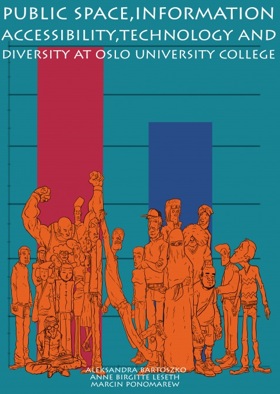
What about presenting research findings with cartoons? A few days ago, anthropologists Aleksandra Bartoszko and Anne Birgitte Leseth published a research report as a comic book – together with cartoonist Marcin Ponomarew. And it was a success! Take a look at here https://anthrocomics.wordpress.com

I’ve asked Aleksandra Bartoszko to write some words about it for us. She is one of the first fieldbloggers (check her blog here http://antropyton.blogspot.com ) and has contributed with several posts here at antropologi.info, among others Pecha Kucha – the future of presenting papers? and – in Norwegian – a series about anthropology and art

———-

The Anthropological Comic Book – an alternative way of reaching the audience

By Aleksandra Bartoszko, Assistant Professor Oslo University College

What if people don’t get it? How will they interpret it? What will the anthropologists say? – we asked ourselves before publishing the comic book. Not without fear. Not without doubts. Anthropology is about writing. But comics, these funny stories in a newspaper that amuse us during breakfast reading – are they a valid form of presentation of ethnographic findings?

“Public Space, Information Accessibility, Technology, and Diversity at Oslo University College” was a project which I, together with Anne Leseth, started in 2009.

We conducted our fieldwork at the campus of the college to assess the friendliness and accessibility of localities and information services in terms of social and cultural diversity. When we told our colleagues about our work, some of them reacted: “Oh, yet another report that nobody will read”. Not an encouraging attitude, but it challenged us to figure out an alternative way of reaching the audience.

We needed something that would attract attention of people who were “fed up with all these reports” on the multicultural environment, integration, exclusion and inclusion. So we decided to present our findings with a twist. We decided to make an anthropological comic book.

The Process

The process of making the comics was challenging yet extremely rewarding. Before we even started to worry about the reactions of the readers and the anthropological community, we asked ourselves how to make an illustrated ethnography.

While working with cartoonist Marcin Ponomarew we experienced something new, the experience that was not possible before – what our readers see when they read our ethnographies. How do they interpret our descriptions, how do they visualize our informants and their environments, and whose version is more real? “The dead of the author” was closer than ever.

We gave Marcin manuscripts. Some drawings he sent us back were very close to what we (or everyone of us) imagined and saw during the fieldwork, some were completely different. Yet, was his graphic presentation less real than if I had drawn the story? We worked with many versions of every story so as to get “the right picture”, to translate ethnography into words and words into pictures. This experience of triple translation gave me a new understanding of relation between the descriptive work of the author and the imaginative process in the reader’s head. As far as I am concerned, writing ethnography will never be the same as it was before this experience.

The Book

The book turned out to be a collection of ethnographic situations. Some of the drawings represent situations that we have observed; some of them are situations that we or our informants have experienced. They are often representations of emotions and feelings. A few of them are representations of stories we were told and some of them represent our analysis of documents and situations at the campus. Just as in written ethnography, we have manipulated some situations so as to anonymize the informants. This process was carried out with the same level of precision and ethical consideration as would be performed with written ethnography. Our goal was to tell a trustworthy story.
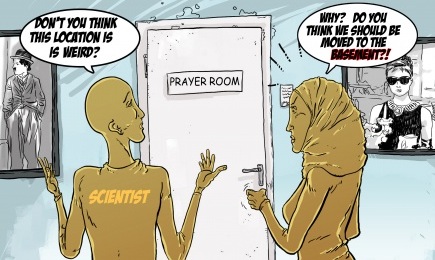

Stereotypes: Wrong diagnosis. Cartoon: Marcin Ponomarew

While working on this collection, various storylines, narrative arcs, drawings, and so forth, we were faced with a series of esthetic, philosophical, and ethical choices. We not only interpreted our ethnographic findings but also presented our view of the world. In some instances, we used irony and humor to clarify situations. These forms of expression also represent our informants’ subjective experiences. They reflect the tone, emotions, and comments that were expressed by the students and employees during our conversations with them.

Visual Anthropology

This book, in both its form and content, breaks with the traditional way of presenting ethnography. Traditionally, anthropology has been a written enterprise. Writing is perceived as the most scientific form of representation of social life. However, other forms of representation exist — not only in other disciplines (like art) but also within anthropology and social sciences.

Anthropological findings have been presented in such forms as photography, film, and material exhibitions. Anthropologists are becoming increasingly inspired to branch out from the written word and use other forms of expression to present their findings. We have learned that there are various ways in which knowledge can be imparted and findings can be communicated. It is well known that the scientific standards of visual anthropology are equivalent to those of the written one.

The challenges related to visual presentation, as well as the lack of anonymity in those products, have been discussed, and these issues remain problematic. However, we believe that the comic book format, with its convincing visual style and preservation of anonymity (i.e., informants do not have to reveal their identities on screen or in photos, thus preserving their anonymity) may be a great solution.

Stereotypes: Culture or money? Cartoon: Marcin Ponomarew

The Reactions

The goals of this comic book were not only to inform and educate but also to entertain and provoke discussion among readers. While working on this collection, we endeavored to set a tone of openness so as to promote reflection and interpretation. In so doing, we hoped that the comic book would involve readers in the dynamic process of learning and create a debate.

Did we succeed? Judging by the comments we received from the public – yes. We received positive feedbacks from both students, employees at the college and fellow anthropologists. Not only did they concern the esthetical values of the comics or the innovative way of presenting research, but what’s most important we received feedbacks on the issues presented in the comics.

We have been told that the book made people reflect. “So this is how it works”, “I didn’t realize before, that stereotypes are also what I do every day” and “This opened my eyes on the integration issues”, we have heard from the readers. I believe that this is because of the form of presentation we have chosen.

People tend to better understand the complex issues when they are visible. Literally. Sometimes we need to see ourselves in a mirror to see ourselves at all. These comics were like a mirror that made people reflect upon the social and cultural issues without the distance which written texts often are creating.

So, yes, we achieved what we hoped for. If this collection will help to improve the learning and work environment at the college is not entirely up to us, but we shed a light on challenges that need to be solved.

I would not say that comics are appropriate to present work engaged in theory development. But is every anthropological text about theory? We read so many articles, monographs, reports and listen to conference papers which actually present nothing more than ethnographic description. Are they less scientific? Well, this questions should be answered by anthropologists in the nearest future. For if pictures tell and do just as much (or more) as words, we should take a serious look at the condition and purposefulness of writing in anthropology and academia in general.

Aleksandra Bartoszko

The Anthropological Comic Book is available online at http://anthrocomics.wordpress.com

UPDATE 4.3.2011: Katarzyna Wala has translated her text into Polish: Komiks antropologiczny

Links:

“On Art and Anthropology” by Amanda Ravetz (part of Art and Anthropology Workshop)

Artopologist: A collective of artists and social scientists

Anthropology meets art: Ethnographic Terminalia

Dancing one’s thesis

SEE ALSO:

Manga instead of scientific paper: How art enriches anthropology

What about presenting research findings with cartoons? A few days ago, anthropologists Aleksandra Bartoszko and Anne Birgitte Leseth published a research report as a comic book - together with cartoonist Marcin Ponomarew. And it was a success! Take a look…

Read more

Tunesien, Libyen und Ägypten: Medien interviewen Ethnologinnen

Seit mehreren Wochen toben sie nun, die Revolutionen in Nord-Afrika, die Rufe nach Freiheit und Demokratie von Millionen von Menschen. Nach dem Fall der Diktatoren in Tunesien, und Ägypten ist nun Libyen an der Reihe.

Ethnologen waren gefragte Interviewobjekte von Journalisten, auch in deutschsprachigen Medien.

Der Standard hat kürzlich die Wiener Sozialanthropologin Ines Kohl über die Rolle der “Stämme” in Libyen und die Zeit nach al-Qaddafi / Gaddafi interviewt.

Sie ist überracht über die Proteste, hätte nicht gedacht, dass es so schnell und so heftig passiert. Obwohl der Unmut in der Bevölkerung in letzter Zeit gestiegen ist. Eine direkte Auflehnung hatte man bisher nicht gewagt:

Begeht jemand Verrat am “revolutionären System”, existieren Kollektivstrafen. Also nicht nur das Individuum wird bestraft, sondern ganze Familien, oder Stämme. Verrat heißt auch: sich gruppieren. Daher ist in Libyen jegliche Freizeitbeschäftigung in Form von Clubs oder Musikveranstaltungen (außer jene des Regimes) untersagt. Zudem existiert ein ausgeprägtes Spitzelwesen unterschiedlicher Geheimdienste, die sich auch gegenseitig kontrollieren. Bis dato hat sich Unmut noch nie offiziell zeigen können.

Sie erklärt auch, warum sie nach Gaddafis Fall keinen Bürgerkrieg fürchtet.

>> weiter im Standard

Ines Kohl hat eine schöne Webseite über ihre Forschung, es hat auch einige Artikel und Papers, besonders über Tuareg in Libyen. Ich hatte sie früher bereits erwähnt, u.a. im Beitrag Feldforschung bei den Tuareg: Makkaroni mit Tomatensauce – monatelang!

Nach dem Sturz von Präsident Zine El Abidine Ben Ali sind tausende Tunesier auf die italienische Insel Lampedusa geflüchtet. Der Tagesspiegel interviewt Ethnologin Heidrun Friese. Wie es der Zufall so will, erforscht sie die Migration nach Lampedusa: Was sind die Wege der Migranten? Was ist die Einstellung der Bevölkerung vor Ort? An mehreren tunesischen Häfen hat sie mit Fischern, Hausfrauen, Jungen und Alten gesprochen, um zu verstehen, warum so viele weg wollen.

Über die Fluchtwelle ist sie nicht überrascht:

Wenn Menschen zwanzig, dreißig Jahre eingesperrt sind und auf einmal sind die Gefängniswärter weg, dann ist es kein Wunder, dass einige die Chance zur Flucht ergreifen. (…) Jetzt freuen sich junge Leute zwar über ihre Revolution, aber besonders die gut ausgebildeten haben nicht mehr die Geduld, auf Veränderung zu warten. Sie wissen: Das kann Jahrzehnte dauern.

Die heutige tunesische Jugend sehe sich als Europäer:

In den Ländern Nordafrikas ist eine Europäisierung von unten zu beobachten. Die jungen Leute leben eine Flugstunde von Italien, Spanien entfernt. Sie nutzen die sozialen Netzwerke, die medialen Informationskanäle. Sie sind längst im modernen Europa angekommen, waren aber im Korsett ihrer korrupten Regime gefangen.

Sie kritisiert die Abschottung Europas von Afrika (“Festung Europa“), warnt vor “linker Revolutionsromantik” genauso wie vor dem rechten Wunsch nach Stabilität um jeden Preis.

>> weiter im Tagesspiegel

Heidrun Friese hat übrigens auch eine schöne Webseite auf http://web.mac.com/hfriese/heidrun_friese/

Dieses im Westen so beiebte Denken “lieber diktatorische Stabilität als demokratisches Chaos” kritisiert Ethnologe Samuli Schielke in einem Interview mit dem DeutschlandRadio

“Dass so was von der Regierung von Amerika und Europa behauptet wird, halte ich für einen moralischen Bankrott”, kommentiert er:

Denn die ägyptische Regierung ist diejenige, die in dem Land für Chaos gesorgt hat und Chaos systematisch als Machtmittel eingesetzt hat. Also ich halte jede Rede darüber, dass Mubarak einen geordneten demokratischen Übergang übersehen sollte, halte ich für eine vollkommene Illusion, weil genau er und seine Machtelite dafür gesorgt hat, dass das Land in Chaos versunken ist. Ich denke, dass die Demonstranten sehr gut in der Lage sind, für Ordnung zu sorgen, die haben sich gerade eine ungesehene spontane Bereitschaft zum organisierten Handeln – also es ist sehr sauber auf dem Tahrir-Platz, der Müll wird gesammelt, es wird alles gut organisiert.


Er kritisiert auch “die ständige Angst, die gegenüber die Muslimbrüder geführt wird”. Diese werde vom Mubarak-Regime gezielt auch geschührt.

Das Wichtigste sei für die Ägypter im Moment nicht, wer das Land regiert, sondern wie das Land regiert wird.

“If this revolution has taught me one thing is that the people of Egypt do not need to look up to Europe or America to imagine a better future”, schrieb er in einem Gastbeitrag auf dem Blog Closer: “Compared to our governments with their lip service to democracy and appeasement of dictators, Egyptians have given the world an example in freedom and courage which we all should look up to as an example.”

Auf http://samuliegypt.blogspot.com/ schildert er seine Eindrücke von der Revolution in Ägypten und auf http://www.samuli-schielke.de/research.htm gibt es jede Menge Papers über die ägyptische Jugend.

Urmila Goel kommentierte die anti-demokratische Haltung des Westens in ihrem Beitrag Europäisches Interesse:

Demokratie – dafür tritt die EU angeblich ein. Die nordafrikanischen Volksaufstände aber zeigen, dass die EU de facto wenig Interesse an Demokratisierung hat. Mit den Diktatoren kann sie ihre Festung Europa viel besser abdichten.
(…)
Europäische (und einige andere Staaten) holen ihre Staatsangehörige aus Libyen raus. Die Libyer_innen aber sind in Europa nicht willkommen. Menschenrechte hängen mal wieder von der Staatsangehörigkeit ab.

Sehr interessant auch die Diskussion im Beitrag “Koloniale Sichtweisen und die Komplizenschaft der europäischen Politik“: Navid Kermani im Interview auf dem Blog Metalust & Subdiskurse Reloaded.

Ägypten: Warum hat der Westen Angst vor Demokratie? fragte ich vor drei Wochen und verwies auf den Kommentar der Ethnologin Katrin Zinoun auf ihrem Blog dialogtexte.

Inzwischen hat sie eine wunderschöne Schilderung der historischen Ereignisse auf dem Tahrir-Platz in Kairo mit vielen Videos ins Netz gestellt

Ich habe eine englischsprachige Uebersichten in den Beiträgen Saba Mahmood: Democracy is not enough – Anthropologists on the Arab revolution part II und “A wonderful development” – Anthropologists on the Egypt Uprising zusammengestellt.

Seit mehreren Wochen toben sie nun, die Revolutionen in Nord-Afrika, die Rufe nach Freiheit und Demokratie von Millionen von Menschen. Nach dem Fall der Diktatoren in Tunesien, und Ägypten ist nun Libyen an der Reihe.

Ethnologen waren gefragte Interviewobjekte von…

Read more

Saba Mahmood: Democracy is not enough – Anthropologists on the Arab revolution part II


Voice of Freedom / Sout Al Horeya by Amir Eid ft. Hany Adel

(post in progress) While the revolutions in Northern Africa and the Middle East are spreading and the Libyan people managed are trying to get rid of another dictator, anthropologists continue to comment the recent events. Here is a short overview.

Much has been said about who or what is going to replace Mubarak after he had to step down two weeks ago. In her article The Architects of the Egyptian Revolution in The Nation, anthropologist Saba Mahmood directs our attention to a rather neclected topic: The economic unjustice in Egypt and its connections to “American driven reforms”. For since the 1970s, she writes, the Egyptian economy has been increasingly subject to neoliberal economic reforms by the World Bank, the IMF and USAID at the behest of the United States government. Egyptian elites have been beneficiaries of, and partners in, these American-driven reforms:

While there is no doubt that the new order in Egypt cannot do without the civil and political liberties characteristic of a liberal democracy, what is equally at issue in a country like Egypt is an economic system that serves only the rich of the country at the expense of the poor and the lower and middle classes.

The vast majority of public institutions and services in Egypt have been allowed to fall into a dismal state of disrepair. Countless Egyptians die in public hospitals for lack of medical care and staff; Egypt’s universities are no longer capable of delivering the education of which they once boasted. Lack of housing, jobs and basic social services make everyday life impossible to bear for most Egyptians, as do declines in real wages and escalating inflation.

It is these conditions that prompted the workers—from the industrial and service sector—to stage strikes and sit-ins over the past ten years. These workers were an integral part of the demonstrations over the past two weeks in Egypt; various unions formally joined the protests in the days immediately preceding Mubarak’s resignation, prompting some to suggest that this was a turning point in the evolution of the protest.

The role the US government plays will be “enormously consequential”:

While the Obama administration has reluctantly yielded to the demands for democratic reform, it is highly doubtful that this administration will tolerate any restructuring of US economic interests in Egypt and in the region more generally.

Egypt was governed as a private estate, explains political scientist Salwa Ismail in the Guardian. Under sweeping privatisation policies, Mubarak and the clique surrounding him appropriated profitable public enterprises and vast areas of state-owned lands.

“Egypt’s protests were a denunciation of neo-liberalism and the political suppression required to impose it”, concludes filmmaker Philip Rizk in Al-Jazeera. He has recently completed a documentary on the food price crisis in Egypt and blogs at tabulagaza.blogspot.com.

Protests were according to him the culmination of a wave of much smaller and more localised strikes and demonstrations that had been taking place across the country since 2006.

Saba Mahmood agrees. She goes in her account back to 2004. In The road to Tahir, another prominent anthropologist, Charles Hirschkind, gives us a comprehensive introduction in the history of the Egyptian revolution, starting with the Kifaya movement, that “brought together Islamists, Muslim Brothers, communists, liberals, and secular-leftists, joined on the basis of a common demand for an end to the Mubarak regime and a rejection of Gamal Mubarak’s succession of his father as president”. Many of the bloggers who helped promote the Kifaya movement have played key roles in the events of the past two weeks, he writes. (A longer version is available in the Open Access journal Revista de Dialectología y Tradiciones Populares.)

Political scientist Moataz A. Fattah lists in the Christian Science Monitor five reasons why Arab regimes are falling. Major societal and demographic factors are at play that in his view won’t go away with a new government, he argues.

Egypt: Rise to Freedom by Basha Beats and Natacha Atlas ناتاشا اطلس

Rise to Freedom by Basha Beats and Natacha Atlas

One of the best sources about the current Arab revolutions is the blog Closer. Anthropologist Martijn de Koning is regularily posting round-ups and recruites guest writers as for example Samuli Schielke, anthropologist at Zentrum Moderner Orient (ZMO), Berlin.

“If this revolution has taught me one thing is that the people of Egypt do not need to look up to Europe or America to imagine a better future”, he writes in his post “Now, it’s gonna be a long one” – some first conclusions from the Egyptian revolution:

“Compared to our governments with their lip service to democracy and appeasement of dictators, Egyptians have given the world an example in freedom and courage which we all should look up to as an example. This sense of admiration and respect is what has drawn so many foreigners to Tahrir Square in the past days, including myself.”

Samuli Schielke has maintained a diary of the protests at Tahrir Square at http://samuliegypt.blogspot.com/ . On his website, we find both photography (among others from Egypt) and several papers, among others Second thoughts about the anthropology of Islam, or how to make sense of grand schemes in everyday life, Ambivalent Commitments: Troubles of Morality, Religiosity and Aspiration among Young Egyptians and Boredom and despair in rural Egypt (what a title!).

The most recent post at Closer is Tunisia: from paradise to hell and back?, a personal account by Miriam Gazzah. She is currently working within the research project Islamic cultural practices and performances: The emergence of new youth cultures in Europe.

Riz Khan - Mother of the revolution

Several anthropologists commented on the rape story where CBS correspondent Lara Logan had been sexually assaulted while covering the Egyptian protests. “Two disturbing lines of commentary have emerged: one that cites irrelevant details about Logan’s beauty or her past sexual history, the other blaming Muslims or Egyptian culture for the assault”, anthropologist Racel Newcomb comments in the Huffington Post:

Rather than blaming religion, we should work to end underdevelopment, poverty, and a lack of education, problems whose eradication is crucial to a prosperous and healthy society anywhere, whether in Egypt or here at home.

In Empire and the Liberation of Veiled Women, anthropologist Maximilian Forte deconstructs the popular narrative of the West bringing freedom to the women of the non-West.

UPDATE: Fascinating developments. Egypt is inspring US protesters. Check From Cairo to Madison: Hope and Solidarity are Alive. Medea Benjamin writes:

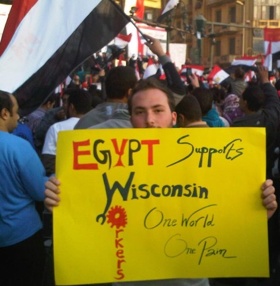
Local protesters were elated by the photo of an Egyptian engineer named Muhammad Saladin Nusair holding a sign in Tahrir Square saying “Egypt Supports Wisconsin Workers—One World, One Pain.” The signs by protesters in Madison include “Welcome to Wiscairo”, “From Egypt to Wisconsin: We Rise Up”, and “Government Walker: Our Mubarak.” The banner I brought directly from Tahrir Square saying “Solidarity with Egyptian Workers” has been hanging from the balcony of the Capitol alongside solidarity messages from around the country.

She quotes Muhammad Saladin Nusair who wrote these wonderful lines:

“If a human being doesn’t feel the pain of his fellow human beings, then everything we’ve created and established since the very beginning of existence is in great danger. We shouldn’t let borders and differences separate us. We were made different to complete each other, to integrate and live together. One world, one pain, one humanity, one hope.”

More texts:

John Postill: Egypt’s uprising: different media ensembles at different stages

Asef Bayat: Egypt, and the post-Islamist middle east: Why the portrayal of Egypt’s uprising in terms of its potential capture by Islamists is doubly misleading

Keith Hart: CLR James and the idea of an African revolution

Sami Hermez: Sacrifice and the Ripple Effect of Tunisian Self-immolation

Slavoj Žižek: For Egypt, this is the miracle of Tahrir Square

Gabriele Marranci: The Libyan massacre: or rather protesters killed for Italian and European interests?

SEE ALSO my first round up: “A wonderful development” – Anthropologists on the Egypt Uprising (updated 6.2.)

https://www.youtube.com/watch?v=CojujCER5Vw
Voice of Freedom / Sout Al Horeya by Amir Eid ft. Hany Adel

(post in progress) While the revolutions in Northern Africa and the Middle East are spreading and the Libyan people managed are trying to get rid of another dictator,…

Read more

Here they are: Open access anthropology books!

(LINKS UPDATED 22.4.2020)

More and more journals have gone open access, now it’s time for open access books!

OAPEN – Open Access Publishing in European Networks is an initiative in Open Access publishing for humanities and social sciences monographs. Several European university presses have joined the initiative that aims to improve the accessibility and dissemination of academic books. “The traditional book publishing model”, they state, “is no longer sustainable”.

OAPEN was launched last autumn at the Frankfurt Book Fair. Their first conference will be held at the end of this week in Berlin

Searching for anthropology gives 289 hits, among others these books. All books can be downloaded as pdf-files.

(Thanks, Marjut for the link!)

Meanwhile, Owen Wiltshire has published a draft of his thesis about making anthropology accessible online including a summary

SEE ALSO:

Democratic Publishing = Web + Paper

SSOAR – The first Social Science Open Access Repository is online

1st of May is Open Access Anthropology Day!

(updated) Danah Boyd on Open Access: “Boycott locked-down journals”

For Open Access: “The pay-for-content model has never been successful”

antropologi.info survey: Six anthropologists on Anthropology and Internet

Why Open Access?

(LINKS UPDATED 22.4.2020) More and more journals have gone open access, now it's time for open access books!

OAPEN - Open Access Publishing in European Networks is an initiative in Open Access publishing for humanities and social sciences monographs.…

Read more