search expand

Bienvenue à mon blog de Ménilmontant

-or maybe I should say Salaam Aleikum in appreciation of Ramadan, which began a few days ago.

Finally it seems like I’m getting the online diary from my east Paris fieldwork up and going. For the next six weeks I’m settled in an Art Déco building in the hill of Ménilmontant. (Fieldwork will continue for eight more months, from a flat in the neighbouring area Charonne, right on the other side of the famous cemetery Père Lachaise).

[teaserbreak]
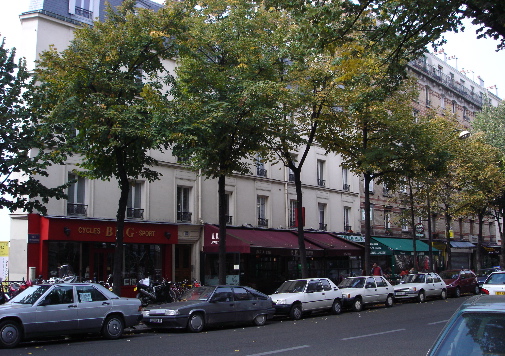
The part of the street where I live is quiet. Just across my Art Déco there is a small, well-ordered French park. Further up, there is an École Elémentaire – from where I can hear a really incredible noise in the breaks, coming from the small, walled off yard common for Parisian schools – and a lycée where the pupils speak the strangest of Parisian dialects (which I can’t imagine I’ll ever understand). I hear them in the local Alimentation Générale (cornershop) where they come to buy sweets and single cigarettes (and sometimes rizlas in the evening).

The alimentation has lovely Muscat grapes (I think it must be the season) and an all right selection of Algerian wine. The owner is North African, I would guess, and perhaps quite newly arrived? In the evening most customers I’ve seen, drop by to buy cans of beer or a bottle of wine. – An adolescent, who sometimes mind the shop in the evening, presumably for his father the owner, became a bit embarrassed when a quite drunk, but amicable white Frenchman tipped over my grocery bag and filled the shop with an odour of old wine when excusing himself.

Next to the alimentation there is a Bistrot Général serving meze, Greek yoghurt with honey, baklava, and other Greek specialities. The family running it are not Greek I think perhaps they are of Turkish origin. (I’m thinking of doing a lifestory/areastudy interview with the merchants of the street. I presume it will comprise most continents…). The newsagent and bike repairer further down seem fairly français du souche (“root/winestock French”) to me. Then there are a book-crossing café-restaurant with Spanish or most likely Argentinean inspiration, a tea and Narguile (water pipe) café, a couple of Senegalese or other west African internet and mobile phone shops, and a number of other cafés, restaurants and bistros which I haven’t got the hang on yet. In addition to a hairdresser, a plumber and other service providers. And believe it or not, this part of the street is short…

-or maybe I should say Salaam Aleikum in appreciation of Ramadan, which began a few days ago.

Finally it seems like I’m getting the online diary from my east Paris fieldwork up and going. For the next six weeks I’m settled…

Read more

Ausstellung “Projekt Migration”im Kölnischen Kunstverein

Ungewohnte Perspektiven auf das Thema Migration bietet die Ausstellung “Projekt Migration” im Kölnischen Kunstverein, an der auch Ethnologen der Universität Frankfurt mitgeschafft haben, schreibt die taz:

Wer das Bild einer multikulturellen Buntheit von dieser Ausstellung erwartet, wird überrascht sein, wie anders sie die Akzente setzt.

Ein Beispiel:

Aus dem Couchtisch in der Mitte ragen Hals, Kopf und Helm des letzten Kaisers des Deutschen Reiches, und mit ihm auf Augenhöhe sitzt ein Besucher und fotografiert. “Und was hat das mit Migration zu tun?”, fragen die meisten ungefähr zehn Sekunden nachdem sie durch die Tür getreten sind.

Das ist auf Seite 262 des kleinen Ausstellungsführers gut erklärt, aber wer den noch nicht hat, erhält Auskunft vor Ort: Erstens ist Kaiser Wilhelm II, Enkel von Queen Viktoria aus England, ein schönes Beispiel dafür, dass Migration in europäischen Adelshäusern üblich und politische Praxis war. Zweitens begann mit der Großindustrie in der Zeit von Wilhelm II eine Zuwanderungspolitik, die zwischen willkommenen und unwillkommenen Nationen unterschied. Drittens steht der Kaiser für die kurze Epoche deutscher Kolonialherrschaft. Auf diese Zusammenhänge kommt erst mal fast keiner. Geschichte aus der Perspektive von Migrationsbewegungen und nicht aus der Erzählung über Nationalstaaten wahrzunehmen ist eben noch immer eine ungewohnte Übung.

>> weiter in der taz

>> Besprechung der Ausstellung in der Welt am Sonntag

>> Webseite der Ausstellung “Projekt Migration”

Ungewohnte Perspektiven auf das Thema Migration bietet die Ausstellung "Projekt Migration" im Kölnischen Kunstverein, an der auch Ethnologen der Universität Frankfurt mitgeschafft haben, schreibt die taz:

Wer das Bild einer multikulturellen Buntheit von dieser Ausstellung erwartet, wird überrascht sein, wie anders…

Read more

“Aboriginal knowledge is science”

10 aboriginal and four non-aboriginal graduate students from the University of Victoria (British Columbia, Canada) are working with First Nations elders, community leaders and educators to identify science content elements of aboriginal knowledge and determine the most culturally appropriate and effective ways of teaching and learning science, according to University paper The Ring:

Using case studies, field studies, surveys, informal interviews and ethnography (such as elder circles, songs and traditional stories) the graduate students are investigating topics as wide-ranging as how elders transmit ecological knowledge and wisdom, how science is taught through traditional storytelling, and how to use digital video as a learning tool for retaining and transferring aboriginal knowledge.

“The big, central questions here are what is science, and is aboriginal knowledge science? We’re saying it is science, and that every culture has its own science. Right now, there’s a complete blank—traditional knowledge is not only devalued, for most teachers it doesn’t exist”, Gloria Snively, associate professor of science, environmental and marine education, says.

>> read the whole story

UPDATE. Comment by Kerim Friedman:

How can we keep creationism out of our science classrooms if we simultaneously embrace “aboriginal science”? The answer is we can’t.

(…)

It is true that many things aborigines know through their traditional forms of knowledge have, in fact, been proven to coincide with scientific knowledge as well. But some have not. This alone shows that traditional forms of knowledge can never be coterminous with science.

(…)

The solution to the relative status of traditional knowledge compared to science is not to simply label knowledge as “science.” It is to find ways create space within which it can find legitimate expression in our society and be accorded a status other than “superstition.” It is also to better educate people about scientific knowledge and its limits, so that all citizens can better distinguish between good and bad science.

>> read Kerim’s post and the discussion on Savage Minds

SEE ALSO:

Indigenous Peoples’ Day: New Universities for a Multicultural Mexico

New Research Study about Traditional Folk Knowledge related to Plants in Albania

Local taboos could save the seas

10 aboriginal and four non-aboriginal graduate students from the University of Victoria (British Columbia, Canada) are working with First Nations elders, community leaders and educators to identify science content elements of aboriginal knowledge and determine the most culturally appropriate and…

Read more

Tagging and Folksonomies: Xerox Scientists Apply Insights From Ethnography

An older story from last summer: In a (cryptic) press release, Xerox writes that they have used insights from ethnography in product development:

Employing the same ethnographic methods used to observe the social order on a Polynesian atoll or document the culture of natives in southern Siberia, Xerox Corporation (NYSE: XRX) scientists have injected more human know-how into text mining, the practice of using computer analysis of documents to extract new information. The result is better categorization, with higher-quality, customized results.

>> read the whole press release

In their article Tag it as you see it, Computerworld explains us (in a more understandable way), what Xerox actually has found out: They go for using tags for organizing content – as on flickr and del.icio.us:

The best systems allow a combination of predetermined categories with the ability for the end user to create new tags on the fly and organize them in a way that has meaning to the individual as well as to the organization. Recent research at Xerox Corp. shows how this approach can achieve bottom-line results

>> read the whole story: Tag as you like it

SEE ALSO
The practice of classification by tags is also called Folksonomy. See Wikipedia article on folksonomy and article by Kerim Friedman on How folksonomy websites can be used by anthropologists

An older story from last summer: In a (cryptic) press release, Xerox writes that they have used insights from ethnography in product development:

Employing the same ethnographic methods used to observe the social order on a Polynesian atoll or document the…

Read more

Bekymret over “muslimenes avsondring” – Paranoid antropolog kritiserer mangfoldsideologien

Den svenske sosialantropologen Aje Carlbom er bekymret over at “flere og flere muslimener trekker seg tilbake i ghettoer, avsondret fra de etniske svensker”. Han siterer sosiolog Olivier Roy som påpeker at islam i Europa er i en “etnifieringsprosess”:

Vissa entreprenörer bortser från alla skillnader (till exempel kulturella, nationella, religiösa, språkliga, utbildningsmässiga och klassmässiga) mellan muslimer och försöker konstruera en homogen etnisk minoritet med en viss särpräge.

Å opprette egne enklaver i byer må også ses i denne sammenhengen, mener han:

Att muslimer drar sig undan i egna enklaver är ett europeiskt fenomen som inte helt och hållet kan reduceras till majoritetsbefolkningars islamofobiska eller rasistiska tänkande. Det handlar också om att många muslimer har andra uppfattningar om vad som är bra/dåligt och rätt/fel än infödda européer.

(…)

Många muslimska föräldrar, islamister och andra, är i regel djupt skeptiska till västvärlden; den uppfattas som moraliskt förvildad. I vardagslivet kommer detta till uttryck i olika åtgärder för att skydda barnen: man placerar dem i konfessionella skolor, i Koranskolor, man flyttar till segregerade områden och så vidare.

(…)

Islamiska skolor och moskéer ingår i ett större urbant sammanhang där det har etablerats olika typer av ”etniska” inrättningar för service och tjänster.

>> les hele saken i Axess 5/2005 (link oppdatert)

Det er blitt politisk korrekt å kritisere mangfoldsideologien. – Imamer forsøker å utnytte den, mener Carlbom og skaper frykt.

Det som kan kritiseres ved slike artikler er at de er altfor ensidige fordi de kun fokuserer på muslimene. Artikkelen hadde vært mye mer interessant hvis forfatteren hadde satt saken i et større perspektiv: Hvorfor nevner han ikke de konservative kristne i samme slengen? De har også sine egne skoler, aviser, kleskode etc? Hvorfor nevner han ikke de velstående som også bor avsondret i egne enklaver, sender barna på privatskoler etc? Hvor mye kontakt har en millionær med en uteligger? Hvor godt integrert er konsernsjefer? Carlbom tar utgangspunkt i et idealisert homogent svensk samfunn som kanskje aldri har eksistert.

Det Store Spørsmålet som trenger seg på er: Hvor mye samhold trenger egentlig et samfunn? Er avsondring nødvendigvis noe negativt?

En annen innvending: Det er ikke umulig å være både ghetto-beboer og integrert i majoritetssamfunnet samtidig. Ghettoen kan faktisk være en viktig ressurs for integreringen som antropologen Halleh Ghorashi har vist.

SE OGSÅ:

Snart bor alla i enklaver – anmeldelse av Carlboms bok “The Imagined Versus the Real Other” (Dagens Nyheter)

Ghetto som ressurs: Derfor lykkes iranerne bedre i USA

Hadia Tajik: Ghettoen i Bygde-Norge

Hvor mye samhold trenger et samfunn? Tyskland etter drapet på Van Gogh

Thomas Hylland Eriksen: De som virkelig kan trenge å bli integrert er Fremskrittspartifolk

Thomas Hylland Eriksen: Nyliberalismen og minoritetene

Den svenske sosialantropologen Aje Carlbom er bekymret over at "flere og flere muslimener trekker seg tilbake i ghettoer, avsondret fra de etniske svensker". Han siterer sosiolog Olivier Roy som påpeker at islam i Europa er i en "etnifieringsprosess":

Vissa…

Read more