
There are only few studies on popular music in South Asia. Tereza Kuldova (Tereza Kuldova) reviews for us the book Hindi Film Songs and the Cinema by ethnomusicologist Anna Morcom. Her review shows – among other things – the differences and barriers between anthropology and ethnomusicology.
—–
Review: Hindi Film Songs and the Cinema by Anna Morcom, 2007, Ashgate, ISBN 978-0-7546-5198-7
Tereza Kuldova, Research Fellow, Museum of Cultural History, Department of Ethnography University of Oslo
Popular music in South Asia equals film music, however, even though its popularity is immense, it has been a very little studied phenomenon. This is even more startling when we realize that film songs “have become the music of public spaces in India, being heard from open windows in peoples’ homes, on buses and in bazaars. They are sung and danced to by millions of people in a range of formal and informal contexts, and have been appropriated in many folk genres” (p. 5) and they are thus literally omnipresent. This book thus must get credit for the choice of its subject matter, in the first place.
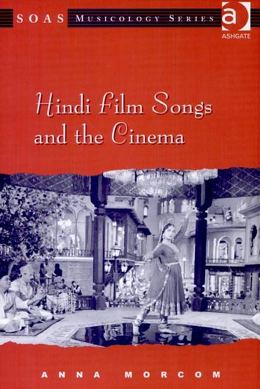
This book deals with the relationship between Hindi film songs and Hindi films and analyzes them in their cinematic, narrative and visual contexts. The ongoing agenda of the book seems to be to persuade us that the Hindi film song cannot be separated from the Hindi film, which is however a rather obvious fact to any viewer of Hindi film. The only thing I have to say to this is – there is a reason why it is called a film song and ergo, how could the song ever be truly independent or separated from its film context?
Another concern of the book is the definition of the Hindi film song genre as an independent style. Anyone following the Hindi cinema knows that Hindi film songs are extremely creative and varied, drawing on great diversity of inspiration and adjusting it to the particular needs of concrete scenes, and it thus might not be that easy to define them in terms of any style. Moreover, I wonder, do we really have to categorize these songs in terms of any style? What do we gain by that? Well, the answer may be that we gain statements such as follows:
“Amongst an array of inconsistent or over-general stylistic parameters, the only true constant in Hindi film songs is their ‘inclusion in a Hindi film’” (p. 70).
That was not a very surprising fact, was it? The intense argumentation for the analysis of Hindi film songs in relation to the cinematic context, however commonsense, obvious and at times felt as redundant and repetitive is certainly not so obvious within musicology. Because as Morcom argues ”the cinematic perspective of Hindi film songs has been ignored, with musicological studies largely viewing them as separate entities from their parent films” (p.7). So possibly Morcom might get credit for introducing a notion that is rather and straightforward to any consumer of Hindi film songs to the musicological studies.
The conclusion of the books are thus following:
“Far from being an independent tradition of popular songs, this book has found film songs to be profoundly integrated with Hindi films on many levels. Film songs are conceived as part of a particular film, and the musical style of each song is tailored to the parent film and the song scene.
In commercial terms, although film songs have become a big business since the late 1980s, their profitability is only exploitable in association with the Hindi cinema. Even after their release, the consumption of film songs is largely tied up with the Hindi cinema generally, and to some extent, with the parent film in particular.
However, songs are distinct from their cinematic roles and contexts in certain ways, although the degree of this independence varies with each song. As well as tailoring a song musically to a situation, its ability to sound good as a separate entity, its ‘audio value’, is also considered during its production. At the level of reception, audiences are able to appropriate songs and adapt them to new situations, which in some cases may result in the relationship with the parent film and cinema culture in general becoming obscure, or even disappearing entirely. Hindi films have a narrative style and structure that is designed for songs, and similarly, film songs are able to fit around cinematic scenes (p. 239).”
Now that we have begun paradoxically with the conclusion, let us get through the book chapter for chapter.
In the first chapter (available online here), we are presented with the argument for the study of the Hindi film songs through a multimedia model of analysis, which takes into account the context of the film songs in their parent films, their narrative and visuals as well as their production process. However, there is no attempt to frame this whole analysis in the context of Indian society or its changing historical realities (even though the book discusses the different periods in the evolution of the Indian cinema).
We also get to know that the work draws extensively on fieldwork in India, from 1998-2000 and read that the “fieldwork was ethnographically based” and “aimed to study film music through observing, fitting in with and joining in with its own people and culture” (p. 20). However, when we proceed to the second chapter which is concerned with the production of the Hindi film songs, and which is supposed to draw almost exclusively on fieldwork, what is presented to us are mostly excessive and in terms of content repetitive selections from interview transcripts with producers, music directors, lyricists and others. We do not get to know much about the ethnographic reality as such and any ‘ethnographic’ description in the true sense of the word is missing, except for the practical aspects of the production process, in which the roles of the director, producer, music director, lyricist and others are assessed.
The point of the chapter is again to show that lyrics and music is closely related to what is happening in the film and that it is used to express various emotional states, actions or drama in the scenes.
Let us move on to the third chapter which tries to answer the question of “why are film songs so difficult to categorize in terms of style?” (p. 134). This is clearly a question in musicology, it does not make much sense to the anthropologist writing this review.
The conclusion of this chapter is again not very surprising:
“Film songs seen in one way seem very formulaic and standardized, but seen in another way, they are very eccentric and unpredictable. Film song is required to have a regular enough style and enough musical autonomy to work as popular music, to make sense without the film, and even to advertise film, but at the same time to be specific and idiosyncratic enough to fit around a particular given situation. (…) Film songs need to be seen as multi-media, musico-dramatic entities as well as popular songs in order to make sense of both individual songs and the development of the genre as a whole” (p. 135-6).
For me this last statement equals saying: Hindi film songs need to be seen as what they are.
In the fourth chapter, Morcom addresses the question of the relation between Western music and Hindi films and the role of narrative in Hindi film music style. Supposedly the most striking feature of Hindi film music, as I perceive it (being interested in it intensely in relation to my research and being also its keen consumer), is its eclecticism, namely its ability to borrow and combine different styles and traditions in just one song, and that is what makes it so much fun – and also what makes it possibly so confusing for a musicologist, trying to make sense of it. Morcom poses such questions as “how is this Hollywood music able to communicate apparently successfully to the Indian audience? European and American culture has little to do with Indian music” (p.147) or how is it possible that “various types of non-indigenous music may be conveying narrative meaning to indigenous audiences” (p.157).
She considers “the amount of overlap in musical meaning in Hindi and Hollywood films surprising. Ethnomusicology tends to emphasize the aspects of music that are culture specific” (p. 156). Well, maybe ethnomusicology should consider the option that cultures do not exist in isolation and Morcom should consider India’s colonial history, not to mention its history of thousands of years of cultural contact and exchanges. When what is considered a traditional Muslim floral decorative motif (which can be seen for example on the walls of the Taj) comes originally from the European herbaria, I tend not to really wonder why the ‘indigenous’ population can identify with Western musical elements in Hindi film songs.
However, Morcom hits on something interesting when she says that “the direct relationship of many musical signs with feeling, experience and somatic states may be one reason why music has greater potential for mutual understanding than language, whose signs are more highly mediated” (p.157). Sadly, she does not really elaborate on this any further. She concludes saying that:
“(M)any of the ‘Hollywood’ techniques most commonly found in Hindi films conveniently constitute an antithesis of rāg and classical melody, and also of film and folk melody, which are associated to a greater or lesser degree with the sacred, love, romance and celebration. They can therefore be used as powerful means to express distortion, destruction and disturbance of these qualities in a range of dramatic situations (p.178).”
However, they can also be used to express many other different things.
In the fifth chapter, Morcom explores the commercial life of Hindi film songs, in relation to Hindi film, in the context of buying, selling, and marketing. She investigates the technologies of distribution, marketing and profitability of film songs from the first few years of sound film to 2000. This chapter is based on fieldwork; however, that again stands for interviews with people in the industry. The chapter discusses the influence of gramophone, radio, cassettes, dvd, vhs, vcd etc. on the commercial potential of Hindi songs.
Again Morcom struggles with the distinction between marketing Hindi film songs and Hindi films, and we can again and again read sentences such as:
“The marketing of film songs and films are ultimately difficult to distinguish. Trailers using the film songs and visuals from the films are produced by the music company to promote the music, and the music, as it gains ground in the popular culture, promotes the film” (p.195).
Even though this book was published in 2007 it does not really take into account the importance of internet and though she discusses the importance of television and various live shows, it appears to me, that she does not really capture the extent of the industry. Moreover, nowadays there are numerous ‘making of the song/film’ videos available all over the internet, as well as numerous TV-shows featuring the stars, directors, singers, music directors etc. discussing the production and marketing process and many other things. This all is the promotion of the songs. However, though she notes that “these shows add another layer of importance to film songs, but are still parasitic on the cinema” (p.220), she does not really consider them in the analysis any depth.
In the last chapter, Morcom deals with the audience reception of Hindi films and with the life of the film song after its release. She again wonders if the songs are “able to become independent of the context of the parent film or of ‘film culture’ in general” (p.208). She analyzes different charts from several websites, concluding:
“(I)ndividual songs have, to some extent, a life of their own in terms of popularity and may become popular even if the parent film is a flop. However, when it is taken into account that only a minority of films are hits, the songs from hit films can be seen to further dominate the chart” (p.211).
When it comes to appropriation of film songs by the audiences, again a part of the text which is based on fieldwork, we get to know very briefly that people appropriate songs by
- singing them,
- playing them and singing at various occasions such as weddings, Holi, romancing or using them as devotional songs in the temple,
- identifying with them across disparate communities in South Asia and the Diaspora as they refer to shared experience
- performing them (from amateurs to professionals).
The conclusion she thus draws is that audiences actively appropriate these songs. However, what is striking when we realize that most of the Hindi film songs are dance songs is the lack of consideration of dance as a form of appropriation. As well as the lack of serious consideration of the movements and gestures in relation to the narrative, lyrics and music as a mode of expression. The embodiment of music and sound is definitely a way of appropriation of music that needs to be considered in any such analysis, and even more so in the analysis of Hindi film songs that rely visually to an extreme degree on bodily movements, gestures and dance scenes.
Reading this book as an anthropologist gave me an insight into on which premises ethnomusicology is established and it certainly thought me to be more sensitive to the various ways in which sound conveys meaning, which is possible the biggest lesson of the book – to give a thought to the various sounds and their interplay with the visual (however I would also include the somatic, emotional and embodied practices) and their ways to express, convey and reproduce meaning. At the same time, I feel that ethnomusicology, as I experienced it though this book, would profit from a more thorough study of anthropology, to get a more nuanced perspective and become more sensitive to the context.
Tereza Kuldova
>> more information by the publisher (Ashgate)
MORE REVIEWS BY TEREZA KULDOVA:
How Indissoluble is Hindu Marriage?
Photography, Anthropology and History (Part I)
Presenting 2nd generation Multi-Sited Ethnography
How the Ganges boatmen resist upper-caste and state domination
How neoliberalism reshapes motherhood in Calcutta
SEE ALSO:
Anthropologist explores heavy metal in Asia, South America and the Middle East
“Pop culture is a powerful tool to promote national integration”
The emerging research field of medical ethnomusicology: How music fights AIDS