search expand

Open access: Journal of Identity and Migration Studies

logo

Xenophobia in South Africa, labour mobility and economic development, minorities’ integration, representation of refugees and forced migrants in the British Economy are some of the topics in the most recent issue of Journal of Identity and Migration Studies.

The journal was founded a bit more than a year ago by The Research Centre for Identity and Migration Issues (RCIMI) at the University of Oradea in Romania. It was recently added to the Directory of Open Acces Journals.

It is an interdisciplinary journal on one of the most popular topics for anthropologists. So far, no anthropologists have contributed to it, though.

>> visit the journal’s website

logo

Xenophobia in South Africa, labour mobility and economic development, minorities’ integration, representation of refugees and forced migrants in the British Economy are some of the topics in the most recent issue of Journal of Identity and Migration Studies.

The journal was…

Read more

Headhunting as expression of indigenousness

logo

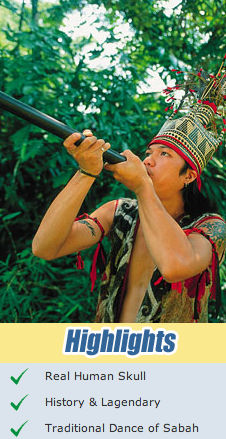
Anthropologists often criticize mainstream media for exoticizing people. But in Borneo you’ll find indigenous people who promote themselves as headhunters and are proud of it.

headhunter-ad

The journal Cultural Analysis has recently received a prize in the Savage Minds awards. It was voted as the second best Open Access anthropology journal. In the recent issue, folklorist Flory Ann Mansor Gingging writes about headhunting as an expression of indigenousness.

Headhunting is no longer practiced but the tradition has been commercialised by the tourist industry many places in South East Asia. But the headhunting past has not only taken on a commercial value, but also a cultural and political one, Flory Ann Mansor Gingging argues:

I propose that the tongue-in-cheek invocation of headhunting by the tourism industry represents one way in which Sabah‘s indigenous people counter the outside world’s designation of them as the Other; that is, by parodying their headhunting past, they demonstrate their understanding of the joke and thus guard their indigenousness and their status as human beings.
(…)
Marginalized groups in Sabah, many of whom share a headhunting past, have re- written the headhunting narrative in their favor, becoming co-authors of a cause that seeks, in Hoskins’ words, “to seize an emblem of power, to terrify one’s opponents, and to transfer life from one group to another” (Hoskins 1996a, 38). Thus re-imagined, the headhunting narrative emerges as a tool useful in working towards change and equality.
(…)
Observed in cadence with past and present political milieus, the “refashioning” of the headhunting narrative within tourism in Sabah hence seems to reflect a general consensus among certain of Sabah’s native groups: that Otherness, strategically invoked and appropriated, provides them with an instrument for addressing external threats to their identities.

The anthropologist folklorist and doctoral student in the Department of Folklore and Ethnomusicology at Indiana University grew up in the village she writes about. One of her friends, herself an indigenous Sabahan, said the headhunting imagery and narrative in tourism promotion is “embarrassing but cool”:

“It’s beyond comprehension that I have ancestors that might have been headhunters. At the same time freakish ancestors totally distinguish you from the rest of the global population, so it’s secretly thrilling as well. I love seeing the slightly raised eyebrows reaction I get when I tell someone new I’m from Borneo.”

The researcher heard lots of stories about headhunters during her childhood. As she grew older, her relations to these stories changed:

As I got older, I began to be aware of the economic and political struggles that indigenous people in my state face. Since becoming part of Malaysia in 1963, Sabah, a former British colony, had never had a chief minister who was both indigenous and non-Muslim. Consequently, when in 1984, Joseph Pairin Kitingan, a Dusun lawyer, became the first non-Muslim native to assume this position, being indigenous suddenly meant something to me.

It was also around the same time that I remember feeling a new attraction to the macabre and exotic elements of my culture—one of them being headhunting. Without quite knowing it, I was invoking those aspects of my culture that were potentially embarrassing as a way of responding to the threat I felt towards my own Dusun-ness. For me, headhunting ceased being just a part of history and became, in the most personal way, a part of my heritage—an expression of my indigenousness.

In my opinion, making headhunting such a visible icon of tourism in Sabah is an example of what Michael Herzfeld calls “cultural intimacy,” which he describes as “the recognition of those aspects of a cultural identity that are considered as a source of external embarrassment but that nevertheless provide insiders with the assurance of common sociality” (Herzfeld 1997, 3).

A good example for this trend is the Monsopiad Cultural Village. Here, she writes, Herzfeld’s “cultural intimacy is performed”. Although it is by no means the first to use the state’s headhunting histories within the context of tourism, she believes the Village is the only tourist site that has developed an entire park around the headhunting theme.

On the village’s website they write:

Monsopiad Cultural Village, the traditional village is a historical site in the heartland of the Kadazandusun people and it is the only cultural village in Sabah built to commemorates the life and time of the legendary Kadazan and head-hunter warrior: Monsopiad. The direct descendants of Monsopiad, his 6th and 7th generations have built the village on the very land where Monsopiad lived and roamed some three centuries ago to remember their forefather, and to give you an extraordinary insight into their ancient and rich culture.

Read the whole article:

>> Flory Ann Mansor Gingging: “I Lost My Head in Borneo”: Tourism and the Refashioning of the Headhunting Narrative in Sabah, Malaysia

SEE ALSO:

Ainu in Japan: Cool to be indigenous

In Norwegian TV: Indian tribe paid to go naked to appear more primitive

“They still eat their fellow tribesmen”

Anthropology and tourism: Conference papers are online

logo

Anthropologists often criticize mainstream media for exoticizing people. But in Borneo you'll find indigenous people who promote themselves as headhunters and are proud of it.

The journal Cultural Analysis has recently received a prize in the Savage Minds awards. It…

Read more

The anthropology of children, war and violence

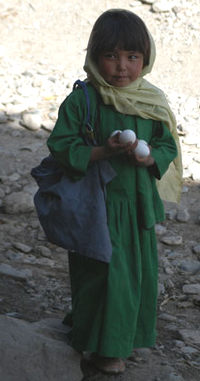
Baktay trying to sell eggs so that she can buy a notebook

What impact has war on children? What has anthropology to say on this? This autumn I watched the movie “Buddha collapsed out of shame” by the Iranian film maker Hana Makhmalbaf. It tells the story of children who reproduce the violence of the adults. For me, it was the most impressive movie of the film festival Films from the South (Film fra Sør) in Oslo. Makhmalbaf won the Silver Mirror, Films from the South’s main award.

– This is no funny movie. I hope you’ll feel the pain and the suffering, said the 19 year old director before the screening in Oslo.

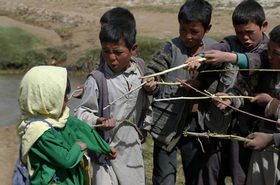
Five year old Baktay dreams of going to school. But her family is poor. When Baktay finally managed to sell the eggs of the family’s chicken and was able to buy a notebook, she gets attacked by boys who play war where they are the Taliban. The boys rip pages from her book, put a paper bag on her head, thread to stone her and to bury her alive. For girls aren’t allowed to go to school, and they must not show their hair.

In an interview on her own homepage, Hana Makhmalbaf says:

By showing today’s picture of Afghanistan, I tried to depict the effects of the recent years’ violence on the country. So that the adults could see how their behavior affects the younger generation.
(…)
First, it was the Russian communists, then the Taliban showed up, and now the Americans. One was communist, the other Muslim and the last one either atheist or Christian. But they all had one thing common, and that was “Violence”. And this violence has been injected over and over from three different groups into the culture of the people in this country so strongly that you can see it in their children’s play.

"Taliban" boys attack Baktay

“Buddha collapsed out of shame” was reviewed (among others) by The Hollywood Reporter, The Guardian, The Epoch Times and Avuncular American. There are some video clips online as well

The movie reminded me of the thesis by anthropologist Elisabet Eikås about young people trying to rebuilt Afghanistan. Their activism is a continuous struggle with the structures of the society that they tend to reproduce.

In Children, War and Nation: Croatia 1991-4, anthropologist Maja Povrzanovic also writes about how children reproduce the adults’ behavior (in this case the Balkan war) in their daily life:

In winter 1991-2, my son Martin, who was two-and-a-half then, constantly built, ruined, rebuilt and ruined again his Duplo-buildings in a very aggressive way, claiming he was ‘playing Vukovar’. (…) In autumn 1993, in my son’s very first minute at kindergarten, a boy approached him with a toy airplane, making noise and boasting: ‘I am shooting the Serbs!’ On christmas Eve 1993, Martin wanted to decorate our Christmas tree with his toy guns (p84/85).

But it seems that children, violence and war is an underresearched topic.

“Descriptive work on children experience violence, in general, is better developed than theoretical frameworks are to explain the causes or consequences of such violence”, Jill E. Korbin writes in her article “Children, Childhoods, and Violence” in the Annual Review of Anthropology 2003.

She notes that for a long time, children’s own voices and perspectives have been largely absent from the anthropological literature on childhood and violence.

Also in a more recent paper, anthropologist Jason Hart and Bex Tyrer remark that there is a lack of anthropological studies on children and war:

To date, the majority of research on children and war has come from the fields of medicine, psychiatry and psychology. This has included a heavy emphasis on “trauma” and pathology, with a more general body of literature exploring the individual’s physical, emotional and psychological nature of suffering.

Although these issues are obviously very significant, the wider societal dimensions of conflict – namely how war pervades institutions, political structures, culture, economy and communication systems – have been overlooked.

They quote Jo Boyden and Jo de Berry who write:

[War] does not just cause psychosocial and emotional harm, but also attacks the most fundamental conditions of sociality, endangering social allegiances and confidence, and drastically reducing social interaction and trust.

The researchers call for childrens’ participation in the research process:

The involvement of children directly in research activities represents an important move away from traditional approaches, according to which children are solely the objects of enquiry. A growing number of advocates now argue that children’s active participation in research is both a means to improve the quality and relevance of the data and make children themselves more visible within a particular community or within the broader society.

Such participation can also improve a child’s ability to communicate her/his views and acquire new knowledge. In this way participatory research can contribute to children’s empowerment.

Both Hart, Tyrer and Korbin stress that children do not only reproduce what they see and experience. They are not necessarily victims but they are active agents as well. Children’s involvement in political-military action (children as soldiers etc) are not solely the result of compulsion, coercion, and brainwashing. Hart and Tyrer write:

Few authors have shown willingness to consider the possibility that, in some situations, young people may engage with military groups as a reasoned strategy – as the most desirable option within the range of choices available. They may also enrol out of social and political concern.

They conclude:

Without denying the existence of trauma and without refuting the idea that the young may be victimised, we should learn more about the strategies children employ to deal with their adverse circumstances and maintain material, psychological, emotional and physical wellbeing.

While most literature that I’ve found is not accessibe for the public, their paper Research with Children Living in Situations of Armed Conflict: Concepts, Ethics & Methods is freely available. It is one of the Refugee Studies Centre Working Papers

SEE ALSO:

Thesis: The limits of youth activism in Afghanistan

“We want children to be their own ethnographers”

Transforming the Anthropology of Childhood – Anthropology News April

Play as research method – new Anthropology Matters

Conflict Resolution and Anthropology: Why more scholarship on violence than on peace?

Baktay trying to sell eggs so that she can buy a notebook

What impact has war on children? What has anthropology to say on this? This autumn I watched the movie "Buddha collapsed out of shame" by the Iranian film maker Hana Makhmalbaf. It tells the story of children who reproduce the…

Read more

Open access to all doctoral dissertations at Temple University

(via Open Access News) Temple University has decided to provide open access to all its doctoral dissertations, starting with those completed August 2008 as Steven Bell, Associate University Librarian announced only a few days ago.

You can browse and search the archive on the Temple University Electronic Dissertations website. A quick search revealed that there are already two anthropology dissertations available:

Carolyn P. Merritt (2008): Locating the Tango: Place and the Nuevo Social Dance Community [link removed upon request by author]

Jay F. Gabriel (2008): Objectivity and Autonomy in the Newsroom: A Field Approach

Bell explains:

Many other leading research universities have created similar “open-access” electronic dissertation repositories and have found that cutting-edge doctoral research is more frequently read and cited as a result of making dissertations globally available in an open-access repository. For example, the University of Nebraska-Lincoln recently reported their open-access dissertations are downloaded sixty times more frequently than are restricted versions offered through the institutional subscription to Digital Dissertations.

He writes that the Libraries will no longer add paper copies of Temple dissertations to the Library stacks nor will it collect dissertations on microfilm.

>> see the official announcement by Temple University

“I hope that all universities will consider an Open Access mandate for electronic theses and dissertations”, comments Peter Suber from Open Access News. Furthermore, Temple should consider an Open Access mandate for peer-reviewed journal articles by faculty, for example, like the Harvard policy.

SEE ALSO:

Anthopology and open access to scholarship. New alliances threaten the American Anthropological Association

2006 – The Year of Open Access Anthropology?

ScientificCommons.org – The Open Access Search Engine

essays.se: Open access to Swedish university papers

A year ago, I wrote Already lots of publications in the open access anthropology repository Mana’o but it seems that the project is dead as the website has been down for several weeks now.

(via Open Access News) Temple University has decided to provide open access to all its doctoral dissertations, starting with those completed August 2008 as Steven Bell, Associate University Librarian announced only a few days ago.

You can browse and search…

Read more

New Anthropology Matters out: Practicing anthropology “out of the corner of one’s eye”

Why do people wear and produce fake underwear, fake suits and fake jeans? In the new issue of Anthropology Matters, anthropologist Magdalena Craciun tells us in a well written paper about what it was like researching “the place of fake brands in lives lived in the margins of Europe”.

She has been on fieldwork in Bucharest, Istabul and in her hometown in Romania – and this was no easy undertaking. “I hope that the paper contributes to the collective effort of sharing field experiences for the benefit of other anthropologists”, she writes.

When an anthropologist studies people who wear fake clothes, Magdalena Craciun writes, she is suspected of secretly laughing at and condemning people, practices and objects. Angry reactions persisted as part of the field routine:

“You want to study how we dress in cheap clothes”; “you want to write about how we dress in turcisme [goods made in Turkey] and chinezisme [goods made in China] from Europa”; “we cannot afford good expensive clothes, like the branded ones, and you take us for people who lack taste in clothing”; “I am trying to weave an image, you come to point out the cracks and remind me of the fluff!”

It was no advantage being from the same place as her informants:

Our shared background made people less tolerant of my curiosity about things they thought I should already understand or experiences I should already have had. The presumption was that I was pretending to be an observer when in fact I was a participant, having a vested interest in trivia, and that I would go on to expose and misuse the information (Bakalaki 1997).

In the “Europa” market in Bucharest, she was also rejected as a researcher:

People working in this quasi-illegal place often had hostile attitudes towards me (journalists reported similar reactions). The few friendly traders pointed out that complicity in illegal activities “place us all in the same pot”, and being seen talking with me could be risky for them.

Then she changed her research strategy and started “practicing anthropology out of the corner of her eye”:

I pieced together various impressions, e.g. different ways of exploring the market, visitors’ clothing, ways of selecting the goods, retorts, exclamations of delight or disappointment, until I felt I saturated in this experience.
(…)
I was not looking at things from above or “nowhere”, as detachment implies, but from one side, discreetly. Instead of immersing myself into social worlds, I found myself hanging around, being here and there, grasping knowledge as it appeared, but also provoking its appearance in glimpses.

In Istanbul, I was told that the act of faking a brand is like a “spark” (kivilcim gibi). This is a pertinent image, suggesting the ephemeral, the intangible, the transient that was so central to my fieldwork (fakes are fakes only in the eyes of certain people, fakes are present only for some people, fakes happen and die out). Practicing anthropology out of the corner of one’s eye allows one to catch some of the sparks.

>> read the whole article in Anthropology Matters

>> overview over all articles in the new issue

SEE ALSO:

“Study how and why people wear denim around the world!”

Kosher cell phones, kosher bus routes and kosher clothing: Israel’s Ultra-Orthodox economy

Why do people wear and produce fake underwear, fake suits and fake jeans? In the new issue of Anthropology Matters, anthropologist Magdalena Craciun tells us in a well written paper about what it was like researching "the place of fake…

Read more