search expand

Conflict Resolution and Anthropology: Why more scholarship on violence than on peace?

Is it because the academe rewards critique rather than advocacy? Conflict resolution studies, Mark Davidheiser and Inga E Treitler write in Anthropology News September, are “not widely acknowledged within our discipline” and are “rarely published in mainstream anthropological journals”.

Is it because these studies are often written to be intelligible to a broad audience, they wonder:

Addressing an interdisciplinary readership makes it impractical to philosophize on the finer points of specialized topics like agency and employ the latest anthropological jargon. A prominent case in point is the bestselling Getting to Yes, coauthored by anthropologist William Ury. Getting To Yes did not foreground anthropological themes, and while it has been read by many public health practitioners and management professionals, it has received scant attention within anthropology.

One may justifiably wonder why anthropology has not engaged conflict resolution in a more sustained manner. As Leslie Sponsel and Thomas Gregor emphasize in The Anthropology of Peace and Nonviolence, there has been much more scholarship on violence than on peace. The fact that their book has long been out of print only underlines their point.

>> read the whole article “Conflict Resolution and Anthropology: An Analytic Introduction and a Call for Interdisciplinary Engagement” (link updated)

In his historical overview of anthropology and Conflict Resolution, Kevin Avruch writes that most of anthropologists’s early involvement was dedicated to the problem of getting the field to take the idea of culture seriously. They faced two main hurdles. First, the political scientists and international relations folk took power to be the only “variable” that counted. Second, the psychologists assumed that given the biogenetic unity of the human brain, we must all think and reason in the same way, and so, say, decision-making (as in negotiation) must look the same everywhere.

>> read the whole article: A Historical Overview of Anthropology and Conflict Resolution (link updated)

Günther Schlee stresses that an important finding of anthropological research is related to causes of conflicts:

Ethnicity is not the cause of so-called ethnic conflicts. The corresponding thesis about religion is that religion is not the cause of religious conflicts. We continue to talk about ethnic or religious conflicts, because there is much about such conflicts that is indeed ethnic or religious—just not their causes. Frequently, ethnic or religious polarization only starts to emerge in the course of a conflict, and that is certainly the wrong time to be looking for a cause.

>> read the whole article “The Halle Approach to Integration and Conflict” (link updated)

As Mark Davidheiser and Inga E Treitler writes, there are anthropologists who argue that conflict resolution can be seen as an ideology that subverts access to “justice”. One of them is Laura Nader.

In her article in Anthropology News, she writes:

Conflict, adversarialness, dissent, confrontativeness are tools used in asymmetrical situations to right a real or perceived wrong—the collision of force with opposing force. In the absence of such opposing force there is acquiescence, subordination, passivity, apathy—features associated with Brave New World or 1984 societies.
(…)
Looking back on our study of consumer justice makes me realize that conflict, confrontativeness, adversarial law would have produced much more benefit for our society than the harmony and reconciliation industry, in terms of improved products, citizen participation (rather than apathy), and an investment in our judicial system appropriate to a country that espouses democratic rule.
(…)
The search for justice is both fundamental and universal in human culture and society. Thus, as long as there is power asymmetry one can expect conflict.

>> read the whole text “What’s Good About Conflict?” (link updated)

Leslie E. Sponsel is one of several anthropologists who contribute to the website Peaceful Societies. Alternatives to Violence and War

SEE ALSO:

Applied anthropology – A wedding ceremony in support of peace in West Timor

Book review: An Anthropological Challenge to Assumptions about War and Violence

Mahmood Mamdani: “Peace cannot be built on humanitarian intervention”

Challenges of Providing Anthropological Expertise: On the conflict in Sudan

Anthropologists on the Israel-Lebanon conflict

Anthropology in a Time of Crisis. A Note from Nepal

Cameroon: “Ethnic conflicts are social conflicts”

Do anthropologists have anything relevant to say about human rights?

Is it because the academe rewards critique rather than advocacy? Conflict resolution studies, Mark Davidheiser and Inga E Treitler write in Anthropology News September, are "not widely acknowledged within our discipline" and are "rarely published in mainstream anthropological journals".

Is…

Read more

Sexual anthropologist explains how technology changes dating, love and relationships

homepage front page

Bella Ellwood-Clayton is sexual anthropologist. As we read in the Washington Post, Bella Ellwood-Clayton has studied texting and dating in the Philippines. On her website you can download the texts Desire and loathing in the cyber Philippines and Unfailthful: Enchantment and disenchantment through mobile use, some of her weekly sex and relationship columns and some poems and short stories.

You can even watch some videos and follow her on her fieldwork in Sumatra, researching beauty as a cultural notion.

>> visit her website

SEE ALSO:

E-mail has become the new snail mail – Text Messaging on Rise

Instant Messaging – Studying A New Form of Communication

Why cellular life in Japan is so different – Interview with anthropologist Mizuko Ito

homepage front page

Bella Ellwood-Clayton is sexual anthropologist. As we read in the Washington Post, Bella Ellwood-Clayton has studied texting and dating in the Philippines. On her website you can download the texts Desire and loathing in the cyber Philippines and…

Read more

People, Place and Policy – New Open Access Journal

(via Intute Social Science Blog) Homeless women, gated commnities, active citizenship and the post-industrial labour market: That’s what the papers in the first issue of the new open access journal People, Place and Policy are about:

People, Place and Policy provides a forum for debate about the situations and experiences of people and places struggling to negotiate a satisfactory accommodation with the various opportunities, constraints and risks within contemporary society.

(…)

PPP is founded on the belief that academic research has a critical role to play in the creation and assessment of policies. This is not to criticise social scientists who shy away from involvement in the messy business of policy, but to celebrate the contribution of critical and questioning applied social research to both academic knowledge and thought, and the interpretation, understanding and responsiveness of policy to contemporary social challenges.

(…)

The editorial home of the journal is the Centre for Regional Economic and Social Research at Sheffield Hallam University.

>> Homepage of the journal

SEE ALSO:

Free access to Anthropologica 2002 – 2005

For Open Access: “The pay-for-content model has never been successful”

Omertaa – Open access journal for Applied Anthropology

2006 – The Year of Open Access Anthropology?

(via Intute Social Science Blog) Homeless women, gated commnities, active citizenship and the post-industrial labour market: That's what the papers in the first issue of the new open access journal People, Place and Policy are about:

People, Place and Policy…

Read more

Anthropology and CIA: “We need more awareness of the political nature and uses of our work”

In the newest issue of Anthropology Today (to be published in October), David Price continues discussing how CIA and similar agencies “covertly set our research agendas and selectively harvest the resulting research” and writes that “sometimes we may need to follow Delmos Jones’ Vietnam War-era example of withholding materials from publication when there is a risk of abuse by military and intelligence agencies:

Given the abuse of power we have already witnessed and the uncertain future we face in relation to the security state that perpetrated this, how far should we permit our professional involvement to go in this matter? We need more awareness of the political nature and uses of our work. As long as we publish in the public arena, anyone can use our findings for ends we may not approve. But we also analyse and advocate on the basis of data we collect, and have a degree of control over our own interpretations. Though secrecy may limit our knowledge of how our research is deployed by the security state, we must continue to expose and publicize known instances of abuse or neglect of our work.

Price’s text “Buying a piece of anthropology. The CIA and our tortured past” is the second part of a two-part article examining how research on stress under Human Ecology Fund sponsorship found its way into the CIA’s Kubark interrogation manual. Abuse of detainees at Guantánamo Bay, in Afghanistan and Iraq, and in the CIA’s network of secret ‘rendition’ prisons involves tweaking techniques described in Kubark:

As I have argued here, new information has become available that shows how anthropological knowledge has been applied to devising coercive interrogation techniques in the past. Also, we now know that Tony Lagouranis, who joined Abu Ghraib as an interrogator after the torture scandal broke, has described how Patai’s The Arab mind was abused by military personnel attempting to help interrogators dehumanize Arab enemies (Lagouranis and Mikaelian 2007). We must take this backdrop to the involvement of our discipline into account if we are not to become complicit.

(…)

Those who lead calls for social scientists to design improved interrogation methods (see ISB, Gross 2007) claim to do so in order to move away from torture towards a more humane interrogation, but they fail to acknowledge the irony that those they hail as pioneers of scientific interrogation were key CIA MK-Ultra-funded scientists who unethically commissioned and mined research for this purpose (Shane 2007). As a discipline we cannot afford to condone torture; were we to allow our work to be used for such ends we should become ‘specialists without spirit, sensualists without hearts’ (Weber 1904: 182).

Among other things, Kubark discussed the importance of interrogators learning to read the body language of interrogation subjects. The HEF funded the research by anthropologist Edward Hall on this issue, David Price writes. Several pages of Kubark describe how to read subject’s body language with tips such as:

It is also helpful to watch the subject’s mouth, which is as a rule much more revealing than his eyes. Gestures and postures also tell a story. If a subject normally gesticulates broadly at times and is at other times physically relaxed but at some point sits stiffly motionless, his posture is likely to be the physical image of his mental tension. The interrogator should make a mental note of the topic that caused such a reaction. (CIA 1963b: 55)

In 1977, after public revelations of the CIA’s role in directing HEF research projects, Edward Hall discussed his unwitting receipt of CIA funds through the HEF to support his writing of The hidden dimension (Hall 1966):

Hall conceded that his studies of body language would have been useful for the CIA’s goals, ‘because the whole thing is designed to begin to teach people to understand, to read other people’s behavior. What little I know about the [CIA], I wouldn’t want to have much to do with it’ (Greenfield 1977: 11).10 But Hall’s work, like that of others, entered Human Ecology’s knowledge base, which was selectively drawn upon for Kubark.

However, it does not take CIA funding for anthropologists to produce research consumed by military and intelligence agencies, Price stresses:

During the 1993 American military actions in Somalia I read a news article mentioning an ethnographic map issued by the CIA to Army Rangers. Because of my interest in ethnographic mapping, I wrote to the CIA’s cartographic section requesting a copy of this map. A CIA staff member responded to my query, informing me that no such map was available to the public. This CIA employee also politely acknowledged that she was familiar with a book I had published while a graduate student that mapped the geographical location of about 3000 cultural groups (Price 1989).

Given the CIA’s historic role in undermining democratic movements around the world, I was disheartened that they were using my work, but I should not have been surprised. Obviously nothing we publish is safe from being (ab)used by others for purposes we may not intend.

For more texts by David Price on anthropology and CIA, se his homepage

SEE ALSO:

Oppose participation in counter-insurgency! Network of Concerned Anthropologists launched

The dangerous militarisation of anthropology

Laura McNamara: Cultural Dynamics in Interrogation: The FBI At Guantanamo (Savage Minds)

Protests against British research council: “Recruits anthropologists for spying on muslims”

More and more anthropologists are recruited to service military operations

“Tribal Iraq Society” – Anthropologists engaged for US war in Iraq

San Jose: American Anthropologists Stand Up Against Torture and the Occupation of Iraq and AAA Press Release: Anthropologists weigh in on Iraq, torture at annual meeting

In the newest issue of Anthropology Today (to be published in October), David Price continues discussing how CIA and similar agencies "covertly set our research agendas and selectively harvest the resulting research" and writes that "sometimes we may need to…

Read more

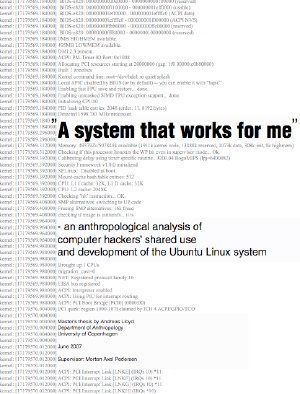
Why were they doing this work just to give it away for free? Thesis on Ubuntu Linux hackers

thesis-cover

It all started when anthropologist Andreas Lloyd (University of Copenhagen) was browsing on the Internet looking for a new laptop computer and ended up installing the free Windows alternative Linux. Two years later, he finished his master thesis “A system that works for me” – an anthropological analysis of computer hackers’ shared use and development of the Ubuntu Linux system.

The thesis is a study of the Internet Gift Economy. Linux is developped by computer geeks saround the world, collaborating over the Internet, building a computer operating system in their spare time, which can be downloaded, installed, used and modified completely for free. It is among the biggest and most complex engineering projects ever conceived and built:

Based on more than 2 years of daily use of the Ubuntu Linux system and 6 months of online and in-person fieldwork among the developers working to develop and maintain it, this thesis examines the individual and collaborative day-to-day practices of these developers as they relate to the computer operating system that is the result of their labour.
(…)
A group of Spanish computer scientists measured the size of a Linux system similar to Ubuntu, and found that it contained around 230 million lines of source code. When they translated this into the effort spent on writing this code using a standard software industry cost estimate model, they found that it would correspond to almost 60.000 man-years of work (Amor-Iglesias et. al. 2005). By comparison, it took an estimated 3.500 man-years to build the Empire State Building in New York, and 10.000 man-years to build the Panama Canal. This immense effort makes modern operating systems such as Ubuntu among the biggest and most complex engineering projects ever conceived and built.

So the anthropologist was curious to learn more about how the hackers collaborate to build such an intricate system, and to learn why they were doing all of this work just to give it away for free.

How do you do fieldwork among hackers around the world? He explains:

I joined the Ubuntu on-line community on the same terms as the Ubuntu hackers, contributing to and using the same system, sharing their experiences with the system, and meeting them in-person on the same terms as they do at the conferences at which they gather, experiencing the same social and technical means and limitations through which they develop the system.
(…)
In order to do participant observation in this on-line space, I began contributing to the system by writing the system help and documentation, rather than the system itself due to my lack of technical understanding. In this way, I could take part in shaping Ubuntu alongside other community members while slowly developing a feel for the everyday exchanges and work in the community.

His thesis is by the way neither dedicated to any girl friend nor his parents:

In the true digital spirit of this work, I dedicate this thesis to Rosinante, the laptop on which I first experienced the Ubuntu system, and which was my faithful companion during my fieldwork and the writing of this thesis, only to bow out a week before tsafe for so long.

>> download the thesis

(Links updated 11.1.17)

SEE ALSO:

The Internet Gift Culture

Open source movement is like things anthropologists have studied for a long time

Open Source Fieldwork! Show how you work!

Gift economies and open source software: Anthropological reflections

Why you always get a present you don’t want – Social Sciences and Gift-Giving

Mobile phone company Vodafone gets inspired by traditional Kula exchange system

Open Source Anthropology : Are anthropologists serious about sharing knowledge?

2006 – The Year of Open Access Anthropology?

thesis-cover

It all started when anthropologist Andreas Lloyd (University of Copenhagen) was browsing on the Internet looking for a new laptop computer and ended up installing the free Windows alternative Linux. Two years later, he finished his master thesis "A…

Read more