
search expand

Headhunting as expression of indigenousness

logo

Anthropologists often criticize mainstream media for exoticizing people. But in Borneo you’ll find indigenous people who promote themselves as headhunters and are proud of it.
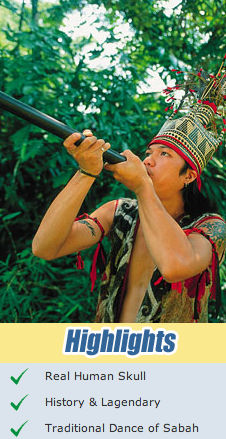
headhunter-ad

The journal Cultural Analysis has recently received a prize in the Savage Minds awards. It was voted as the second best Open Access anthropology journal. In the recent issue, folklorist Flory Ann Mansor Gingging writes about headhunting as an expression of indigenousness.

Headhunting is no longer practiced but the tradition has been commercialised by the tourist industry many places in South East Asia. But the headhunting past has not only taken on a commercial value, but also a cultural and political one, Flory Ann Mansor Gingging argues:

I propose that the tongue-in-cheek invocation of headhunting by the tourism industry represents one way in which Sabah‘s indigenous people counter the outside world’s designation of them as the Other; that is, by parodying their headhunting past, they demonstrate their understanding of the joke and thus guard their indigenousness and their status as human beings.
(…)
Marginalized groups in Sabah, many of whom share a headhunting past, have re- written the headhunting narrative in their favor, becoming co-authors of a cause that seeks, in Hoskins’ words, “to seize an emblem of power, to terrify one’s opponents, and to transfer life from one group to another” (Hoskins 1996a, 38). Thus re-imagined, the headhunting narrative emerges as a tool useful in working towards change and equality.
(…)
Observed in cadence with past and present political milieus, the “refashioning” of the headhunting narrative within tourism in Sabah hence seems to reflect a general consensus among certain of Sabah’s native groups: that Otherness, strategically invoked and appropriated, provides them with an instrument for addressing external threats to their identities.

The anthropologist folklorist and doctoral student in the Department of Folklore and Ethnomusicology at Indiana University grew up in the village she writes about. One of her friends, herself an indigenous Sabahan, said the headhunting imagery and narrative in tourism promotion is “embarrassing but cool”:

“It’s beyond comprehension that I have ancestors that might have been headhunters. At the same time freakish ancestors totally distinguish you from the rest of the global population, so it’s secretly thrilling as well. I love seeing the slightly raised eyebrows reaction I get when I tell someone new I’m from Borneo.”

The researcher heard lots of stories about headhunters during her childhood. As she grew older, her relations to these stories changed:

As I got older, I began to be aware of the economic and political struggles that indigenous people in my state face. Since becoming part of Malaysia in 1963, Sabah, a former British colony, had never had a chief minister who was both indigenous and non-Muslim. Consequently, when in 1984, Joseph Pairin Kitingan, a Dusun lawyer, became the first non-Muslim native to assume this position, being indigenous suddenly meant something to me.

It was also around the same time that I remember feeling a new attraction to the macabre and exotic elements of my culture—one of them being headhunting. Without quite knowing it, I was invoking those aspects of my culture that were potentially embarrassing as a way of responding to the threat I felt towards my own Dusun-ness. For me, headhunting ceased being just a part of history and became, in the most personal way, a part of my heritage—an expression of my indigenousness.

In my opinion, making headhunting such a visible icon of tourism in Sabah is an example of what Michael Herzfeld calls “cultural intimacy,” which he describes as “the recognition of those aspects of a cultural identity that are considered as a source of external embarrassment but that nevertheless provide insiders with the assurance of common sociality” (Herzfeld 1997, 3).

A good example for this trend is the Monsopiad Cultural Village. Here, she writes, Herzfeld’s “cultural intimacy is performed”. Although it is by no means the first to use the state’s headhunting histories within the context of tourism, she believes the Village is the only tourist site that has developed an entire park around the headhunting theme.

On the village’s website they write:

Monsopiad Cultural Village, the traditional village is a historical site in the heartland of the Kadazandusun people and it is the only cultural village in Sabah built to commemorates the life and time of the legendary Kadazan and head-hunter warrior: Monsopiad. The direct descendants of Monsopiad, his 6th and 7th generations have built the village on the very land where Monsopiad lived and roamed some three centuries ago to remember their forefather, and to give you an extraordinary insight into their ancient and rich culture.

Read the whole article:

>> Flory Ann Mansor Gingging: “I Lost My Head in Borneo”: Tourism and the Refashioning of the Headhunting Narrative in Sabah, Malaysia

SEE ALSO:

Ainu in Japan: Cool to be indigenous

In Norwegian TV: Indian tribe paid to go naked to appear more primitive

“They still eat their fellow tribesmen”

Anthropology and tourism: Conference papers are online

logo

Anthropologists often criticize mainstream media for exoticizing people. But in Borneo you'll find indigenous people who promote themselves as headhunters and are proud of it.

The journal Cultural Analysis has recently received a prize in the Savage Minds awards. It…
Read more

The anthropology of children, war and violence

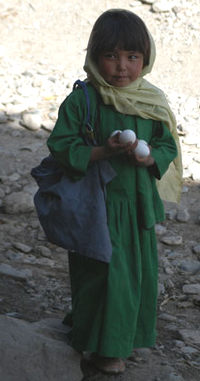
Baktay trying to sell eggs so that she can buy a notebook

What impact has war on children? What has anthropology to say on this? This autumn I watched the movie “Buddha collapsed out of shame” by the Iranian film maker Hana Makhmalbaf. It tells the story of children who reproduce the violence of the adults. For me, it was the most impressive movie of the film festival Films from the South (Film fra Sør) in Oslo. Makhmalbaf won the Silver Mirror, Films from the South’s main award.

– This is no funny movie. I hope you’ll feel the pain and the suffering, said the 19 year old director before the screening in Oslo.

Five year old Baktay dreams of going to school. But her family is poor. When Baktay finally managed to sell the eggs of the family’s chicken and was able to buy a notebook, she gets attacked by boys who play war where they are the Taliban. The boys rip pages from her book, put a paper bag on her head, thread to stone her and to bury her alive. For girls aren’t allowed to go to school, and they must not show their hair.

In an interview on her own homepage, Hana Makhmalbaf says:

By showing today’s picture of Afghanistan, I tried to depict the effects of the recent years’ violence on the country. So that the adults could see how their behavior affects the younger generation.
(…)
First, it was the Russian communists, then the Taliban showed up, and now the Americans. One was communist, the other Muslim and the last one either atheist or Christian. But they all had one thing common, and that was “Violence”. And this violence has been injected over and over from three different groups into the culture of the people in this country so strongly that you can see it in their children’s play.

"Taliban" boys attack Baktay

“Buddha collapsed out of shame” was reviewed (among others) by The Hollywood Reporter, The Guardian, The Epoch Times and Avuncular American. There are some video clips online as well

The movie reminded me of the thesis by anthropologist Elisabet Eikås about young people trying to rebuilt Afghanistan. Their activism is a continuous struggle with the structures of the society that they tend to reproduce.

In Children, War and Nation: Croatia 1991-4, anthropologist Maja Povrzanovic also writes about how children reproduce the adults’ behavior (in this case the Balkan war) in their daily life:

In winter 1991-2, my son Martin, who was two-and-a-half then, constantly built, ruined, rebuilt and ruined again his Duplo-buildings in a very aggressive way, claiming he was ‘playing Vukovar’. (…) In autumn 1993, in my son’s very first minute at kindergarten, a boy approached him with a toy airplane, making noise and boasting: ‘I am shooting the Serbs!’ On christmas Eve 1993, Martin wanted to decorate our Christmas tree with his toy guns (p84/85).

But it seems that children, violence and war is an underresearched topic.

“Descriptive work on children experience violence, in general, is better developed than theoretical frameworks are to explain the causes or consequences of such violence”, Jill E. Korbin writes in her article “Children, Childhoods, and Violence” in the Annual Review of Anthropology 2003.

She notes that for a long time, children’s own voices and perspectives have been largely absent from the anthropological literature on childhood and violence.

Also in a more recent paper, anthropologist Jason Hart and Bex Tyrer remark that there is a lack of anthropological studies on children and war:

To date, the majority of research on children and war has come from the fields of medicine, psychiatry and psychology. This has included a heavy emphasis on “trauma” and pathology, with a more general body of literature exploring the individual’s physical, emotional and psychological nature of suffering.

Although these issues are obviously very significant, the wider societal dimensions of conflict – namely how war pervades institutions, political structures, culture, economy and communication systems – have been overlooked.

They quote Jo Boyden and Jo de Berry who write:

[War] does not just cause psychosocial and emotional harm, but also attacks the most fundamental conditions of sociality, endangering social allegiances and confidence, and drastically reducing social interaction and trust.

The researchers call for childrens’ participation in the research process:

The involvement of children directly in research activities represents an important move away from traditional approaches, according to which children are solely the objects of enquiry. A growing number of advocates now argue that children’s active participation in research is both a means to improve the quality and relevance of the data and make children themselves more visible within a particular community or within the broader society.

Such participation can also improve a child’s ability to communicate her/his views and acquire new knowledge. In this way participatory research can contribute to children’s empowerment.

Both Hart, Tyrer and Korbin stress that children do not only reproduce what they see and experience. They are not necessarily victims but they are active agents as well. Children’s involvement in political-military action (children as soldiers etc) are not solely the result of compulsion, coercion, and brainwashing. Hart and Tyrer write:

Few authors have shown willingness to consider the possibility that, in some situations, young people may engage with military groups as a reasoned strategy – as the most desirable option within the range of choices available. They may also enrol out of social and political concern.

They conclude:

Without denying the existence of trauma and without refuting the idea that the young may be victimised, we should learn more about the strategies children employ to deal with their adverse circumstances and maintain material, psychological, emotional and physical wellbeing.

While most literature that I’ve found is not accessibe for the public, their paper Research with Children Living in Situations of Armed Conflict: Concepts, Ethics & Methods is freely available. It is one of the Refugee Studies Centre Working Papers

SEE ALSO:

Thesis: The limits of youth activism in Afghanistan

“We want children to be their own ethnographers”

Transforming the Anthropology of Childhood – Anthropology News April

Play as research method – new Anthropology Matters

Conflict Resolution and Anthropology: Why more scholarship on violence than on peace?

Baktay trying to sell eggs so that she can buy a notebook

What impact has war on children? What has anthropology to say on this? This autumn I watched the movie "Buddha collapsed out of shame" by the Iranian film maker Hana Makhmalbaf. It tells the story of children who reproduce the…

Read more

Reggae, Punk and Death Metal: An Ethnography from the unknown Bali

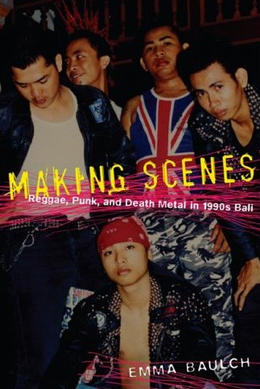
cover

“This is a break from the norm of writing about Bali”, writes Laura Noszlopy enthusiastically about a new book by anthropologist Emma Baulch called “Making scenes: reggae, punk, and death metal in 1990s Bali”.

In 1996, Emma Baulch went to live in Bali to do research on youth culture. She hang out in the death metal scene among unemployed university graduates clad in black T-shirts and ragged jeans; in the punk scene among young men sporting mohawks, leather jackets, and hefty jackboots; and among the remnants of the local reggae scene in Kuta Beach, the island’s most renowned tourist area.

The scene that Baulch has accessed is a deliberately closed and marginalized one, though it is situated largely in Bali’s most ‘open’ places: Kuta and Denpasar. And it is a scene that anthropologists had overlooked or not have not been interested before according to Baulch.

Laura Noszlopy quotes the author who writes that sidewalks of Kuta she entered in 1996 were

… a gaping frontier land of which anthropology rarely spoke … they raged with charged encounters between tourists and street-side watch sellers, drug dealers, drivers, pimps, and whores … punk jams chafed against the pop soundscape emanating from the Hard Rock Café across the road. Mohawks, feigned brawls, Bad Religion, metal spikes, hefty jackboots, and leather jackets thrived (p. 1).

Noszlopy comments:

This is an image that may possibly be familiar to travellers who have stayed in Kuta, Bali’s largest resort. But is not one that is found in brochures or highlighted by Balinese cultural commentators, and neither is it one that anthropologists tend to write about

The book also explains the machinations of the various contesting groups within the scene(s):

This is fascinating stuff; I doubt that many observers of Balinese society, or Balinese themselves, will have any idea of the detailed differences and ‘othering’ that took place not from the perspective of counterculture juxtaposed against mainstream, but between the multiple shifting identities created amongst the various groups. And these, of course, ‘othered’ themselves against the reggae groups that played in tourist bars.

All, Baulch argues, are somehow part of a peripheral Balinese Other in a love-hate relationship with Jakarta’s Indonesian centre, rather than the predictable West. This rather radical and, to some traditionalists, surprising point that Balinese punk is somehow principally about Balineseness and regionalism recurs throughout the book.

“This is the kind of work about Bali that I would like to see more of”, Laura Noszlopy writes:

It is truly contemporary. It deals with the complexities of a set of subcultural groups juxtaposed against and yet parallel to the local and national hegemonies. It recognizes the particularities of these groups and many of the individuals who people them, rather than lumping them together as ‘youth culture’.

Baulch does not simplify the issues, avoid people’s chaotic agency, or seek neat conclusions. Her work seems to embrace the complexity of the process of making scenes in Bali. And it does all this while recognizing the global music scene and late capitalist cultural economy – what Appadurai called the ‘global modern’– of which it is also a small, but noisy, part. This is a refreshing change.

But the reviewer writes less enthusiastically about the language of the book (a well known problem in many ethnographies):

The main difficulty I found with the text, however, was the marrying of the sometimes opaque style of theoretical analysis with the much looser conversational mode of the ethnography. While consistently vibrant and entertaining, it was not always complementary. The mixed tone was also apparent across chapters.

The review appeared in the recent issue of Journal of the Royal Anthropological Institute (subscription required)

But I found this text by Emma Baulch: Punks, rastas and headbangers: Bali’s Generation X (Inside Indonesia 48: Oct-Dec 1996)

Together with several other researchers, she has written Poverty and Digital Inclusion: Preliminary Findings of Finding a Voice Project

SEE ALSO:

Ainu musicians in Japan: Cool to be indigenous

Anthropologist explores heavy metal in Asia, South America and the Middle East

Socially conscious hip-hop is worldwide phenomenon

cover

"This is a break from the norm of writing about Bali", writes Laura Noszlopy enthusiastically about a new book by anthropologist Emma Baulch called "Making scenes: reggae, punk, and death metal in 1990s Bali".

In 1996, Emma Baulch went to…

Read more

Thesis: The limits of youth activism in Afghanistan

What possiblities have Afghan youth to rebuild their country and to work for a better future? Which constraints do they meet? Anthropologist Elisabet Eikås has been on fieldwork among young people in Kabul from October 2003 to June 2004. The result is the thesis ‘It is open, but not so open’ – gaining access to participation among Kabuli youths.

Young people are often seen as agents of change. But they don’t act independently of the wider society. Eikås’ study provides an ambivalent picture of the young peoples’ possiblities.

There are lots of young people in different organisations who work for a better future. Many of them want to replace the political model of the elder and ethnicity & affiliation with a model based on equality: “All generations or sects should be involved in politics, everybody, every group should be represented in politics”, informant Amin said.

But the young peoples’ activism is a continuous struggle with the structures of the society.

A big problem for many young people is the strong position of the family. As the government is not able to provide satisfactory social services and security, the extended family is still regarded as the safety-net. The strong reciprocity of obligations and rights within the family is limiting the time young people can spend on political activism.

Eikås regards personal autonomy from the family as the main entrance to change.

Being in their 20s, the young activits are expected to marry – something that would mean further responsibilities and less time for political activities. Many informants try therefore to delay the time of marriage. One of her informants decided to move away from his family.

The tradition of respect of the elders was often mentioned as one of the major obstacles for the youths to contribute to society, this being in the family, at university, at work or in other social arenas, she writes. Patriarchy is not only concerned with male domination over females, but also dominance by seniors (“elders”) over juniors.

She describes a meeting with some board members in a youth organisation, when suddenly the leader of the organisation enters the room.

All stand up to greet him. (…) He sits down behind his 3X2 meter teak desk where there is a picture of himself, a framed table sign with his name and an Afghan flag. One of the others pours him a cup of tea and serves him. (…)

The feedback of the members to the leader, their behaviour towards him, shows similarities with how the youths describe the elders, or how the teachers at university expect to be treated. In the interaction with the regular members, the behaviour by the members are characterised by loyalty and respect towards the leader. They are hesitant to state critical comments, they usually wait for him to invite them to speak, and some of them to a certain degree expect the leader to have more knowledge and provide the answers.
(…)
The hierarchy within the youth organisations suggests that these organisations are not able to change the model of the elder for that of equality within their own organisations, and as such they alternate but still reproduce the patriarchy, however through a young leader

The most promising place for an alternative form of politics to evolve is the university. Despite the prohibition of political activities on campus enforced by the Ministry of Higher Education, student groups are established, and seminars, also concerning participation by students, are held, she writes.

At the university, students with diverse backgrounds, both ethnically, regionally and regarding gender, meet:

The proximity of these students, the diverse forums they meet in, in class, in the canteen (although that is segregated according to gender) and outside the classroom, builds the foundation for diverse networks to mingle and also the possibility of bridging networks to evolve, where their common status as students can be the main source of their solidarity.

The fact that they were able to arrange a seminar, where representatives from different student groups were gathered, further substantiates the potential, through co-operation, of a change in the political culture towards a more universalistic culture where equality between the different students can be the guiding principle.
(…)
On the other hand, there is also evidence that bonded loyalties prevail, also among the students. (S)ome students see their possibility of participation best secured through a bonding network adhering to particularistic values, whether this be family, kin, an external patron, political group or ethnicity.

Many problems are related to the long periods of war in Afghanistan. War leads to the breakdown of trust, and networks are usually narrowed:

My data seem to support Putnam’s understanding of trust to be developed through face-to- face contact, in lack of institutional trust, exemplified through how relations to political activities or aspirations only were discussed with ‘people one knows’. As such, Kabul University can be a promising place for increased trust to develop.

As I interpret much of the data in this thesis, I believe the lack of trust in the Afghan society, is one of the main reasons why both bonding networks and also patron- client relations prevail. It takes time to build trust in a population which has been at war. The people in Afghanistan have just started this process.

>> download the thesis

SEE ALSO:

Researched the sexual revolution in Iran

Online: Thesis about Up-Country Tamil Students

Conflict Resolution and Anthropology: Why more scholarship on violence than on peace?

What possiblities have Afghan youth to rebuild their country and to work for a better future? Which constraints do they meet? Anthropologist Elisabet Eikås has been on fieldwork among young people in Kabul from October 2003 to June…

Read more

Accused of being CIA-spy: Anthropologist on fieldwork among Cambodian muslims

Are muslim communities getting more sceptical towards anthropologists? In an interview with Phnom Pen Post, anthropologist Bjørn Blengsli tells about his research among muslims in Cambodia – “one of the fastest-changing Muslim societies in the world”.

After September 11, he got arrested and expelled from the village and the district. He was accused of being one of “60 identified CIA spies”. (After a letter from the Ministry of Religion and meetings with undersecretaries of state, he could continue his research.)

Furthermore, Blengsli is concerned about reports of certain researchers who have pretended to convert to Islam in order to gain the confidence of Muslim informants. Muslims consider such people hypocrites, or munafiq – one who is more dangerous to Muslims than the enemies of Islam, he says. “I am afraid that this kind of devious behavior will negatively impact legitimate researchers in the future.”

Blengsli is especially interested in religious change and the impact of foreign donors on religious schooling. He found out that the schools’ religious content is closely linked to the type of religion practiced in the donor countries – often conservative Arab countries. Islamic schooling has led to a “growing sympathy for fundamentalist understandings of the faith and terrorism”.

In his opinion, secular education should be implemented in all Muslim schools:

The secular education among Muslims is still low when compared to that of the Khmer, with Muslim girls most disadvantaged in their pursuit of secular education. Increased knowledge not only about the Khmer society, but also the different sects within Islam is also imperative. As many as 99 percent of Muslim religious students believe there is only one correct interpretation of their religion and this is extremely dangerous.

>> read the whole interview

Earlier, he told Arab News:

In Cambodia … religious activists from the Arab world are arriving with a new view on religion and they preach an austere version of Islam. These organizations want to purify Cham Islamic practice by getting rid of the many influences from Buddhism.

He was also interviewed by the New York Times. He said:

‘This country is ripe for Muslim missionaries. They had to start all over again. They had no religious leaders, nothing. They lost almost everything — their script, their rituals, almost all their written material. They were left with a couple of myths. That’s why today a purification movement is so easy. They are very vulnerable, and a lot of people are coming into Cambodia and telling them how to change.

But he added that ”being fundamentalist does not mean being a terrorist.” And ”If you have radical, militant Muslims living in Cambodia, I have not seen any proof.”

SEE ALSO:

Protests against British research council: “Recruits anthropologists for spying on muslims”

“Arabs and Muslims should be wary of anthropologists”

Anthropology and CIA: “We need more awareness of the political nature and uses of our work”

Religious divide grows amid Thai unrest

Doctoral Thesis: Is Islam Compatible with Secularism?

Islam in Morocco: TV and Internet more important than mosques

Are muslim communities getting more sceptical towards anthropologists? In an interview with Phnom Pen Post, anthropologist Bjørn Blengsli tells about his research among muslims in Cambodia - "one of the fastest-changing Muslim societies in the world".

After September 11, he got…

Read more