
search expand

Ainu in Japan: Cool to be indigenous

ainu rebels screenshot

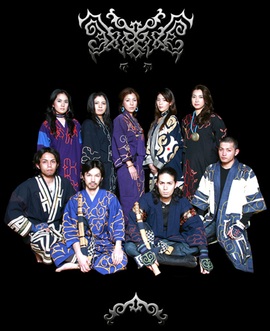
Better times for the Ainu in Japan? There is an “revival of ethnic pride” going on in Japan according to ap.

At the forefront are the Ainu Rebels (image). They use music and dance to rebel against a history of institutionalized discrimination. They celebrate being an Ainu by mixing traditional dress, dance and language with hip-hop and rap.

And they’re getting an enthusiastic response from young Japanese. T-shirts, vests and handbags adorned with Ainu motifs are selling well, and Ainu rock musician Oki Kano is making it big with a band featuring the tonkori, a sort of Ainu guitar, ap journalist Malcolm Foster writes. Ethnicity is hip in Japan according to linguist John Maher.

When I visited the indigenous music festival Riddu Riddu in Northern Norway a few years ago, I noticed the strong ties between the Saami and other indigenous people around the world. Riddu Riddu started as a Saami festival but developped into an international festival with guests from Papua New Guinea, Botswana, New Zealand, Nunavut and Greenland.

Contact with other indigenous people was also critical to the Ainu revival. Mina Sakai from the Ainu Rebels tells that her awareness came at age 16 when, on a cultural exchange trip to Canada, she was struck by the passionate way Canadian indigenous people danced and sang:

“I was shocked. They were so cool and so proud of being native Canadians. I realized that I have a beautiful culture and strong roots. I decided that I should be a proud Ainu and express that in my life.”

In June, Japan’s parliament recognized the Ainu as an indigenous people – a major shift from the mid-1980s when Yasuhiro Nakasone, the then prime minister, declared that Japan was a homogenous nation with no minorities.

>> read the whole ap-story “Ainu rise up from the margins of society in Japan, celebrate long-hidden culture”

The article also mentions Ann-Elise Lewallen, an American cultural anthropologist at Hokkaido University who has worked closely with the Ainu community for 10 years. But I could not find info about her online.

LINKS UPDATED 18.7.2024

SEE ALSO:

Inuit language thrives in Greenland

“Pop culture is a powerful tool to promote national integration”

The cultural nationalism of citizenship in Japan and other places

How Media and Digital Technology Empower Indigenous Survival

“But We Are Still Native People” – Tad McIlwraith’s dissertation is online

Indigenous people no victims of globalisation: Alex Golubs dissertation on mining and indigenous people

Open Access to Indigenous Research in Norway

How filmmaking is reviving shamanism

Thomas Hylland Eriksen on Cosmoculture: Preferably more art than books!

ainu rebels screenshot

Better times for the Ainu in Japan? There is an "revival of ethnic pride" going on in Japan according to ap.

At the forefront are the Ainu Rebels (image). They use music and dance to rebel against a history of…

Read more

The death of Buddhism in Japan?

Will Buddism die out in Japan? Across Japan, Buddhism faces a confluence of problems, the New York Times reports.

Interest in Buddhism is declining in urban areas. The religion’s rural strongholds are being depopulated. Successors to chief priests are lacking. Many temples in the countryside are expected to close.

Buddhism is also losing its grip on the funeral industry as more and more Japanese are turning to funeral homes or choosing not to hold funerals at all. Although the Japanese have long taken an “buffetlike approach to religion”, the New York Times writes, the Japanese have traditionally been inflexibly Buddhist when it comes to funerals (they ring out the old year at Buddhist temples and welcoming the new year, several hours later, at Shinto shrines. Weddings hew to Shinto rituals or, just as easily, to Christian ones.)

“Buddhism doesn’t meet people’s spiritual needs”, according to chief priest Ryoko Mori. “If Japanese Buddhism doesn’t act now, it will die out,” he says.

According to anthropologist Noriyuki Ueda, Japanese Buddhism had been sapped of its spiritual side in great part because it had compromised itself during World War II through its close ties with Japan’s military.

>> read the whole story in the New York Times

But Buddhist monks are trying to reach out to the public, see the story Buddhist monks now going clubbing

SEE ALSO:

“Racist” Buddhist monks hope for “ethnically clean” Tibet?

Book review: Ritual praxis in modern Japan

Maurice Bloch: Religion is a Figment of Human Imagination

“Visual Anthropology of Japan” and more new blogs

Will Buddism die out in Japan? Across Japan, Buddhism faces a confluence of problems, the New York Times reports.

Interest in Buddhism is declining in urban areas. The religion’s rural strongholds are being depopulated. Successors to chief priests are…

Read more

Thesis: How Indian women fight the stigma of divorce

Three weeks ago, anthropologist Siru Aura defended her doctoral dissertation Women and Marital Breakdown in South India: Reconstructing Homes, Bonds and Persons at the University of Helsinki. She has studied divorced, separated and deserted women from different socio-religious backgrounds in the city of Bangalore in South India.

In her conclusion she makes several interesting points. We all know that we should avoid essentializing. Particularly since the 1990’s, Siru Aura writes, there has been a tendency to emphasise the differences among the various groups of Indian women, based their cultural, social, religious or regional backgrounds. One should avoid presenting a “monolithic” picture of “an Indian woman” – a representation that does not exist in real life.

But this focus on diversity can make us blind to seeing what these divorced and separated women have in common. In her thesis, she challenges the popular notion that religion is a main determinator of a person’s social position in India. It’s rather being a wife and being in an unequal power relationship with the husband.

The Indian proverb “there are only two castes: men and women” highlights that the inequality between men and women is so enormous that it overpowers differences between the women, Siru Aura writes:

The significance of wifehood in the South Indian environment leads to my suggestion that there is such a thing as a South Indian marital breakdown. Although the women of different religious communities (Hindu, Muslim, Christian, Parsi) each have their own religious personal laws concerning marriage and divorce, they share similarities in their ways of constructing wifehood. Therefore the practical reasons and consequences of marital problems are often similar in different religious groups.
(…)
The women, from the richest to the most impoverished; from the most highly-educated and sophisticated to the most illiterate women; from their various religious backgrounds: all tolerated severe harassment throughout their marriages and their threshold of leaving the marriage was very high.

But as her study shows, more and more women question male domination. They use the cultural and social structures of their society creatively in order to improve their situation – for example by adopting the prestigious family roles of sons or fathers and by the means of legal procedures and public demonstrations and by the other activities of women’s organisations.

The anthropologist thinks that the womens’ activities “could gradually lead to a greater acceptance of divorce as an unfortunate but not unavoidable state of affairs and the abolishment of the stigma attached to divorced or separated women”:

I suggest that the transformation of social and kin relations will continue because marital breakdown may become a more common occurrence in Bangalore and even broaden further in South India and consequently the number of love marriages as well as the number of single women will also increase. Despite the importance of wifehood in South India, the conditions of wifehood are changing.

Marital breakdown is an anomaly in South India. In Siru Aura’s view, the focus on the margins of the kinship relations revitalises kinship studies:

It emphasises the importance of looking between the structures and highlights the worth of looking beyond the kinship rules and into the “exceptions” to the rules, which are, as I suggest, as frequent as the rules themselves.

As I have shown, although the exceptions are hard to pin down, they are of great consequence: ignoring them may in fact distort kinship theory. Moreover, this study demonstrates that examining something truly significant in Indian society such as personhood, gender or law, or the interplay between an agent and the structure, leads us to study kinship. This keeps the study of kinship at the heart of anthropology in India and makes the renewal of it an anthropological mission.

>> download the thesis

SEE ALSO:

Chronicles Women’s Social Movements in India

Unmarried Women in Arab Countries: Status No Longer Dependent upon the Husband

China: Where women rule the world and don’t marry

On African Island: Only women are allowed to propose marriage

Three weeks ago, anthropologist Siru Aura defended her doctoral dissertation Women and Marital Breakdown in South India: Reconstructing Homes, Bonds and Persons at the University of Helsinki. She has studied divorced, separated and deserted women from different socio-religious backgrounds in…

Read more

“Racist” Buddhist monks hope for “ethnically clean” Tibet?

In his post Not only freedom: the dark ethnic side of the Tibetan Buddhist revolt, anthropologist Gabriele Marranci challenges mainstream images of Tibetans as peaceful and writes about Tibetan racism, ethno-nationalistic dreams, and attacks against muslims in Tibet.

Both the mass media, academics, and even anthropologists specialised in Tibetan Buddhism, have hidden what Marranci calls the ‘dark ethnic side’ of the revolt.

The Muslims in Tibet have been the target of Buddhist Tibetan violence for some time now, especially since 9/11. During the recent protests in Tibet there were anti-muslim attacks:

The mosque in Lhasa was burnt and destroyed, shops and the possessions of Muslim Tibetans smashed, a family burned alive in their own shop, terror and terrorism have affected this community because of a pernicious form of ethnic (Buddhist) nationalism

Marranci points to the paper Close Encounters of an Inner Asian Kind: Tibetan-Muslim co-existence and conflict in Tibet past and present by Andrew Fischer. According to Fischer, the tensions are primarily the cause of ‘economic’ differences and opportunities:

During the 1990s Ethnic Tibetan Buddhist started to fear that the economic success of Muslim Tibetans (particularly their restaurants and shops), would have undermined the economic, and so social, status of the Buddhist Tibetans. The Buddhist monks began a campaign against the economic activities of Tibetan Muslims, which epitomised in the 2003 boycott of Muslims’ businesses and saw also violent actions against innocent Muslim Hui families

Marranci writes:

Since the beginning of the revolt in March, demonstrations against China are held in all those countries through which the Olympic torch is passing. From the politicians, to the public, from Hollywood to Bollywood, from the scholars (with few exceptions) to the students, from the Trade Unions to the Industrial associations: all show indignation against the ‘oppression of the Chinese government’. Yet they ignore the dark side of this ‘revolt’ which is not so different from that in 2003.
(…)
Meanwhile monks and lamas are just stoking the fire in the hope of not just a free Tibet but also an ethnically clean one!

>> read the whole post on Marranci’s blog

SEE ALSO:

The special thing about the Tibet protests

In his post Not only freedom: the dark ethnic side of the Tibetan Buddhist revolt, anthropologist Gabriele Marranci challenges mainstream images of Tibetans as peaceful and writes about Tibetan racism, ethno-nationalistic dreams, and attacks against muslims in Tibet.

Both the mass…

Read more

Manga instead of scientific paper: How art enriches anthropology

“Anthropologist creates oceanic manga fantasy” is the headline of a story in The Daily Yomiuri Shimbun (Japanese newspaper). “I want to portray in manga what I gained from field investigation, but cannot fully express in scientific papers,” anthropologist Daisaku Tsuru says.

Tsuru is assistant cultural anthropology professor at Toyama University and the author of Nacun, a manga focusing on the mystery of (sea) life:

Nacun is based on Tsuru’s own experience of having researched fishing culture on an isolated island in Okinawa Prefecture for a total of six months while at graduate school.

Nacun, set in the future, revolves around graduate student Terunari Ishii. In the manga’s world, humans have expanded their range of marine activities thanks to the development of a convenient underwater breathing device in 2051. Ishii, who has received a prophecy in the form of a video left by an academic genius, begins living on an isolated island in the prefecture to find clues for the development of artificial intelligence.

The depiction of Ishii, who blends into local life through encounters with a lonely, middle-aged fisherman or a mysterious, beautiful girl who plays with dolphins, reflects parts of Tsuru’s fieldwork. At the same time, it can be read as a coming-of-age tale of an impressionable young man.

“Such a depiction of Ishii, that he idly spends his time drinking with fishermen, at least on days when he cannot go out fishing, is surely based on my own experience,” Tsuru said with a smile.

But the most fascinating aspect of Nacun is likely its clever combination of oceanic science fiction and romanticism with the inner psychological world of traditional Okinawans, typified by the worship of utaki, or sacred grounds.

>> read the whole story in the Daily Yomiuri (link updated)

A few days ago I mentioned an interview I’ve conducted with Lavleen Kaur, a criminologist who studies the relationship between Norwegian-Pakistanis and Norwegian-Indians. For her, theater and research go hand-in-hand. She has studied classic Indian dance in Lonon and also has experience as a choreographer and instructor.

She said:

– Yes, the artistic and academic aspects are for me something that go hand-in-hand and they are something I actively link together. For example, I came in contact with many of my informants for my Master’s degree by staging a play in cooperation with the Indian Welfare Society of Norway. (…) The piece was based on a book that was written in the 1600s, Heer by Waris Shah. The story of “Heer and Ranjha”, the Romeo and Juliette from Punjab, is something both Indians and Pakistanis have a very special relationship to.

(…)

– We set up the play in a traditional original version, and more recent version that focused on a mixed couple. This generated quite a response! There were people who started leaving and paternal heads of family who did not want to attend the second version, which they considered to be a “youthful notion”. The play helped start a debate within the community about topics that today we are compelled to relate to. There was a lot of participant-observation – it was “going native” in a very real sense.

>> read the whole interview

UPDATE: Entertaining Research writes about an archaelogist who has danced his thesis

SEE ALSO:

Connecting Art and Anthropology

"Anthropologist creates oceanic manga fantasy" is the headline of a story in The Daily Yomiuri Shimbun (Japanese newspaper). "I want to portray in manga what I gained from field investigation, but cannot fully express in scientific papers," anthropologist Daisaku Tsuru…

Read more