
search expand

Akbar Ahmed’s anthropological excursion into Islam

“One of the most famous anthropologists in the world” was he called by Alan MacFarlane. According to the BBC he is “probably the world’s best known scholar on contemporary Islam”. Akbar Ahmed‘s new book Journey Into Islam: The Crisis of Globalisation is out and according to a review in The Blade he has “painted a fascinating picture of contemporary Islamic world”:

He is a master of simplification. He can take snarled strands of culture, religion, and traditions and through the reason and logic of an anthropologist, Islamic scholar, and historian, is able to untangle the complex jigsaw puzzle and present it in an easy to comprehend narrative.

But maybe this ability to simplify also represents a weakness as he seems to generalize too much? Ahmed’s book was “Book of the week” in The Guardian. Reviewer Edward Mortimer writes:

To a surprising extent he (Akbar) accepts Huntington’s premise that Islam and the west are still distinct civilisations. Only once does he abandon this construct and refer to “a world civilisation”, in which “people are now too close to and dependent on each other to afford the luxury of ignoring and excluding others”. The rest of the time he treats western and Muslim cultures as discrete entities, which need to be brought closer together.

Two weeks ago he said according to The Guardian:

“It’s not just 9/11. It started in the 19th century when the first clashes between the west and Islam took place. We’re seeing the same patterns being played out today.”

The book is based on a “anthropological excursion”: Ahmed Akbar and two students visited eight Islamic countries — India, Pakistan, Syria, Jordan, Turkey, Qatar, Malaysia, and Indonesia — to talk to a cross section of people about their attitudes towards America, their fears and their concerns according to The Blade:

Most of the people in those countries feel alienated from the West and believe that the war on terrorism is in fact a war against Islam being waged under the rubric of globalization. (…) This fear is partly based on the 500-year colonial era. The colonists ruled Muslim lands with two objectives; to exploit natural resources of the occupied lands and to civilize them by converting them to Christianity. The current push for globalization is, to many, the re-colonization of the Islamic world, albeit with a difference. This time the seeds of exploitation are hidden in the Trojan horse of globalization.

>> review in The Blade

>> review in The Guardian

>> Alan MacFarlane interviews Akbar Ahmed

Akbar has also started to blog (a bit) and has a professional website with links to articles and interviews.

Akbar Ahmed appears regularily in the media, see for example:

West ‘must stop looking at Islam through the lens of terror’ (The Guardian, 28.6.07)

Akbar Ahmed’s Call for Compassion: How has globalization changed the world in terms of religious tolerance and stereotyping? (The Internationalist, 4.3.07)

Interview with Prof. Akbar Ahmed (ABC News Austraia, 19.9.01)

‘It Is Time for Muslims to Reciprocate’ (Newsweek, 28.9.06)

Globalist Interview: Akbar Ahmed: Islam Under Siege (The Globalist, 20.6.03)

Conflict with Iraq: Akbar Ahmed (BBC, 2003)

Akbar Ahmed studies differences but seeks unity (Princeton University, 7.11.00)

Articles on Islam by Professor Akbar S. Ahmad (Islam For Today)

SEE ALSO:

New blog: Islam, Muslims, and an Anthropologist

Anthropological perspectives on suicide bombing

Protests against British research council: “Recruits anthropologists for spying on muslims”

Doctoral thesis: Towards a transnational Islam

Muslims in Calcutta: Towards a middle-class & moderation

What does it mean to be Muslim in a secular society? Anthropologist thinks ahead

Islam: Embracing modernity while remaining true to their traditions and core beliefs

Book review: Mahmood Mamdani: “Good Muslim, Bad Muslim”

Islam in Europe: Mainstream society as the provider of conditions

Interview with Arjun Appadurai: “An increasing and irrational fear of the minorities”

"One of the most famous anthropologists in the world" was he called by Alan MacFarlane. According to the BBC he is "probably the world’s best known scholar on contemporary Islam". Akbar Ahmed's new book Journey Into Islam: The Crisis of…
Read more

Good anthropological writing: “Nuclear Borderlands” and “Global Body Shopping”

Examples of good anthropological writing? In his constant search to find books he can hand to students and say: “Here is anthropology”, Christopher Kelty is two books richer in 2007: Global Body Shopping: An Indian Labor System in the Information Technology Industry by Xiang Biao’s and Nuclear Borderlands: The Manhattan Project in Post-Cold War New Mexico by Joseph Masco.

On Savage Minds he reviews both books.

Xiang’s book, he writes “could serve as an excellent starting point for a new generation of comparative ethnography of quasi-formal labor systems”. But what is body shopping? Laborers as a commodity in the new global labour market? A new form of slave trade? The anthropologist explains:

(…) a usually Indian intermediary firm hires a bunch of “qualified” Indian IT employees, deals with immigration and visa issues, and in turn sends them off to work for EU, Aus or US IT firms. Often the intermediary can be taking up to half (or more) of the employee’s wages, but they also take all the risk in terms of immigration and labor-market surpluses. It leads to lots of unemployed Indian IT workers (“benched”) milling about places like Central New Jersey and Southern Silicon Valley waiting for IT firms to take up the slack. There are all kinds of horrible results, but it has been central to making Indian labor so globally visible and accessible in the IT industry…

>> read the whole review on Savage Minds

>> read the introduction of the book

Whereas Xiang’s book was excellent for its simplicity, Masco’s book Nuclear Borderlands: The Manhattan Project in Post-Cold War New Mexico is excellent for its controlled complexity, he writes. It is “a frankly cosmological book; it is about how the bomb makes us who we are today”:

The naive anthropology student might approach New Mexico as a place with many different populations: anglo scientists, pueblo indians, neuvomexicanos, hippie anti-nuke activists — each with their own distinctive lifeworld and worldview. But Masco is having none of that: for him, the bomb is the bomb. It has determined nearly every aspect of our lives (and “our” means basically everyone on the planet) for 50 years… to say nothing of our futures. Thus, in the chapters that explore the lives and thoughts of these different groups, the same cosmological questions about the impact of Nuclear Weapons and the Cold War keep coming up—and keep providing ways to connect these seemingly diverse groups to each other: through the lab, through secrecy and hypersecurity measures, and through politics of race and sovereignty.

>> read the whole review on Savage Minds

>> read the introduction of the book

SEE ALSO:

The Secret of Good Ethnographies – Engaging Anthropology Part III

Examples of good anthropological writing? In his constant search to find books he can hand to students and say: "Here is anthropology", Christopher Kelty is two books richer in 2007: Global Body Shopping: An Indian Labor System in the…

Read more

Book review: An Anthropological history of the Adivasis of Bastar

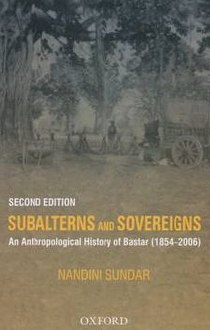
adivasi-cover According to Hindu-reviewer Jyotirmaya Sharma, anthropologist and sociologist Nandini Sundar has written an interesting book about the Adivasi in India. The book Subalterns and Sovereigns — An Anthropological History of Bastar (1854-2006) “tells a very complex and nuanced story of the ‘adivasis’ of Bastar being displaced by centralised models of “development”, losing, in turn, their rights over land, water and forests”:

The book is a very skilful coming together of anthropology and history. It exhaustively chronicles the story of Bastar from the time colonial administrative structures sought to impose “order” and “civilisation” on the ‘adivasis’ by imposing colonial prejudices and stereotypes to the present time when state-sponsored private vigilantism in the name of countering the Maoist movement threatens to wreck an entire way of life. It also details the way in which the ‘adivasis’ have resisted the colonial state in the past and a repressive state now.

But Sundar’s study is not an attempt to romanticise either the ‘adivasis’ or their history as one of “undiluted innocence or even heroism.”

>> read the whole review in The Hindu

On her own website, the anthropologist writes about her book:

Anthropologists are often accused of wanting to keep tribals or indigenous people as museum pieces. Subalterns and Sovereigns shows how misplaced this charge is, arguing that forested and hill areas like Bastar have never been outside the ‘mainstream’ of history, and that the flattening out of local politics to create the appearance of isolation and homogeneity is essentially a product of colonialism and post-colonialism. The choice today, as in the past, has never been one between ‘tradition’ and ‘modern civilisation’ or between ‘development’ and ‘backwardness’, but over alternative visions of democracy.

By exploring the expansion of the state in Bastar over the past century and a half, and resistance to the particular forms it has taken, this book has been part of redefining the way in which history and anthropology are thinking of tribal India.

For more info about the Adivasi see Wikipedia and Kerim Friedman’s posts about Adivasi and Adivasi Rebels

adivasi-cover

According to Hindu-reviewer Jyotirmaya Sharma, anthropologist and sociologist Nandini Sundar has written an interesting book about the Adivasi in India. The book Subalterns and Sovereigns — An Anthropological History of Bastar (1854-2006) "tells a very complex and nuanced story of…

Read more

Anthropological perspectives on suicide bombing

“On Suicide Bombing” is the title of a new book by anthropologist Talal Asad. In the introduction he writes:

For many non-Muslims in the United States, Western Europe, and Israel, the suicide bomber quickly became the icon of an Islamic “culture of death.” This led me to try to think in a sustained way about the contemporary mode of violence that is described by much of the Western media as “Islamic terrorism.” Is there, I asked myself, a religiously motivated terrorism? If so, how does it differ from other cruelties? What makes its motivation—as opposed to the simple intent to kill—religious? Where does it stand in relation to other forms of collective violence? How is the image of the suicide bomber, bringing death to himself and others, addressed by Christians and post-Christians?

He also examins the “clash of civilizations” thesis that purports to explain contemporary Islamic jihadism as the essence of contemporary terrorism, and he argue against the kind of history that assumes self-contained civilizations having fixed values. Asad also discusses state terrorism and violence exercised by the modern state:

I am simply impressed by the fact that modern states are able to destroy and disrupt life more easily and on a much grander scale than ever before and that terrorists cannot reach this capability. I am also struck by the ingenuity with which so many politicians, public intellectuals, and journalists provide moral justifications for killing and demeaning other human beings. What seems to matter is not the killing and dehumanization as such but how one kills and with what motive. People at all times have, of course, justified the killing of so-called enemies and others they deem not deserving to live. The only difference is that today liberals who engage in this justification think they are different because morally advanced.

>> read the whole introduction

By the way, Paradise Now is a great film about suicide bombers.

There are several articles by or about Talal Asad online, among others:

Interview with Talal Asad (Asia Source, 16.12.02)

Interview with Talal Asad: Modern power and the reconfiguration of religious traditions (Stanford University)

Talal Asad: A single history? Francis Fukuyama’s defence of the universalism of western values and institutions is challenged by modern global political realities (Open Democracy, 5.5.06)

Talal Asad: Reflections on Laïcité & the Public Sphere (Keynote address at the “Beirut Conference on Public Spheres,” October 22-24, 2004)

Talal Asad’s hour-long Stanford Presidential Lecture

"On Suicide Bombing" is the title of a new book by anthropologist Talal Asad. In the introduction he writes:

For many non-Muslims in the United States, Western Europe, and Israel, the suicide bomber quickly became the icon of an Islamic “culture…

Read more

Museum Anthropology Review: Blogging book reviews

Another example of experimenting with the internet: The journal Museum Anthropology (MUA) has started publishing its book reviews in a blog called Museum Anthropology Review:

Its purpose is the dissemination of reviews, essays, obituaries and other editorially-reviewed content complementing the work of Museum Anthropology. It reflects the research and outreach interests of the Council for Museum Anthropology and is offered as a resource enhancing all fields concerned with the study of material culture and with the place of museums and related institutions in social life.

Journal editor Jason Baird Jackson explains:

On a case by case basis, I am asking authors of reviews-in-hand if they would be willing to publish their review online. Publishing reviews in this way takes advantage of the following benefits of the online medium (among others): immediate rather than delayed publication, free access to anyone in the world with internet access, the ability to incorporate internet hyperlinks, the ability to publish color images along with the review, the ability (if desired by the author) to turn on the blog’s comment function for the review (thus allowing others to comment on the review or its subject matter), and the ability for an author to simply send an email link for the review to whomever they wish to share the review with.

Because reviews published thus are easily found by anyone doing internet searches, they may become a subject of discussion elsewhere on the web. They can also benefit from the power of the social networking dynamic of the web today, such as with folksonomy tagging. This strategy also provides more space for publication of peer-reviewed articles in the journal itself.

>> visit the Museum Anthropology Review

SEE ALSO:

More book reviews: Publishers are approaching bloggers

New: Anthropology Matters with book reviews

American Ethnologist: Book Reviews in Full-Text!

Lots of book reviews on The Canadian Review of Sociology and Anthropology’s site

Another example of experimenting with the internet: The journal Museum Anthropology (MUA) has started publishing its book reviews in a blog called Museum Anthropology Review:

Its purpose is the dissemination of reviews, essays, obituaries and other editorially-reviewed content complementing the…

Read more