search expand

“How can I contribute to a better world?” Anthropologists on the Oslo terror attacks – an update


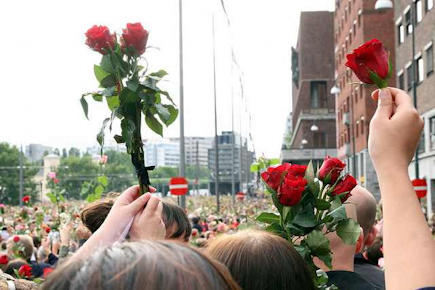
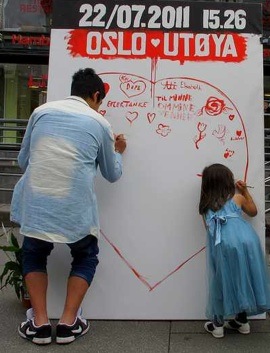
Love instead of hate: Norway’s reaction after the terror attack. Photo: Erik F. Brandsborg, Aktiv I Oslo.no, flickr

Many new comments by anthropologists have appeared since my first post on the terror attack in Oslo. Here is a quick overview:

Cicilie Fagerlid: Slow attempts at making sense: Oslo 22/7, 30.7.11:

What good is it to devote my professional life to understanding nationalism, belonging, community cohesion, conceptions of difference and the like when I have done nothing to prevent the worst thinkable acts of violence to take place in my own country? Especially since I think – or I’m sure – that I’ve felt there was a need for worry (but of course, not to this unconceivable degree…). For several days now I’ve been thinking about how I can contribute. How can I contribute in the best way with my knowledge (of living with difference in Europe), my concern (for the future of us all) and my devotion (to work for a better world)?

Simone Abram: ‘Evil can murder a person, but never defeat a whole people’ (Savage Minds 26.7.):

Responses to the tragedy this weekend have included the massed flying of flags, using flag symbols as facebook identifiers, and so forth. (…) The tying together of national symbols with talk of love reinforces a sense of moral good associated with the Norwegian nation, and reappropriates the nation from racist nationalism. But in this endless tussle between a nation of care and an exclusive people, it seems that racism is the shadow-concept of nationalism. Nationalism is alive and well, and racism continues to creep along in its underbelly.
(…)
In a country where Social Anthropology is one of the more popular subjects for study at university, and where anthropologists retain a high media profile, the persistence of racist ideologies and acts and their resistance to rational argument raise difficult questions.

Sindre Bangstad: The Hatred in Our Own Eyes (Excerpt translated into English by stalinsmoustace 27.7.11):

Norway has produced Europe’s first anti-Muslim terrorist. It seems, however, that the public narrative about him and his actions will not accurately emphasise what is said concerning the direction Norway as a society has taken in the Islamophobic era.

No matter how many bombing raids Norwegian pilots conduct in Muslim countries, no matter how many innocent civilians are killed by Norwegian soldiers in the same countries, and regardless of how much the public debate about Muslims and Islam in Norway has been wallowing in the gutter, one thing is clear: We will not face the hatred in our own eyes.

(see also an article by him Fighting words that are not fought, written a month before the attack about Norwegian mainstream anti-Muslim discourse)

Thomas Hylland Eriksen: Anders Behring Breivik: Tunnel vision in an online world (Guardian 25.7.11):

Norway’s extremists don’t tend to gather in visible ‘rightwing groups’. But online, they settle into a subculture of resentment. (…) The fact that Breivik was Made in Norway, a homegrown terrorist with a hairdo and an appearance suggesting the west end of Oslo, and not a bearded foreign import, should lead not only to a closer examination of these networks, but also to a calm, but critical reflection over the Norwegian self-identity itself.

Thomas Hylland Eriksen and Jostein Gaarder: A Blogosphere of Bigots (New York Times 28.7.11):

The racism and bigotry that have simmered for years on anti-Islamic and anti-immigration Web sites in Norway and other European countries and in the United States made it possible for him to believe he was acting on behalf of a community that would thank him.

Martijn de Koning: Radicalization Series V: Freedom Fighters, Conflict and Culture Talk (Closer, 27.7.11):

It is important I think to see how his ideas (but not his actions) not only are derived from bloggers and politicians but also who they resonate with and are grounded on a grassroots everyday level. I also think the Netherlands can give some clues to that and is relevant here since Breivik partly derived his inspiration from Wilders’ Freedom Party ideology.

Johannes Wilm: 29/07: Terror in Norway – more democracy or more surveillance?:

Nice. So even though the only terror attack so far came from the anti-Islamists, PST (Norwegian FBI) does not see much of a threat in them, whereas they believe that Islamists continue to pose the main problem in Norway it seems.

UPDATE: Thomas Hylland Eriksen sums up in a guest post at anthropologyworks:

It was only a matter of hours between the blast in central Oslo and my most extensive and exhausting engagement with international media since I started out as an anthropologist in the 1980s. Between Friday night and Wednesday, I spoke on radio, on television (via a mobile phone), to newspapers and magazines from China to Chile, and wrote articles for nearly a dozen publications in five countries.

My priorities shifted in a matter of hours. Our holiday house was turned into a makeshift media centre, and the computer was online almost 24/7.

Interesting article about biased terror research in the age of neoliberalism by Charles Kurzman: Where Are All the Islamic Terrorists?, The Chronicle Review, 31.7.11

The more that non-Muslims fear Islam, the more security threats are hyped, the more attention my colleagues and I get. I am in the awkward position of undermining the importance of my own field. My research finds that Islamic terrorism has not posed as large a threat as reporters and the public think.

Check also the most recent round-up by Erkan Saka and my first post: Terror in Oslo: Who cares about Christian right wing extremism?

SEE ALSO:

Racism: The Five Major Challenges for Anthropology

What is terrorism? Selected quotes from “On Suicide Bombing” by Talal Asad

How to challenge Us-and-Them thinking? Interview with Thomas Hylland Eriksen

For an Anthropology of Cosmopolitanism

– Highlight the connections between people!

Love instead of hate: Norway's reaction after the terror attack. Photo: Erik F. Brandsborg, Aktiv I Oslo.no, flickr

Many new comments by anthropologists have appeared since my first post on the terror attack in Oslo. Here is a quick overview:

Cicilie…
Read more

Terror in Oslo: Who cares about Christian right wing extremism?

While politicians and social scientists have directed all their attention towards “islamist” terror groups, right-wing extremist milieus were able to grow unnoticed.

Memorial Art. Photo: Agnar Kaarbø, flickr

(draft / see update 31.7.11) Oslo like a war zone, nearly 100 people killed in the worst attack on Norway since World War II: How could this happen? Two days after the attack, the web is filled with comments and analyses. But I have to consult international media to find a discussion of the, I suppose, most important issue: Right-wing extremist and islamophobic attitudes have become mainstream, but nobody cares – neither politicians nor social scientists. Instead, all their attention is directed towards “islamistic” groups as the major threat to the West.

“Europeans have spent so much time and effort in banning veils, minarets and preventing the construction of mosques that they have forgotten their own native cancer”, writes anthropologist Gabriele Marranci on his blog.

“We can no longer ignore the far-right threat”, argues Matthew Goodwin in the Guardian. Terrorist Anders Behring Breivik is “not a Norwegian oddity, but symptomatic of a growing culture of politically motivated violence across Europe”. It “is important to note that some of Breivik’s core concerns have also played a prominent role within Norwegian and European politics more generally.”

Nicolas Kulish provides us the details in his New York Times article:

Friday’s attacks were swiftly condemned by leaders from across the political spectrum in Europe. Germany’s Chancellor Angela Merkel was particularly sharp in speaking out against what she called an “appalling crime.” The sort of hatred that could fuel such an action, she said, went against “freedom, respect and the belief in peaceful coexistence.”

Yet some of the primary motivations cited by the suspect in Norway, Anders Behring Breivik, are now mainstream issues. Mrs. Merkel, President Nicolas Sarkozy of France and Prime Minister David Cameron in Britain all recently declared an end to multiculturalism. (…) While the parties themselves generally do not condone violence, some experts say a climate of hatred in the political discourse has encouraged violent individuals.

Therefore it is somehow correct when Ahmed Moor writes at Al Jazeera that Breivik did not act alone. He “acted within a cultural and political context that legitimises his fearful and hate-infested worldview.”

In this context, it is not surprising that the first speculations about who might be responsible for the attack centered around muslims. When I watched the BBC few hours after the attack, islam was the main topic.

Gabriele Marranci has observed the same in Italy:

Immediately the newscasters told us that it may be an Al-Qaeda attack in revenge of Norway’s marginal role in Iraq and Afghanistan, and the more recent Libyan air campaign. Islamic terrorism has hit Europe again. Immediately a flurry of comments about the high number of Muslims living in Oslo appeared – yet these were quickly substituted, upon confirmation that the culprit behind the bloodshed was a tall blonde man, with comments about the danger of ‘converts’.

Generally, the words ‘terrorist’ and ‘Christian’, he adds, are infrequently used together. Shooter is now the preferred word for Europeans committing terrorist actions as part of their political or religious beliefs.  

“Tragic Day for Norway; Shameful Day for Journalism”, summarizes Shiva Balaghi in the magazine Jadaliyya. Among others, she mentions the New York Times that “let the story become one of Muslim terrorists wreaking the worst destruction on Norway since World War Two”:  

As it turns out, the worst attack on Norway since Hitler’s invasion was actually carried out by a neo-Nazi. This attack was about Europe’s own ghosts.

The Colbert Report: Norwegian Muslish Gunman’s Islam-Esque Atrocity: CNN: – Nordic looking terrorist? Maybe it was a good disguise

If those journalists and analysts had been paying attention, they would not be surprised at all about this attack, writes Juan Cole:

Europol reports have long made it clear that the biggest threat of terrorism in Europe comes from separatist movements, then from the fringe left, then from the far right.

But, as it is noted on the blog Cultural Meanings, “the Islamophobic current in Europe and North America is so strong that it seems very difficult to swim against it.”

These views have also made it into academia. Two years ago I wrote about the Centre for Studies in Islamism and Radicalisation at the University in Aarhus, Denmark that views “Islamism” as “the primary enemy of the democratic world”.

Looking at the guide Terrorism: Anthropological Perspectives by Rutgers University Libraries shows similar bias. When they recommend “relevant subject headings” that you can use to find books on the topic “Terrorists Groups and Incidents”, then it is Al-Qaeda and Hamas.

The syllabus Anthropology 255: Terror and Violence in Anthropological Perspective at Washington and Lee University (Spring 2004 by Sascha L. Goluboff), while also providing examples from Ireland, deals mostly with Islam and the Middle East.

Far right extremism is a complex topic, as the case in Oslo shows. Breivik was “far from what we might term a traditional rightwing extremist”, Matthew Goodwin writes. Within the Far Right, the researcher has observed broader changes:

Rather than oppose immigration and Islam on racial grounds (an argument that would attract little support), the emphasis shifts on to the more socially acceptable issue of culture: Muslims are not biologically inferior, but they are culturally incompatible, so the argument goes. The aim is to open modern far right groups up to a wider audience.

As I also noticed during a public debate with racists in Oslo, the belief that they are engaged in a battle for racial or cultural survival is quite common.

“It is not simply about jobs or social housing”, Goodwin stresses. It is a profound sense of concern that a set of values, way of life and wider community are under threat, and that only the most radical forms of action can remove this threat.

In his manifesto that was put online before his attack, Breivik also calls for suicidal operations in service of the larger cause. He claims to be a follower of the Knights Templar – a medieval Christian organisation involved in the Crusades, and sometimes revered by white supremacists.

The Labor Party (Arbeiderpartiet), is the main target for this war, as it is commonly seen by these ”antiislamists” as ”worse than the Quslingparty in the WW2″ according to Torbjörn Jerlerup who presents Breiviks worldview in his text Antiislamists with World War Two rethoric and iconography.

I’ll close this post with wise words by Wilfred Hildonen who on his blog writes:

It is about time to realise that to be born and to have grown up within a certain geographical area, do not bestow us with a certain kind of personality; that being human is something universal, which implies that all of us carry both heaven and hell within and that we all are capable of inconceivable evil at the same time as we can show up an incredible degree of compassion and kindness. It doesn’t matter whether we are Muslims or Christians, Jews or French or Greek, Somalis or Norwegians.


He reminds us on the possibly explosive power of words:

Some of us will perhaps have to realise that we too, are responsible for our thoughts, our words and our attitudes. These form the basis for the deeds of the future – evil deeds included. Most of us will perhaps not be influenced, but someone, somewhere, will be. Words, thoughts and attitudes carry an explosive energy within and should therefore be treated with consideration. We should consider what we do think and say and our attitudes as well. Not because we shall be political correct, but because what we say and think today, may have unexpected consequences tomorrow. 

(to be continued)

UPDATE 26.7.11 (via Erkan Saka’s round-up) Thomas Hylland Eriksen has written an in my view rather depressing (others might say a rather realistic) comment at OpenDemocracy: Norway’s tragedy: contexts and consequences. “The first consequence and the main message to Norwegian society is thus that citizens can never again be or feel entirely safe”, he argues. “We doubtless woke on Saturday morning to a slightly more paranoid, slightly less pleasant society. A society where we have become aware of our fundamental vulnerability.”

He also wrote a text for the Guardian Anders Behring Breivik: Tunnel vision in an online world and the New York Times (together with Jostein Gaarder) A Blogosphere of Bigots where he highlights the role of the role of the internet in fragmenting the public sphere. Norway’s extremists don’t tend to gather in visible ‘rightwing groups’. But online, he writes, they settle into a subculture of resentment:

Perhaps one lesson from this weekend of shock and disbelief may be that cultural pluralism is not necessarily a threat to national cohesion, but that the tunnel vision resulting from selective perusal of the internet is.

UPDATE 31.7.2011: Many new comments by anthropologists have appeared, see new post “How can I contribute to a better world?” Anthropologists on the Oslo terror attacks – an update

While politicians and social scientists have directed all their attention towards “islamist” terror groups, right-wing extremist milieus were able to grow unnoticed.

Memorial Art. Photo: Agnar Kaarbø, flickr

(draft / see update 31.7.11) Oslo like a war zone, nearly 100 people…

Read more

Criticizes “scholarly and political indifference toward the workers’ lives”

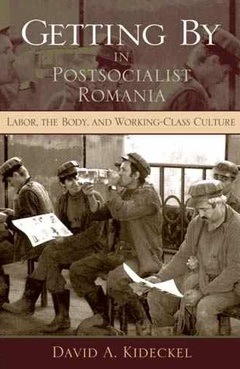
Mass media and intellectuals have typically portrayed them as aggressive, uneducated, and morally spoiled. In his recent book, anthropologist David A. Kideckel challenges these views and lets the Romanian working class speak for themselves.

“Most east and southeast European scholars tend to avoid labor and workers in postsocialist science, a topic that Kideckel embraces”, writes Simona C. Wersching in her review in the Monthly Review.

Kideckel points out the scholarly and political indifference toward the workers’ lives, their physical states, and embodied perceptions. Workers are only visible when they appear threatening and protest.

In Getting By in Postsocialist Romania. Labor, the Body, and Working-Class Culture, he provides according to Wersching “refreshing perspectives” about life coping strategies of two distinct working-class groups in Romania, the miners of the Jiu Valley and the industrial workers of the Nitramonia factory in Făgăraş/Transylvania:

Kideckel’s contribution pays particular attention to workers’ words and thoughts about themselves, their work, their families, their societies, their fears, and their dreams, and highlights the diverse legal and illegal practices of “getting by” (a se descurca) in this changing world after 1989.

Health, living standards, and consumption possibilities have deteriorated. Postsocialist pressures on labor and bodies produce “frustrated agency”. These problems have according the anthropologist nothing to do with ‘socialist legacies’ or ‘culture’, but should be understood as responses to “neo-capitalism”, “a system that reinterprets the main principles of capitalism in a new way and that promotes social injustice much more than does the Western model from which it derives”:

Kideckel interprets the workers’ words as typical preoccupations of workers confronted with the “effects of the forced diet of neo-liberalism” (p. 8), such as changing and uncertain status of property due to privatization, inequalities, instrumentalization, commodification of basic social relations by the market democracy, weak state structures that allow the existence of mafia and corruption, the misusage of funds and foreign assistance, the decline in agricultural markets, the return to subsistence farming, and emigration. Kideckel connects the effects of neoliberalism to his critics’ notion of “transition” as an academic representation of triumphalist politics.

Kideckel, who conducted his first fieldwork in Romania in 1974, also claims that the workers’ “selective perception of the past” (when workers had high status) and their present feeling of alienation from society at large, create a feeling of frustration that hinders effective agency.

>> read the whole review

SEE ALSO:

Durham Anthropology Journal: How “post-socialist” is Eastern Europe?

Doing fieldwork in Eastern Europe – New issue of Anthropology Matters

– Use Anthropology to Build A Human Economy

Ethnographic study: Why the education system fails white working-class children

Available for download: Alex Golubs dissertation on mining and indigenous people

Fieldwork as cab-driver: “An amazing other world”

Financial crisis: Anthropologists lead mass demonstration against G20 summit

Mass media and intellectuals have typically portrayed them as aggressive, uneducated, and morally spoiled. In his recent book, anthropologist David A. Kideckel challenges these views and lets the Romanian working class speak for themselves.

"Most east and southeast European scholars…

Read more

Global apartheid: Are you expat or immigrant? (updated)

What comes into your mind, when you’re reading the following lines?

“We tend to gather in certain locales (cities, sometimes specific neighbourhoods); we frequent particular businesses – some of the services being unique to our community; we have dedicated media, strong social networks and political tendencies; we even have certain etiquette, social rules and beliefs we would likely agree on (a topic for another day), all the result of shared experiences distinct to our clique.”

Sounds like one of those popular descriptions of “immigrants living in a parallel society”? Wrong, anthropologist Sarah Steegar writes about a group of people called “expats”.

Why doesn’t she call them migrants? Well, it’s a question of class and “race”: The people she writes about aren’t from Somalia or Iraq. They’re white people and wealthy. By using a different term, a distance to “the other” is established.

So, it’s not surprising to see that no Somali people are interviewed on the website about Expats in Norway.

In Wikipedia we get this revealing definition:

In its broadest sense, an expatriate is any person living in a different country from where he or she is a citizen. In common usage, the term is often used in the context of professionals sent abroad by their companies, as opposed to locally hired staff (who can also be foreigners).

The differentiation found in common usage usually comes down to socio-economic factors, so skilled professionals working in another country are described as expatriates, whereas a manual labourer who has moved to another country to earn more money might be labelled an ‘immigrant’. There is no set definition and usage does vary depending on context and individual preferences and prejudices.

I always found the usage of the word expat interesting. Personally, I never use it, and call everybody for migrants regardless their class or “race”. Inspired by Steegar’s text I googled around and found that the usage of the terms expat and migrant is contested.

On Wikipedia’s talk page long there’s a long debate about the meaningfulness of this distinction.

Aaron Hotfelder points to a long interview in the journal Reason. There, Kerry Howley writes:

“If you picked up, moved to Paris, and landed a job, what would you call yourself? Chances are, if you’re an American, you’d soon find yourself part of a colorful community of ‘expats.’ If, while there, you hired an Algerian nanny– a woman who had picked up, moved abroad, and landed a job– how would you refer to him or her? Expat probably isn’t the first word that springs to mind. Yet almost no one refers to herself as a ‘migrant worker.'”

Yes, that’s because, as Laura María Agustín says in the interview with Howley, ” ‘migrants’ travel because they are poor and desperate, ‘expatriates’ travel because they are curious, self-actualizing cosmopolites.”

Or as Andrew Kureth writes:

Westerners don’t like referring to themselves as immigrants because the word “immigrant” has such nasty connotations. (…) An immigrant is an unwanted job-stealer, while an expat is a foreigner who could be leaving any day now. An immigrant is on a desperate search for a better life. An expat is on an adventure. (…) Our usage of these words reveals a certain double standard. Whether you’re an expat or an immigrant depends not on your residency plans, but on the relative wealth of your native country.

I might add, the usage of this term suits very well to the rhetoric of the political elite in the West who is building and enforcing Fortress Europe, as part of the larger project of Global Apartheid

UPDATE 1: (via richmondbrige) Great commentary in the Guardian by sociologist Peter Matanle, British migrant in Japan, published today. He feels uncomfortable when British people overseas, or the Guardian, use the term “expat” with reference to Britons abroad, then use words such as “immigrant” when describing people from other countries who are in the UK:

So, my proposal is for the Guardian to amend its style guide to discourage the use of the word “expat” in its pages. The word is too redolent of the days of empire and sipping gin and tonic in the shade while the locals toil beyond the fence. It is too easily used as a cultural marker to distinguish people from one another, making it easy for some Britons to feel both superior to and separated from the local people in their host cultures. I suggest that words such as resident, visitor, settler, immigrant and tourist be used instead in order to equalise the way we describe ourselves with the ways in which we describe others. It is only fair and just to do so.

UPDATE 2: Brendan Rigby has written an excellent post: Are you a Greek or a Barbarian?

UPDATE 3: Great post by Julie Sheridan, “native Scot” in Spain: Double acts & double standards. She asks: What makes me an expat but my neighbour an immigrant? She also draws attention to the etymology of “expat” (excluded, absent from one’s “fatherland”) and ends her post with these sentences:

No idea how long I’ll be here, but while I am, I want to feel settled, and ideally integrated. And try to remember that being here is an experience, rather than an identity.

SEE ALSO:

Paperless underclass exposes dark side of Europe

“Human smugglers fight global apartheid”

The “illegal” anthropologist: Shahram Khosravi’s Auto-Ethnography of Borders

Racism: The Five Major Challenges for Anthropology

How to challenge Us-and-Them thinking? Interview with Thomas Hylland Eriksen

What comes into your mind, when you're reading the following lines?

"We tend to gather in certain locales (cities, sometimes specific neighbourhoods); we frequent particular businesses - some of the services being unique to our community; we have dedicated media, strong…

Read more

Paperless underclass exposes dark side of Europe


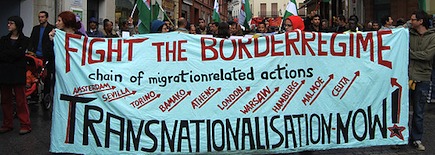
Demonstration in Sevilla. Photo: No Border Network, flickr

(Draft) “All human beings are born free and equal in dignity and rights.” These noble words in the Universal Declaration of Human Rights might be true in some distant part on this planet, but certainly not in Europe.

Here, peoples’ rights are dependent on their nationality. While I, with my German EU passport may travel and live nearly everywhere I want, people from countries like Egypt, Syria or Pakistan cannot. Europe has put much effort in building different kind of walls to prevent certain categories of people from entering. While wealthier peoples’ migration is celebrated, poorer peoples’ migration is criminalized. Anthropologist Owen Sichone calls this policy “Global apartheid”.

Two weeks ago, eight Norwegian police men arrested 25 year old Maria Amelie, an award winning book author, blogger and former anthropology student, born in North Ossetia. She had just finished her lecture at the Nansen Academy – the Norwegian Humanistic Academy about being paperless, undocumented, “illegal” migrant. This happened just three months after she had published her bok “Ulovlig norsk” (Illegally Norwegian), and one month after she was named “Norwegian of the Year” by Norway’s only cosmopolitan-minded magazine, Ny Tid.

Maria Amelie (her real name is Madina Salamova) is one of those 18 000 illegalized migrants in Norway who live here without any rights at all. No access to healthcare, education or work. They cannot open an bank account, they don’t get an ID-number, they actually don’t exist officially. Even helping them is forbidden.

Here is a video from Russia Today about Maria Amelie and a demonstration i Oslo for better rights for undocumented migrants. See related news story

Yesterday, despite lots of demonstrations and media attention, she was thrown out of Norway, where she has lived since she was 16, and deported to Russia. For Prime Minister Jens Stoltenberg and his red-green government, it was important to make clear that they don’t tolerate people like her. The Norwegian government is responsible for the deportation of hundreds of individuals and families – usually in the middle of the night without any prior notice. Media in Norway has done a good job in highlighting the plight of these people who all have a unique story to tell.

Read more:

Norway Expels Migrant Celebrity (Moscow Times, 25.1.2011)

Human rights court slams EU asylum policy as inhumane (Deutsche Wele, 21.1.2011)

‘No One Is Illegal’ Campaign aims to protect Norway’s ‘paperless’ refugees (Women News Network 8.12.2010)

SEE ALSO:

The “illegal” anthropologist: Shahram Khosravi’s Auto-Ethnography of Borders

“Human smugglers fight global apartheid”

“Anthropologists Should Participate in the Current Immigration Debate”

No more conferences in Arizona: Anthropologists condemn Immigration Law

How to challenge Us-and-Them thinking? Interview with Thomas Hylland Eriksen

Why borders don’t help – An engaged anthropology of the US-Mexican border

David Graeber: There never was a West! Democracy as Interstitial Cosmopolitanism

For an Anthropology of Cosmopolitanism

Interview with Sámi musician Mari Boine: Dreams about a world without borders

For free migration: Open the borders!

Demonstration in Sevilla. Photo: No Border Network, flickr

(Draft) "All human beings are born free and equal in dignity and rights." These noble words in the Universal Declaration of Human Rights might be true in some distant part on this planet,…

Read more