search expand

Oral history, folk music and more: British Library puts vast sound archive online

Wow! Overwhelming! The British Library has made more than 23 000 sound recordings from all over the world freely available to everyone at http://sounds.bl.uk

“World and traditional music”, “oral history”, “accents and dialects”, “environment and nature” are some of the categories on the websites. Right now I’m listening to Sunna Saora in India with his two-stringed Sora fiddle. Sunna went from house to house, asking for some rice grains and playing his songs.

“One of the difficulties, working as an archivist, is people’s perception that things are given to libraries and then are never seen again – we want these recordings to be accessible”, Janet Topp Fargion, the library’s curator of world and traditional music, says in the Guardian.

To say the sounds are diverse may be understatement, according to the presentation in the Guardian:

There are Geordies banging spoons, Tawang lamas blowing conch shell trumpets and Tongan tribesman playing nose flutes. And then there is the Assamese woodworm feasting on a window frame in the dead of night. (…) The recordings go back more than 100 years, with the earliest recordings being the wax cylinders on which British anthropologist Alfred Cort Haddon recorded Aboriginal singing on his trip to the Torres Strait islands off Australia in 1898

>> more in the Guardian (incl selected sound files)

The sound archive website has even a project blog where selected recordings are presented.

Unfortunately, the website is optimised for Windows users and the people behind the website don’t seem to have much knowledge about other operating systems. For example, they advise Mac users to download “software such as Winamp or Windows Media Player” – which are Windows applications (VLC works fine). Their statement “Some features are unavailable in some web browser/operating system configurations” is not very helpful either.

SEE ALSO:

How to save Tibetan folk songs? Put them online!

Multimedia Music Ethnography of Yodelling and Alphorn Blowing

Smithsonian Folkways to Open MP3 Music Store

“A new approach to the collection of traditional Aboriginal music”

Acoustic Environments in Change – a multi-disciplinary project

Wow! Overwhelming! The British Library has made more than 23 000 sound recordings from all over the world freely available to everyone at http://sounds.bl.uk

"World and traditional music", "oral history", "accents and dialects", "environment and nature" are some of the…

Read more

96 year old anthropologist starts blogging

(via AAA-blog) He was both president of the American Anthropological Association (AAA) and editor of the journal American Anthropologist. Now Walter Goldschmidt, born in 1913, is joing the growing anthropological blogging community at http://waltergoldschmidt.wordpress.com/

He writes:

Electronic communication, and these things called “blogs,” represent a medium I am singularly unready for. My amanuensis has suggested that I use it to place various of my essays and monographs for public use, and I do find this appeals to me, and invite you to make what use of them you may. Among these, I shall offer presentation of a book of memoirs that I have long intended to write but am only now getting around to.

During the recent weeks and months, many other anthropologists have started blogging as well. Among others, there are two new group blog projects: Anthropoliteia – a blog about police, policing and security from an anthropological perspective and Anthropologyworks – a more general anthro blog that also provides overviews over “anthropology in the news”. It is a project of the Culture in Global Affairs (CIGA) research and policy program at The George Washington University in Washington, D.C.. Then there is the blog Economics in Cultural Perspective that also looks very interesting. I’m very glad to see that two anthropologists from Scandinavia have joined us: Daniel Winfree Papuga with his blog Recontextual – Expressive culture in new formations and Johanna Sommansson who is blogging about her fieldwork in India at Anthromodernity.

Not all of them can be found on the blog overview at http://www.antropologi.info/blog/ I’ll update it later today tomorrow.

SEE ALSO:

“Blogging sharpens the attention”

Paper by Erkan Saka: Blogging as a Research Tool for Ethnographic Fieldwork

Professor lets students blog their field experiences: More than 20 new blogs online!

Anthropology blogs more interesting than journals?

5 years antropologi.info

(via AAA-blog) He was both president of the American Anthropological Association (AAA) and editor of the journal American Anthropologist. Now Walter Goldschmidt, born in 1913, is joing the growing anthropological blogging community at http://waltergoldschmidt.wordpress.com/

He writes:

Electronic communication, and these things called…

Read more

5 years antropologi.info

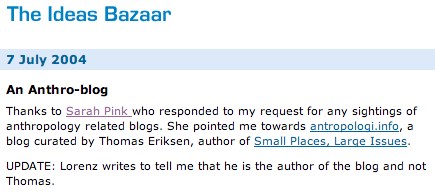
It’s hard to believe that I have been running this blog already for around five years. It was in June 2004, I bought the domain antropologi.info and on the 7th of July 2004, the English blog was launched by anthropologist Simon Roberts from Ideas Bazaar who was the first one who found antropologi.info and blogged about it (see screenshot or the webarchive) – three weeks before I launched it officially in Norway (he is still blogging by the way).

There were only very few anthropology blogs at that time. So the news about a new anthropology blog spread fast. The same day, Dina Mehta, located in India, and Mónica Pinheiro in Portugal, blogged about it. Dina Mehta is still blogging, too, and was recently interviewed about her early blogging. And four days later, antropologi.info was mentioned on maybe the oldest anthropology blog, the ethno:log in Munich.

Blogging in 2004 (or even in 2005) was totally different from today. We were a very small anthroblog-community. There was no Savage Minds or Culture Matters. It was easy to stay up to date. People generally didn’t know what blogging was and rather looked upon it with suspicion. There was no web 2.0. Few used internet in their research and only few scholars published electronically. In 2004 there was no spam! I started with a simple blog script without any spam protection (see the old blog here)

My plan was creating an anthropology portal with both a news section, a calendar, link directory, forum, chat and some kind of magazine section – both in Scandinavian languages, in German and English. I found there is so much interesting research that should be wider known. I wanted to make anthropology more accessible – both to people outside and inside the university.

So I started scanning the news: But I also blogged about interesting posts by other bloggers. In the beginning, I wrote about every thesis that was posted online because this happened so rarely. I interviewed lots of people and also wrote some book reviews. I had lots of time as I just had quit my job. I missed my discipline. I tried to get up to date again, created this website and prepared possible phd-projects (that were never realised).

My first interview was with Eduardo Archetti (in Norwegian only) who died less than one year later. He had just returned from the largest European anthropology conference and I thought it must be exciting to know what knowlege was exchanged when so many anthropologists from all over Europe come together. Usually, this knowledge would remain unknown to the wider public.

I also tried to get anthropologists online, start blogging, publishing online (but only with limited success). I also offered free blogs on antropologi.info – one of the anthropologists is still blogging – Cicilie Fagerlid.

I interviewed some of the first anthrobloggers in 2005 about anthropology and the internet.

Things are very different now. Much has changed in a very short time. We have become a huge community. It is an amazing development! Many anthropologists have started blogging. In addition to pioneering sites like Savage Minds and anthropology.net, we now have several impressive group blog projects like Culture Matters, Material World, Neuroanthropology, Cognition and Culture, Somatosphere and more.

Blogging has become mainstream and blogs a central space for scholary communication.

One of the most impressive developments might be that mainstream organisations like the American Anthropological Association (AAA) and the Association of Social Anthropologists of the UK and Commonwealth (ASA) have started blogging. Today the AAA has one of the most active anthropology blogs. There are new posts nearly every day. Who would have thought that only one year ago?

Then, more and more papers and theses are published online, and the list of Open Access journals is growing. Some have started podcasting like the Society of Applied Anthropology (SfAA) or most recently The Informal Ethnographer (Alexandre Enkerli). German EVIFA has created an impressive anthropology online library (German / English).

Recently, Facebook has become a new arena for communication. Anthropologists are extremly active on twitter and the new Open Anthropology Cooperative has more than 1400 members.

I was once asked if the large number of blogs leads to competition. I answered that for me there are no competitors or rivals. Blogging is fun because there are so many other bloggers. It is because of the anthropology community (and the many friends I made via blogging), that I enjoy blogging and still do blog. Blogging in Norwegian for example is less fun than blogging in English. There is no Scandinavian anthrosphere online, and there is little interaction on the Norwegian blog.

So a big thank you to you who read these lines! Thanks also to everybody who sent papers and theses and contributed with book reviews, guest posts, articles and comments!

Nevertheless, the growing number of anthropological content online has also changed the content of this blog. Too much is happening, it is no longer possible to follow up and cover everything. But this overview feature is still available – on the “antropologi.info Newspaper site” http://www.antropologi.info/blog/ and http://www.antropologi.info/feeds/anthropology/

Feedback face to face, via email, links via other websites etc tell me that the website has been useful for anthropologists. But antropologi.info is not only visited by loyal readers. Most websites get the most traffic from occasional readers – via search engines like Google. I think it is funny to know that for example people who google something like “most primitive people” or “naked tribes” (happens several times a day) are directed to posts where I criticize the idea that there are primitive people. A few days ago, a Norwegian googled after a Norwegian doctor in Arguineguin (place in Spain where many Norwegians live) and then was directed to a blogpost about Norwegians in Spain not willing to integrate.

News travel fast. It was fascinating to see that few hours after I had published the news Anthropology in China: IUAES-conference boycott due to Uyghur massacre, the post was reposted on several Uyghur websites and even translated into Chinese. They weren’t regular readers. They either googled or used aggregators that notify them when new articles about Uyghur issues appeared online. Something similar (in much larger extend, though) might have happened to Maximilan Forte at Open Anthropology. His blog post on America’s Iranian Twitter Revolution received much attention. It was translated into Arabic and Farsi and even published by Al Jazeera. He was also interviewed by Egypt’s Al-Ahram Weekly.

Although it sometimes takes a week or more before a new blog post appears, I have no plans of stopping blogging. It might be necessary to stress that antropologi.info is a one-man project without any financial support. I say that because I often get emails that treat antropologi.info as an institution or organisation. I was for example asked if it was possible to visit antropologi.info’s office and an anthropologist in India even sent me a job application.

UPDATE: Thanks for congratulations and mentioning this post Savage Minds, Neuroanthropology, Erkan Saka, Kulturwissenschaftliche Technikforschung and somatosphere!

It's hard to believe that I have been running this blog already for around five years. It was in June 2004, I bought the domain antropologi.info and on the 7th of July 2004, the English blog was launched by anthropologist…

Read more

Journal of the Anthropological Society of Oxford Goes Open Access

“I am pleased to announce that JASO (Journal of the Anthropological Society of Oxford” has been relaunched as a free online journal, editor David Zeitlyn (University of Kent) writes in an email to the Anthropology Matters mailing list:

The intention is for the new version to exploit the flexibilities of web publication while maintaining a continuity with the precedent set by JASO. A retrospective conversion of the back issues is planned in due course.

On the journal’s website, though, they “reserve the right to levy a charge at any time in the future”.

JASO-Online is no refereed journal. Nevertheless, “a strict quality threshold will apply”.

The journal was originally launched in 1970 as a hard copy journal; it ceased publication in that form in 2005. It has now been re-launched to coincide with the Centenary of the Oxford Anthropological Society in 2009.

There is only one issue online. The most contributors to this issue are graduate students of the Institute of Social and Cultural Anthropology at the University of Oxford.

The current issue consists of nine book reviews and these four articles:

Arielle Rittersmith: Contextualising Chinese medicine in Singapore: microcosm and macrocosm

Marisa Wilson: Food as a good versus food as a commodity: contradictions between state and market in Tuta, Cuba

Harry Walker: Transformations of Urarina kinship

Ieva Raubisko: Proper ‘traditional’ versus dangerous ‘new’: religious ideology and idiosyncratic Islamic practices in post-Soviet Chechnya

"I am pleased to announce that JASO (Journal of the Anthropological Society of Oxford" has been relaunched as a free online journal, editor David Zeitlyn (University of Kent) writes in an email to the Anthropology Matters mailing list:

The intention…

Read more

The Open Anthropology Cooperative – A Worldwide Anthro-Community in the Making

(updated)What about creating A worldwide community for anthropological discussion and collaboration away from the restrictions of formal academic structures has been created at http://openanthcoop.ning.com/ (already more than 140 members Thursdag night!) It started as a twitter-conversation, now the debate also takes place on Keith Hart’s website.

In some way, this community already exists – in the anthropological blogosphere. But also non-bloggers shall be included, and The Open Anthropology Cooperative – that’s what it is supposed to called – is actually much more. Maybe we can call it the web 2.0 version of the conventional (mostly national) anthropological associations.

More than 30 comments have been posted so far. They include following ideas and suggestions about the new community:

* A place to share ideas

* A place to find like-minded anthropologists

* A place to collaborate

* A place to hold virtual conferences

* A place to host podcasts

* A place to ask questions

* A place to learn about new tools for anthropology (online tools, field tools, etc.)

* a place to find resources (e.g. databases, good grad programs, upcoming colloquia, software, field opportunities)

* A place to publish
* The idea of an engaged anthropology for the 21st century in relation to the digital revolution
* Group blog with posts from both Keith and others
* Forum for discussion
* Online press to publish longer pieces
* The incorporation of Twitter, social bookmarking, wiki, etc

>> read the whole discussion

>> follow the debate on twitter

Anthropologist “Fran” at http://ethblography.blogspot.com likes to see the Open Anthropology Cooperative “become a comfortable channel for discussion which does not intimidate amateurs or first-year undergraduates, yet remains useful for doctoral students, fieldworkers, lecturers and specialists in all fields”. She also hopes “that it will become truly international (and multilingual)”.

She continues:

In my opinion, there is no reason for an invented divide that reduces web-based academic content to a second-rate substitute for formal (read: expensive, elaborate, bureaucratic) channels. Why not overlap “open” and “official” academia until they are one and the same? If the technology and demand can sustain it – which I believe they can – making anthropological and ethnographic knowledge freely available should be a priority. This can reflect back heavily upon the academic method itself, both in theory and in practice.

>> read the whole post

SEE ALSO:

How can we create a more plural anthropological community?

World Anthropologies Network – Working towards a global community of anthropologists

The Future of Anthropology: “We ought to build our own mass media”

Keith Hart and Thomas Hylland Eriksen: This is 21st century anthropology

(updated)What about creating A worldwide community for anthropological discussion and collaboration away from the restrictions of formal academic structures has been created at http://openanthcoop.ning.com/ (already more than 140 members Thursdag night!) It started as a twitter-conversation, now the debate also…

Read more