search expand

Intute Anthropology – overview over “high quality resources on the Internet”

We all know the directory SOSIG, but now it has been relaunched as Intute: Social Sciences. It combines two databases of the Resource Discovery Network (RDN): Altis and SOSIG. It is edited by the University of Manchester and the University of Kent at Canterbury.

Intute: Anthropology provides free access to high quality resources on the Internet. Each resource has been evaluated and categorised by subject specialists based at UK universities. We aim to match resources to the anthropology curriculum and the needs of researchers. Our target audience is students, staff and researchers in higher and further education.

The overview over anthropology sites has been updated recently.

>> Intute Anthropology

>> Intute Social Science

A similar service is EVIFA – Virtual Library of Social Anthropology, edited by the University Library of the Humboldt University Berlin (both in English and German)

We all know the directory SOSIG, but now it has been relaunched as Intute: Social Sciences. It combines two databases of the Resource Discovery Network (RDN): Altis and SOSIG. It is edited by the University of Manchester and the…

Read more

"Hearing has been neglected in studies of enculturation and personality development"

In one the recent additions in the anthropology journal AnthroGlobe, Grace Keyes examines “how hearing loss impacts an individual’s enculturation”. Enculturation, she explains, is in anthropology textbooks defined as “process by which people acquire their culture (the social norms, symbols, customs, cultural knowledge, meanings, etc.)”.

So what happens when a person cannot hear? Researchers, however, have largely neglected to take into account how biological factors such as hearing may affect enculturation, she writes:

It is generally assumed that language is a major vehicle of enculturation and that most people experience the process in much the same way if they belong to the same culture or society. The role of hearing in language acquisition and enculturation is taken for granted. Thus, works that examine the role of hearing in the enculturation process are non-existent in the anthropological literature. In fact, there exits very little literature on enculturation itself in anthropology.

>> read the whole paper “Incomplete Enculturation: The Role of Hearing” by Grace Keyes

SEE ALSO:

New Ethnography: The Deaf People – A Forgotten Cultural Minority

In one the recent additions in the anthropology journal AnthroGlobe, Grace Keyes examines "how hearing loss impacts an individual’s enculturation". Enculturation, she explains, is in anthropology textbooks defined as "process by which people acquire their culture (the social norms,…

Read more

“They still eat their fellow tribesmen”

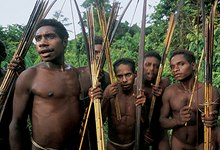
(via del.icio.us) If you miss “good old-style” stories about cannibals in far away places like Papua or New Guinea, read this story by Paul Raffaele in the Smithsonian Mag. It starts like this:

For days I’ve been slogging through a rain-soaked jungle in Indonesian New Guinea, on a quest to visit members of the Korowai tribe, among the last people on earth to practice cannibalism.

And about cannibalism: A local guide with “dark eyes” explains:

It’s because of the khakhua, which comes disguised as a relative or friend of a person he wants to kill. “The khakhua eats the victim’s insides while he sleeps,” Boas explains, “replacing them with fireplace ash so the victim does not know he’s being eaten. The khakhua finally kills the person by shooting a magical arrow into his heart.” When a clan member dies, his or her male relatives and friends seize and kill the khakhua. “Usually, the [dying] victim whispers to his relatives the name of the man he knows is the khakhua,” Boas says. “He may be from the same or another treehouse.”

I ask Boas whether the Korowai eat people for any other reason or eat the bodies of enemies they’ve killed in battle. “Of course not,” he replies, giving me a funny look. “We don’t eat humans, we only eat khakhua.”

The killing and eating of khakhua has reportedly declined among tribespeople in and near the settlements. Rupert Stasch, an anthropologist at Reed College in Portland, Oregon, who has lived among the Korowai for 16 months and studied their culture, writes in the journal Oceania that Korowai say they have “given up” killing witches partly because they were growing ambivalent about the practice and partly in reaction to several incidents with police.

(…)

Still, the eating of khakhua persists, according to my guide, Kembaren. “Many khakhua are murdered and eaten each year,” he says, citing information he says he has gained from talking to Korowai who still live in treehouses.

The travel writer even meets “true cannibals”:

Two men approach through the gloom, one in shorts, the other naked save for a necklace of prized pigs’ teeth and a leaf wrapped about the tip of his penis. “That’s Kilikili,” Kembaren whispers, “the most notorious khakhua killer.” Kilikili carries a bow and barbed arrows. His eyes are empty of expression, his lips are drawn in a grimace and he walks as soundlessly as a shadow.

The other man, who turns out to be Kilikili’s brother Bailom, pulls a human skull from a bag. A jagged hole mars the forehead. “It’s Bunop, the most recent khakhua he killed,” Kembaren says of the skull.

The story ends like this:

Three years earlier I had visited the Korubo, an isolated indigenous tribe in the Amazon, together with Sydney Possuelo, then director of Brazil’s Department for Isolated Indians [SMITHSONIAN, April 2005]. This question of what to do with such peoples—whether to yank them into the present or leave them untouched in their jungles and traditions—had troubled Possuelo for decades. “I believe we should let them live in their own special worlds,” he told me, “because once they go downriver to the settlements and see what is to them the wonders and magic of our lives, they never go back to live in a traditional way.”

So it is with the Korowai. They have at most a generation left in their traditional culture—one that includes practices that admittedly strike us as abhorrent.

>> read the whole story in The Smithsonian

>> BBC about the Kombai (Korowai)

>> Rupert Stasch: Giving up homicide: Korowai experience of witches and police (West Papua) (Oceania, Sep 2001)

On Papua Adventures we read:

Due to this very recent exposure to outside influences, the Korowai tribes are not as open and welcoming to tourists as the Yali, Dani and Lani for example. They remain on guard and suspicious of ways different to their own. This does of course make for an exciting and truly adventurous visit flying in by chartered Cessna from Jayapura to Yaniruma and trekking into Korowai country by foot and canoe.

UPDATE: Anthropologist Sarah Hewat comments: “Good story about cannibals. Pity it’s not even close to the truth”

SEE ALSO:

Disney-Film depicts indigenous people as involved in cannibalism

Inuit cannibalism?

Brief history of cannibal controversies

Our obsession with the notion of the primitive society

Is this anthropology? African pygmies observe Britains in TV-show

Ancient People: We are All Modern Now

Primitive Racism: Reuters about “the world’s most primitive tribes”

(via del.icio.us) If you miss "good old-style" stories about cannibals in far away places like Papua or New Guinea, read this story by Paul Raffaele in the Smithsonian Mag. It starts like this:

For days I've been slogging through a rain-soaked…

Read more

“Discuss politics!” – How anthropologists in Indonesia engage with the public

Crossroads is the name of a new blog by anthropologist Fadjar I. Thufail, currently completing his Ph.D. at the University of Wisconsin-Madison. In an interview (from 2001), he tells us that Indonesian anthropologists continually attempt to link themselves to the non-academic world – and they succeed. When anthropologists in Indonesia are interviewed by newspapers, their comments are not squeezed into tiny sound bites, instead they are written up in long, detailed articles. Anthropologists often appear on television or on radio:

What makes anthropology as a discipline different than the discipline in the United States is that from the beginning, Indonesian anthropologists are supposed to be able to talk to the public and get involved in development practices.

The first anthropology department in Indonesia was established in 1957 and that was after the Indonesian independence when the people were eager to develop the country. Part of the institution of Indonesian anthropology is that the anthropologists were asked to contribute to development practices and that makes what in the U.S. called “applied anthropology” a part of Indonesian anthropology. There is no distinction like in the U.S.

He also explains the differences between “public anthropology” and “applied anthropology”:

Public anthropology is supposed to involve in a critical position. It should be a reminder, no…not a reminder. It should involve engaging the public, but by criticizing projects or challenging the dominant paradigm.

To me, applied anthropology is not the same as public anthropology because they (applied anthropologists) do government development and journal writing etc. Applied anthropologists are just technicians or sponsors of the government and hence are not ‘public anthropologists’ because there is not a critical component to it.

In Indonesia, most of the anthropological scholars are engaged in such a critical function. (…) That is why lots of anthropologists in Indonesia are invited to various seminars, give public talks, probably invited to TV talk shows, or interviewed by newspaper journalists.

So, basically, in Indonesia, it’s not only the scholars who want to go public, but also the journalists. A connection exists between the community of scholars and the media. That I don’t see in the United States where academics are beyond the reach of the public.”

This has to do with the specific Indonesian context:

Most of the media think of themselves as opposed to the government. They have a function to criticize the government. Most of the scholars also think of themselves as critics. They [the scholar’s] use media to launch critiques of the government, especially the ‘New Order’ [Suharto’s regime – 1966-1998]. So that is why whatever scholars say, the media accepts it without saying ‘too difficult’ – nothing is ‘too difficult’ for the story…they feel this is something we must publish because we must criticize.”

Therefore, anthropology is much more involved in politics in Indonesia – that’s why it’s so relevant for people:

Anthropologists in the U.S. think of politics as separate from academics. To do academic work, one must be free of politics. I think this is a legacy of colonialism, of the Enlightenment or something.

(…)

In Indonesia, as I said earlier, Anthropologists from the beginning actively pursued involvement in public/political events. Some chose to be part of the government, some put themself against the government.

(…) I think that is the most important message I want to get across. Anthropology is political – I want to remind you that as an anthropologist you must talk about politics. You can’t talk about culture as separate from politics. In order to put yourself in a more public sphere, you must discuss politics. There are different ways to do this. One is by not talking about cultural systems anymore, or semiosis, but instead discussing politics. Then realize that anthropology has critical power.

>> read the whole interview

>> visit Fadjar I. Thufail’s blog

SEE ALSO:

More and more anthropologists, but they’re absent from public debates – “Engaging Anthropology” by Thomas Hylland Eriksen (1)

Why anthropology fails to arouse interest among the public – Engaging Anthropology (2)

Riots in France and silent anthropologists

“Anthropologists Should Participate in the Current Immigration Debate”

Bush, “war of terror” and the erosion of free academic speech: Challenges for anthropology

Crossroads is the name of a new blog by anthropologist Fadjar I. Thufail, currently completing his Ph.D. at the University of Wisconsin-Madison. In an interview (from 2001), he tells us that Indonesian anthropologists continually attempt to link themselves to the…

Read more

Food and Religion: New issue of Anthropology of Food

Anthropology of Food is one of the few anthropological Open Access Journals. In their new edition, we’ll find five articles on food and religion in English (two in French), among them:

Michelle Lelwica: Redefining Womanhood (?): Gender, Power, and the “Religion of Thinness”
Although women who are devoted to losing weight do not constitute a “religious” group in the traditional sense of the word, the symbols, rituals, and beliefs surrounding their pursuit of thinness have come to function much like a religion.

Adele Wessell and Andrew Jones: Reading religion and consuming the past in the feast of Guadalupe
Food is integral to the religious expression and community identity of the fiesta, echoed in its translation as the feast day of the Virgin of Guadalupe. In this paper the meal served in the Casa de Comida will be used as a historical text, as a form of communication or representation of the community and its history. Attention is directed to the interdependence of indigenous and immigrant histories expressed in the preparation and consumption of meals, as well as to the legacies of colonialism inherent in the feast.

Meritxell Martín-i-Pardo: Colombo Cabri or vegetarian meal: wherein lies the power?
“Colombo Cabri or Vegetarian Meal” argues that certain foods are used to configure two competing sectarian Hindu groups in Guadeloupe, French West Indies. What are appropriately identified as “traditionalist” and “globalist” Hindus define a rhetoric for legitimating their different claims by appropriating or rejecting “colombo,” a curry of meats simmered in this sauce, as the ritual meal for the sect whose narrative rightly claims to define the correct path for the Hindu community on the island.

>> overview over all articles in Anthropology of Food nr5/2006

Anthropology of Food is one of the few anthropological Open Access Journals. In their new edition, we'll find five articles on food and religion in English (two in French), among them:

Michelle Lelwica: Redefining Womanhood (?): Gender, Power, and the “Religion…

Read more