search expand

From Tahrir to Israel: “Protest movements inspire greater human understanding”

“Irhal” (=“Leave!”), says the banner in Arabic (a slogan from the Egyptian revolution), directed at Prime Minister Benjamin Netanyahu, and below in Hebrew: “Egypt is here!”

One of the most interesting things about the Egyptian Revolution is its global impact. Is has inspired people and movements around the world, from Spain to Greece, the USA, and now even Israel.

Anthropologist Ted Swedenberg posted a picture of this banner on his blog (that he borrowed from the progressive Israeli blog +972).

Initially mostly ignored from mainstream media, hundreds of thousands of people have taken to the street and demanded social justice and “people before profits”. It is one of biggest waves of protests in decades in Israel.

Via an announcement by Jason Baird Jackson I learned about the blog by a PhD student who on her blog provides “an ethnographic glimpse of what is happening on the streets and in the parks there now”, both in texts, photos and videos. She has been in Israel for about a year to conduct research in a “multi-cultural” and “multi-ethnic neighborhood” in the Tel Aviv-area.

Her posts about the Israeli revolution are fascinating.

The last few days have been really moving, she writes in her most recent post One People, One Revolution – not because of the continually growing masses that are protesting, “but because of a few moments in which I saw how a movement like this can inspire greater human understanding and connection. I was humbled to watch as people on opposite sides of a fence broke it down, and saw each other for more than they knew the other to be until then.”

[video:vimeo:27117034]

This uprising cuts across the population. “Lefties” joined Right-wingers and Zionists, single mothers protested together with students, African refugees and migrant workers, “Arabs and Jews”. As in Tahrir Square, tent cities have been established.

In Rothschild Boulevard, hundreds have been camping out in tents for two weeks now, the researcher writes:

The Rainbow Child-like scene is a growing communal living situation complete with a large shared kitchen (with fridge and composting/washing/recycling stations), first aid tent, salon-like “living rooms” set up every few hundred feet… people gather in circles and play music, smoke nargila/hooka, talk about the protest, read, and sleep there all night. They then wake in the morning, go to work, and return “home” to their tents in the evening when the weather has cooled only so immeasurably much.(…)

In the southern Park Levinsky, by the Central Bus Station — where most of the African and refugees and migrant workers live and congregate — the more radical “lefties” have set up camp, and hold nightly gatherings and dinners. On Friday night, hundreds of African men gathered around a group of drummers/dancers from Ghana who performed at the birthday celebration of one of the protesters, for example. It was an incredible scene that didn’t feel anything like the ’60s Woodstock scene on Rothschild, but which also brought people together in revolutionary spirit.

One of the protesters said:

(T)he government tries to make everyone feel as if they’re alone, as if they’re against each other, so that they can remain in control, in power. We must unite, and Tel Aviv with all its populations must be one.

Read her posts and watch her videos:

>> One People, One Revolution

>> A new generation is living in tents

>> The people demand social justice

While according to many headlines, people protested “against high cost of living”, the the frustration runs deeper, as the New York Times explains:

The shift from state-dominated quasi socialism to markets and privatization — a shift that arguably saved the country from economic collapse in the 1980s — has been accompanied by some sense of loss of community, spiking prices and the accumulation of great wealth in a few hands. (…) Israel’s majority Jewish citizens feel they have suppressed their individual needs for the perceived good of the community over the course of many wars.

Famous Israeli Writer Amos Oz is quoted who in an article in Haaretz states:

The heart of this protest is the affront and outrage over the government’s indifference to the people’s suffering, the double standard against the working population and the destruction of social solidarity.

The heart-warming sights of the tent cities spreading through Israel’s cities, of the doctors marching for their patients, of the demonstrations and rallies are in themselves a delightful revival of mutual fraternity and commitment. After all, the first thing these demonstrators are saying, even before “social justice” and “down with the government,” is: “We are brethren.”

A similar local cosmopolitanism was the fundament of the uprisings in Egypt. People unitied in order to fight inequalities and rebuilt the nation.

Sociologist Honaida Ghanim is one of many people who are certain that the recent events in Egypt and Tunisia had a large impact on the Israeli protest movement. In an interview with Amira Hass in the paper Haaretz, she says explains:

On the one hand, there is neo-liberalism and globalization that have resulted in an unacceptable gap between the wealth of the state and individuals and the harshness of life for the masses. On the other hand, these are similar tools – online social networks, with Facebook heading the list, which had a far-reaching effect on the media.

But she also points out that many Pakestinians feel rather indifferent towards the protests. No connections are made to the occupation.

But the current crisis is an opportunity for Israelis to understand that they too are victims of the occupation, two Palestinian activists, Nariman al-Tamimi and Afaf Ghatasha, stress:

All the tear gas grenades thrown at us in demonstrations cost money which cannot be spent on improving social conditions for Israelis.”

and the protests will in Sociologist Honaida Ghanim’s view allow the Palestinians to see that “Israeli society isn’t one-dimensional, that it is complex, that it shouldn’t be flattened, that it has struggles and oppressed classes of its own.”

Here a Al Jazeera feature:

Inside Story - Arab Spring Comes to Israel?

SEE ALSO:

Saba Mahmood: Democracy is not enough – Anthropologists on the Arab revolution part II

Thesis: Neoliberal policies, urban segregation and the Egyptian revolution

Lila Abu Lughod: “In Israel and Palestine we have an amazing opportunity”

Ethnographic study of anti-corporate globalization movements

What anthropologists can do about the decline in world food supply

– Use Anthropology to Build A Human Economy

“Irhal” (=“Leave!”), says the banner in Arabic (a slogan from the Egyptian revolution), directed at Prime Minister Benjamin Netanyahu, and below in Hebrew: “Egypt is here!”

One of the most interesting things about the Egyptian Revolution is its global impact.…

Read more

Interview: Self-publish your thesis!

Phd-theses belong to the least accessible academic publications. Anthropologist Johannes Wilm chose to make his thesis available to the public – both online as a free download, as e-book and affordable paper book. In this email-interview he explains us how he did it and why he thinks students should set up their own publishing company.

Why is open access publishing important for you?

Open access is the best way of ensuring that your material is available for anyone who cares to look. Writing this thesis, I realized that much of the background literature from just 25 years ago already is impossible to get at, even when printed with a top university press. While publishing this with for example Cambridge University Press may have had some advantages in the short-term in terms of marketing, in a perspective of some decades it would have had the opposite effect. Others have told me that the financial gain of publishing an academic book may be up to 700 USD. In comparison to current Scandinavian wages that really means very little, so I don’t think that earning another 700 USD should be a motive to restrict the access to one’s thoughts.


Johannes Wilm: Open access is the best way of ensuring that your material is available for anyone who cares to look. Photo: privat

What is your thesis about?

– The Sandinista movement in Nicaragua, and how I believe it has changed since the 1980s. There are elections in Nicaragua this fall, and while the Sandinistas have been in power since 2007, this may change a lot and interest in Nicaragua may grow around the elections, so I feel it’s necessary to have this out right now.

– I have been wondering whether I should wait with the free web version until real-life small-scale bookstores have had a chance, but what they have been telling me at the Revolutionary Grounds bookstore in Tucson, AZ is that people still buy the real paperback version even if things are online. So based on that the current plan is to put out everything at the same time.

– By the way, I should add that the text I will publish has a lot in common with my current thesis draft, but it is not the same. The book-version has a completely different conclusion than the thesis version. It is much less academic, aimed more at the general public, and looks more at the political outlook the country currently has. The requirements of what needs to go into a PhD thesis these days are unfortunately such that the text that comes out of it is not really interesting to read for anyone beyond the exam committee.

You chose to set up your own publishing entity instead of using well known publishers. Why?

– I thought about that. I found the handful of publishers that do open access publishing and contacted them. They all sent me encouraging comments, but said that my field was too strange or too specific. I also considered printing it with a traditional publishing house. With the exception of the top 10 university presses it seems like there is no real advantage of doing it that way. On the contrary, they impose their not-so-well founded ideas, then have someone edit it who has no knowledge of the field and end up hijacking the manuscript for at least a very long period of time – possibly forever. The publishing house should give some quality assurance, but given that many smaller presses just appear and disappear within very short time, that is not really given.

– Printing with a certain university press makes your work unavailable to almost anybody, with the exception to those few living close enough to a bookshop that sells it. People in the “Third world” are generally cut off from access to these books also due to the price, which oftentimes is upward of 35 USD. Using the techniques described below one should be able to offer a 300+ paged book in softcover for under 20 USD, while still being able to pay for returns and some more and offering the required discount to booksellers.
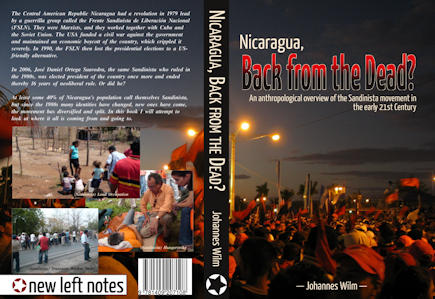

Johannes Wilm created the book cover with the Open Source software Scribus

I learnt that prestige is important for many researchers. Their argument against self publishing may be that it won’t give you much academic credit compared to publishing via f.ex. Columbia University Press?

– It is true that in the past there was some prestige connected to the label. Academia is currently changing massively and so is the publishing business. Nobody can quite know what things will be like in just a few years, so I think one should look at what makes sense technically. Who published Das Kapital? Does anybody know? Does anybody care? Not really.

– Great books should be able to stand on their own merit. That is also the case for the less famous books. When I was looking for books about Sandinismo in Nicaragua in the 1980s, the publishers were all over the place. Had I decided only to stick with books printed by the top university publishers, I would not have read any of the best books.

How did the faculty react? Did they support you?

– I think the faculty was mainly surprised. Everything about publishing is currently changing and so they didn’t quite know how to react. Unfortunately it seems to me that some felt the need to try to find some rule or other which would prevent me from being able to do this. Such a rule fortunately does not exist at the University of London, but other universities do make their students sign a note I which they specify that the work has not been published when they submit it. I am still a bit afraid that they may suddenly change the rules in order to prevent me from going ahead with my plan, so I decided to wait with publishing it until two hours after I hand the thesis in.

Now some more practical questions. Your aim was to make your phd thesis accessible to the public, both online as free download and offline as affordable paper book. How easy was this undertaking?

[teaserbreak]

– It took quit a bit of research to understand how book distribution is set up currently, including its pricing models. It involved some bureaucratic hurdles, such as registering a publishing company, and a lot of technical work setting up a work-flow that lets me edit the material in an program that shows the material similar to how it will end up in print (similar to Word) and then takes that material and converts it to the various output formats (PDF, HTML, Epub).

Is it required to be computer geek to do the technical stuff?

– If one is afraid of all that and doesn’t have a technical-genius spouse or brother or someone else close, I would recommend giving up on trying to make it look pixel-perfect and instead just write the whole thing in Libreoffice which is free. It shouldn’t be too hard to have it produce reasonably well-looking PDFs, HTML-files and Epubs out of that.

Do you have more advice to other master and phd students who’d like to publish an open access thesis?

– I would recommend to research first what the guidelines for publishing your manuscripts at your particular university are. Some universities seem to have set out to make this impossible as they feel threatened. Much work could be saved if several students were to go together to make a formal publishing company and register it. If PhD students could be convinced to lower themselves enough to talk to master-degree students, they could form the more permanent part of such a publishing company at one particular institute, that makes sure that knowledge about how to do these things is not lost every time a class graduates. This way they could built up links to particular bookstores in the university area and share technical knowledge about the process.

– Also, I would recommend to have several official sites of publishing. so if you have one in the US and one in a European country where ISBN-numbers are free, you can get your book listed bot with the US Library of Congress and enjoy the free ISBN-numbers. All you need to have in the US is “an office that can answer substantial cataloging questions” as I was informed. I take that as meaning some person with an address and a cell-phone which most likely never will be called up anyway. The site of publication is independent of the site of printing.

What is your advice to those who are not interested in setting up their own publishing company? So, first converting via LibreOffice, then…?

– Those who don’t want to start up their own publishing company can self-publish easily through Lulu.com and Createspace.com (Amazon’s self-publishing arm) for softcover books and Lulu.com, Kindle Direct Publishing (KDP) and Smashwords.com for the electronic versions for just about all devices. ISBN-numbers are given for free by Lulu and Smashwords and KDP publishes without one, but these companies will then be listed as the publisher. It simply means that it’s easier to spot these as being the product of self-publishing.

– The format you need to deliver it in is PDF for the printed version. Libreoffice has a built-in function to create PDFs. Just make sure that the margins are at least .5“ for the outer margins and .75” for the inner margin (gutter) and that you set the document size to be what it needs to be.

– For the electronic version you need some different formats. Lulu.com is good for Ipad-publishing and it accepts Epub, which is good, because that is also the output format. That means that you can fully control what it will look like. What works best is oftentimes first to convert the Libreoffice document to an HTML-page. You may want to change the contents to accommodate for the fact that page-numbering will not be available. Then use Calibre to convert it to an Epub for the required device. If the Epub doesn’t go through the input-checking mechanisms of Lulu.com, get Sigil and open the Epub in that program. Sigil checks for compliance with the standard and makes any necessary change automatically. Save te file again immeidately and now it should work.

– KDP accepts Epub-files, but will eventually convert it to the Mobipocket-format, so you are better of converting to Mobipocket to start with. Calibre can do that for you. KDP can also be used to publish to the Ipad.

– Smashwords is good for almost all other E-readers, such as Nook, Sony E-reader, etc. They only accept Word-files which they then convert to Epub-files for the different readers through an automatic script. This means that the quality will not be the best and you have few ways to control how it comes out. I would only recommend this as a backup solution and as a way of bringing the book to more obscure ereaders.

It selfpublishing expensive?

– The technical costs are not that high. The ISBNs are free if you register your publishing house in certain European countries. They only require you to send in a certain number of printed books once it’s done for them to put in their research libraries. In other countries you have to pay up to 100 USD for each number.

– Electronic distribution does not carry a start-up cost. The cost of setting up the printing and automatic distribution to all the main distribution channels is a bit higher. The only company that does this at a world scale is Lightningsource.com . If you pay in Euros, they charge 48 Euros for the uploading of cover and book interior as well as an 8 Euro cataloging fee a year. Additionally they make you buy a proof copy for 25 Euros (including delivery) and it’s probably a good idea to take advantage of their offer to list you in Ingram Advance Trade Advertising for one month for 50 Euro. Once your book is listed with Lightningsource, it is listed in all the main distribution channels in the UK and the US, which will also be available to the continental European market.

– Additionally you may want to list the book with Amazone’s Createspace.com. You can use the same ISBN, so that the books will be listed under the same heading on Amazon and it should always be listed as in-stock on Amazon.com .

– The real costs nowadays lie in the editing process. I count myself as very fortunate to have found volunteer editors who did this for free for me. Although in theory it is in exchange for other services – help with computers – that I provided them with, the value of what they did far exceeds the value of what I did. I do think that the final result comes out much better than what it would have with a traditional publishing company, precisely because I knew these editors and they had an interest in the material.

– Another cost may be marketing. Fortunately I have work experience as an IT professional and so making web pages and alike are not an issue for me. Nevertheless, I don’t have any illusions about massive sales. One aspect that was important to me was to make sure that the pricing would work out for small real-life bookstores so that hopefully with enough marketing efforts. I can convince the radical book stores around to have at least one copy out for people to flip through.

– Most self-publishing solutions offer to list your book so that it is available to all these, but it does so under conditions that are unattractive for the bookstore. What you need to offer is 55% discount on the recommended salesprice and the offer for them to return the books. Lightningsource will trow away those books, and it is generally said that 30% of books will end up like this. They will charge you for the whole-sale price of these books, so you need to make sure that your earnings on each book covers those extra costs. When you offer this through Ingram (one of the distribution channels of Lightningsource), it seems to end up as 40% discount to the bookstore if they order only one book. That is good enough for them. Some people have experimented with short discounts of only 20–25% and no returns. That is too little for any normal bookstores to carry it, but until very recently at least, Amazon still carried these books and profits for authors were accordingly high. This seems to have ended recently though.

– Another cost factor are photos. The photos that are commercially for sale are generally priced out of the general range. My solution has been to use United Nations image databases, as these explicitly allow for their photos to be used for free if accredited correctly. Also, you can filter for CC licensed photos on flickr and anything that is on Wikipedia has to carry a license that allows you to use it. I even obtained several pictures that were licensed under normal copyrights. A friendly email to the photographer, explaining what my project was and asking him to donate the license rights was oftentimes enough.

What were the main obstacles you faced?

– I was quite surprised to find that the tools for doing the conversion between one format and the other weren’t really evolved. Also the bibliography part of the Lyx editor I chose to use, were outdated and didn’t provide some of the things that people writing in the humanities rely on – such as providing a first-published date for a bibliographic item or converting graphs inside of the text to an image format that works in Epub and HTML.

– I ended up in long conversations on email lists with the developers of these programs and send in some patches to these programs for some of the things. I wrote a small program that takes care of all the bugs in all the programs that are involved. It can do the conversion as well as some other things (such as backup, calculating statistics, find common grammatical mistakes, etc.). I will be happy to share it with anyone who needs it.

– Another issue: Most ebook-readers out there so not implement the Epub-standard perfectly. That means that although one has an Epub that follows all the standards, one can be quite sure that it will not display properly on all the readers. Kovid Goyal, the creator of the Calibre ebook management software has done a good job in creating conversion scripts that create Epubs for all the different readers. Unfortunately they do this by breaking compatibility with the standard, and many distribution sites will only check whether your Epub complies to the standards and not whether the book will actually look good in the reader.

– Some of the other obstacles were things like that as a newly registered publishing company, the US Library of Congress will not prepare the Cataloging-in-Publication data (CIP) that needs to go on the Copyright page until you have published books by at least three different authors that are present in libraries somewhere. That means that until then one has to prepare the data oneself. Much of it is easy enough, but classifying the book according to the Dewey and the Library of Congress classification systems is challenging, because these numbers are not available freely online and no library nearby would let me take a look at their copies. These numbers are part of the CiP data so one somehow needs to find these.

Some last words?

– In many European countries there are extensive measures put in place to help small-scale authors. If one of these happens to help you – good luck! If they restrict you from putting the manuscript online, I would think twice about signing up for it.

Johannes Wilm has also self-published his master thesis back in 2006: On the Margins: US Americans in a bordertown to Mexico

SEE ALSO:

Democratic Publishing = Web + Paper

Anthropology and the challenges of sharing knowledge online: Interview with Owen Wiltshire

Here they are: Open access anthropology books!

Open Access anthropology journals

Open Access anthropology repositories and archives

Phd-theses belong to the least accessible academic publications. Anthropologist Johannes Wilm chose to make his thesis available to the public - both online as a free download, as e-book and affordable paper book. In this email-interview he explains us how…

Read more

“How can I contribute to a better world?” Anthropologists on the Oslo terror attacks – an update


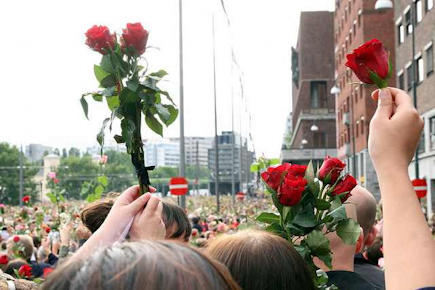
Love instead of hate: Norway’s reaction after the terror attack. Photo: Erik F. Brandsborg, Aktiv I Oslo.no, flickr

Many new comments by anthropologists have appeared since my first post on the terror attack in Oslo. Here is a quick overview:

Cicilie Fagerlid: Slow attempts at making sense: Oslo 22/7, 30.7.11:

What good is it to devote my professional life to understanding nationalism, belonging, community cohesion, conceptions of difference and the like when I have done nothing to prevent the worst thinkable acts of violence to take place in my own country? Especially since I think – or I’m sure – that I’ve felt there was a need for worry (but of course, not to this unconceivable degree…). For several days now I’ve been thinking about how I can contribute. How can I contribute in the best way with my knowledge (of living with difference in Europe), my concern (for the future of us all) and my devotion (to work for a better world)?

Simone Abram: ‘Evil can murder a person, but never defeat a whole people’ (Savage Minds 26.7.):

Responses to the tragedy this weekend have included the massed flying of flags, using flag symbols as facebook identifiers, and so forth. (…) The tying together of national symbols with talk of love reinforces a sense of moral good associated with the Norwegian nation, and reappropriates the nation from racist nationalism. But in this endless tussle between a nation of care and an exclusive people, it seems that racism is the shadow-concept of nationalism. Nationalism is alive and well, and racism continues to creep along in its underbelly.
(…)
In a country where Social Anthropology is one of the more popular subjects for study at university, and where anthropologists retain a high media profile, the persistence of racist ideologies and acts and their resistance to rational argument raise difficult questions.

Sindre Bangstad: The Hatred in Our Own Eyes (Excerpt translated into English by stalinsmoustace 27.7.11):

Norway has produced Europe’s first anti-Muslim terrorist. It seems, however, that the public narrative about him and his actions will not accurately emphasise what is said concerning the direction Norway as a society has taken in the Islamophobic era.

No matter how many bombing raids Norwegian pilots conduct in Muslim countries, no matter how many innocent civilians are killed by Norwegian soldiers in the same countries, and regardless of how much the public debate about Muslims and Islam in Norway has been wallowing in the gutter, one thing is clear: We will not face the hatred in our own eyes.

(see also an article by him Fighting words that are not fought, written a month before the attack about Norwegian mainstream anti-Muslim discourse)

Thomas Hylland Eriksen: Anders Behring Breivik: Tunnel vision in an online world (Guardian 25.7.11):

Norway’s extremists don’t tend to gather in visible ‘rightwing groups’. But online, they settle into a subculture of resentment. (…) The fact that Breivik was Made in Norway, a homegrown terrorist with a hairdo and an appearance suggesting the west end of Oslo, and not a bearded foreign import, should lead not only to a closer examination of these networks, but also to a calm, but critical reflection over the Norwegian self-identity itself.

Thomas Hylland Eriksen and Jostein Gaarder: A Blogosphere of Bigots (New York Times 28.7.11):

The racism and bigotry that have simmered for years on anti-Islamic and anti-immigration Web sites in Norway and other European countries and in the United States made it possible for him to believe he was acting on behalf of a community that would thank him.

Martijn de Koning: Radicalization Series V: Freedom Fighters, Conflict and Culture Talk (Closer, 27.7.11):

It is important I think to see how his ideas (but not his actions) not only are derived from bloggers and politicians but also who they resonate with and are grounded on a grassroots everyday level. I also think the Netherlands can give some clues to that and is relevant here since Breivik partly derived his inspiration from Wilders’ Freedom Party ideology.

Johannes Wilm: 29/07: Terror in Norway – more democracy or more surveillance?:

Nice. So even though the only terror attack so far came from the anti-Islamists, PST (Norwegian FBI) does not see much of a threat in them, whereas they believe that Islamists continue to pose the main problem in Norway it seems.

UPDATE: Thomas Hylland Eriksen sums up in a guest post at anthropologyworks:

It was only a matter of hours between the blast in central Oslo and my most extensive and exhausting engagement with international media since I started out as an anthropologist in the 1980s. Between Friday night and Wednesday, I spoke on radio, on television (via a mobile phone), to newspapers and magazines from China to Chile, and wrote articles for nearly a dozen publications in five countries.

My priorities shifted in a matter of hours. Our holiday house was turned into a makeshift media centre, and the computer was online almost 24/7.

Interesting article about biased terror research in the age of neoliberalism by Charles Kurzman: Where Are All the Islamic Terrorists?, The Chronicle Review, 31.7.11

The more that non-Muslims fear Islam, the more security threats are hyped, the more attention my colleagues and I get. I am in the awkward position of undermining the importance of my own field. My research finds that Islamic terrorism has not posed as large a threat as reporters and the public think.

Check also the most recent round-up by Erkan Saka and my first post: Terror in Oslo: Who cares about Christian right wing extremism?

SEE ALSO:

Racism: The Five Major Challenges for Anthropology

What is terrorism? Selected quotes from “On Suicide Bombing” by Talal Asad

How to challenge Us-and-Them thinking? Interview with Thomas Hylland Eriksen

For an Anthropology of Cosmopolitanism

– Highlight the connections between people!

Love instead of hate: Norway's reaction after the terror attack. Photo: Erik F. Brandsborg, Aktiv I Oslo.no, flickr

Many new comments by anthropologists have appeared since my first post on the terror attack in Oslo. Here is a quick overview:

Cicilie…

Read more

“Difficult to read, chaotic, bothering conclusions”

Russia has one of the fastest-growing rates of HIV infection in the world, and the Church remains its only resource for fighting these diseases.

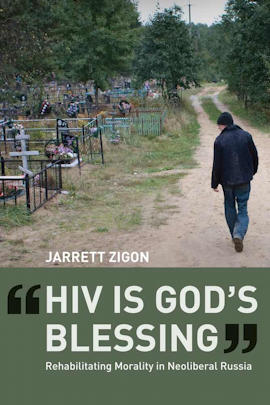
Antropologi.info contributor Aleksandra Bartoszko reviews Jarret Zigon’s recent book „HIV Is God’s Blessing”. Zigon takes the reader into a Church-run treatment center near St. Petersburg that employs both priests and psychologists to work with the HIV-infected drug users.

—-

Review: HIV Is God’s Blessing. Rehabilitating Morality in Neoliberal Russia by Jarret Zigon, University of California Press, Berkley, 2011

Aleksandra Bartoszko, Oslo University Hospital

While I was finishing my review of Jarret Zigon’s recent book „HIV Is God’s Blessing”, Somatosphere has just published a review written by Tomas Matza.

When I read it, I was slightly surprised. I asked myself if we read the same book and why have I focused on totally different points while thinking of Zigon’s work.

I believe that one of the reasons for the huge discrepancy between what the two of us have learned from reading is our fields of research and interests we had in this book. As I am not too familiar with anthropology of morality and ethics, and many theoretical discussions in the book were pretty new to me, I must admit that this book did not invite me to further exploration of the subject. The book was difficult to read, a little bit chaotic and badly edited.

What Is this Book About?

Jarrett Zigon’s book „HIV Is God’s Blessing”, according to the publisher:

„examines the role of today’s Russian Orthodox Church in the treatment of HIV/AIDS. Russia has one of the fastest-growing rates of HIV infection in the world – 80 percent from intravenous drug use and the Church remains its only resource for fighting these diseases. Jarrett Zigon takes the reader into a Church-run treatment center where, along with self-transformational and religious approaches, he explores broader anthropological questions of morality, ethics, what constitutes a “normal” life, and who defines it as such. Zigon argues that this rare Russian partnership between sacred and political power carries unintended consequences: even as the Church condemns the influence of globalization as the root of the problem it seeks to combat, its programs are cultivating citizen-subjects ready for self-governance and responsibility, and better attuned to a world the Church ultimately opposes.”

As an ethnographic case Zigon takes a rehabilitation centre near St. Petersburg called The Mill, which is a cooperation between secular NGOs and Russian Orthodox Church, employing thus both priests and psychologists to work with the HIV-infected drug users. Zigon follows his informants both in the rehabilitation centre as well as the recruitment process in the city, and he is attending events arranged by the NGOs and Church outside the Mill.


Writing and the Art of Repetition

How the book is written and its style is usually mentioned at the end of every review. Unfortunately, when it comes to this book, the writing style was so disturbing that it influenced my overall reception of the book. I like some of the stylistic choices, like the description of the road leading to the rehabilitation centre, which I read as a metaphor for the social position of the centre and the life history of the rehabilitants (p. 33).

But unfortunately the book suffers from a very poor editorial work. There are a lot of redundancies, repetitions and the language itself creates at times confusion. It is hard to read this book. The excessive repetitiveness is most disturbing. Usually, there is nothing wrong with repeating, especially for learning purposes, but in this case this is just too heavy and achieving, in my opinion, a ludicrous dimension.

[teaserbreak]

Not to be ungrounded, I am giving an example. These sentences appeared at 3 pages:

„To live sanely in the world, then, is to a large degree to live what Russians call a normal life. But to live normal life, or a sane life, is not to live a life determined by any one discursive and authoritative structure (…) To be normal is not to adhere to one specific way of living – or one specific disciplinary and discursive tradition – but to live within an acceptable range of what counts as normal. (…) In other words, the social world is a range of possibilities, and to live it sanely is to have the sensibility for negotiating these possibilities. (…) That is, as persons work on themselves to fit themselves within the range of what counts as normal, this range is itself altered. (…) There is no one normal life. Just as in statistical analysis normal indicates a distribution, so too a normal life can be conceived of as a distribution of possibilities. (…) That is to say, responsibilized freedom as a „formula of rule“ is that which allows persons to negotiate the range of possible discursive traditions, and thus the range of possible ways of living normally in a social world“ (pp. 226-229)

Methodology and Analysis

Like most of the contemporary anthropological monographies, the book unfortunately does not offer any extensive presentation of method used during the fieldwork. The author is also sparse in presenting reflections regarding access to field, communication with informants and methodological challenges at all. We are presented with some reflections regarding the author’s presence during the activities in the centre. These are of great value.

The author presents also a good deal of quotes, so there is more «talking» from the fieldwork, than «doing», and thus description of how the rehabilitants actually are «working on themselves» (p. 196) is pretty thin. This might be a reason for the ethic/emic problem in the book.

Zigon’s normative explanations and conclusions are bothering. At times I even think that he puts words in mouths of his informants. He writes extensively on what the Church means, thinks and wants to do, but when the author does not present any sources, documents, and provides only a small number of references, it is difficult to know where the information, and thus data and conclusions, come from. This lack of methodological transparency worries me. I would also like to know how the informants themselves perceive the «Soviet times» which Zigon refers to, and what kind of change they experienced. It is often unclear where Zigon’s knowledge of the “Soviet Man” and Soviet society is taken from except from a rather uncritical use of Oleg Kharkhordin’s book „The Collective and the individual in Russia”. In this way I experienced Zigon’s text as slightly stereotypic.

I also did not like the way Zigon makes generalizations which anthropologists should try to avoid. We often read «Russian mean…» (p. 13) and we read of “American drug program” or “American context” (p. 193). We all know there are different groups of Russians, different ways of seeing the world, life and morality. We also know that there are thousands of rehabilitation programs in USA, so in my opinion speaking about American rehabilitation is not a fruitful way of comparison. Lack of nuances is also disturbing in presentation of the rehabilitation program at the Mill. I would like to know more about the relation of the rehabilitation program and the Church itself.

Rehabilitation and Normality

The book still has something to offer, although I needed to work really hard to dig up the essence of some of the most important ideas of the book. And still, I am not sure if I was able to grasp it. One of the biggest contributions which I see in this book is the processual approach to rehabilitation. Zigon writes:

”That the rehabilitation process is not simply about overcoming addiction. If this were the case, nearly all rehabilitation programs would be considered failures, since studies show that up to 60 percent of clients treated for alcohol or other drug dependence begin to actively use again within a year. There must be something more to this process” (p.3)

I believe that his understanding of rehabilitation as a process is a very important point which should be taken up not only by anthropologists and social scientists, but also by health personnel working on both physical and mental rehabilitation. The book contributes to the rehabilitation study indeed. And the approach can (and should) be applied also to the strictly (if existent) physical rehabilitation. The book adds also some interesting perspectives to normality discussion, which appears mostly in disability studies and medical anthropology. Zigon presents some interesting and new examples on the notion of normality and sane life.

Responsibility

Zigon devotes a significant part of his book to the idea of responsibility, and the changes surrounding the concept and experience of responsibility in the light of neoliberal discourses. This is an interesting idea and I was looking forward to reading Zigon’s exploration of this subject.

Nevertheless, the author’s reflections lack consequence. To me it was difficult to grasp what kind of changes in the ideas of and perception of responsibility actually had happened. As he included historical perspective and presents extensively the Soviet Man (also, a little bit unclear on what basis but Kharkhordin’s book), he also presents the “responsibilized Soviet person” (p. 103). At the same time he writes that responsibility is a neoliberal feature (intro, p. 104, 105). The difference between the „responsibilized subjects” of neoliberalism and during the Soviet period stays still unclear to me.

Neoliberalism(s)

Interested in studies of post-socialism and political changes in Eastern Europe, I was looking forward to reading this book and hoped for an intricate text on changes in neoliberal Russia in relation to church, HIV-patients, drug abusers and healing process at all. Unfortunately, the author seems to stay in rather unfruitful and uncreative thinking box: yet another text which is based on the distinction neoliberalism vs. … Yes, exactly versus what?

The author set up neoliberalism against the Russian Orthodox Church values or Soviet values (when it suits better, is my impression), but the values that he seems to define by himself. His starting point is his own opinions and taken-for-granted, almost populist visions on what neoliberalism is about. Therefore I was extremely happy to read finally (p. 181):

„Many of the values, reasonings, and practices may be quite similar across many global assemblages, but the kinds of persons and the processes by which they come to embody them locally may be quite different. For this reason it may be more appropriate to speak of neoliberalisms”.

To me, this point is the most important part of the book. And probably most innovative and brave. Anthropologists tend to work on the discourses of neoliberalism as if they forgot about the locally based communities and the different ways of dealing with the global economy, neoliberal politics and so on. I was therefore delighted to read that Zigon made this kind of reflection and pointed to the nuances in speaking of neoliberalism and neoliberal life and person. Therefore it was also a huge disappointment that on the pages following this important reflection he seems to be back to the stereotypical thinking of neoliberalism as a phenomena or term that stands for itself.

Both before this reflection appears in the book and after, Zigon seems to use the notion of neoliberalism still as a statical, encompassing and all-covering term. And he consequently uses this term in a non-dynamic and generalizing way.

His generalizations are also confusing regarding his own ideas and understanding of neoliberalism by the informants. When he quotes one of Caroline Humphrey’s informants, he concludes for example: ”Zhenia’s comments are not meant to be critical of the dominant discourse and way of life of neoberalism” (p. 151). It is difficult to not know what he means here by life of neoliberalism. And what most important, what Zhenia means by life of neoliberalism? This kind of confronting individuals with the often abstract to them discourses is difficult enterprise, and I am not sure that Zigon has managed to do it.

Punishment from God and Illness Explanatory Models

Regarding HIV/AIDS patients and understanding of the disease and illness experience, Zigon offers an interesting insight into the perception of both the drug abusers and the employees at the rehabilitation centre. As the title of the book suggests, the readers will be given an understanding of perspective that connects getting sick and believing in God. The dominating perspective amongst his informants working for the rehabilitation centre and who shared the view of the Church was that getting sick was ”punishment from God for the immoral acts that led to infection” (p. 58).

To readers who are familiar with different explanatory models regarding illness and disease, and especially models which include religion, this statement is not new, and I would like to hear more analysis around this statement than what the author offers. Unfortunately, Zigon does not challenge his informants to give other explanations. It is hard for me to believe that the informants’ own reflection on their life, life of the rehabilitants and disease was limited to the moral dimension, mostly circulating around the notion of punishment. Zigon was obviously in search of the moral dimension and thus he found morality discourse everywhere.

It would be also interesting to read more about how the rehabilitants themselves understand their disease and to what degree they share the Church view on sin. This subject is undercommunicated, in my opinion. I supposed that anthropologists interested in illness experience, would also find it interesting to read more explicitly how rehabilitating morality influences this experience. Of course, this was not main focus of Zigon’s book. Nevertheless, his ethnography and some of the theoretical discussions on rehabilitation and morality invites to see these in the broader context of illness experience as presented in medical anthropology.

Missing Theoretical Discussion

Zigon devotes also a significant space on the secular vs. sacred distinction. It is thus surprising that there is no theorizing on the subjects to be found in the book. Zigon presents his conclusion that it is not easy to separate these two and tell what kind of social action or phenomena are secular or sacred, but without any following (or preceding) discussion on the subject.

Even if not explicitly written, this book is about social change. While Zigon writes about the Soviet society, he mentions phenomena that according to him are „typical” to change from socialist to post-socialist society. And in this respect, he follows the tendencies amongst scholars of „post-socialism” who often forget that a lot of phenomena that happens, let’s say in Eastern Europe, are typical to every society in change, not only the post-socialist ones. In order to keep the comparative perspective that used to be so fundamental in anthropology, anthropologists of post-socialism need to include in their research more reflections which do not limit their research and theoretical work to post-socialist societies or Eastern Europe.

In this respect, I also felt like the discussion on continuity vs. discontinuity is completely omitted in the book. It is methodologically challenging to determine whether social phenomena are inherited from an old order or whether they are an expression of a new situation, and anthropologists should show caution so as not to find the “socialist legacy” where it does not exist. And I agree with Nancy Ries who suggests to look at the cultural systems as “’web of significance’ that is constantly woven and rewoven, continually integrating all sorts of historical changes and innovations” (Ries 1997: 22). Still, Zigon work is in a way reducing the complexity of the social process to the model continuity vs. discontinuity without mentioning the problems appearing around this way of thinking of social change.

Works cited:

Ries, N. (1997). Russian Talk. Culture and Conversation During Perestroika. London: Cornell University Press.

Aleksandra Bartoszko is anthropologist, currently working at the Section for Equitable Health Care at Oslo University Hospital and known to antropologi.info readers for her anthropological comic book and her interview about Pecha Kucha as new way of presenting papers. She’s also one of the first fieldbloggers.

The first chapter of the book can be downloaded as pdf. More papers and articles by Zigon are available on his homepage and on Open Democracy

Russia has one of the fastest-growing rates of HIV infection in the world, and the Church remains its only resource for fighting these diseases.

Antropologi.info contributor Aleksandra Bartoszko reviews Jarret Zigon’s recent book „HIV Is God’s Blessing”. Zigon takes the…

Read more

Thesis: Neoliberal policies, urban segregation and the Egyptian revolution


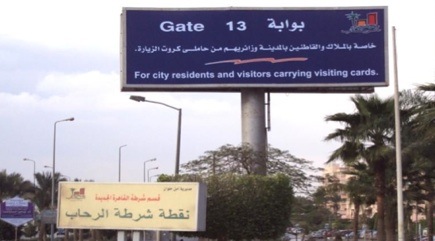
Gated communities: Access denied for outsiders. Photo: Safaa Marafi

While Cairo’s slum areas are growing, the richest layer of the society is enjoying a luxury life in privately guarded communities in safe distance from the lower classes. Hosni Mubarak’s neoliberal dream of segregation seems to have come true. But during the Egyptian revolution some of the young people have started to tear down the walls of their gated communities.

Safaa Marafi from the American University in Cairo (AUC) tells us in her well-written anthropology thesis the story of the giant segregation projects of the Mubarak regime. She has conducted fieldwork in Al-Rehab, one of those gated communities constructed on desert land, where the middle- and upperclass isolate themselves, shop in luxury malls, use private door-to-door limousine services and send their children to private schools or universities.

It’s a thesis about how neoliberal policies threaten the cohesion of a society.

The development of gated communities was part of Egypts neoliberal policies under Mubarak. In the late 1990s, Egypt underwent a process of structural adjustment guided by international financial organizations (Worldbank, IMF etc), which led to further privatization and liberalization of the economy. The most visible outcome has been land speculation, Marafi expains:

This segregation began when the Egyptian Ministry of Housing sold massive amounts of desert land, situated at the margins of Cairo, to private corporations. Approximately 320 private corporations purchased portions of this land and planned projects for a potential 600 thousand housing units (Denis 2006:52). This expansion process resulted in the construction of numerous gated communities in the suburbs of greater Cairo.

The Neoliberal Dream of Segregation

The Mubarak-government and its “clique of businessmen” were driven by a “neoliberal dream of segregation” – a term coined by sociologist Mona Abaza:

The neoliberal dream of segregation can be defined as a political-economic agenda adopted by the Egyptian government, which fostered and supported rich local and foreign investors in building gated communities in Cairo‘s suburbs. By constructing these enclaves for the richest layer of Egyptian society, these development projects created a physical segregation in Cairo‘s urban fabric. This segregation is evidenced by the way the residents of these hinterlands are protected by private security systems, walls and/or fences, gates, and private security guards.

“Neoliberal policies”, Marafi writes, “have encouraged class-based urban segregation, leading to polarization in the urban fabric.” The adoption of neoliberal polices turned the state into a private territory, where wealth is monopolized by political elites and businessmen.

Moral panic towards the lower classes

This segregation is not only related to space but also related to the mind.

Living in this gated communities intensifies the mood of moral panic felt towards the other – people from lower classes. “This is”, the anthropologist explains, “because they believe that their community is labeled as a rich one and therefore may be a target of potential criminals. State and media contributed to the fear of the other. Not only the marketing campaigns of gated communities seek to convince potential buyers that outside of the gates, fences, and walls of these closed venues lies a dangerous world. The consequence is a “culture of fear”.

Many residents, especially in recent times, moved to Rehab for class and safety reasons. They wanted to isolate themselves from the other. But soon they had to realise that they cannot live without “the uncivilized others”. They are dependent on them. For who shall clean their houses, deliver food, and patrol the streets to protect them? The supposed enemy and security threat is living among them!

Culture of fear

The residents feel a need to apply extra security measures. Despite these measures taken by the participants, the private security department of Al-Rehab, and the public police, the participants‘ fears are not alleviated, Marafi writes.

Security cameras, intrusion alarms, extra secure locks, as well as guard-dogs, can all be observed in the community. In addition, there are some shops which sell extra-large security lamps to be attached onto the roofs of villas.

In many villas, the use of such lamps as security tools makes the villas look more like military buildings at night, rather than family residences.

In addition, surveillance real and fake cameras are among other security methods implemented by other participants. Fake cameras are sold in at least one of the most popular electronics shops in the souk of Al-Rehab.

Some residents don’t even trust the security guards. Nora is one of them. Private security, she points out, relies on guards, and as they are humans they might fall asleep while on the job. Moreover, Nora claims that there are some cases where private security guards collaborated with criminals.

The private security guards themselves are aware of the distrust felt by the residents. Security guard Hanafi tells about Sara:

Madam Sara drives every night and checks the kiosks of the security guards located around her villa. If she does not find a security guard in any of these kiosks, she takes a picture of the empty kiosk with her camera and sends the picture to the security department. The security department trusts her word over the security guards and punishes those guards who were not in their positions or patrol areas. Also, she reports to the security department if she finds any of the security guards falling asleep, and she also takes pictures of them as evidence.

Being protected creates a sense of superiority

The anthropologist has noticed that classist phrases are used frequently. Being protected by private security guards and systems creates a sense of superiority.

When for example Nora explains why she moved to Rehab, she stresses that she wanted her son to live in a “clean neighborhood” when he gets married. Mohandessin, where they lived previously, “became old-fashioned”, populated by lower classes and “polluted”. In Rehab, on the contrary, reside “clean people”, their neighbors are “respectful” and “civilized people”.

Marafi comments:

The prejudicial connotations of these elitist, classist notions of newness, civilization, cleanness and decency indicate a desire for urban segregation and a keeping of distance from “the other”: the dirty, polluted, and uncivilized.

Security measures are also used to show wealth and status (“conspicouos consumption”). Some of the residents design security bars using branded logos, such as Versace. Others paint their security bars in different colors, such as white, to differentiate themselves from others (“aesthetic security”).

It is obvious to see primarily the poor as victim of neoliberal policies. Safaa Marafi suggests a different view:

While slums are stigmatized by poverty, gated communities are labeled by their richness. It is not that one group should be victimized over the other, but they both ought to be understood as victims of the implementation of the neoliberal segregation policy.

Breaking the walls

But her thesis has a somehow “happy ending” (depending on your world view of course), caused by the 25th January Revolution.

While the political participation of the residents previously has been rather low and there was a “noticeable sense of detachment” from any involvement with earlier protest movements, things have been slowling changing:

In the beginning of this unexpected revolution, none of my participants showed interest in joining the peaceful protests. (…) Yet, as I learned, a few of Al-Rehab‘s youth are active agents in this revolution. The neoliberal segregation plays a role in detaching many, but not all, of the residents of Al-Rehab. The youth especially were the ones participating in the political sphere. (…) Optimistically, this tells us that some of the youth of Al-Rehab want to be part of the world outside their gated community.

Safaa Marafi sent me a video from the youth celebration in Rehab after the announcement of the resignation of President Hosni Mubarak on 11th February 2011. “The quality is is not that good”, she admits, “but its content is very important as it shows how the youth of the gated community are breaking the walls of their gated community and want to be part of the outside world”.

[video:flow:http://www.antropologi.info/blog/anthropology/media/rehab]

Her thesis can be downloaded here on antropologi.info:

Safaa Marafi: The Neoliberal Dream of Segregation. Rethinking Gated Communities in Greater Cairo. A Case Study. Al-Rehab City Gated Community (pdf, 2.7MB)

An earlier version is available at the digital archive of the AUC (DAR)

SEE ALSO:

Ethnographic Research: Gated Communities Don’t Lead to Security

“The insecure American needs help by anthropologists”

Why borders don’t help – An engaged anthropology of the US-Mexican border

Criticizes “scholarly and political indifference toward the workers’ lives”

– Use Anthropology to Build A Human Economy

Saba Mahmood: Democracy is not enough – Anthropologists on the Arab revolution part II

Cautioning Against Security Fundamentalism

Gated communities: Access denied for outsiders. Photo: Safaa Marafi

While Cairo’s slum areas are growing, the richest layer of the society is enjoying a luxury life in privately guarded communities in safe distance from the lower classes. Hosni Mubarak’s…

Read more