Janine Wedel has done something that far too few anthropolologists do: She studied powerful people. Those who rule the world.
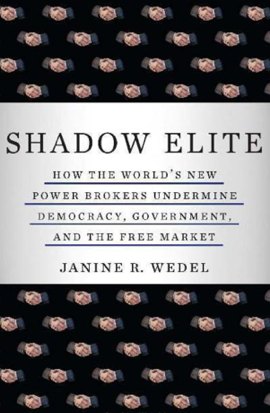
In her book “Shadow Elite“, she shows how a new system of power and influence has taken hold globally, one that undermines democracy, government, and the free market.
Why went America to war against Iraq? More and more “government work” is performed by “shadow elites”: consulting firms, companies, nongovernmental organizations, think tanks etc, rather small circles of powerful people (she calls them “flexians”) who use their interlocking relationships to control public policy without public input. “Flexians” work often for private interests, academia and government at the same time.
The flexians form “Flex nets”. They cannot be reduced to lobbyists or interest groups. They are according to a review in the Financial Times defined by four features:
1) personalizing bureaucracy, or using personal connections and loyalties to realize goals;
2) privatizing information while branding conviction, or branding the information available only to insiders in this game;
3) juggling roles and representations, or changing spots frequently, wearing the pelt of military leader one day, analyst the next, and concerned citizen the next;
4) relaxing rules at the interstices of official and private institutions, or adjusting accountability and rules that apply to one or more of their pelts from the safety of a seemingly non-aligned position.
One of those flexians is the retired US general Barry McCaffrey, who has been simultaneously a commentator for the media, a consultant to the defence industry and professor. According to a 2008 exposé in the New York Times, he was one of several former military men who helped to shape public opinion on the Iraq war, while simultaneously having undisclosed ties to the Pentagon.
Wedel’s book has received quite a lot of media attention since it was released earlier this year. It was book of the month at Huffington Post (where she has started writing a weekly column) and was also reviewed in mainstream media. She was interviewed both by BBC, Russia Today, MSNBC and Al Jazeera.
Riz Khan - Shadow Elite - 15 dec 09 - Pt 1
Riz Khan - Shadow Elite - 15 dec 09 - Pt 2
It would be interesting to know how she studied the “shadow elites”. Has she been on fieldwork? I haven’t read all her texts. But in her newest article in Huffington Post, she explains how she came to understand the game: through her experience studying the mechanisms of power and influence in post-Cold War eastern Europe for about 30 years:
(E)xamining eastern Europe up close–through its transformations away from communism over the last quarter century–has been excellent preparation for making sense of how a small group of power brokers helped engineer the invasion of Iraq, and more broadly, how a new system of power and influence has taken hold globally, one that, as I write in my book Shadow Elite, undermines democracy, government, and the free market.
In communist Poland, the necessity of getting around the state-controlled system created a society whose lifeblood–just beneath the surface–was vital information, circulated only among friends and trusted colleagues, information that was not publicly available. Under-the-radar dealings that often played on the margins of legality – this was the norm, not the exception.
(…)
I began to recognize a familiar (to me) architecture of power and influence. I started to follow the networks and overlapping connections in government, foundations, think tanks, and business of a tiny set of neoconservatives – just a dozen or so players I call the “Neocon core”.
(…)
The playbook of the Neocon core seemed to come straight from that of the top players of transitional eastern Europe. In both cases, players who already knew each other set up a host of organizations–organizations that seemed more like an extended family franchise than think tank, populated by the same set of individuals. (…) And despite a new administration in Washington, not to mention the damage done to their credibility since the Iraq invasion, the Neocon core lives on, because networks like it are self-propelling, multipurpose, and enduring.
And she adds that as a social anthropologist, her “focus is not on whether the U.S. should have invaded Iraq, but rather how that decision was made, who made it, and what mechanisms of power and influence were used to make it”.
I have concluded that an ethnographic focus is indispensable to sorting out power and influence amid transforming federal governance in the United States, not only under change-of-system conditions such as those found in transitional eastern Europe.
The ethnographic sensibility that enabled scholars of communist and post-communist societies to deal with the complexity, ambiguity and messiness of political and policy processes is ideally suited to examine the interactions between public policy and private interests and the mixing of state, nongovernmental, and business forms that are increasingly preva- lent in the United States and around the world.
By focusing on players and their networks as drivers of governing and policy decisions, these ethnographers have laid the groundwork for badly needed critiques of social science categories such as “state” versus “private,” “top-down versus bottom-up,” and “centralized” versus “decentralized.” They have provided a basis for reexamining conventional models that guide so much thinking about politics, policy and power, and yet obfuscate, rather than illuminate, the real system of power and influence.
My post Pecha Kucha – the future of presenting papers? received much attention and inspired others to arrange such sessions where papers are not read but presented through 20 images displayed for 20 seconds each. But I’m no longer sure if I would recommend Pecha Kucha after having received this email a few days ago:
To Lorenz Khazaleh,
This is Jean from PechaKucha HQ here in Tokyo. It has come to our attention that you recently organized a PechaKucha event without our consent.
The PechaKucha name, logo, and format are all trademarked concepts, and as we clearly indicate on our site, we ask that anyone who is interested in running a PK event get in touch, as we have a review and agreement process that we go through.
http://pecha-kucha.org/night/start-a-city
We do support one-off events as well, but again, they are all officially sanction.
http://pecha-kucha.org/events/
We hope to hear back from you very shortly to prevent this from happening again.
—
Jean Snow
PechaKucha Night
founded by Astrid Klein and Mark Dytham in Tokyo
http://pecha-kucha.org
I first couldn’t believe what I read. A review and agreement process? Trademarking an idea? Is there a dubious commercial corporation behind Pecha Kucha? (And apart from that – I did not arrange a PK session, but only interviewed two participants.)
As I learnt on their website, you will need to go through a lot of bureaucracy, especially if you intend to arrange Pecha Kucha Nights. You’ll have to meet a lot of requirements and be prepared for providing lots of details about yourself and your team.
As we are now inundated with similar requests from across the world, we would love to know more about you!!! – your design background, design connections, events experience, ideas about venues, designers you would approach to present their work etc….Once we receive [your background/plans] we can review everything and get back in touch! KDa own the Registered Trademark for Pecha Kucha Night, 20 x 20 in the UK, Europe and US and if we decide to proceed we can provide you with the logos, templates and formats and our standard handshake agreement in order for you to get started!
As the Pecha Kuchs trademark owners explain on their website, they “sometimes say yes and sometimes say no – so be prepared for both answers”. And normally it takes them “a month or so” to grant PKN “handshake” agreements.
Nevertheless, the Pecha Kucha format is great. So the best thing might be to call it something different, like speed presentations or so, a term that Greg Downey introduced last year at Neuroanthropology.net, create your own logos etc Good luck!
My post Pecha Kucha - the future of presenting papers? received much attention and inspired others to arrange such sessions where papers are not read but presented through 20 images displayed for 20 seconds each. But I'm no longer sure…
For the second time, Associated Press has engaged anthropologists in order to improve its services. The first research project, conducted by Context-Based Research Group, revealed that people – contrary to what AP believed – wanted more breadth and depth instead of short blasts of news. The new study shows that news consumers want a two-way conversation instead of one-way bombardment:
It is not just that people feel overloaded. As consumers, they long for a better way to communicate with information providers – news companies and advertisers alike. They want that communication to be two-way, transparent and honest. They seek a new relationship that is built on trust, not simply on the value of the content or advertising itself.
“You have to socialize the space before you can monetize it,” Robbie Blinkoff, principal anthropologist for Context, concluded. “The solution is not just to create more engaging content, but to create better environments for engaging with content.”
In the report, Blinkoff used Victor Turner‘s concept “Communitas” – something that APs Vice President Jim Kennedy Vice President called “an interesting bit of cultural theory”:
He called Communitas a time of egalitarian information sharing which can be harnessed to rebuild trust between information providers and consumers. He likened Communitas to the social networking phenomenon online, where consumers feel comfortable engaging with information among their friends and peer groups. (…) With Communitas, there is no such thing as one-way communication. There are only two-way conversations that inspire loyalty and trust, and those are key ingredients with the power to cut through the clutter of the Internet.
Both studies are based on ethnographic research methods. The researchers tracked and analyzed the behavior of individuals in their work and home environments.
AP seems to be fascinated by anthropological methods. “One of the keys to understanding how to address the situation”, AP writes, “has been the extraordinary insight enabled by the Context methodology”:
Context does ethnographic research, meaning it studies small groups of people up close to get at the root of their behavior. That “Deep Structure,” as Context calls it, opens up a view of how companies can respond to cultural changes that aren’t so obvious on the surface.
For the second time, Associated Press has engaged anthropologists in order to improve its services. The first research project, conducted by Context-Based Research Group, revealed that people - contrary to what AP believed - wanted more breadth and depth…
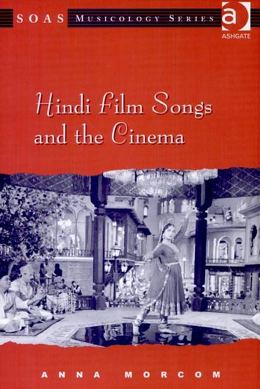
There are only few studies on popular music in South Asia. Tereza Kuldova (Tereza Kuldova) reviews for us the book Hindi Film Songs and the Cinema by ethnomusicologist Anna Morcom. Her review shows – among other things – the differences and barriers between anthropology and ethnomusicology.
—–
Review: Hindi Film Songs and the Cinema by Anna Morcom, 2007, Ashgate, ISBN 978-0-7546-5198-7
Tereza Kuldova, Research Fellow, Museum of Cultural History, Department of Ethnography University of Oslo
Main Yahaan Hoon Song | Veer-Zaara | Shah Rukh Khan, Preity Zinta | Madan Mohan, Udit Narayan
Popular music in South Asia equals film music, however, even though its popularity is immense, it has been a very little studied phenomenon. This is even more startling when we realize that film songs “have become the music of public spaces in India, being heard from open windows in peoples’ homes, on buses and in bazaars. They are sung and danced to by millions of people in a range of formal and informal contexts, and have been appropriated in many folk genres” (p. 5) and they are thus literally omnipresent. This book thus must get credit for the choice of its subject matter, in the first place.
This book deals with the relationship between Hindi film songs and Hindi films and analyzes them in their cinematic, narrative and visual contexts. The ongoing agenda of the book seems to be to persuade us that the Hindi film song cannot be separated from the Hindi film, which is however a rather obvious fact to any viewer of Hindi film. The only thing I have to say to this is – there is a reason why it is called a film song and ergo, how could the song ever be truly independent or separated from its film context?
Another concern of the book is the definition of the Hindi film song genre as an independent style. Anyone following the Hindi cinema knows that Hindi film songs are extremely creative and varied, drawing on great diversity of inspiration and adjusting it to the particular needs of concrete scenes, and it thus might not be that easy to define them in terms of any style. Moreover, I wonder, do we really have to categorize these songs in terms of any style? What do we gain by that? Well, the answer may be that we gain statements such as follows:
“Amongst an array of inconsistent or over-general stylistic parameters, the only true constant in Hindi film songs is their ‘inclusion in a Hindi film’” (p. 70).
That was not a very surprising fact, was it? The intense argumentation for the analysis of Hindi film songs in relation to the cinematic context, however commonsense, obvious and at times felt as redundant and repetitive is certainly not so obvious within musicology. Because as Morcom argues ”the cinematic perspective of Hindi film songs has been ignored, with musicological studies largely viewing them as separate entities from their parent films” (p.7). So possibly Morcom might get credit for introducing a notion that is rather and straightforward to any consumer of Hindi film songs to the musicological studies.
The conclusion of the books are thus following:
“Far from being an independent tradition of popular songs, this book has found film songs to be profoundly integrated with Hindi films on many levels. Film songs are conceived as part of a particular film, and the musical style of each song is tailored to the parent film and the song scene.
In commercial terms, although film songs have become a big business since the late 1980s, their profitability is only exploitable in association with the Hindi cinema. Even after their release, the consumption of film songs is largely tied up with the Hindi cinema generally, and to some extent, with the parent film in particular.
However, songs are distinct from their cinematic roles and contexts in certain ways, although the degree of this independence varies with each song. As well as tailoring a song musically to a situation, its ability to sound good as a separate entity, its ‘audio value’, is also considered during its production. At the level of reception, audiences are able to appropriate songs and adapt them to new situations, which in some cases may result in the relationship with the parent film and cinema culture in general becoming obscure, or even disappearing entirely. Hindi films have a narrative style and structure that is designed for songs, and similarly, film songs are able to fit around cinematic scenes (p. 239).”
Now that we have begun paradoxically with the conclusion, let us get through the book chapter for chapter.
In the first chapter (available online here), we are presented with the argument for the study of the Hindi film songs through a multimedia model of analysis, which takes into account the context of the film songs in their parent films, their narrative and visuals as well as their production process. However, there is no attempt to frame this whole analysis in the context of Indian society or its changing historical realities (even though the book discusses the different periods in the evolution of the Indian cinema).
We also get to know that the work draws extensively on fieldwork in India, from 1998-2000 and read that the “fieldwork was ethnographically based” and “aimed to study film music through observing, fitting in with and joining in with its own people and culture” (p. 20). However, when we proceed to the second chapter which is concerned with the production of the Hindi film songs, and which is supposed to draw almost exclusively on fieldwork, what is presented to us are mostly excessive and in terms of content repetitive selections from interview transcripts with producers, music directors, lyricists and others. We do not get to know much about the ethnographic reality as such and any ‘ethnographic’ description in the true sense of the word is missing, except for the practical aspects of the production process, in which the roles of the director, producer, music director, lyricist and others are assessed.
The point of the chapter is again to show that lyrics and music is closely related to what is happening in the film and that it is used to express various emotional states, actions or drama in the scenes.
Let us move on to the third chapter which tries to answer the question of “why are film songs so difficult to categorize in terms of style?” (p. 134). This is clearly a question in musicology, it does not make much sense to the anthropologist writing this review.
The conclusion of this chapter is again not very surprising:
“Film songs seen in one way seem very formulaic and standardized, but seen in another way, they are very eccentric and unpredictable. Film song is required to have a regular enough style and enough musical autonomy to work as popular music, to make sense without the film, and even to advertise film, but at the same time to be specific and idiosyncratic enough to fit around a particular given situation. (…) Film songs need to be seen as multi-media, musico-dramatic entities as well as popular songs in order to make sense of both individual songs and the development of the genre as a whole” (p. 135-6).
For me this last statement equals saying: Hindi film songs need to be seen as what they are.
In the fourth chapter, Morcom addresses the question of the relation between Western music and Hindi films and the role of narrative in Hindi film music style. Supposedly the most striking feature of Hindi film music, as I perceive it (being interested in it intensely in relation to my research and being also its keen consumer), is its eclecticism, namely its ability to borrow and combine different styles and traditions in just one song, and that is what makes it so much fun – and also what makes it possibly so confusing for a musicologist, trying to make sense of it. Morcom poses such questions as “how is this Hollywood music able to communicate apparently successfully to the Indian audience? European and American culture has little to do with Indian music” (p.147) or how is it possible that “various types of non-indigenous music may be conveying narrative meaning to indigenous audiences” (p.157).
She considers “the amount of overlap in musical meaning in Hindi and Hollywood films surprising. Ethnomusicology tends to emphasize the aspects of music that are culture specific” (p. 156). Well, maybe ethnomusicology should consider the option that cultures do not exist in isolation and Morcom should consider India’s colonial history, not to mention its history of thousands of years of cultural contact and exchanges. When what is considered a traditional Muslim floral decorative motif (which can be seen for example on the walls of the Taj) comes originally from the European herbaria, I tend not to really wonder why the ‘indigenous’ population can identify with Western musical elements in Hindi film songs.
Satrangi Re
However, Morcom hits on something interesting when she says that “the direct relationship of many musical signs with feeling, experience and somatic states may be one reason why music has greater potential for mutual understanding than language, whose signs are more highly mediated” (p.157). Sadly, she does not really elaborate on this any further. She concludes saying that:
“(M)any of the ‘Hollywood’ techniques most commonly found in Hindi films conveniently constitute an antithesis of rāg and classical melody, and also of film and folk melody, which are associated to a greater or lesser degree with the sacred, love, romance and celebration. They can therefore be used as powerful means to express distortion, destruction and disturbance of these qualities in a range of dramatic situations (p.178).”
However, they can also be used to express many other different things.
In the fifth chapter, Morcom explores the commercial life of Hindi film songs, in relation to Hindi film, in the context of buying, selling, and marketing. She investigates the technologies of distribution, marketing and profitability of film songs from the first few years of sound film to 2000. This chapter is based on fieldwork; however, that again stands for interviews with people in the industry. The chapter discusses the influence of gramophone, radio, cassettes, dvd, vhs, vcd etc. on the commercial potential of Hindi songs.
Again Morcom struggles with the distinction between marketing Hindi film songs and Hindi films, and we can again and again read sentences such as:
“The marketing of film songs and films are ultimately difficult to distinguish. Trailers using the film songs and visuals from the films are produced by the music company to promote the music, and the music, as it gains ground in the popular culture, promotes the film” (p.195).
Even though this book was published in 2007 it does not really take into account the importance of internet and though she discusses the importance of television and various live shows, it appears to me, that she does not really capture the extent of the industry. Moreover, nowadays there are numerous ‘making of the song/film’ videos available all over the internet, as well as numerous TV-shows featuring the stars, directors, singers, music directors etc. discussing the production and marketing process and many other things. This all is the promotion of the songs. However, though she notes that “these shows add another layer of importance to film songs, but are still parasitic on the cinema” (p.220), she does not really consider them in the analysis any depth.
Emi (Chori Chori Dekhe Mujhko) FULL SONG *HQ*
In the last chapter, Morcom deals with the audience reception of Hindi films and with the life of the film song after its release. She again wonders if the songs are “able to become independent of the context of the parent film or of ‘film culture’ in general” (p.208). She analyzes different charts from several websites, concluding:
“(I)ndividual songs have, to some extent, a life of their own in terms of popularity and may become popular even if the parent film is a flop. However, when it is taken into account that only a minority of films are hits, the songs from hit films can be seen to further dominate the chart” (p.211).
When it comes to appropriation of film songs by the audiences, again a part of the text which is based on fieldwork, we get to know very briefly that people appropriate songs by
singing them,
playing them and singing at various occasions such as weddings, Holi, romancing or using them as devotional songs in the temple,
identifying with them across disparate communities in South Asia and the Diaspora as they refer to shared experience
performing them (from amateurs to professionals).
The conclusion she thus draws is that audiences actively appropriate these songs. However, what is striking when we realize that most of the Hindi film songs are dance songs is the lack of consideration of dance as a form of appropriation. As well as the lack of serious consideration of the movements and gestures in relation to the narrative, lyrics and music as a mode of expression. The embodiment of music and sound is definitely a way of appropriation of music that needs to be considered in any such analysis, and even more so in the analysis of Hindi film songs that rely visually to an extreme degree on bodily movements, gestures and dance scenes.
Reading this book as an anthropologist gave me an insight into on which premises ethnomusicology is established and it certainly thought me to be more sensitive to the various ways in which sound conveys meaning, which is possible the biggest lesson of the book – to give a thought to the various sounds and their interplay with the visual (however I would also include the somatic, emotional and embodied practices) and their ways to express, convey and reproduce meaning. At the same time, I feel that ethnomusicology, as I experienced it though this book, would profit from a more thorough study of anthropology, to get a more nuanced perspective and become more sensitive to the context.
There are only few studies on popular music in South Asia. Tereza Kuldova (Tereza Kuldova) reviews for us the book Hindi Film Songs and the Cinema by ethnomusicologist Anna Morcom. Her review shows - among other things - the differences…
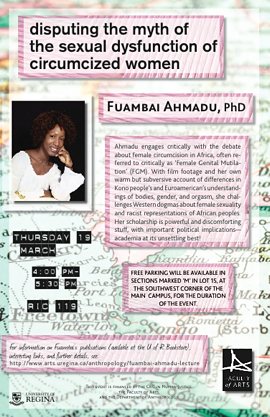
(Links updated 2.2.2021) Is it a good idea to fight against female circumcision? Not neccesarily according to Sierra Leonean-American anthropologist Fuambai Ahmadu.
In an interview in Anthropology Today , she attacks Western feminists, media and anti-Female Genital Mutilation campaigns and accuses them for presenting a one-sided, ethnocentric picture of female circumcision.
A great deal of what is regarded as facts is not true, she explains. Many people think circumcision is a “barbaric tradition” and “violence against women”. But Ahmadu does not see circumcision as mutilation. Circumcision is no notable negative effects on your health and does not inhibit female sexual desire either.
The problem with the representation of various forms of female circumcision as ‘mutilation’ is that the term, among other things, presupposes some irreversible and serious harm. This is not supported by current medical research on female circumcision.
But this research (Obermeyer, Morison etc) has not received any attention in Western media:
However, neither Obermeyer’s reviews nor the Morison et al. study have been mentioned in any major Western press, despite their startling and counter-intuitive findings on female circumcision and health. This is in contrast to the highly publicized Lancet report by the WHO Study Group on FGM, released in June 2006, which received widespread, immediate and sensationalized press coverage highlighting claims about infant and maternal mortality during hospital birth.
Supporters of female circumcision justify the practice on much of the same grounds that they support male circumcision, she says:
The uncircumcised clitoris and penis are considered homologous aesthetically and hygienically: Just as the male foreskin covers the head of the penis, the female foreskin covers the clitoral glans. Both, they argue, lead to build-up of smegma and bacteria in the layers of skin between the hood and glans. This accumulation is thought of as odorous, susceptible to infection and a nuisance to keep clean on a daily basis. Further, circumcised women point to the risks of painful clitoral adhesions that occur in girls and women who do not cleanse properly, and to the requirement of excision as a treatment for these extreme cases. Supporters of female circumcision also point to the risk of clitoral hypertrophy or an enlarged clitoris that resembles a small penis.
For these reasons many circumcised women view the decision to circumcise their daughters as something as obvious as the decision to circumcise sons: why, one woman asked, would any reasonable mother want to burden her daughter with excess clitoral and labial tissue that is unhygienic, unsightly and interferes with sexual penetration, especially if the same mother would choose circumcision to ensure healthy and aesthetically appealing genitalia for her son?
It is important to remove the stigma around circumcision, Ahmadu stresses:
It is my opinion that we need to remove the stigma of mutilation and let all girls know they are beautiful and accepted, no matter what the appearance of their genitalia or their cultural background, lest the myth of sexual dysfunction in circumcised women become a true self-fulfilling prophecy, as Catania and others are increasingly witnessing in their care of circumcised African girls and women.
In an article in The Patriotic Vanguard, she describes the term Female Genital Mutilation as “offensive, divisive, demeaning, inflammatory and absolutely unnecessary”:
As black Africans most of us would never permit anyone to call us by the term “nigger” or “kaffir” in reference to our second-class racial status or in attempts to redress racial inequalities, so initiated Sierra Leonean women (and all circumcised women for that matter) must reject the use of the term “mutilation” to define us and demean our bodies, even as some of us are or fight against the practice.
Anthropologist Carlos D. Londoño Sulkin comments Ahmadu’s talk in Anthropology Today and criticizes his colleagues:
My own sense, after listening to Ahmadu, is that many Euroamericans’ reactions to the removal of any genital flesh is shaped by parochial understandings and perfectly contestable biases and values concerning bodies, gender, sex and pain.
(…)
Many anthropologists, reacting against collectivist social theories and some of the less felicitous entailments of cultural relativism, have joined in the condemnation of female circumcision without first taking counsel from our discipline’s methodological requirement actually to pay attention to what the people we write about say and do about this or that, over an extended period. Listening to Ahmadu, I can no longer condemn the practices of genital cutting in general, nor would I be willing to sign a zero-tolerance petition.
(Links updated 2.2.2021) Is it a good idea to fight against female circumcision? Not neccesarily according to Sierra Leonean-American anthropologist Fuambai Ahmadu.
In an interview in Anthropology Today , she attacks Western feminists, media and anti-Female Genital Mutilation…