

search expand

Back from Lahore: Terror and Open Access

shalamar gardenShalamar Gardens, Lahore

I have been back from Lahore, Pakistan’s cultural center and “City of Poets”, for a while now. It was one of the most inspiring journeys I’ve been to.

Just a few weeks ago we’ve been at the same place where – a few days ago – six policemen were killed and several cricket players from Sri Lanka wounded in a terrorist attack. We were also constantly under police protection. Our hosts were very concerned for our safety.

I went to Lahore to document the conference “Covering Each Other In An Era Of Imagined Clashes Of Civilizations” (see summary in Norwegian), part of the Global Inter-Media Dialogue). Journalists and media researchers from Norway, Pakistan, Indonesia and Bangladesh participated.

Terrorism was one of the main topics during the whole stay – both during and outside the conference. Among other things, the impact of the so-called “war on terror” on global journalism was discussed. Being an journalist in conflict areas has become much more dangerous if you are not willing to let you embedd – and censor – by the military: Not only in Gaza, but also in Iraq and in Pakistan, journalists are hindered in doing their job.

Every Pakistani we met was worried about the “talibanisation” of Pakistan, but also about the drone attacks by the USA in the semi-autonomous “tribal areas” along the Afghan border. The drones are supposed to target Al-Qaida and Taliban terrorists, but mainly kill innocent children, men and women.

Before my departure I wrote about a Pakistani anthropologist who fights for young girls’ right to education in Taliban-controlled Swat in the North. In the same region, a few days ago, Taliban killed journalist Musa Khankhel, a colleague of one of the speakers at the conference, Hamid Mir. ‘He saved me, but I could not save him‘, Mir commented on rediff.com. One day before the recent attack in Lahore, Mir wrote the piece “Don’t create another Swat in Punjab“.

All these issues are debated in the newspapers, several of them are written in English as f.ex The News, Dawn, The Nation or Daily Times. They are of high quality, especially the opinion section where many academics contribute regularily with comments and analysis. Some of the interesting texts are Such is life… in Swat written by a history teacher who had to flee from Taliban, or Forget Gaza, care about Swat and Missing the essence of Talibanism

People in Lahore are troubled about the recent development – something that Imran Khan, Al Jazeera’s correspondent in Lahore, captures very well in the article Lahoris lament ‘shameful’ attack – an aspect that is often missing from mainstream “Western” coverage. When talking with Lahoris, we were often confronted with the negative images that “Western media” spread about Pakistan.

So due to the security situation and Pakistan’s negative image, I suppose, we hardly saw any tourists. Everywhere we went, we became an attraction. People approached us, said hi and shook hands and started a conversation. Some even wanted to be photographed together with us. Needless to say, we only met friendly people.

I was very impressed by the two universities we’ve been at. I have never seen such a huge campus before as at the University of the Punjab in Lahore. At the University of Gujrat they are building seven spectacular “ships of knowledge”. 70% of the students are women. Something I found strange is the role of religion: The conference started with Qur’an recitations and some speakers started their lectures with a short prayer. “That would have been impossible in Indonesia”, the delegates from Jakarta commented.

Interesting for us who engage for open access to scholarship is the icon “Journals” on the front page of the website of the University of the Punjab. A click on it leads us to a list of departments that edit and publish their own journals. And most of them are available online as pdf’s (the current and the previous issue). Journals in Pakistan do not seem to be commercialised as it is the case in Europe and America.

Among the journals with online content we find Journal of Political Studies (including an issue about the “war on terror”), the philosophy journal Al-Hikmat, the Journal of Pakistan Vision, the Oriental College Magazine and the Oriental College Research Journal
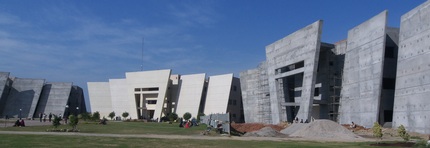
Ships of KnowledgeShips of Knowledge, University of Gujrat
shalamar garden

Shalamar Gardens, Lahore

I have been back from Lahore, Pakistan's cultural center and "City of Poets", for a while now. It was one of the most inspiring journeys I've been to.

Just a few weeks ago we've been at the…

Read more

Off to Lahore

I haven’t had much time for blogging recently due to preparations for my Lahore-trip. Now I’ll shut off my macbook and head for the airport. I’ll spent one week in Lahore at a journalism conference. More updates after the 10th of February!

By the way, there is a cool website called Metblogs – a network about city focused blogs – there is also a section about Lahore. There is a quite vivid blogging scene there (I actually wanted to write a post about exploring cities via blogs…)

UPDATE (2.3.09): I’ll be back very soon during this week!

I haven't had much time for blogging recently due to preparations for my Lahore-trip. Now I'll shut off my macbook and head for the airport. I'll spent one week in Lahore at a journalism conference. More updates after the 10th…

Read more

Boycott Israel? – More anthropologists on Gaza (II)

LINKS UPDATED 26.10.2023 (text changed, name removed, see comments below) Four anthropologists are among a long list of scholars who in The Guardian call for a boycott of Israel:

We must do what we can to stop Israel from winning its war. Israel must accept that its security depends on justice and peaceful coexistence with its neighbours, and not upon the criminal use of force.

We believe Israel should immediately and unconditionally end its assault on Gaza, end the occupation of the West Bank, and abandon all claims to possess or control territory beyond its 1967 borders. We call on the British government and the British people to take all feasible steps to oblige Israel to comply with these demands, starting with a programme of boycott, divestment and sanctions.

Sarah at Once Upon a Time an Anthropologist Wrote reports about more protests at British Universities in her post How Academic World Reacted Toward the War on Gaza

Maximilian Forte at Open Anthropology has posted more info on boycott activities in Canada and university protests in Britain.

In the US on the other hand 3 students, who protested against Israel’s attacks, were arrested (one of them an anthropologist).

The question of academic boycott was also discussed at a seminar that Thomas Hylland Eriksen organized with his colleages at the research project Culcom. Personally, I am not sure if boycott is the way to go, but I liked the “smart boycott” that political scientist Nils Butenschøn suggested. If you collaborate with Israel you should be sure that the Israeli institution does not discriminate or support acts that breache international law.

What role should academics play in situations like these in Gaza? Theologian Anne Hege Grung said that the conflict is held up by myths. Our job is to deconstruct these myths.

Israeli anthropologist Jeff Halper is one of those intellectuals who does exactly that, she said. Last year he arranged a boat trip to Gaza in order to break the Israeli blockade. There, he formulated a message to his fellow Israelis:

(1) Despite what our political leaders say, there is a political solution to the conflict and there are partners for peace. If anything, we of the peace movement must not allow the powers-that-be to mystify the conflict, to present it as a “clash of civilizations.” The Israeli-Palestinian conflict is political and as such it has a political solution;

(2) The Palestinians are not our enemies. In fact, I urge my fellow Israeli Jews to disassociate from the dead-end politics of our failed political leaders by declaring, in concert with Israeli and Palestinian peace-makers: We refuse to be enemies. And

(3) As the infinitely stronger party in the conflict and the only Occupying Power, we Israelis must accept responsibility for our failed and oppressive policies. Only we can end the conflict.

His report of the trip can be read on the blog by Ted Swedenburg, another blogging anthropologist. Swedenburg is professor at the University of Arkansas and editorial committee member of the Middle East Report. He has blogged a lot about the Gaza-conflict.

In an earlier post I’ve mentioned several antropologists who try to do something similar. In a more recent post, Maximilian Forte analyzes and criticizes the myths spread by American media:

So THE WORLD trembles with love at the mere mention of “Obama,” while all those who oppose Israeli genocide and demonstrated against it were “Muslims.” In the meantime, the only real threat to peace is Hamas, and its bottle rockets.

Palestinians, not being white, European, privileged allies of the U.S., unlike Israelis, are less than human, and less than important, except as “obstacles.” All that Israel ever does is respond and get provoked, it never initiates — a pristine white victim of irrational brown people, you can almost hear its maiden-like screams across the white Atlantic.

With “reporting” like this, the media will keep anthropologists in business for a long time to come, as we try to clean up the damage they cause in creating a deranged culture of war and hatred. And it is hatred, a subtle, insidious, and racist hatred that motivates and encourages AP to write the kind of articles about Gaza as it has.

Then, I found a post by Palestinian anthropologist Khalil Nakhleh who concludes:

The only future for us, as an indigenous national minority that can exercise our inherited basic human rights on our land and that can achieve true justice and equality, is to reclaim and re-assert our narrative. (…) Our repossessed narrative cannot be a reinterpretation of our history as a dull shadow of Jewish-Zionist narrative. Our repossessed narrative must be based on the deconstruction of the racist Zionist-Ashkenazi system, which itself is a precondition for such a just solution. The existing Israeli system is, by definition, racist and exclusivist, and it is inherently and structurally incapable of providing justice and genuine equality to my Palestinian people.

Today, Anthropologist Smadar Lavie emailed me a link to her text Sacrificing Gaza to revive Israel’s Labor party. She reminds us of the different groups within the Israeli society and writes that it was mostly was the Mizrahim (Jews with origin in the Arab and Muslim World) who have been hit by the Hamas missiles. The Israeli European elite “imported” them “as a demographic shield against the Arab enemy”.

Smadar Lavie has put lots of papers online.

Finally, the anthropologists Kerim Friedman and Kiven Strohm have set up the wikipage “Understanding Gaza”

For more comments by anthropologists see my first posts: Anthropologists on the war on Gaza

LINKS UPDATED 26.10.2023 (text changed, name removed, see comments below) Four anthropologists are among a long list of scholars who in The Guardian call for a boycott of Israel:

We must do what we can to stop Israel from winning its…

Read more

Anthropological activism in Pakistan with lullabies

screenshot

A few days ago, Pakistani anthropologist Samar Minallah lauched a “video song”, a tribute to little girls in all the regions of Afghanistan and Pakistan where schools are being destroyed, depriving girls of their right to education, The News reports.

The song ‘Allaho: A Lullaby for You, My Daughter’ (both in Dari and Pashto) is one of the first lullabies that have been dedicated to girls according to the news report. Traditionally lullabies are made for sons alone. The new song is “a welcome break from the traditional practice”:

The production and launch of the song has acquired an added significance in that hundreds of schools have been burnt down in recent months both in Pakistan and Afghanistan by those who are not ready to allow girl education despite the fact that women constitute almost half of the population of both the neighbouring countries.
(…)
One of the verses in Pashto is: ‘Ookhiyaara sha taleem oka; Da tol jahan tazeem oka; Da khalqo khidmatgaara sha; Har kaar pa lowar tasleem oka’ If translated into English, it means: ‘Become clever and educated; Respect and serve mankind; Ready for the challenges of life; Learning makes the journey of life easy.’

Samar Minallah is a Pukhtun (Pashtun / Pashto) from the North-West Frontier Province who has done her MPhil in Anthropology and Development at the University of Cambridge. She heads Ethnomedia, an organisation in Islamabad that works in the field of media and communications for a social change. She is the winner of Perdita Huston Human Rights Activist Award 2007 for effectively using electronic media to highlight the lives of women in Pakistan.

UPDATE (via pukhtunwomen.org) The video is now availabe on youtube:

Allaho--A lullaby for you my daughter

Samar Minallah has produced lots of documentaries, among others ‘Swara — A Bridge Over Troubled Waters’. ‘Swara’ is the name of a practice where minor girls are given away as compensation to end disputes between different families. Even swara killings occur. Although officially outlawed in Pakistan, the custom prevails.

In the documentary a “tribal leader” says about one of the swara girls:

“She is the prize of my son’s death and will be treated accordingly, I’ll taunt and humiliate her for she’s the price paid for my son’s death. She’s not part of the family and cannot partake in any rituals or festivities.”

The anthropologist comments:

“Swara is a part of the Pukhtun culture, we are always told it is a noble sacrifice or that the girl is an ambassador of peace. Sadly though, throughout my research, it is clear that the girl that is given away in the name of Swara has very little chances of leading a good life. A custom that so heartlessly forces a girl to suffer for the rest of her life is completely against basic human rights”

The film can be watched online in full length. At first I only found a six minutes introduction and I was not sure if I liked it as it seemed to be a bit essentializing. But in an interesting interview with Damon Lynch, she is more nuanced:

Samar points out that culture is never static. What is seen as a fixed cultural tradition today may have developed over time from an honorable tradition into a profoundly negative one. For instance, a current “traditional” method of dispute resolution involves the payment of a girl to a family that has been wronged. (…)

Historically, Samar believes this tradition involved a girl from one family or village going to another family or village, and returning with gifts, signifying the respect of one family or village for the women of the other. However this practice decayed until it reached its present form. Samar is challenging this practice of dispute resolution in the Supreme Court, hoping to have it declared illegal. (…)

Samar believes that aspects of Pukhtunwali–the ancient code of Pukhtun honor and custom–are good, even as there are other areas in need of reform.

As part of her work, Minallah even produced a talk show for a Pashto television channel, which she hosted. And she persuaded truck and rickshaw owners to paint slogans against Swara, such as “Giving away little girls as compensation is not only inhuman but also un-Islamic” on their vehicles.

She has been present in Pakistani media many times also related to other issues like Da Bajaur Guloona — Homeless at Home. Highlighting the plight of the displaced and Minallah brings out hidden colours of NWFP (North-West Frontier Province)

SEE ALSO:

“Anthropology needs to engage in an activist way”

Criticizes the “apathy of anthropologists toward the human rights situation in the Balochistan Provice in Pakista”)

Thesis: The limits of youth activism in Afghanistan

John Postill on media anthropology and internet activism in Malaysia

Do anthropologists have anything relevant to say about human rights?

Chronicles Women’s Social Movements in India

Thesis: How Indian women fight the stigma of divorce

5.11.2022: Some links updated, links to her site ethnomedia.pk removed as the site has been hacked

screenshot

A few days ago, Pakistani anthropologist Samar Minallah lauched a "video song", a tribute to little girls in all the regions of Afghanistan and Pakistan where schools are being destroyed, depriving girls of their right to education, The News reports.…

Read more

Dissertation: Why kids embrace Facebook and MySpace

After 30 months ethnographic fieldwork on Facebook, MySpace and other social networking sites, danah boyd has finally completed her PhD-thesis and put it online. Although she is no anthropologist, she seems to have worked like an anthropologist. Her thesis is relevant reading for anybody who is interested in the anthropology of childhood – especially in children’s relations to adults.

For children spend so much time on Facebook or MySpace (“networked publics”) partly because they are marginalized in their society by adults, she explains in the concluding chapter:

One of the most notable shifts I observed in the structural conditions of today’s teens, compared to those of earlier decades, involves their limited opportunities for unregulated, unstructured social interaction.
(…)
When asked, teens consistently reported that they would prefer to socialize in physical spaces without constant parental oversight. Given that this is not an option for many of them and that many have more access to networked publics than to unmediated public spaces, social network sites are often an accepted alternative.
(…)
Their desire to connect with others is too frequently ignored or disregarded, creating a context in which many must become creative in making space for maintaining connections outside the control of adults. (…) Through the use of technology, teens are able to socialize with others from inside the boundaries of their homes. This presents new freedoms for teens, but it also provokes new fears among adults.

The teen years are marked by an interest in building new connections and socializing broadly. Online-activites are extensions of offline-activites. Teens’ engagement with social network sites reveals a continuation of earlier practices inflected in new ways, she writes.

My findings show that teens are drawn to social media collectively and that individuals choose to participate because their friends do. The appeal is not the technology itself—nor any particular technology— but the presence of friends and peers.

boyd draws many interesting parallels and comparisons:

Baudelaire’s Parisian flâneur enters the public to see and be seen. Teenagers approach publics in a similar vain. Like the flâneur, teens use fashion to convey information about their identities.
(…)
Teens have long struggled to find a place for themselves; they have consistently formed counterpublics within broader structures. Yet when they do, adults typically demonize them, the identity markers they use, and the publics they co-opt. The demonization of MySpace is akin to the demonization of malls and parking lots that took place when I was growing up.

The inability to access publics is an explicit reminder of teens’ marginalized position within society according to danah boyd:

When well-intentioned parents limit access to publics out of fear of potential dangers, they fail to provide their children with the tools to transition into adult society. This may have other unexpected consequences, including isolating teens from political life and curbing their civic engagement. I believe that the practice of maximum control and restrictions infantilizes teenagers, making them more dependent on or resentful of adults and adult society.
(…)
In learning how to make sense of publics that are different from those with which their parents are comfortable, teenagers reveal valuable techniques for interpreting and reworking publics. Their experiences provide valuable insight for understanding how publics are transformed by structural forces.
(…)
The key is for adults, and society more broadly, to engage with these issues and help guide teens in making healthy decisions that allow them to leverage social media in positive ways as part of their everyday lives.

>> download the thesis via danah boyd’s blog

Her thesis reminded me of Mari Rysst’s thesis on the (presumed) “sexualisation of childhood” and the notion of the “pure childhood”.

I’ve only read the last chapter of boyd’s thesis.

By the way: As a famous blogger, danah boyd’s blog post on her thesis has received more than 40 comments within two days. Furthermore, there a numerous blog posts about her thesis already.

SEE ALSO:

Ethnographic Study: Social Websites Important For Childhood Development

Ethnographic study: Social network sites are “virtual campfires”

Ethnographic research on Friendster’s online communities

Cyberanthropology: “Second Life is their only chance to participate in religious rituals”

Danah Boyd on Open Access: “Boycott locked-down journals”

After 30 months ethnographic fieldwork on Facebook, MySpace and other social networking sites, danah boyd has finally completed her PhD-thesis and put it online. Although she is no anthropologist, she seems to have worked like an anthropologist. Her thesis is…

Read more