search expand

Anthropologists on the war on Gaza (updated)

LINKS UPDATED 26.10.2023 (See also part II David Graeber: Boycott Israel! – More anthropologists on Gaza) After two weeks war in Gaza, it’s time to round up: How have anthropologists contributed to a better understanding of the conflict? According to my overview, they have been quite silent. And they have been more active on blogs than in traditional media. Neither Google or Yahoo news search give any relevant results.

Gabriele Marranci has written one of the first blog posts: Gaza: bad politics needs blood. He criticizes both Hamas and the Israeli government:

And here lies the main issue: both parties, the Israeli and Palestinian leaders, share at least something in common: an immoral and unethical view for which political gain are more important than innocent lives, including those of women and children.
(…)
Hamas has no problem to sacrifice Palestinian lives in the name of an impossible mission (to remove Israel from the Middle East), and the Israeli government has no issue with endangering the lives of innocent Israelis with the inevitable retaliation of suicide bombing and killings.
(…)
Palestinians and Muslims have to accept one simple fact: Israel is here to stay. Israel and its supporters have likewise to accept that sophisticated forms of ethnic cleansing will not be sustainable nor sucessful. Palestinians are, generation after generation, there to stay, and if a solution not found, to fight.
(…)
The Israeli-Palestinian conflict, of course, has some clear historical reasons. Yet the fact that it is still one of the most deadly conflicts affecting civilians is due to extremely bad politics, and bad politics, akin to a kind of cancer, requires innocent blood in order to perpetuate itself.

In New American Media, William O. Beeman explains why Hamas is Not Iran’s Puppet:

The conflict between Israel and Hamas is not a proxy war between Israel and Iran. This is a myth that has grown up during the Bush administration, and is now widely promulgated with little or no support. (…) Hamas has been effectively sealed off from the world by Israel, and by Egypt.

tabsir – one of the best resources regarding the Middle East – collects continuisly news stories and analysis on Gaza. Daniel Martin Varisco wrote two posts: Rizpah and the Politics of Vengeance and David vs Goliath, the IDF vs Hamas

John Hutnyk posted two eyewitness reports by Ewa Jasiewicz, a former student from Goldsmiths.

Maximilian Forte has collected lots of links in his post Currently Covering and Commenting on the Gaza Massacre and reflected on using twitter in Tweets of Conflict in the New Online War Zone.

Erkan Saka is also sharing Gaza-analysis with us, see More than 200,000 protested in Çağlayan, Istanbul and For the people of Gaza

That’s it so far. Not much. In Gaza: A Frightening Anthropological Analogy, Pamthropologist criticizes her colleagues:

Is presenting a discussion of these issues not, exactly, what we should be doing as Anthropologists? And yet, our blogs rarely cover these issues–the notable exception being Open Anthropology, wait he is a Canadian. You know, as a discipline, we have no functioning voice in the American dialogue.

But anthropologists have raised their voices about this conflict before. Last year, among others, Adam S. Kucharski published his thesis about The Politics of Water in the Israeli-Palestinian Conflict.. Linda Teigland Helgesen was eight months of fieldwork among Palestinian students at Birzeit University. The result is her thesis The construction of resistance. A case study among “Il-majaneen” students in the occupied West Bank

Earlier this year, Jeff Halper published his new book An Israeli in Palestine. Resisting Dispossession, Redeeming Israel. It was reviewed by Electronic Intifada. See also interview with Halper ‘As Israelis, We Also Fight for Palestinians’ (Oh My News).

For general news see The Guardian and the impressive round-up of blogposts from Gaza by Global Voices: Palestine: “In Gaza our future is almost destroyed”

UPDATE 5: Metronews in Halifax (no longer available) writes about Israelian anthropologist Jeff Halper (mentioned above): “It’s unusual to have an Israeli who’s critical of Israel and supports Palestinian rights, especially with the war in Gaza going on,” he told Metro yesterday. Something needs to be done, he said, because the current situation isn’t just affecting Gaza, it’s “messing up the whole world.”

UPDATE 4: New posts by Gabriele Marranci: Gaza and the ethos of death and Maximilian Forte at Open anthropology Campus Gaza: Academic Boycotts and Complicit Silence

UPDATE 3: Palestinian anthropologist Yara El-Ghadban has collected lots of information on her bilingual (French / English) blog Tropismes

UPDATE 2: New post by Maximilian Forte: Accepting the Might to Exist: Some Israeli Lessons for Anthropology:

Anthropology teaches us not to naturalize any human construction, and to recognize the arbitrariness of culture, not to mention the arbitrariness of power. Political Anthropology invites us to recognize that the state is the most violent of all arbitrary institutions in human history, that all states on earth owe their existence to massive and bloody assaults, and continue to preserve and promote themselves through violence against the peoples governed by other states.

UPDATE 1: Today, here in Norway, Thomas Hylland Eriksen wrote an article in the newspaper Aftenposten where he proposed a possible solution – to put Israel-Palestine under (UN-) administration (in Norwegian only). Yesterday, the Norwegian Psychological Association demanded the end of the war. The psychologists are among other things concerned for possible consequences for children’s mental health (Norwegian only)

SEE ALSO PART TWO OF THIS POST

David Graeber: Boycott Israel! – More anthropologists on Gaza (II)

SEE ALSO EARLIER POSTS:

Lila Abu Lughod: “In Israel and Palestine we have an amazing opportunity”

Anthropologists on the Israel-Lebanon conflict

Selected quotes from “On Suicide Bombing” by Talal Asad

The anthropology of children, war and violence

Conflict Resolution and Anthropology: Why more scholarship on violence than on peace?

For an Anthropology of Cosmopolitanism

LINKS UPDATED 26.10.2023 (See also part II David Graeber: Boycott Israel! - More anthropologists on Gaza) After two weeks war in Gaza, it's time to round up: How have anthropologists contributed to a better understanding of the conflict? According…


Read more

What is good applied anthropology?

Most anthropologists work outside the university where they don’t enjoy academic freedom. These anthropologists must be better prepared for the perils of non-academic applied work, Brian McKenna writes in Counterpunch. For good applied anthropology is being troublesome:

He quotes Robert Lynd who in 1939 wrote:


[T]he role of the social sciences to be troublesome, to disconcert the habitual arrangements by which we manage to live along, and to demonstrate the possibility of change in more adequate directions . . . like that of a skilled surgeon, [social scientists need to] get us into immediate trouble in order to prevent our present troubles from becoming even more dangerous. In a culture in which power is normally held by the few and used offensively and defensively to bolster their instant advantage within the status quo, the role of such a constructive troublemaker is scarcely inviting.

Too often, applied anthropologists say “Yes, sir”:

Some years back Harvard anthropologist Kris Heggenhougen argued that the strength of anthropology in collaborating with other disciplines lies in saying, “yes, but. . . and to critically examine the decisive factors affecting peoples’ health including power, dominance and exploitation.” (Heggenhougen 1993)

Yes, but. . . . while that sounds good, more needs to be said.


First of all, we spend much more time saying “yes, sir” than “yes, but” in paid employment. This is necessary if we wish to stay employed. The workplace is a not a democracy but a hierarchy in which academic freedom does not apply. (…) (A)pplied anthropologists have to be prepared to travel the road from “yes, but,” to “no, sir” in order to better serve the public interest.

Brian McKenna mentions several applied anthropologists who were “troublesome”. One of them is Barbara Johnston who has worked with environmental justice. She warns about associated risks:

Environmental justice work “requires confronting, challenging and changing power structures.” When someone is involved in this work, says Johnston, “backlash is inevitable.” Because most anthropologists usually enter organizations as change agent s of some kind they need to be aware that they are especially at risk of being labeled a “troublemaker” at any time. If the label sticks it can lead not only to getting fired; it also can lead to a vicious form of bullying that can make one’s life unbearable.

According to Johnston, academic culture “trivializes the importance of this work,” while, at the same time, the engaged anthropologist struggles to find disciplinary support. 


Another example is Ted Downing who worked for the World Bank. In 1995, he wrote about the potential social and environmental impacts a proposed World Bank dam project will have on Chile’s Pehuenche Indians. The result: The report was censored:

After his report was censored Downing demanded that the World Bank publicly disclose his findings. The Bank responded by threatening “a lawsuit garnering Downing’s assets, income and future salary if he disclosed the contents, findings and recommendations of his independent evaluation.” (Johnson and Garcia Downing). As a result of his whistleblowing, Downing was blacklisted from the World Bank after 13 years of consulting service.


In his case, “yes, but” didn’t work. He progressed, reluctantly, to “no, sir”:

In fact this happens to many applied anthropologists but most do not have the resources, support or disciplinary guidance to assist them in their struggles. They might become whistleblowers but their careers suffer. And their stories are untold. We do not have a good accounting of how often this happens to anthropologists, but we need to learn more about this. In any case, resisting censorship is, as Downing says, “good applied” anthropology.

>> read the whole article in Counterpunch

SEE ALSO:

Neoliberal applied anthropology: Who owns the research — the anthropologist or the sponsor?

When applied anthropology becomes aid – A disaster anthropologist’s thoughts

Bush, “war of terror” and the erosion of free academic speech: Challenges for anthropology

USA: Censorship threatens fieldwork – A call for resistance

Examples of engaging anthropology – New issue of “Anthropology Matters”

Omertaa – Open access journal for Applied Anthropology

Most anthropologists work outside the university where they don't enjoy academic freedom. These anthropologists must be better prepared for the perils of non-academic applied work, Brian McKenna writes in Counterpunch. For good applied anthropology is being troublesome:

He quotes Robert…

Read more

Do we (still) need journals?

“Journals? Who cares?” anthropologist George Marcus said recently. Journals as we know them are a thing of the past, and the last to understand this fact are universities and academics, philosopher Mark C. Taylor says in an interview with E. Efe Çakmak in the new Eurozine issue:

For the most part, presses and journals as they now exist do not serve the interests of intellectual or cultural development. To the contrary, their proliferation is symptomatic of increasing hyper-specialization in which there is more and more about less and less. This is going in the opposite direction of history, in which there is increasing interconnectedness.

So my advice is to forget journals – I no longer read any academic journals and I stopped publishing in them years ago. The only function presses and journals serve is to authorize those who write for them among a dwindling group of peers. If ideas are to matter – and I believe it is crucial that they do – we must completely change the way in which they are communicated.

Taylor is critical of the “tyranny of the word”:

What I want to stress is that language in today’s world is not primarily verbal but is, more importantly, visual. The problem is that we are visually illiterate – and nowhere is this more evident than in the university. In the “real” world, image trumps word every time; in the academic world, word represses image all the time.

If communication is going to become effective on a global scale, we must liberate the image from the tyranny of the word. This does not mean giving up reading and writing as they have been known in the past. But it is no longer enough. The multilingualism of young people today is multimedia. If we do not learn to communicate in this language, we will have nothing to say.

>> read the whole interview in Eurozine (link updated 18.8.2020)

Already in the early 90s, Taylor has experimented with new information technologies according to Wikipedia. See also his comprehensive website.

SEE ALSO:

George Marcus: “Journals? Who cares?”

Anthropology blogs more interesting than journals?

"Journals? Who cares?" anthropologist George Marcus said recently. Journals as we know them are a thing of the past, and the last to understand this fact are universities and academics, philosopher Mark C. Taylor says in an interview with E.…

Read more

Headhunting as expression of indigenousness

logo

Anthropologists often criticize mainstream media for exoticizing people. But in Borneo you’ll find indigenous people who promote themselves as headhunters and are proud of it.

headhunter-ad

The journal Cultural Analysis has recently received a prize in the Savage Minds awards. It was voted as the second best Open Access anthropology journal. In the recent issue, folklorist Flory Ann Mansor Gingging writes about headhunting as an expression of indigenousness.

Headhunting is no longer practiced but the tradition has been commercialised by the tourist industry many places in South East Asia. But the headhunting past has not only taken on a commercial value, but also a cultural and political one, Flory Ann Mansor Gingging argues:

I propose that the tongue-in-cheek invocation of headhunting by the tourism industry represents one way in which Sabah‘s indigenous people counter the outside world’s designation of them as the Other; that is, by parodying their headhunting past, they demonstrate their understanding of the joke and thus guard their indigenousness and their status as human beings.
(…)
Marginalized groups in Sabah, many of whom share a headhunting past, have re- written the headhunting narrative in their favor, becoming co-authors of a cause that seeks, in Hoskins’ words, “to seize an emblem of power, to terrify one’s opponents, and to transfer life from one group to another” (Hoskins 1996a, 38). Thus re-imagined, the headhunting narrative emerges as a tool useful in working towards change and equality.
(…)
Observed in cadence with past and present political milieus, the “refashioning” of the headhunting narrative within tourism in Sabah hence seems to reflect a general consensus among certain of Sabah’s native groups: that Otherness, strategically invoked and appropriated, provides them with an instrument for addressing external threats to their identities.

The anthropologist folklorist and doctoral student in the Department of Folklore and Ethnomusicology at Indiana University grew up in the village she writes about. One of her friends, herself an indigenous Sabahan, said the headhunting imagery and narrative in tourism promotion is “embarrassing but cool”:

“It’s beyond comprehension that I have ancestors that might have been headhunters. At the same time freakish ancestors totally distinguish you from the rest of the global population, so it’s secretly thrilling as well. I love seeing the slightly raised eyebrows reaction I get when I tell someone new I’m from Borneo.”

The researcher heard lots of stories about headhunters during her childhood. As she grew older, her relations to these stories changed:

As I got older, I began to be aware of the economic and political struggles that indigenous people in my state face. Since becoming part of Malaysia in 1963, Sabah, a former British colony, had never had a chief minister who was both indigenous and non-Muslim. Consequently, when in 1984, Joseph Pairin Kitingan, a Dusun lawyer, became the first non-Muslim native to assume this position, being indigenous suddenly meant something to me.

It was also around the same time that I remember feeling a new attraction to the macabre and exotic elements of my culture—one of them being headhunting. Without quite knowing it, I was invoking those aspects of my culture that were potentially embarrassing as a way of responding to the threat I felt towards my own Dusun-ness. For me, headhunting ceased being just a part of history and became, in the most personal way, a part of my heritage—an expression of my indigenousness.

In my opinion, making headhunting such a visible icon of tourism in Sabah is an example of what Michael Herzfeld calls “cultural intimacy,” which he describes as “the recognition of those aspects of a cultural identity that are considered as a source of external embarrassment but that nevertheless provide insiders with the assurance of common sociality” (Herzfeld 1997, 3).

A good example for this trend is the Monsopiad Cultural Village. Here, she writes, Herzfeld’s “cultural intimacy is performed”. Although it is by no means the first to use the state’s headhunting histories within the context of tourism, she believes the Village is the only tourist site that has developed an entire park around the headhunting theme.

On the village’s website they write:

Monsopiad Cultural Village, the traditional village is a historical site in the heartland of the Kadazandusun people and it is the only cultural village in Sabah built to commemorates the life and time of the legendary Kadazan and head-hunter warrior: Monsopiad. The direct descendants of Monsopiad, his 6th and 7th generations have built the village on the very land where Monsopiad lived and roamed some three centuries ago to remember their forefather, and to give you an extraordinary insight into their ancient and rich culture.

Read the whole article:

>> Flory Ann Mansor Gingging: “I Lost My Head in Borneo”: Tourism and the Refashioning of the Headhunting Narrative in Sabah, Malaysia

SEE ALSO:

Ainu in Japan: Cool to be indigenous

In Norwegian TV: Indian tribe paid to go naked to appear more primitive

“They still eat their fellow tribesmen”

Anthropology and tourism: Conference papers are online

logo

Anthropologists often criticize mainstream media for exoticizing people. But in Borneo you'll find indigenous people who promote themselves as headhunters and are proud of it.

The journal Cultural Analysis has recently received a prize in the Savage Minds awards. It…

Read more

The anthropology of children, war and violence

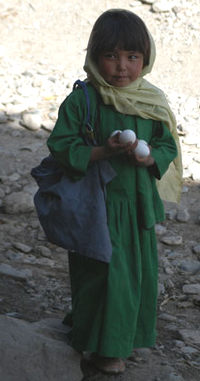
Baktay trying to sell eggs so that she can buy a notebook

What impact has war on children? What has anthropology to say on this? This autumn I watched the movie “Buddha collapsed out of shame” by the Iranian film maker Hana Makhmalbaf. It tells the story of children who reproduce the violence of the adults. For me, it was the most impressive movie of the film festival Films from the South (Film fra Sør) in Oslo. Makhmalbaf won the Silver Mirror, Films from the South’s main award.

– This is no funny movie. I hope you’ll feel the pain and the suffering, said the 19 year old director before the screening in Oslo.

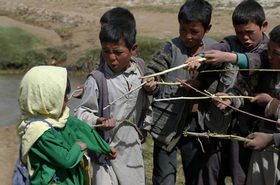
Five year old Baktay dreams of going to school. But her family is poor. When Baktay finally managed to sell the eggs of the family’s chicken and was able to buy a notebook, she gets attacked by boys who play war where they are the Taliban. The boys rip pages from her book, put a paper bag on her head, thread to stone her and to bury her alive. For girls aren’t allowed to go to school, and they must not show their hair.

In an interview on her own homepage, Hana Makhmalbaf says:

By showing today’s picture of Afghanistan, I tried to depict the effects of the recent years’ violence on the country. So that the adults could see how their behavior affects the younger generation.
(…)
First, it was the Russian communists, then the Taliban showed up, and now the Americans. One was communist, the other Muslim and the last one either atheist or Christian. But they all had one thing common, and that was “Violence”. And this violence has been injected over and over from three different groups into the culture of the people in this country so strongly that you can see it in their children’s play.

"Taliban" boys attack Baktay

“Buddha collapsed out of shame” was reviewed (among others) by The Hollywood Reporter, The Guardian, The Epoch Times and Avuncular American. There are some video clips online as well

The movie reminded me of the thesis by anthropologist Elisabet Eikås about young people trying to rebuilt Afghanistan. Their activism is a continuous struggle with the structures of the society that they tend to reproduce.

In Children, War and Nation: Croatia 1991-4, anthropologist Maja Povrzanovic also writes about how children reproduce the adults’ behavior (in this case the Balkan war) in their daily life:

In winter 1991-2, my son Martin, who was two-and-a-half then, constantly built, ruined, rebuilt and ruined again his Duplo-buildings in a very aggressive way, claiming he was ‘playing Vukovar’. (…) In autumn 1993, in my son’s very first minute at kindergarten, a boy approached him with a toy airplane, making noise and boasting: ‘I am shooting the Serbs!’ On christmas Eve 1993, Martin wanted to decorate our Christmas tree with his toy guns (p84/85).

But it seems that children, violence and war is an underresearched topic.

“Descriptive work on children experience violence, in general, is better developed than theoretical frameworks are to explain the causes or consequences of such violence”, Jill E. Korbin writes in her article “Children, Childhoods, and Violence” in the Annual Review of Anthropology 2003.

She notes that for a long time, children’s own voices and perspectives have been largely absent from the anthropological literature on childhood and violence.

Also in a more recent paper, anthropologist Jason Hart and Bex Tyrer remark that there is a lack of anthropological studies on children and war:

To date, the majority of research on children and war has come from the fields of medicine, psychiatry and psychology. This has included a heavy emphasis on “trauma” and pathology, with a more general body of literature exploring the individual’s physical, emotional and psychological nature of suffering.

Although these issues are obviously very significant, the wider societal dimensions of conflict – namely how war pervades institutions, political structures, culture, economy and communication systems – have been overlooked.

They quote Jo Boyden and Jo de Berry who write:

[War] does not just cause psychosocial and emotional harm, but also attacks the most fundamental conditions of sociality, endangering social allegiances and confidence, and drastically reducing social interaction and trust.

The researchers call for childrens’ participation in the research process:

The involvement of children directly in research activities represents an important move away from traditional approaches, according to which children are solely the objects of enquiry. A growing number of advocates now argue that children’s active participation in research is both a means to improve the quality and relevance of the data and make children themselves more visible within a particular community or within the broader society.

Such participation can also improve a child’s ability to communicate her/his views and acquire new knowledge. In this way participatory research can contribute to children’s empowerment.

Both Hart, Tyrer and Korbin stress that children do not only reproduce what they see and experience. They are not necessarily victims but they are active agents as well. Children’s involvement in political-military action (children as soldiers etc) are not solely the result of compulsion, coercion, and brainwashing. Hart and Tyrer write:

Few authors have shown willingness to consider the possibility that, in some situations, young people may engage with military groups as a reasoned strategy – as the most desirable option within the range of choices available. They may also enrol out of social and political concern.

They conclude:

Without denying the existence of trauma and without refuting the idea that the young may be victimised, we should learn more about the strategies children employ to deal with their adverse circumstances and maintain material, psychological, emotional and physical wellbeing.

While most literature that I’ve found is not accessibe for the public, their paper Research with Children Living in Situations of Armed Conflict: Concepts, Ethics & Methods is freely available. It is one of the Refugee Studies Centre Working Papers

SEE ALSO:

Thesis: The limits of youth activism in Afghanistan

“We want children to be their own ethnographers”

Transforming the Anthropology of Childhood – Anthropology News April

Play as research method – new Anthropology Matters

Conflict Resolution and Anthropology: Why more scholarship on violence than on peace?

Baktay trying to sell eggs so that she can buy a notebook

What impact has war on children? What has anthropology to say on this? This autumn I watched the movie "Buddha collapsed out of shame" by the Iranian film maker Hana Makhmalbaf. It tells the story of children who reproduce the…

Read more