
I’m off to Germany on a short holiday (by train). I’ll resume blogging again after the 14.5.08
I'm off to Germany on a short holiday (by train). I'll resume blogging again after the 14.5.08


I’m off to Germany on a short holiday (by train). I’ll resume blogging again after the 14.5.08
I'm off to Germany on a short holiday (by train). I'll resume blogging again after the 14.5.08
In his post Not only freedom: the dark ethnic side of the Tibetan Buddhist revolt, anthropologist Gabriele Marranci challenges mainstream images of Tibetans as peaceful and writes about Tibetan racism, ethno-nationalistic dreams, and attacks against muslims in Tibet.
Both the mass media, academics, and even anthropologists specialised in Tibetan Buddhism, have hidden what Marranci calls the ‘dark ethnic side’ of the revolt.
The Muslims in Tibet have been the target of Buddhist Tibetan violence for some time now, especially since 9/11. During the recent protests in Tibet there were anti-muslim attacks:
The mosque in Lhasa was burnt and destroyed, shops and the possessions of Muslim Tibetans smashed, a family burned alive in their own shop, terror and terrorism have affected this community because of a pernicious form of ethnic (Buddhist) nationalism
Marranci points to the paper Close Encounters of an Inner Asian Kind: Tibetan-Muslim co-existence and conflict in Tibet past and present by Andrew Fischer. According to Fischer, the tensions are primarily the cause of ‘economic’ differences and opportunities:
During the 1990s Ethnic Tibetan Buddhist started to fear that the economic success of Muslim Tibetans (particularly their restaurants and shops), would have undermined the economic, and so social, status of the Buddhist Tibetans. The Buddhist monks began a campaign against the economic activities of Tibetan Muslims, which epitomised in the 2003 boycott of Muslims’ businesses and saw also violent actions against innocent Muslim Hui families
Marranci writes:
Since the beginning of the revolt in March, demonstrations against China are held in all those countries through which the Olympic torch is passing. From the politicians, to the public, from Hollywood to Bollywood, from the scholars (with few exceptions) to the students, from the Trade Unions to the Industrial associations: all show indignation against the ‘oppression of the Chinese government’. Yet they ignore the dark side of this ‘revolt’ which is not so different from that in 2003.
(…)
Meanwhile monks and lamas are just stoking the fire in the hope of not just a free Tibet but also an ethnically clean one!
>> read the whole post on Marranci’s blog
SEE ALSO:
In his post Not only freedom: the dark ethnic side of the Tibetan Buddhist revolt, anthropologist Gabriele Marranci challenges mainstream images of Tibetans as peaceful and writes about Tibetan racism, ethno-nationalistic dreams, and attacks against muslims in Tibet.
Both the mass…
Articles on Biometrics, US Refugee policy, children’s migration, transnational students, challenges of multi-sited ethnography and more can be found in the most recent issue of Anthropology News May, a publication by the American Anthropological Association (AAA).
16 articles can be downloaded!
Additionally, we find a photo essay and a photo gallery (Anthropology News is on flickr!)
UPDATE: See also Maximilian Forte’s comments on the article about multisited ethnography
Articles on Biometrics, US Refugee policy, children's migration, transnational students, challenges of multi-sited ethnography and more can be found in the most recent issue of Anthropology News May, a publication by the American Anthropological Association (AAA).
16 articles can be…
Why did religions evolve? According to anthropologist Maurice Bloch, there is nothing special with religion. It’s just a product of human imagination – in the same way as nations are, Bloch writes in an article to be published in June, the New Scientist informs.
The development of religion is dependent on the development of imagination. We had to evolve the necessary brain architecture to imagine things and beings that don’t physically exist, and the possibility that people somehow live on after they’ve died, Bloch argues according to New Scientist:
Once we’d done that, we had access to a form of social interaction unavailable to any other creatures on the planet. Uniquely, humans could use what Bloch calls the “transcendental social” to unify with groups, such as nations and clans, or even with imaginary groups such as the dead. The transcendental social also allows humans to follow the idealised codes of conduct associated with religion.
“What the transcendental social requires is the ability to live very largely in the imagination,” Bloch writes.
“One can be a member of a transcendental group, or a nation, even though one never comes in contact with the other members of it,” says Bloch. Moreover, the composition of such groups, “whether they are clans or nations, may equally include the living and the dead.”
(…)
“Once we realise this omnipresence of the imaginary in the everyday, nothing special is left to explain concerning religion,” he says.
>> read the whole story in the New Scientist
Bloch has recently been interviewed in Vikerkaar / Eurozine and was presented as an anti-anthropologist: “It may well be that anthropology departments disappear, and that wouldn’t bother me very much”, he said.
UPDATE Maximilian Forte has written a summary of the interview with Bloch, see Maurice Bloch: “Reluctant Anthropologist” or “Anti-Anthropologist”?
See also the tutorial Anthropology and Religion
Why did religions evolve? According to anthropologist Maurice Bloch, there is nothing special with religion. It's just a product of human imagination - in the same way as nations are, Bloch writes in an article to be published in June,…
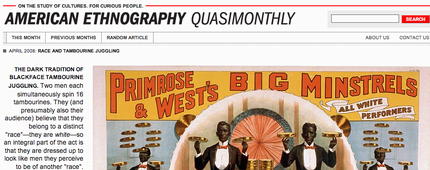
Anthropologist Martin Høyem has launched the e-zine “American Ethnography”, an “internet glossy on the study of cultures”:
We cover ethnography that relates to anything we would call America. We aim to present the tradition and practice of ethnography to people who didn’t know they could be intrigued by ethnography. The goal is to help increase the interest in how we all try to understand unfamiliar cultures. This, we think, could do the world good.
As he writes to me in an email, “it’s pretty new, so there isn’t a lot of material there yet, and most of what is there is old public domain texts (previously not freely available to the general public).” Most of the texts were previously published in the journal American Anthropologist.
Around twelve articles are online already, including portraits of some famous anthropologists and texts about the peyote-cult – a cactus that was eaten in rituals of native Indians. The most recent issue contains articles about race and tambourine juggling. Looks interesting!
Høyem has previously written a thesis about American Lowrider Culture called I want my car to look like a whore. Lowriding and poetics of outlaw aesthetics, see also my post about the thesis: When Norwegians do business in Brazil, Lowrider Culture and 9 more anthropology theses.
Høyem is currently working at Pacific Ethnography – anthropology and design
UPDATE: The discussion about American Ethnography and copyright issues is continuing over at Savage Minds, see American Ethnography, the AAA, and the Public Domain
Anthropologist Martin Høyem has launched the e-zine "American Ethnography", an "internet glossy on the study of cultures":
We cover ethnography that relates to anything we would call America. We aim to present the tradition and practice of ethnography to people…