search expand

Military spies invade anthropology conferences?

The U.S. military is not only interested in employing anthropologists. Now, they have started attending anthropology conferences. Anthropologist Caroline Osella from the University in London and one of the editors of Social Mobility In Kerala, is worried.

In a post in the ASA Globalog (run by the Association of Social Anthropologists of the UK and Commonwealth) she tells us about her recent experience from a conference at the Exeter Gulf Studies Centre where she met people from the U.S. military both in the bar and in the conference:

Bad enough to have to check oneself and what one says in conferences…but to have to be on your guard in the bar afterwards in case you say something of interest about the Gulf-connected Muslim Indians you work among is surely one step too James Bond for an anthropologist?

A week before, she had attended a conference on south Asian studies in Leiden and “also found some of these security types there, listening in on the panels on south Asian Muslims – and even presenting papers themselves!”

Do we have to tolerate this?, she wonders:

I still maintain that this is a worrying trend and that effectively, academic freedom and decent research is jeopardised if all our conferences are gatecrashed.

Conferences are places where we try out ideas and present first drafts of our work; we may later decide to alter some things before going to publication in order to protect the people we work with.

By letting security personnel or academics form the military into conferences then effectively our work is going into the public realm before we are ready for it to do so.

Washington and whoever else is welcome to read the published versions of my and Filippo’s work, like any other members of the interested public. But they can download it and read it in their offices.

They can please keep away from academic conferences, where I want the freedom to try out my ideas, decide which details I might want to keep confidential for ethics’ sake, and feel free to engage in discussions which are not monitored or where the information I may pass on is not feeding into any policy agenda. And I want to be able to go and drink and talk shop in the bar in the evening without wondering who is listening.

(…)

We teach our undergrads about our shameful past with regard to colonialism. Are we going to find the next generation of anthropologists teaching about us and our pathetic accommodations to state power and our polite refusals to speak out?

>> read the whole blog post on the ASA Globalog

>> more posts on counterinsurgency on the ASA Globalog (quite a lot actually!)

On the website of the Network of concerned anthropologists (NCA), Hugh Gusterson tells a related story. During a panel at the American Anthropological Association annual meeting featuring three NCA members, witnesses saw two U.S. Army personnel writing down the names and institutional affiliations of anthropologists who had signed copies of the NCA pledge of Non-participation in Counter-insurgency circulating during the panel.

SEE ALSO:

Protests against British research council: “Recruits anthropologists for spying on muslims”

Final report launched: AAA no longer opposes collaboration with CIA and the military

The dangerous militarisation of anthropology

“Arabs and Muslims should be wary of anthropologists”

Anthropology and CIA: “We need more awareness of the political nature and uses of our work”

The U.S. military is not only interested in employing anthropologists. Now, they have started attending anthropology conferences. Anthropologist Caroline Osella from the University in London and one of the editors of Social Mobility In Kerala, is worried.

In a post…

Read more

(updated) Anthropology News February about Open Access Anthropology

The American Anthropological Association (AAA) is starting to remind me of the recording industry and their rearguard actions against file-sharing and online dissemination in general”, Eric Kansa commented one year ago.

I was reminded on this comment when I read about the the Februrary issue of Anthropology News that focuses on Open Access Anthropology. Five articles are available online – but only for one month. Then, the articles about Open Access Anthropology will be hidden behind login-boxes.

UPDATE: Dinah Winnick, Associate Managing Editor Anthropology News writes to me and clarifies that the articles will continue to be accessible after the 1st of March:

To clarify, these articles will appear on the Featured page for one month, after which they will be moved over to our Archives page and also be available through AnthroSource. They are moved from the Featured page monthly so that we can feature new content from our latest issue. I appreciate your bringing this misunderstanding to my attention and I have added a phrase to our website for clarification.

Four of the five articles provide lots of good arguments for Open Access Anthropology. It’s only Jason Cross, member of the AAA Long-Range Planning Committee who is reluctant. He is mainly concerned for the financial consequences and proposes “careful research on business models to assess whether and how to make an OA transition”.

So download now:

Lee D Baker: Mission Improbable and the Possible Mission

Don Brenneis: Process, Access and Value

Melissa Cefkin: Organizing for Access

Jason Cross: Open Access and the AAA

Christopher Kelty: The State of Open Access Anthropology (see also an earlier version of the text on Savage Minds)

The AAA has also set up an Open Access blog “where members and non-members alike can offer both their reactions to the In Focus series and their general thoughts on the Open Access issue”.

PS: The AAA has redesigned their website, see discussion over at Savage Minds

RELATED:

selv-archiving

A quick guide to selv-archiving for anthropologists (mainly USA/GB-related, it seems) by Kerim Friedman

SEE ALSO:

Open Access: “The American Anthropological Association reminds me of the recording industry”

American Anthropological Association opposes Open Access to Journal Articles

Kerim Friedman: Open Source Anthropology

The Anthropologists – Last primitive tribe on earth? (Take a look at indigineuos people’s use of online communication as a mean of resistance and raising awareness.)

2006 – The Year of Open Access Anthropology?

Already lots of publications in the open access anthropology repository Mana’o

Why Open Access?

Open Access News

selv-archiving

"The American Anthropological Association (AAA) is starting to remind me of the recording industry and their rearguard actions against file-sharing and online dissemination in general", Eric Kansa commented one year ago.

I was reminded on this comment when I read…

Read more

Really an ethnic conflict? An anthropologist on the Kenya-crisis

Both in Norwegian and international media, the recent crisis in Kenya has often been described as an ethnic or an tribal conflict. But is this a correct view? “There is a tendency in media in the West to portray Africa as a place where tribal rivalries inevitably and almost naturally yield conflict and violence, and that is fairly misleading”, says anthropologist Angelique Haugerud in a The Real News Network radio interview:

It’s clear that ethnicity is a part of this picture, but it is only one piece of it. And the conflict in Kenya is as much due to political party competition, modern efforts at democratization, and the kinds of political dynamics we see anywhere in the world.

The kind of anger that’s boiling over now has also to do with economic inequalities:

The U.S., like the World Bank, the IMF, and European donors have over the years emphasized neoliberal economic policies—privatization, user fees for health care, and so on. That’s a set of policies that were, of course, widely implemented in Africa by these international financial institutions, as well as through bilateral aid. In Kenya, those have accentuated economic inequality and poverty.

>> view and read a transcript of the interview

In an article in OpenDemocracy, the anthropologist gives us an optimistic buttom-up-perspective. The way Kenyan citizens are living out and working through their country’s crisis offers insight into how boundaries of ethnicity, clan and class can be overcome, she writes:

Yet such hardening of ethnic boundaries, even four weeks into the crisis, is by no means pervasive or irreversible. 23-year-old Muthoni, for example – a Nairobi resident whose parents are from Embu district and thus again perceived as nearly Kikuyu – traveled with her church group to assist Luo people who had taken refuge at a police station in the nearby town of Limuru, whose population is predominantly Kikuyu. She comments: “we are all Kenyans…it’s a mixed brew; we can’t live without the other….it’s not logical to kill your neighbour; you were in agreement before.”

(…)

In spite of today’s newly charged ethnic identities and growing mistrust, now (as in the past) mutual assistance and other social bonds soften boundaries of ethnicity, neighborhood, clan, and class.

>> read the whole story in OpenDemocracy

I wish she’d elaborated more on this issue. But several excellent round-ups over at GlobalVoices provide us with useful links.

Rebecca Wanjiku writes:

After a week of killings, looting and the political madness witnessed in Kenya after last month’s general elections, Kenyan Bloggers are at the forefront of reconciliation, urging people to reach out, regardless of their ethnic background

>> read Kenya: “Bloggers seek to heal a wounded nation” and Kenya: Moving images of unrest and hope by Juliana Rincón Parra and Kenya: Cyberactivism in the aftermath of political violence by Ndesanjo Macha

A similar perspective can be found in the analysis by media researcher George Ogola:

A week prior to the election, only Al-Jazeera had taken some trouble to tell the Kenyan story. Reuters Africa proved another notable exception. But the familiar would soon follow, vicious and unrelenting.

When protests met the announcement of the presidential results, CNN, BBC 24 and Sky News sent some of their finest to Nairobi. But the frame of reference had been pre-determined. A narrative had been established. Kenya had descended into tribal anarchy reminiscent of the Rwanda genocide. Neighbours had turned onto each other just because they belonged to different tribes. ‘Tribal violence’ became the definitive mantra and was the basis for reports across the world.

(…)

It was equally about a western anthropology that figures conflict in Africa only in tribal terms; an Africa whose existence is so basic it must not be understood beyond the discourse of the tribe. I witnessed the power of a selective morality that tends to view Africa from a paradigm of difference, a unique rationality that embraces the kind of savagery the world was witnessing.

(…)

Amid this, the obvious was deliberately being negated. Why was violence in Nairobi largely restricted to the slums of Kibera and Mathare? Was it possible that the Kenyan poor were at war with the rich and with themselves? (…) Was it really possibly that because of disputed presidential elections, Kenya would suddenly implode? Was there a historical trajectory to this conflict?
(…)
The assumption that informs the continent’s interpretation is that this is a continent whose civilisation cannot be so sophisticated as to have class wars; neither can it justifiably fight for anything remotely democratic.

>> read the whole comment in AfricanPath

See also comment by Madeleine Bunting in the Guardian: “The west’s exotic fantasy of Africa means we fail to understand the real reasons for conflict in developing countries”, she writes.

>> read the whole comment “The violence in Kenya may be awful, but it is not senseless ‘savagery'”

UPDATE: Anthropologist Miroslava Prazak agrees: “Economic difference is truly at the heart of what is happening,” she said. “… It’s not about ethnic clashes. It’s about a political process that has gone wrong.” >> full story in the Bennington Banner (link updated)

SEE ALSO:

Cameroon: “Ethnic conflicts are social conflicts”

Turning away from ethnicity as explanatory model

Seeing Africa as exceptional underestimates common experience of globalisation

Conflict Resolution and Anthropology: Why more scholarship on violence than on peace?

Both in Norwegian and international media, the recent crisis in Kenya has often been described as an ethnic or an tribal conflict. But is this a correct view? "There is a tendency in media in the West to portray Africa…

Read more

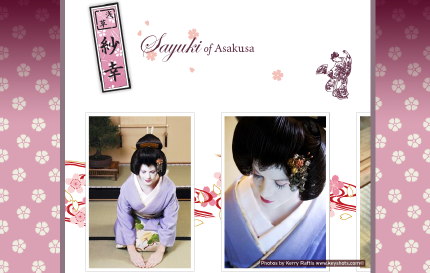
Australian anthropologist is Japan’s first-ever foreign geisha

website screenshot

A documentary film-maker and academic with a doctorate in anthropology from Oxford University, Fiona Graham has just become what she says is the first non-Japanese in 400 years to debut as a geisha. But she hasn’t become a geisha for private reasons: She is now recording her life on film according to The Independent:

Sometime soon, she says, the world will see the results: a rare, scholarly inside look into one of the most closed societies in Japan. “It will be unique,” she insists. “Most Westerners who have tried to write about the traditions have failed because they never really lived the life. I’m going to represent the society that I’m living in now, as it is.”

Graham (or Sayuki as she now is called) has been doing anthropological fieldwork in Asakusa – one of the oldest of Tokyo’s six remaining geisha districts – for the past year, living in a geisha house (okiya), and participating in banquets as a trainee. She first came to Japan on an exchange programme from Melbourne aged 15. Fluent in Japanese, she has spent time working in Japanese companies and as a journalist.

It seems that it was during her fieldwork she learned to become a geisha:

The training involves learning how to walk, talk and dress, and master several skills, such as the tea ceremony and the three-stringed shamisen, and her own speciality, the Japanese bamboo flute, which she practises every day. Then there are the rules of being in an okiya, or geisha house.
(…)
Her duties will include attending parties at these venues, pouring drinks and entertaining guests. “Everything is carefully rehearsed,” she explains. “When I open a sliding door I have to be on my knees, and stand up. Then close the door again on my knees. Learning what kimono to wear and when … there are many, many little customs like that.” Despite a year of training, she says she is still “not confident” about choosing the appropriate kimono to wear.

Geishas are traditional, female Japanese entertainers, who dance, sing and chat to high-paying guests, usually men (Wikipedia on Geishas / BBC Photo journal Geisha / about.com about Geishas)

According to Fiona Graham, Geishas are “strong, independent businesswomen who control their own lives. They were among the first independent women.”

>> read the whole story in the Independent

>> first coverage by the Telegraph

The anthropologist-geisha has her own website http://www.sayuki.net/ (not so much content there yet, though)

SEE ALSO:

Book review: Ritual praxis in modern Japan

“A unique art form” – Anthropological Research on Anime

Pop goes Japanese culture: Japan’s most visible export isn’t economic, but cultural

Why cellular life in Japan is so different – Interview with anthropologist Mizuko Ito

Anthropologist examines influence of robots in Japan

website screenshot

A documentary film-maker and academic with a doctorate in anthropology from Oxford University, Fiona Graham has just become what she says is the first non-Japanese in 400 years to debut as a geisha. But she hasn't become a geisha for…

Read more

Anthropologist: Investors need to understand the tribal nature of banking culture

Can anthropology help us to understand the current Wall Street crisis? Of course. Anthropologist Gillian Tett is an assistant editor of the Financial Times. “It is undoubtedly an unusual background for a financial journalist”, she writes:

Indeed, whenever I reveal my strange past today, bankers usually either react with horror (what does she know about finance?) or incredulity (why would anyone spend years studying Tajik goat-herders?). But a decade later, my years in Tajikistan are suddenly starting to look a whole lot more useful.

For one thing that anthropology imparts is a healthy respect for the importance of micro-level incentives and political structures. And right now these issues are becoming critically important for Wall Street and the City, as the credit crunch deepens by the day.

One of the important issues is the culture of power:

(G)roups such as Citi or Merrill appear to have developed a more hierarchical pattern, in which the different business lines have existed like warring tribes, answerable only to the chief. Moreover, the most profitable tribe has invariably wielded the most power – and thus was untouchable and inscrutable to everyone else. Hence the fact that, in this tribal culture, nobody reined in the excesses of the structured finance teams at Citi and Merrill.
(…)
(W)hat is crystal clear is that if you want to understand which banks will emerge as winners from the current mess, it is no longer enough to look at their computer systems and balance sheets. Now, more than ever, investors need to understand a bank’s culture too – and the degree to which it is tribal. As I said, a training in Tajik anthropology is suddenly looking very useful.

>> read the whole article in The Financial Times

>> Steve Portigal comments on this piece

Gillian Tett has also written Office Culture – good overview about corporate anthropology

>> more pieces by Gillian Tett

SEE ALSO:

An anthropologist finds insight into Japan’s bad-loan crisis

Can anthropology help us to understand the current Wall Street crisis? Of course. Anthropologist Gillian Tett is an assistant editor of the Financial Times. "It is undoubtedly an unusual background for a financial journalist", she writes:

Indeed, whenever I reveal…

Read more