
search expand

Airport lamps light only option for studious Guinea kids

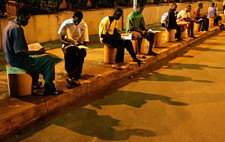
When the sun has set in Guinea, one of the world’s poorest nations, and the floodlights come on at Gbessia International Airport, the parking lot begins to fill with children. It is among the only places where they can count on finding the lights on. The long stretch of pavement has the feel of a hushed library, according to ap-writer Rukmini Callimachi in an fascinating article in USA Today:

Groups of elementary and high school students begin heading to the airport at dusk, hoping to reserve a coveted spot under the oval light cast by one of a dozen lampposts in the parking lot. Some come from over an hour’s walk away.

“I used to study by candlelight at home but that hurt my eyes. So I prefer to come here. We’re used to it,” says 18-year-old Mohamed Sharif, who sat under the fluorescent beam memorizing notes on the terrain of Mongolia for the geography portion of his college entrance test.

Eighteen-year-old Ousman Conde admits that sitting on the concrete piling is not comfortable, but says passing his upcoming exam could open doors. “It hurts,” he says, looking up from his notes on Karl Marx for the politics portion of the test. “But we prefer this hurt to the hurt of not doing well in our exams.”

Only about a fifth of Guinea’s 10 million people have access to electricity and even those that do experience frequent power cuts. With few families able to afford generators, students long ago discovered the airport.

The lack of electricity is “a geological scandal,” says Michael McGovern, a political anthropologist at Yale University, quoting a phrase first used by a colonial administrator to describe Guinea’s untapped natural wealth. Guinea has rivers which if properly harnessed could electrify the region, McGovern says. It has gold, diamonds, iron and half the world’s reserves of bauxite, the raw material used to make aluminum.

>> read the whole story in USA Today

“Although Guinea’s mineral wealth makes it potentially one of Africa’s richest countries, its people are among the poorest in West Africa” >> more information on Guinea in the BBC country guide

Michael (Mike) McGovern is / was the West Africa project director for the International Crisis Group. He has appeared quite often in the media on Guinea related issue as a google search reveals

When the sun has set in Guinea, one of the world's poorest nations, and the floodlights come on at Gbessia International Airport, the parking lot begins to fill with children. It is among the only places where they can count…

Read more

Ethnographic reports about the uses of ICT in low-income communities

Culture Matters points to “exciting” working papers by the Information Society Research Group about the social and economic benefits of Information and Communication Technology (ICT) in low-income communities in Jamaica, India, South Africa and Ghana: “These working papers strongly re-enforce the benefits of an ethnographic approach for the wider world”.

One of the most convincing papers is according to Culture Matters written by Daniel Miller and Heather: Horst juxtaposes conventional ICT policy making in Jamaica with ethnographic findings and uncovers that the assumptions concerning internet use held by the government as well as international NGOs diverge hugely from the realities.

Culture Matters juxtapose some of the current policies with Miller’s and Horst’s recommendations:

  • Instead of more computers in secondary schools invest in post-educational training for young adults
  • Instead of investing into expensive high-end computers invest in low-price computers without gaming facilities
  • Instead of creating their own content at high costs, a lot of money can be saved by creating portals which identify useful and high-quality web resources
  • Instead of investing in community computers, offer Internet access via individual mobile phones

Also fascinating according to the blog: the reports from Ghana by Don Slater and Janet Kwami:

Again, ethnography unveiled a huge gap between policy assumptions and actual usage. On the one hand there is the widespread belief amongst governments and NGOs that the Internet is a tool of development through information distribution.

Yet all Internet users in the Accra slum studied used the internet only for chat with foreigners (as well as some diasporic family members and friends). “There was exceptionally low awareness of even the existence of websites”. In internet cafes everybody is chatting with unknown foreigners, largely in the North but also in Asia, with a view of accumulating actual and symbolic goods (either on IM (Yahoo or MSN) or in Yahoo chat rooms).

Internet access, although widespread and popular in Accra, is not cheap – one hour costs much more than the average kid’s lunch money – but many teenagers come several times a week, for several hours, solely to chat with foreigners.

>> read the whole post on Culture Matters

>> all working papers by the Information Society Research Group

SEE ALSO:

How internet changes the life among the First Nations in Canada

INTEL-ethnographers challenge our assumptions of the digital divide

How Media and Digital Technology Empower Indigenous Survival

Why cellular life in Japan is so different – Interview with anthropologist Mizuko Ito

Women in Cameroon: Information technology as a way out of the cultural cul-de-sac

Now online: EASA-conference papers on media anthropology

Culture Matters points to "exciting" working papers by the Information Society Research Group about the social and economic benefits of Information and Communication Technology (ICT) in low-income communities in Jamaica, India, South Africa and Ghana: "These working papers strongly re-enforce…

Read more

“To know what’s happening around the world, you have to study the knowledge of local people”

Recently, we cound find a portrait of anthropologist Melissa Leach in the Guardian. At the age of 35, Leach became professor of the Institute of Development Studies at Sussex University. Now, at 42 and proficient in four African languages, she has been made director of a new global research hub known as the Steps centre (social, technological and environmental pathways to sustainability).

Her research has consistently challenged public policy and the stance taken by government authorities, the Guardian writes:

In the early 1990s, when Leach was a PhD student at the School of Oriental and African Studies at the University of London, she went to Guinea in west Africa with Fairhead, then her research partner.

The area was widely assumed to be experiencing a deforestation crisis, and experts held local villagers responsible. Leach, Fairhead and a Guinean researcher discovered – by talking to the villagers, researching the area’s history and “viewing things through an anthropological lens” – that the opposite was true. The forest was in fact growing, because farmers had worked out how to turn savannah into forest.

Leach and her colleagues had shown how experts can reach wildly wrong conclusions if local knowledge and history are not taken into account. Their findings became a book, Misreading the African Landscape, and a film, Second Nature: Building Forests in West Africa’s Savannahs. A decade later, they are still being used to illustrate the power of anthropological methods.

Her new centre opened in June and hopes to develop a new approach to understanding why the gap between the poorest and the richest is growing, and to doing something about it. It promises to question the “assumption that the world is stable, predictable and knowable through a single form of knowledge that assumes one size fits all”. “We are about producing scholarly research, and playing a public and intellectual role.”

At the Steps centre, there are 18 academics representing disciplines ranging from anthropology to ecology to medicine. Academic and policy debates, she says to the Guardian, are compartmentalised into areas as agriculture or health. Rarely do the different disciplines manage to speak to one another. “We urgently need new, interdisciplinary approaches to understanding and addressing situations that combine an understanding of social, technological and environmental processes.”

>> read the whole story in the Guardian

There are already several papers to download at the website of the Steps centre.

And the centre has of course its own blog “The crossing”

Leach has been interviewed by the Guardian before, see Ground rules for research. Technology won’t help developing countries if it is not tailored to local needs and Steps towards better development.

I also found an older paper:

James Fairhead and Melissa Leach: Webs of power: forest loss in Guinea

SEE ALSO:

Primatologists go cultural – New issue of Ecological and Environmental Anthropology

How to survive in a desert? On Aboriginals’ knowledge of the groundwater system

Thailand: Local wisdom protects hometown from the onslaught of globalisation

Culture and Environment – New issue of Pro Ethnologica is online

Collaborative Ethnography: Luke Eric Lassiter Receives Margaret Mead Anthropology Award

Teamwork, Not Rivalry, Marks New Era in Research

Recently, we cound find a portrait of anthropologist Melissa Leach in the Guardian. At the age of 35, Leach became professor of the Institute of Development Studies at Sussex University. Now, at 42 and proficient in four African languages, she…

Read more

National Geographic Channel Is Going Anthropology?

Michelle Shildkret from the National Geographic Channel writes to me and informs about a new TV-program called taboo. This season of Taboo premieres Sunday, August 5th.

Taboo is an hour-long program that challenges the way we look at other cultures and ourselves, by exploring practices that are completely normal to their participants but seem brutal, disgusting or even immoral to many of us today.

For those of you who – in contrast to me – have a TV, it will be interesting to check what kind of perspectives they have chosen – if it’s mainly exoticism or if they manage to challenge stereotypes and give deeper insights into the many ways we live on our planet.

National Geographic Channel has just posted three video preview clips on Google Video. One of them (see below) explores a ritual that brings boys into manhood, by having their skin sliced thousands of times to create scars that resemble alligator skin

[video:google:5622871516732076641]

More information: I’ve posted Michelle Shildkret’s email in the forum

SEE ALSO:

The Dictionary of Man: Will Bob Geldof and the BBC reproduce racist anthropology?

Is this anthropology? African pygmies observe Britains in TV-show

Disney-Film depicts indigenous people as involved in cannibalism

Michelle Shildkret from the National Geographic Channel writes to me and informs about a new TV-program called taboo. This season of Taboo premieres Sunday, August 5th.

Taboo is an hour-long program that challenges the way we look at other cultures…

Read more

(updated) Site upgrade – new antropologi.info email subscription

I’m back from my holidays and have upgraded the blog software I’m using (b2evolution). Upgrading is a tricky thing, so as you can see (especially if you don’t use Firefox, but Internet Explorer, Opera or Safari), there are some layout issues (sidebar f.ex) that I need to fix. there are some things I need to fix.

But upgrading also means new features. For all of you who don’t use rss readers, it is now possible to get email notifications when this blog gets updated. The only thing you need to do is to register, visit the blog and fill out the subscription form down in the sightbar (direct link) and choose which blogs you want to subscribe to.

(no very user-friendly procedure, maybe I’ll offer a monthly newsletter for the Non-Norwegian readers as well somewhen)

I hope everything will be fixed during the following week.

I'm back from my holidays and have upgraded the blog software I'm using (b2evolution). Upgrading is a tricky thing, so as you can see (especially if you don't use Firefox, but Internet Explorer, Opera or Safari), there are some layout…

Read more