
search expand

Neighborhood Shopkeepers in South Korea – Dissertation by Antti Leppänen is online

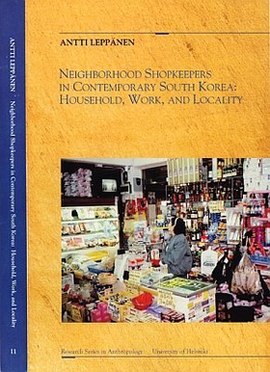
cover Another anthro-blogger has published his dissertation. Antti Leppänen has been on fieldwork among neighborhood shop keepers in South Korea. His interest in this toipc was “aroused by the visible ethnographic difference between my native Finland and the Korea of neighborhoods and marketplaces with its multitude of shops and the colorfulness, restlessness, disorder, and shabbiness of the urban scenery marked by shop signboards, from which my interest moved to people behind the visual façade”.

But that’s not the whole story as he writes:

The article that particularly directed my attention to the keepers of small businesses in South Korea in the first place was Laurel Kendall’s study (1996) of shamanism in Seoul in the 1990s, in which she discusses the phenomenon that the majority of the patrons of shaman rituals she encountered were shop owners, restaurateurs, and proprietors of small companies.

She suggests that the apparent ease with which the shamanistic rituals, earlier practiced mainly to cure illnesses, have now turned to ensuring entrepreneurial success and providing wealth, lies in a “calibration” of those practices to meet the contemporary arbitrariness of the market and the political economy (ibid: 521–2)

He conducted his field research during the aftermath of the Asian currency crisis, colloquially termed at the time as the “IMF crisis,” which highlighted the social and cultural circumstances of small businesskeeper in a specific way.:

The livelihoods of small-scale entrepreneurs became even more precarious than before; self-employment became an involuntary choice for many middle-class salaried employees who were laid off; and the cultural categories and concepts of society and economy – South Korean capitalism – were articulated more sharply than before.

Although the keepers of small businesses occupy approximately one fourth of the population in active work force, the livelihoods of these people and their cultural and social worlds have according to Leppänen rarely been in the focus of social science inquiry.

>> download Antti Leppänen’s dissertation “Neighborhood Shopkeepers in Contemporary South Korea: Household, Work, and Locality”

>> Antti Leppänen’s blog

SE ALSO:

“But We Are Still Native People” – Tad McIlwraith’s dissertation is online

Thesis: How does EU influence the life of farmers in Finland?

Available for download: Alex Golubs dissertation on mining and indigenous people

cover

Another anthro-blogger has published his dissertation. Antti Leppänen has been on fieldwork among neighborhood shop keepers in South Korea. His interest in this toipc was "aroused by the visible ethnographic difference between my native Finland and the Korea of…

Read more

Anthropology podcasts receive much attention

Jen Cardew has done a great job in recording and publishing speeches held at the annual meeting of the Society for Applied Anthropology (SfAA). Several new podcasts (mp3-files from the session “Global Health in the Time of Violence”) can be downloaded. She has even written an introduction in podcasting and blogging.

The podcasts received lots of attention as you can see on the page Buzz Around the Web. Even a blog about internet marketing found something interesting there.

As she explains in a comment on Savage Minds, her project was “quite easy and cost effective”.

>> visit the website Podcasts from the SfAA

EARLIER COVERAGE

Conference Podcasting: Anthropologists thrilled to have their speeches recorded

Anthropologists no longer a primitive tribe?

Jen Cardew has done a great job in recording and publishing speeches held at the annual meeting of the Society for Applied Anthropology (SfAA). Several new podcasts (mp3-files from the session "Global Health in the Time of Violence") can be…

Read more

Global Migrants For Climate Action – Migrants organize to fight climate change


We’ve read a lot about the consequences of climate change for the Inuit. But it’s people in poor countries who will suffer most and they already do. Lots of people from these countries live as migrants in countries like Norway or the U.S. Because of personal knowledge and experience, immigrants from poorer countries have a special motivation to circulate information both ways. Therefore, immigrants in Norway have started a new organisation Global Migrants For Climate Action:

The organization will seek cooperation with other immigrant organizations in Norway and internationally, in order support all demands for stronger reduction of emissions. We are also focusing on how important the issue of social justice is regarding the consequences of climate change.

Poor countries in Africa and Asia that are emitting a small part of greenhouse gas emissions are likely to bear the brunt of rising temperatures.

On their website they provide lesser known information about global activism against climate change, among other things about a film festival by Exiled Tibetans in Dharamsala about global warming.

Around 200 people attended the opening conference, most of them were immigrants.

>> visit the website of Global Migrants for Climate Action

SEE ALSO:

Time to reframe the climate issue? “It’s time to ask questions about equal rights, fairness, vulnerability, and the balance of power,” researcher Karen O’Brien argues (CICERO – Center for International Climate and Environmental Research Oslo)

Bangladesh: A nation in fear of drowning (The Independent, 18.4.07)

Intergovernmental Panel on Climate Change (IPCC): Billions face climate change risk (BBC, 7.4.07)

A new word For June – or: When is the Arctic no longer the Arctic?

We've read a lot about the consequences of climate change for the Inuit. But it's people in poor countries who will suffer most and they already do. Lots of people from these countries live as migrants in countries like Norway…

Read more

“But We Are Still Native People” – Tad McIlwraith’s dissertation is online

Our fellow anthro-blogger Tad McIlwraith has successfully defended his dissertation “But We Are Still Native People’: Talking about Hunting and History in a Northern Athapaskan Village” that now can be downloaded from his website (The graduates in his year are the first who are able to request open access publication)

His dissertation is a study of hunting in the northern Athapaskan village of Iskut, British Columbia, Canada. Iskut hunting is a source of pride for Iskut people. Yet, hunting is sometimes stigmatized by outsiders with interests in the lands and natural resources of northern British Columbia. For some outside observers, he writes, modernization and acculturation are one-way processes. Traditions are better left in the past. At times, he found out, Iskut talk about hunting conveys those sentiments too. At other times, Iskut people strongly reject the stigma of labels like ‘impoverished’ or ‘nomadic’ that resonate in the words that have been written about Iskut people.

Tad McIlwraith indicates that the ethnographic inquiry into an Iskut culture was a profitable way to identify the importance of hunting to Iskut people and, thus, to offset the racism and stereotypes that are frequently associated with native lives.

He also argues that ethnoecological research and the Ethnography of Speaking both contribute useful methodological alternatives to Traditional Use Studies particularly when the documentation and interpretation of the varied expressions of hunting in Iskut Village is of concern.

>> download the dissertation

>> visit his blog

Our fellow anthro-blogger Tad McIlwraith has successfully defended his dissertation "But We Are Still Native People’: Talking about Hunting and History in a Northern Athapaskan Village" that now can be downloaded from his website (The graduates in his year are…

Read more

The Dictionary of Man: Will Bob Geldof and the BBC reproduce racist anthropology?

Bob Geldof is to team up with the British Broadcasting Corporation (BBC) on a project to digitally catalogue all known human existence. They want to create the “largest ever living record” of films, photographs, anthropological histories, philosophies, theologies, economies, language and art, as well as people’s personal stories, according to afp

Might sound good but reading Geldofs statements (“In an age of globalisation, we face the growing homogenisation of cultures”) and their plans to “capture all 900 of the separate groups of people anthropologists believe exist in the world”, one begins to doubt: It seems that Geldof and the BBC are going to reproduce old fashioned racist anthropology (“Völkerkunde”). Although they call it an “anthropological project”, they can’t have read much anthropology.

>> BBC: Geldof unveils earth series plans

>> afp: BBC, Geldof join forces to draw up a map of mankind

>> Guardian: Geldof plans the definitive record of mankind

UPDATE: Over there at Culture Matters, Joana Breidenbach comments:

Here we see again the widely popular notion of “cultures” as distinct, static and unchanging entities threatened by Western-led globalization.

It seems a pity that this outdated view should be perpetuated by the BBC who in its reportages so often manages to portray a very different image of the cultural dynamics in globalization: i.e. in which a new diversity is created by the encounter between global consumer goods, media, ideas and institutions with local ways of doing and thinking.

>> read the whole comment

SEE ALSO:

Is this anthropology? African pygmies observe Britains in TV-show

In Detroit and London: More African Villages in the Zoo

Geldof’s Live8 and Western myths about Africa

Bob Geldof is to team up with the British Broadcasting Corporation (BBC) on a project to digitally catalogue all known human existence. They want to create the "largest ever living record" of films, photographs, anthropological histories, philosophies, theologies, economies, language…

Read more