search expand

Nepal: Anthropologists, sociologists urged to build country

“Anthropologists should actively cooperate in the building of new Nepal”, Subash Chandra Nembang said at the three-day international seminar on ‘social science in a multi-cultural world’, organized by the Nepal Sociological and Anthropological Society (NSAS).

“It is sad that most of the projects run in Nepal do not have participation of sociologists and anthropologists”, he said. Secretary of the Society Bhanu Timsina said the sector has been under shadows as the planners have not realized the utility of the sociologists and anthropologists, according to the website The Rising Nepal.

Unfortunately, neither the conference nor the organisation seems to have a website. Digital Divide?

SEE ALSO:

Anthropology in a Time of Crisis. A Note from Nepal

Global identity politics and The Emergence of a Mongol Race in Nepal

Festivals and Cultural Change in Kathmandu, Nepal

“No Nepalese Can Dare To Challenge Centuries Old Religious Harmony”

Stefanie Lotter: Studying-up those who fell down: elite transformation in Nepal (Anthropology Matters 2/2004)

"Anthropologists should actively cooperate in the building of new Nepal", Subash Chandra Nembang said at the three-day international seminar on 'social science in a multi-cultural world', organized by the Nepal Sociological and Anthropological Society (NSAS).

"It is sad that most…

Read more

Fieldwork reveals: Bush administration is lying about the “war on terror” in the Sahara

“The US is sending troops to the Sahara desert of west Africa to open what it calls a new front in the war on terror”, the Guardian reported three years ago. “The ‘official truth’ about the ‘war on terror’ on the Sahara-Sahel is a ‘lie’”, anthropologist Jeremy Keenan writes in Anthropology Today December and argues that in this situation, anthropologists have to act as independent witnesses and have to refuse collaborating with intelligence agencies and government bodies.

Keenan has been – according to himself – the sole ‘external’ or ‘foreign’ witness to a sequence of events associated with the US administration’s ‘global war on terror’ that many Tuareg believe has irreversibly transformed the central Sahara and Sahel, as well as their lives and livelihoods. Keenan has done research in the central Sahara for more then 30 years. He writes:

As a result of more or less continuous and at times microscopically detailed field research, much of which has been undertaken by and in collaboration with local Tuareg in Algeria, Niger, Mali and Libya, and with Toubou in Chad, we now know that all the incidents used to justify the launch of this new front in the ‘war on terror’ were either fiction, in that they simply did not happen, or were manufactured by US and Algerian military intelligence services.

(…)

How and why did such a monstrous deception take place? The ‘how’ is simple. First, the Algerian and US military intelligence services channelled a stream of disinformation to an industry of ‘terrorism experts’, conservative ideologues and a compliant media, whose prevailing ‘cut and paste’ culture has made them the perfect mouthpiece for an administration that operates through the Orwellian concept of ‘reality control’ and ‘proof by reiteration’. The result is that several thousand articles have turned the great ‘lie’ into the ‘official truth’.

Second, if a story is to be fabricated, it helps if the location is far away and ‘beyond verification’. The Sahara is the perfect place – larger than the United States and effectively closed to public access.

As we know, the CIA has started sponsering anthropologists to gather sensitive information in their so-called “war on terror”.

Here, anthropologists have a key role to play, Keenan writes:

The role of the anthropologist in such situations (as in all his/her work) must be to provide field-based information that can counter the propaganda emanating from the ever growing (and now increasingly privatized) intelligence and other war agencies. At the very least, the anthropologist must be the witness, the recorder, perhaps the interpreter and, where necessary, the author of the ‘truth’.

In the present critical juncture, anthropologists have a key role to play in the ‘war on terror’: to remain located outside the corrupting sphere of intelligence agencies and government bodies and to act as independent witnesses and reporters. This requires considerable courage, not necessarily because of dangers in the field situation, but because access to the field, on which the anthropologist’s professional career often depends, is likely to be terminated.

Even more serious for anthropologists in American universities is that such actions, especially in the prevailing‘McCarthyist’ climate of the Bush-Cheney administration, may increasingly lead to self-censorship as the result of threats to employment prospects.

The risks are not so high in ‘old Europe’. But there is no certainty that similar pressures as those in the USA will not be brought to bear on anthropologists and other academics in the UK. After all, it was only in October that the Foreign and Commonwealth Office’s offer of £1.3 million to the Economic and Social Research Council (ESRC) and Arts and Humanities Research Council (AHRC)45 attempted to inveigle academics, anthropologists in particular, to help it in ‘combating terrorism by countering radicalisation’.

In this duplicitous incident, the Association of Social Anthropologists (ASA) played a key role in getting the project cancelled, at least for the time being. With such potential threats to anthropologists greater now than at any time in the past, it is imperative that our professional associations publicly recommit themselves to the protection of all anthropologists from any such pressures and threats.

The text is not available online (for subscribers only. But Keenan has written on this issue here as well:

Jeremy Keenan: Bush’s Imaginary Front in the War on Terror (AlterNet, 28.9.06)

More information:

Saharan peoples are falsely accused of terrorist acts (ESRC Science Today, June 2004)

Jason Motlagh: The Trans Sahara Counter-Terrorism Initiative: U.S. takes terror fight to Africa’s ‘Wild West’ (Global Research, San Francisco Chronicle, 30.12.05)

Anthropology Today editor Gustaaf Houtman comments:

If anthropologists, as a particularly exposed branch of academia, are to have any value at all in the ‘war on terror’, we must, to adopt a Quaker maxim coined in Nazi Germany, ‘talk truth to power’. But talking truth is clearly not enough. We must, first, be wary of ‘spin’ and find new and more appropriate ways to converse with government agencies without compromising our academic independence. And second, we must ensure we are actually heard. So let us engage the world of popular communications to our best ability on issues that matter.

UPDATE:

The dangerous militarisation of anthropology

SEE ALSO:

San Jose: American Anthropologists Stand Up Against Torture and the Occupation of Iraq and AAA Press Release: Anthropologists weigh in on Iraq, torture at annual meeting

“War on terror”: CIA sponsers anthropologists to gather sensitive information / see also debate on this on Savage Minds

Anthropology and Counterinsurgency: The Strange Story of Their Curious Relations

Bush, “war of terror” and the erosion of free academic speech: Challenges for anthropology

USA: Censorship threatens fieldwork – A call for resistance

Two Books Explore the Sins of Anthropologists Past and Present

Embedded anthropology? Anthropologist studies Canadian soldiers in the field

“Tribal Iraq Society” – Anthropologists engaged for US war in Iraq

"The US is sending troops to the Sahara desert of west Africa to open what it calls a new front in the war on terror", the Guardian reported three years ago. "The ‘official truth’ about the ‘war on terror’ on…

Read more

Islam in Morocco: TV and Internet more important than mosques

Another example of how religious and cultural practices change: A soon to be released survey of religious practices in Morocco will show that the majority of Moroccans prefer to pray alone, and use audiovisual media and the internet for information on their religion, according to Magharebia.com:

About 65% of those interviewed pray on a regular basis and a significant portion of Moroccans practise their religion in an individual manner, rather than collectively. As for sources of religious knowledge, the survey has demonstrated the ever-growing role of satellite channels, audiovisual media in general, cassettes and the Internet. These channels have become essential sources, taking the place of traditional written sources, to the level of 85%.

The survey also picks up on the shrinking role of institutions providing religious teaching in the acquisition of religious knowledge. These institutions, such as the family, the mosque, the school, the brotherhood etc., do not play the role they used to play in giving Moroccan people a grounding in religion.

As for the status of women, the survey highlights the ever-growing role of women in the field of religion.

The survey was carried out by three Moroccan researchers — sociologist Mohamed El Eyadi, political analyst Mohamed Tozy and anthropologist Hassan Rachik — who were assisted by a team of field workers.

>> read the whole story in Magharebia.com

SEE ALSO:

Muslims in Calcutta: Towards a middle-class & moderation

What does it mean to be Muslim in a secular society? Anthropologist thinks ahead

Islam: Embracing modernity while remaining true to their traditions and core beliefs

Book review: Mahmood Mamdani: “Good Muslim, Bad Muslim”

Islam in Europe: Mainstream society as the provider of conditions

Islam Is Gaining a Foothold in Chiapas

How Islamic cassette sermons challenge the moral and political landscape of the Middle East

Lila Abu-Lughod: It’s time to give up the Western obsession with veiled Muslim women

Another example of how religious and cultural practices change: A soon to be released survey of religious practices in Morocco will show that the majority of Moroccans prefer to pray alone, and use audiovisual media and the internet for information…

Read more

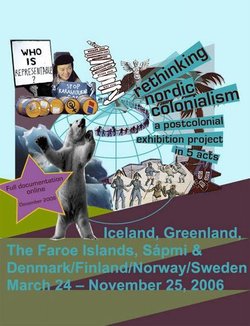
Rethinking Nordic Colonialism – Website Sheds Light Over Forgotten Past

plakat 56 artists, theorists, politicians, and grassroots activists from all over the world participated in the project that took place in Iceland, The Faroe Islands, Sapmi, Norway, Sweden and Finland. They exchanged colonial and postcolonial experiences and strategies, examined why this past has been forgotten and how it continues to reproduce itself as waves of intolerance, xenophobia, and nationalism.

A week ago the (impressive!) website of this project (which has also been published on DVD) has been launched in Oslo. You can spend hours and days, reading the papers, watching videos and movies, looking at exhibitions, listening to presentations.

In the introduction Frederikke Hansen and Tone Olaf Nielsen explain:

The colonial history of the Nordic region is a dark chapter that seems to have slipped the memory of many of the Nordic populations. Although it continues to make itself very much felt in the region’s former colonies, this history is alarmingly absent in the collective memory of the once-colonizing Nordic countries.

With Rethinking Nordic Colonialism: A Postcolonial Exhibition Project in Five Acts, we aim to shed light over this history. Not only do we hope to explain why this past has been forgotten in some parts of the region. We also want to show how this history continues to structure the Nordic societies today, and how our contemporary problems of intolerance, xenophobia, and nationalism have their roots in this past.

I’ll come back with more blog posts about this website

>> visit Rethinking Nordic Colonialism

SEE ALSO:

An exhibition and a movie: The French, colonialism and the construction of “the other”

Anthropology and Colonial Violence in West Papua

“A postcolonial urban apartheid”: Two anthropologists on the riots in France

The Five Major Challenges for Anthropology

plakat

56 artists, theorists, politicians, and grassroots activists from all over the world participated in the project that took place in Iceland, The Faroe Islands, Sapmi, Norway, Sweden and Finland. They exchanged colonial and postcolonial experiences and strategies, examined why this…

Read more

“Don’t transfer all copyrights to the publisher”

Is it okay to publish your own journal articles on your website? Won’t you violate any copyright? No problem! Publishers are quite flexible if you let them know you are just going to include a copy of your article on your own website or on your institution’s website, according to the most recent entry in the Open Access Anthropology Blog.

But important: Many publishers ask the author to transfer all copyrights in the work to the publisher. Don’t give them all copyrights! They quote Peter Hirtle who in his article Author Addenda: An Examination of Five Alternatives proposes an author’s addendum — “a little bit of legalese that you add to the agreement with your publisher and sign that lets you save the rights you need in order to make your work open access”.

>> read the whole entry: Author’s right agreements: how to make them work for you

For example when I published the (rather short) article Cosmopolitanism and anthropology/ in Anthropology Today, it was no problem to delete the second part of this part of the copy right agreement:

In consideration of the publication of the Article in the above Journal, I hereby warrant and undertake:
a. that this Article is an original work, has not been published before and is not being considered for publication elsewhere in its final form either in printed or electronic form.

SEE ALSO:

antropologi.info Open Access Anthropology Special

Is it okay to publish your own journal articles on your website? Won't you violate any copyright? No problem! Publishers are quite flexible if you let them know you are just going to include a copy of your article on…

Read more