
search expand

Researches neo-paganism in an overwhelmingly Catholic society

They believe in witches but are catholics at the same time. In a forthcoming book, anthropologist Kathryn Rountree describes surprising links between paganism and traditional Catholicism in Malta. It will be the first book to explore neo-paganism in an overwhelmingly Catholic society, Rountree tells Massey University News:

What fascinated Dr Rountree was the observation that although Maltese pagans and witches shared a kind of global pagan culture with feminist and New Age spiritual movements elsewhere through books and the internet, they did not share the same antipathy towards orthodox Christianity.

Maltese pagans maintain an affinity with Catholicism simply because they are so deeply imbued with it.

“There is little choice about being Catholic in Malta,” she says. “It is not so much a religion which an individual accepts (willingly or not) or rejects as it is the cultural ‘ground of being’ for all Maltese.” As one of the pagans she interviews says: “For me, trying not to be Catholic would be like trying not to be Maltese.”

By accepting an invitation to attend a Summer Solstice celebration, Dr Rountree met other pagans and witches in Malta who gathered to participate in these and other pagan rituals.

But because of Catholic disapproval of alternative religions, she has had to conceal the identities of those she interviewed to protect them. She believes the people she interviewed for a book could risk losing their jobs if they became known as practising pagans in the strongly Catholic country.

>> read the whole story in Massey News

SEE ALSO:

Kathryn Rountree: Goddess pilgrims as tourists: inscribing the body through sacred travel (Sociology of Religion, Winter 2002)

BBC on Paganism and Neo-Paganism

Pagan Network – to promote the acceptance and tolerance of Paganism as a faith system within the UK

They believe in witches but are catholics at the same time. In a forthcoming book, anthropologist Kathryn Rountree describes surprising links between paganism and traditional Catholicism in Malta. It will be the first book to explore neo-paganism in an overwhelmingly…
Read more

World Cup Witchcraft: European Teams Turn to Magic for Aid

(via del.icio.us/anthropology) I’ve just returned from the match France-Portugal and have just stumpled upon this news story in the National Geographic. Many European soccer stars, including those currently playing in the World Cup, turn to magic and odd rituals before the game:

England defender John Terry, for example, says he always sits in the same place on the bus traveling to the game. He also must tie the tapes around his socks that hold shin guards in place three times before a game.

During this World Cup, Spanish striker Raul Gonzalez was reportedly berated for turning up at practice wearing a yellow T-shirt. His coach, Luis Aragones, considers yellow bad luck. (France went on to knock Spain out of the cup on Tuesday.)

(…)

Former Italy coach Giovanni Trappatoni could be seen sprinkling holy water on the playing field from a bottle provided by his sister, a nun.

>> read the whole story (as you see, the National Geographic has a different focus…)

MORE:

Soccer superstitions: Some fans will have wacky ways of spurring their team to victory (BBC)

“Superstition, a football tradition” (Fifaworldcup.yahoo.com)

SEE ALSO:

World Cup Enthusiasm: “Need for a collective ritual, not nationalism”

(via del.icio.us/anthropology) I've just returned from the match France-Portugal and have just stumpled upon this news story in the National Geographic. Many European soccer stars, including those currently playing in the World Cup, turn to magic and odd rituals before…

Read more

Interviews on Christians and Muslims, Class, Immigration History and Black Feminism

Four interviews that I’ve conducted for the research program “Cultural Complexity in the new Norway” have been translated into English:

The sacred space between Christians and Muslims – Interview with Oddbjørn Leirvik
Leirvik has been involved in inter-religious dialogue since the middle of the 1980s: “I want to investigate the space in between. The space between Christians and Muslims. I wonder whether there is an open landscape which we share and which nobody has control over.”

– Class, equally as important as ethnicity – Interview with Ivar Morken
For special needs educationalist Ivar Morken cultural complexity is just as much about class differences in a Norwegian valley as it is about immigration from distant lands.

Collecting immigrants’ life histories – before it’s too late – Interview with Knut Kjeldstadli
In the three volume “Norsk innvandringshistorie” ( A History of Immigration in Norway) the historian Knut Kjedstadli, showed that it is wrong to believe that Norway was a homogeneous society before the arrival of Pakistanis and Somalis.

In pursuit of “black feminism” in Norway – Interview with Beatrice Halsaa
What is the relationship between ethnic Norwegian and non-ethnic Norwegian feminists or immigrant women? This is one of the big questions that Beatrice Halsaa, leader of the Centre for Women’s Studies and Gender Research (SKK) is interested in.

Four interviews that I've conducted for the research program "Cultural Complexity in the new Norway" have been translated into English:

The sacred space between Christians and Muslims - Interview with Oddbjørn Leirvik
Leirvik has been involved in inter-religious dialogue since the middle…

Read more

The Journals of Knud Rasmussen: The impact of Christianity among the Inuit

rasmussen-film

(LINKS UPDATED 30.9.2020) A new film by Inuit film maker Zacharias Kunuk (53) explores how missionaries force-fed Christianity to the Inuit in the 1920s. It’s called The Journals of Knud Rasmussen. Before its official world premier at the Toronto International Film Festival, a preview was held for Kunuks home community Igloolik, a cultural hub of the Arctic, 2,800 kilometres north of Toronto. Gayle MacDonald from The Globe and Mail has been there and reports:

The frigid temperature (30 C below) does not faze these people, who came in droves — some by prop plane from as far away as Qaanaaq, Greenland; and Nunavut’s capital, Iqaluit — to watch Kunuk’s latest cinematic creation. (…) “One of my friends left the seal hunt early so that he could get here before the show starts,” Kunuk, himself an avid hunter, adds proudly.
(…)
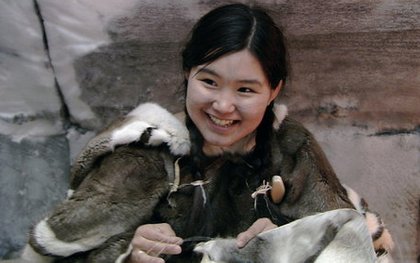
The shy filmmaker explains that his new film, shot in the relatively balmy months of April and May last year, is the story of explorer Knud Rasmussen, who travelled through this area in the 1920s, chronicling the conversion to Christianity of the great shaman Avva (played by local resident Pakak Innukshuk) and his willful daughter Apak (Leah Angutimarik).

The local Inuits appreciated that he took on taboo topics:

Some say they liked Atanarjuat, based on an Inuit legend, better. Others attest to being equally touched by this film, about the last great Inuit shaman, Avva. But all say they were glad Kunuk took on a taboo topic: shamanism, which the early missionaries dubbed devil worship, and which still sits uneasily with some of the town’s most religious Anglican, Roman Catholic and evangelical residents.

Kunuk’s production company, Igloolik Isuma Productions is according to the article one of the few success stories, periodically employing hundreds of local people as actors and film crew while injecting several million dollars into the economy. The people, by and large, are poor. Suicide (especially among those under 20), alcoholism, drug use and spousal abuse are rampant.

>> read the whole story in The Globe and Mail (replaced by copy)

Journals of Knud Rasmussen - trailer - IFFR 2007

SEE ALSO:

Isuma preps to film Igloolik’s history. Kunuk’s new film documents the arrival of Knud Rasmussen, Christianity (Nunatsiaq News, 10.9.04)

Study examines how Inuit coped with contact

Eskimo Folk-Tales collected by Knud Rasmussen

Inuit play makes fun of anthropologists

rasmussen-film

(LINKS UPDATED 30.9.2020) A new film by Inuit film maker Zacharias Kunuk (53) explores how missionaries force-fed Christianity to the Inuit in the 1920s. It's called The Journals of Knud Rasmussen. Before its official world premier at the Toronto International…

Read more

Explores how indigenous peoples interprete Christianity

Carolyn Schwarz spent 17 months in the most remote part of northern Australia to conduct field work for her dissertation on how Christianity and Western religious systems either came together or conflicted with one another. “There hadn’t been much work on introduced religious practices in aboriginal Australia”, she says to the journal Advance at the University of Conneticut:

In Western society, “religion is treated as being something separate,” she says, “But in aboriginal societies, religious beliefs are not as separated – politics and religion are one and the same. Religion is a way of life. It carries over into mundane activities, such as exchanging food, negotiating for money and receiving access to vehicles.”

>> read the whole story in Advance

Carolyn Schwarz spent 17 months in the most remote part of northern Australia to conduct field work for her dissertation on how Christianity and Western religious systems either came together or conflicted with one another. "There hadn’t been much work…

Read more