search expand

New e-zine: American Ethnography

cover

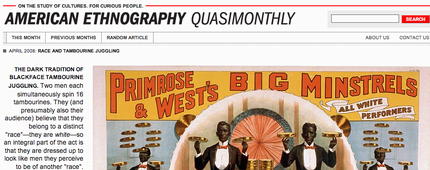
Anthropologist Martin Høyem has launched the e-zine “American Ethnography”, an “internet glossy on the study of cultures”:

We cover ethnography that relates to anything we would call America. We aim to present the tradition and practice of ethnography to people who didn’t know they could be intrigued by ethnography. The goal is to help increase the interest in how we all try to understand unfamiliar cultures. This, we think, could do the world good.

As he writes to me in an email, “it’s pretty new, so there isn’t a lot of material there yet, and most of what is there is old public domain texts (previously not freely available to the general public).” Most of the texts were previously published in the journal American Anthropologist.

Around twelve articles are online already, including portraits of some famous anthropologists and texts about the peyote-cult – a cactus that was eaten in rituals of native Indians. The most recent issue contains articles about race and tambourine juggling. Looks interesting!

>> visit American Ethnography

Høyem has previously written a thesis about American Lowrider Culture called I want my car to look like a whore. Lowriding and poetics of outlaw aesthetics, see also my post about the thesis: When Norwegians do business in Brazil, Lowrider Culture and 9 more anthropology theses.

Høyem is currently working at Pacific Ethnography – anthropology and design

UPDATE: The discussion about American Ethnography and copyright issues is continuing over at Savage Minds, see American Ethnography, the AAA, and the Public Domain

cover

Anthropologist Martin Høyem has launched the e-zine "American Ethnography", an "internet glossy on the study of cultures":

We cover ethnography that relates to anything we would call America. We aim to present the tradition and practice of ethnography to people…

Read more

Phd-Thesis: That’s why they embrace Islam

cover

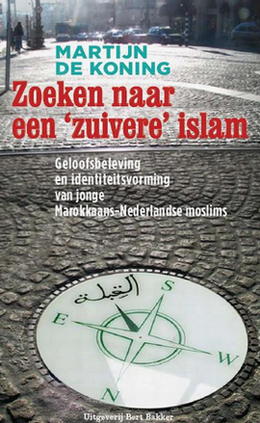
Our fellow anthro-blogger Martijn de Koning was awarded his doctorate at the Free University of Amsterdam last week.

In his Ph.D. thesis he shows how Islam has become the most important frame of reference for Moroccan-Dutch youth to reflect upon who they are and what they want to be.

In the late 1990s, the general perception was that young muslims were turning away from their religion. But things went differently, he says in an interview with Radio Netherlands. Young Dutch Moroccans are increasingly turning to their religion.

According to Martijn de Koning this is a direct result of the current polarisation of the debate on Islam:

Even before 9/11 there was already an increase in interest for religion among young Moroccans. But once the debate on Islam flared up, their interest increased enormously. They were continually asked about their Muslim identity; not just by the media, but also by school mates and teachers and by people at their sports club. They started looking into Islam so that they could answer these questions.

These group of young Muslims searched for an identity with which they could distinguish themselves from Dutch society as well as from their parents:

They wanted a pure Islam, without compromise. Not an Islam that had been watered down because they happened to live in the Netherlands. Nor did they want an Islam peppered with Moroccan traditions.

The Islam they found was not the traditional type from Morocco. They found their answers on the Internet in the conservative, Saudi-Arabian version called Salafism, the anthropologist says:

It is a form of Islam with clear rules, which makes a clear distinction between good and evil. An Islam which is stricter and more orthodox than that of the older generation, but nevertheless seemed to provide better answers to their complicated lives in modern Dutch society.

>> read the whole story in Radio Netherlands

>> visit his blog (in both Dutch and English)

Interestingly, researchers in Norway came to similar conclusions, for example anthropologist Christine M. Jacobsen – see Doctoral thesis: Towards a transnational Islam and the culture historian Liv Bjørnhaug Johansen – see Moving toward a Cultureless Islam

cover

Our fellow anthro-blogger Martijn de Koning was awarded his doctorate at the Free University of Amsterdam last week.

In his Ph.D. thesis he shows how Islam has become the most important frame of reference for Moroccan-Dutch youth to reflect…

Read more

Transforming the Anthropology of Childhood – Anthropology News April

Has Anthropology News gone open-access? 14 articles of the new issue are online. Anthropology News examines new ways of thinking about childhood and children’s roles and experiences. Methodological challenges of anthropological work with and of children are addressed as well.

We can read articles on children and climate change and disasters, on a successful antipoverty program for working poor adults and their children where anthropologists were involved, children as anthropologists, on children’s rights and much more.

>> overview over all articles

screenshot

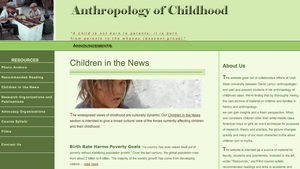
In this issue, we also are informed about the existence of a website called Anthropology of Childhood that grew out of collaborative efforts at Utah State University between anthropologist David Lancy and past and present students in his anthropology of childhood class.

SEE ALSO:

“We want children to be their own ethnographers”

Ethnographic study: Why the education system fails white working-class children

Anthropologist calls for a greater appreciation of child labor

Technologies of the Childhood Imagination- new text by anthropologist Mizuko Ito

Play as research method – new Anthropology Matters is out

screenshot

Has Anthropology News gone open-access? 14 articles of the new issue are online. Anthropology News examines new ways of thinking about childhood and children's roles and experiences. Methodological challenges of anthropological work with and of children are addressed as well.

We…

Read more

Examples of engaging anthropology – New issue of “Anthropology Matters”

logo

How can anthropology contribute to understanding and fighting inequality? The new issue of Anthropology Matters brings together articles from the first British postgraduate MA in Applied Anthropology and Community and Youth Work. Most of the students are experienced youth workers, working with underprivileged, marginalised youth in the UK.

As Alpa Shah writes in her editorial:

All the papers are in some form interested in the lessons from and for anthropological theory and analysis in its engagement with applied action. The articles focus on youth, encourage youth workers to be critically aware of the policy discourses with which they operate, the structural inequalities which they veil, and promote a more reflexive praxis of working with youth in order to create spaces of critical thinking between them.

One example is Saffron Burley’s analysis of the growing trend among young people in urban areas in the UK to own fighting dog breeds such as bull terriers, and the resultant “moral panic” that this has caused among dominant groups. Burley employed participant observation by taking a young Pit Bull Terrier called “Biscuit” out for walks in the area, in order to understand these young people better.

The result, Alpa Shah writes, is “an insightful ethnographic account which explores the subtle potentials that exist in the union of the young person and the dog”:

Burley’s work not only contributes to our understanding of inequality, marginalisation and animal-human relations, but concludes with some lessons for community and youth workers – rather than seeing the dogs as “problems”, as external to the young person, the dog needs to be drawn into the centre of understandings of the dilemmas and tensions faced by youth.

The issue is dedicated to an engaging anthropologist and participant of the MA course at Goldsmith who was killed in a bicycle accident in January: Paul Hendrich. In his phd-project on “Charting a new course for Deptford Town Hall”, Hendrich examines his own institutional context at Goldsmiths College and the debates surrounding the history of the racism of the British slave trade that is embedded in Deptford’s former Town Hall:

As I was putting the finishing touches to this editorial, Paul Hendrich’s wife, Sasha, called with the devastating news that Paul had been run over on his bicycle by a lorry. Paul was 36 years old and had a one year old daughter, Agatha. His death is a deep loss to all of us. Paul was a very special person with some extremely rare qualities. His life was committed to engaging an everyday struggle against racism. He held a passion and belief that anthropology could and should be used for and rethought through this struggle against racism and it is this that guided his engagement with academia.

>> read the whole editorial

>> read Charting a new course for Deptford Town Hall by Paul Hendrich

>> overview over all articles in Anthropology Matters Journal, 2008, Vol 10 (1) Engaging Anthropology

logo

How can anthropology contribute to understanding and fighting inequality? The new issue of Anthropology Matters brings together articles from the first British postgraduate MA in Applied Anthropology and Community and Youth Work. Most of the students are experienced youth…

Read more

Another way of doing fieldwork: Developing websites with your informants!

Indigenous communities have embraced the internet from early on. The website of the Oneida Indian Nation was set up before the website for the White House. Anthropologist Maximilian C. Forte has developped several websites in collaboration with indigenous organisations. Website development is a mode of action research, he explains in an interesting paper that is based on a recent presentation.

In his research on Caribbean indigenous resurgence, he began offline and later moved online, he writes. It started after he has signed a reciprocity agreement with the leader of the Carib Community in Arima. In return for access to the community, Forte would assist them with whatever technological, graphic, and writing knowledge he had.

Website development is no purely technical process:

The websites that were created represented, to a large extent, collaborative writing exercises, emerging from meetings, conversations, and interviews. Viewers would not have known that the launching of some of the websites were also occasions for parties in my apartment, with photographs, drinking, music, drinking, laughter, and much more drinking.
(…)
The result of these early experiences led to my creating various online fora with a wider embrace, such as the Caribbean Amerindian Centrelink – part directory, part listserv, part message board, part online publishing centre – and then one of the earliest and still existing open access, peer reviewed journals in anthropology and history, that being KACIKE.

Together with his indigenous partners (informants) he created the field. In contrast to traditional fieldwork, the researcher and his informants predate the site, they don’t arrive at it.

Web-based and Web-oriented ethnographic research, Forte explains, leads to “a series of moves from participant observation to creative observation, from field entry to field creation, and from research with informants to research with correspondents and partners”:

The Internet permits the co-construction of cultural representations and documentary knowledge, especially where the resource that is produced is the result of collaboration between those we traditionally sorted out as the researchers and the researched.
(…)
Those who were traditionally “the researched about” in offline settings, now have access to the works of researchers, can argue back (as they often do), and produce alternative materials in their own right. No longer is there a simple one-sided determination by the researcher over what research should be about, how it should be done, how it should be written or shown, and what its results should be-researchers are often called to account.

Among the persons and communities that have had access to the technology there has been considerable enthusiasm for the internet from early on. “The Internet may be for marginalized indigenous minorities what the printing press was for European nationalism”, Forte writes. “We are not extinct” has become the leitmotif of online self representations by Caribbean indigenous persons and a basis for online activism, especially among Taínos.

These online struggles have produced some noteworthy successes in gaining recognition and some degree of validation from the usual authorities according to the anthropologist.

>> read the whole paper by Maximilian Forte on his own blog “Open Anthropology”

SEE ALSO:

Interview with Michael Wesch: How collaborative technologies change scholarship

Open Source Fieldwork! Show how you work!

“We have a huge responsibility to give back to the places we study from”

Collaborative Ethnography: Luke Eric Lassiter Receives Margaret Mead Anthropology Award

Play as research method – new Anthropology Matters is out

Going native – part of the darker arts of fieldworkers’ repertoir?

How to save Tibetan folk songs? Put them online!

The Birth of a Cyberethnographer: The MU5 is to Blame

Indigenous communities have embraced the internet from early on. The website of the Oneida Indian Nation was set up before the website for the White House. Anthropologist Maximilian C. Forte has developped several websites in collaboration with indigenous organisations. Website…

Read more