
search expand

Neuroanthropology: “Different cultures produce different brains”

It might sound deterministic (and essentialising – maybe one should replace “cultures” with “societies”), but Juan Dominguez, a PhD student at the University of Melbourne, believes “different cultures” produce “different brains” and that cultural differences reflect different neurological functioning. He discussed the effects of ‘enculturation’ on the human brain at a recent anthropology conference in Cairns, according to ABC Australia. He said:

In certain societies and cultures there are certain patterns of behaviour, people may make certain evaluations, have certain opinions, there are certain tasks that are culturally specific. We should be able to find that … the brain would have some sort of bias acquired through exposure to culture.

Douglas Lewis, a senior lecturer at anthropology who is supervising the work, acknowledges this is a controversial area. He explains that the emerging science of neuroanthropology suggests that brains within a group can be ‘wired’ by common experience, just as individual brains become ‘wired’ by individual experiences. “What we’re looking for are correlates in the brain that anthropologists have in the past thought of as being cultural or culturally mediated,” he says.

>> read the whole story in ABC

>> coverage in the Neorophilosopher’s weblog

John Walter, a Ph.D. candidate in the Department of English at Saint Louis University comments:

This kind of work makes some of us in the liberal arts really nervous, but that’s because we don’t understand cognitive studies and neuroscience well enough. (…)

My sense is that there’s a fear that if we accept or find that difference is part of our neurological wiring we’ll be taking a step back to past racist practices of essentializing and differentiating groups. This fear is, I think, rooted in the assumption that there’s some kind of culture-biology duality, that if something is wired into us it is unchangeable, because (…) wiring doesn’t change. Those familiar with cognitive science, however, know that brains are adaptive.

>> read the whole comment in Machina Memorialis

SEE ALSO:

Social Neuroscience – Psychologists neuroscientists and anthropologists together

It might sound deterministic (and essentialising - maybe one should replace "cultures" with "societies"), but Juan Dominguez, a PhD student at the University of Melbourne, believes "different cultures" produce "different brains" and that cultural differences reflect different neurological functioning.…
Read more

How filmmaking is reviving shamanism

As noted earlier, Inuit film maker Zacharias Kunuk explores in his film The Journals of Knud Rasmussen how missionaries force-fed Christianity to the Inuit in the 1920s.

Now the film has made its way to the International Film Festival in Toronto and to movies across Canada. In an interview with the Edmonton Journal, Kunuk tells about how film making has contributed to a revival of Inuit shamanism:

“For our Inuit audience and for our young people, we’re showing that we survived 4,000 years under shamanism: Be kind to animals, use only what you need. We had everything — food, clothes. You had to be a good hunter to be rich. Christianity came, all that was put aside. Growing up, the minister was telling us don’t do drum dances, don’t tell legends because they’re the work of the devil. It’s brainwashing. It happened in New Zealand, Australia, Africa. It probably all happened the same.

(..)

“I wanted to put it down on record. For 4,000 years of our history, it is only the last 85 years that Christianity came. It doesn’t balance. We traded 100 taboos — laws of nature — for Ten Commandments, which now I don’t have any trust for after looking at where they came from. Love thy neighbour? They’re bombing the hell out of each other! But we had to throw away all these rules of the land, taboos we just dumped so we could go to heaven.”

(…)

“Shamanism was here, and it’s going to be here, that’s what my elders tell me. After Atanarjuat [an earlier film], the elders started to talk about shamanism more. With this film, because their families are in this community, people learned about their namesakes. We live by namesakes. When I was born, I was given five names, but the government couldn’t pronounce them so we were given tags and family names.”

>> read the whole interview

Read also film reviews in the Edmonton Journal, in the Toronto Sun, and on Cinematical.com.

EARLIER COVERAGE:

The Journals of Knud Rasmussen: The impact of Christianity among the Inuit

As noted earlier, Inuit film maker Zacharias Kunuk explores in his film The Journals of Knud Rasmussen how missionaries force-fed Christianity to the Inuit in the 1920s.

Now the film has made its way to the International Film Festival in…

Read more

“Good story about cannibals. Pity it’s not even close to the truth”

Great commentary (and a good example of engaged anthropology) by anthropologist Sarah Hewat about a recent TV story on Wa Wa, a Korowai boy in Papua, who should be “rescued” from “cannibals”. Hewat says, the journalists should have read some work by anthropologist Rupert Stasch before talking about cannibalism. Stasch did his doctoral research on the Korowai of West Papua in the mid-1990s:

If they did, they would learn that as a Korowai, Wa-Wa does not live as a member of a lost tribe, tyrannised by tradition. (…)
The Korowai may live in the forest, but that does not exclude them from having a certain style of modern life. Korowai may fly in planes, go to church, attend school, have meetings with government officials, or sell produce at the market — or gaharu (agarwood) to black-market traders. Even in the peripheries of Korowai territory, where Wa-Wa lives, people no longer kill and eat witches. Times have changed, and in any case, they fear the barbaric repercussions of the Indonesian police.

Part of the story is Paul Raffaele, who brought the TV-team to Wa-Wa. Raffaele has written this doubtful article I’ve mentioned two weeks ago “They still eat their fellow tribesmen”. Hewat writes about Raffaele:

His work does not enhance understanding of the KorowaI but panders to a Western public hungry to consume the primitive.

The Korowai, like other tribal groups portrayed by Raffaele, are presented by him through a series of either/ors: either they are bright-eyed upholders of a fragile Eden, or else they are darkly menacing, horrifying us with their cruel customs.

But if we pay attention to who they are rather than what we want them to be, then we will find ordinary people trying to come to terms with their place in the world. The Korowai, like other ethnic peoples in their position, are simply struggling to engage state and global forces in their own way.

In her view, the journalists should have rather talked with her and other people who have lived in Papua for years, about “the cannibalistic nature of the tourism industry” there. “Primitiveness” is, she writes, after natural resources, a prize commodity in Papua. Tour operators have perfected the art of selling “first contact tours”. She continues:

I have known locals who have been paid a measly sum to take off their clothes, brandish spears and speak of a barbaric past to satisfy the voyeurism of white tourists, journalists or filmmakers seeking a close encounter with our ancestral past. The cash-strapped locals who stage such performances are, unfortunately, adjuncts to people who get paid much more to bring Westerners to them.

(…)

Our debates about human rights should focus on real issues: supporting the growth of democracy and the rule of law in Papua, building a strong education system that extends to the villages, and, not least, interrogating the exploitative relations between the West and the “primitive other” in the international tourist industry.

>> read the whole story in The Age

PS: Thanks to Peter Keough for alterting me to this article and sorry for not having posted more often recently

UPDATE (24.9.06): I’ve just found an Sydney Morning Herald article where Raffaele conceded he did not know Stasch’s research, doesn’t speak Indonesian or any Papuan language and had spent less than six weeks of his life in the restive province. And Wa-Wa is apparently not Korowai after all. Anthropologist Chris Ballard says, says that Raffaele, two television networks and millions of viewers were misled: The Korowai depend on the tourism trade and have learnt to say what rich foreigners want to hear. “Most of these groups have 10 years’ experience in feeding this [cannibal] stuff to tourists,” Ballard said.

MORE ABOUT THIS ISSUE:

Savage Minds: Breaking News: Intrepid Explorer’s First Contact with a Vanishing Race of Noble Savages

Australian networks clash over cannibal boy (afp, 15.9.06)

Spears fly over ‘cannibal’ expedition (The Age, 15.9.06)

Experts decry cannibalism claims (The Age, 15.9.06)

SEE ALSO:

Rubert Stasch: Giving up homicide: Korowai experience of witches and police (West Papua) (Oceania, Sep 2001)

“They still eat their fellow tribesmen”

Brief history of cannibal controversies

Our obsession with the notion of the primitive society

Ancient People: We are All Modern Now

On Savage Minds: Debate on the Construction of Indigenous Culture by Anthropologists

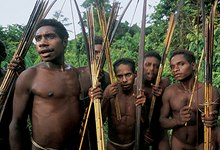
Great commentary (and a good example of engaged anthropology) by anthropologist Sarah Hewat about a recent TV story on Wa Wa, a Korowai boy in Papua, who should be "rescued" from "cannibals". Hewat says, the journalists should have read…

Read more

"Hearing has been neglected in studies of enculturation and personality development"

In one the recent additions in the anthropology journal AnthroGlobe, Grace Keyes examines “how hearing loss impacts an individual’s enculturation”. Enculturation, she explains, is in anthropology textbooks defined as “process by which people acquire their culture (the social norms, symbols, customs, cultural knowledge, meanings, etc.)”.

So what happens when a person cannot hear? Researchers, however, have largely neglected to take into account how biological factors such as hearing may affect enculturation, she writes:

It is generally assumed that language is a major vehicle of enculturation and that most people experience the process in much the same way if they belong to the same culture or society. The role of hearing in language acquisition and enculturation is taken for granted. Thus, works that examine the role of hearing in the enculturation process are non-existent in the anthropological literature. In fact, there exits very little literature on enculturation itself in anthropology.

>> read the whole paper “Incomplete Enculturation: The Role of Hearing” by Grace Keyes

SEE ALSO:

New Ethnography: The Deaf People – A Forgotten Cultural Minority

In one the recent additions in the anthropology journal AnthroGlobe, Grace Keyes examines "how hearing loss impacts an individual’s enculturation". Enculturation, she explains, is in anthropology textbooks defined as "process by which people acquire their culture (the social norms,…

Read more

“They still eat their fellow tribesmen”

(via del.icio.us) If you miss “good old-style” stories about cannibals in far away places like Papua or New Guinea, read this story by Paul Raffaele in the Smithsonian Mag. It starts like this:

For days I’ve been slogging through a rain-soaked jungle in Indonesian New Guinea, on a quest to visit members of the Korowai tribe, among the last people on earth to practice cannibalism.

And about cannibalism: A local guide with “dark eyes” explains:

It’s because of the khakhua, which comes disguised as a relative or friend of a person he wants to kill. “The khakhua eats the victim’s insides while he sleeps,” Boas explains, “replacing them with fireplace ash so the victim does not know he’s being eaten. The khakhua finally kills the person by shooting a magical arrow into his heart.” When a clan member dies, his or her male relatives and friends seize and kill the khakhua. “Usually, the [dying] victim whispers to his relatives the name of the man he knows is the khakhua,” Boas says. “He may be from the same or another treehouse.”

I ask Boas whether the Korowai eat people for any other reason or eat the bodies of enemies they’ve killed in battle. “Of course not,” he replies, giving me a funny look. “We don’t eat humans, we only eat khakhua.”

The killing and eating of khakhua has reportedly declined among tribespeople in and near the settlements. Rupert Stasch, an anthropologist at Reed College in Portland, Oregon, who has lived among the Korowai for 16 months and studied their culture, writes in the journal Oceania that Korowai say they have “given up” killing witches partly because they were growing ambivalent about the practice and partly in reaction to several incidents with police.

(…)

Still, the eating of khakhua persists, according to my guide, Kembaren. “Many khakhua are murdered and eaten each year,” he says, citing information he says he has gained from talking to Korowai who still live in treehouses.

The travel writer even meets “true cannibals”:

Two men approach through the gloom, one in shorts, the other naked save for a necklace of prized pigs’ teeth and a leaf wrapped about the tip of his penis. “That’s Kilikili,” Kembaren whispers, “the most notorious khakhua killer.” Kilikili carries a bow and barbed arrows. His eyes are empty of expression, his lips are drawn in a grimace and he walks as soundlessly as a shadow.

The other man, who turns out to be Kilikili’s brother Bailom, pulls a human skull from a bag. A jagged hole mars the forehead. “It’s Bunop, the most recent khakhua he killed,” Kembaren says of the skull.

The story ends like this:

Three years earlier I had visited the Korubo, an isolated indigenous tribe in the Amazon, together with Sydney Possuelo, then director of Brazil’s Department for Isolated Indians [SMITHSONIAN, April 2005]. This question of what to do with such peoples—whether to yank them into the present or leave them untouched in their jungles and traditions—had troubled Possuelo for decades. “I believe we should let them live in their own special worlds,” he told me, “because once they go downriver to the settlements and see what is to them the wonders and magic of our lives, they never go back to live in a traditional way.”

So it is with the Korowai. They have at most a generation left in their traditional culture—one that includes practices that admittedly strike us as abhorrent.

>> read the whole story in The Smithsonian

>> BBC about the Kombai (Korowai)

>> Rupert Stasch: Giving up homicide: Korowai experience of witches and police (West Papua) (Oceania, Sep 2001)

On Papua Adventures we read:

Due to this very recent exposure to outside influences, the Korowai tribes are not as open and welcoming to tourists as the Yali, Dani and Lani for example. They remain on guard and suspicious of ways different to their own. This does of course make for an exciting and truly adventurous visit flying in by chartered Cessna from Jayapura to Yaniruma and trekking into Korowai country by foot and canoe.

UPDATE: Anthropologist Sarah Hewat comments: “Good story about cannibals. Pity it’s not even close to the truth”

SEE ALSO:

Disney-Film depicts indigenous people as involved in cannibalism

Inuit cannibalism?

Brief history of cannibal controversies

Our obsession with the notion of the primitive society

Is this anthropology? African pygmies observe Britains in TV-show

Ancient People: We are All Modern Now

Primitive Racism: Reuters about “the world’s most primitive tribes”

(via del.icio.us) If you miss "good old-style" stories about cannibals in far away places like Papua or New Guinea, read this story by Paul Raffaele in the Smithsonian Mag. It starts like this:

For days I've been slogging through a rain-soaked…

Read more