
search expand

National Geographic Channel Is Going Anthropology?

Michelle Shildkret from the National Geographic Channel writes to me and informs about a new TV-program called taboo. This season of Taboo premieres Sunday, August 5th.

Taboo is an hour-long program that challenges the way we look at other cultures and ourselves, by exploring practices that are completely normal to their participants but seem brutal, disgusting or even immoral to many of us today.

For those of you who – in contrast to me – have a TV, it will be interesting to check what kind of perspectives they have chosen – if it’s mainly exoticism or if they manage to challenge stereotypes and give deeper insights into the many ways we live on our planet.

National Geographic Channel has just posted three video preview clips on Google Video. One of them (see below) explores a ritual that brings boys into manhood, by having their skin sliced thousands of times to create scars that resemble alligator skin

[video:google:5622871516732076641]

More information: I’ve posted Michelle Shildkret’s email in the forum

SEE ALSO:

The Dictionary of Man: Will Bob Geldof and the BBC reproduce racist anthropology?

Is this anthropology? African pygmies observe Britains in TV-show

Disney-Film depicts indigenous people as involved in cannibalism

Michelle Shildkret from the National Geographic Channel writes to me and informs about a new TV-program called taboo. This season of Taboo premieres Sunday, August 5th.

Taboo is an hour-long program that challenges the way we look at other cultures…
Read more

How to save Tibetan folk songs? Put them online!

More and more Tibetan folk songs are disappearing. Led by anthropology professor Gerald Roche, the Tibetan Endangered Music Project (TEMP) uses digital media to capture tunes that are being lost. The volunteer-run program aims to put all the digital songs they collect online, as a way of archiving the material for future generations, the National Geographic writes.

So far the students at Qinghai Normal University have recorded more than 250 songs, including melodies for herding, harvesting, singing babies to sleep, and coaxing yaks into giving more milk. “The goal is to digitalize the songs we record and return them to our communities,” said 20-year-old student Dawa Drolma. “We want to record as many songs as possible.”

“It is quite remarkable how much they have been able to accomplish from such a remote place, thanks to the Internet and digital recording technology,” said Jonathan C. Kramer, a professor of music at North Carolina State University who has worked with the students. “It is hard to imagine such a project even 20 years ago.”

>> read the whole story in the National Geographic

“One of the biggest challenges that we face at the moment is how to return the music to the communities it comes from,” says Roche, as there are few Tibetan communities with Internet access. “Putting it online is a start, but just a small start.” Tsering Lhamo from Ngawa, Sichuan suggests, “the music we have recorded [could be] taught in primary schools of Tibetan areas in order to preserve them.” according to That’s Beijing.

TEMP is remarkable for many reasons according this blog: its ease of growth, use of existing technology with no budget, a method of preservation by people from the culture itself, and a prospect for real use by both local and global communities.

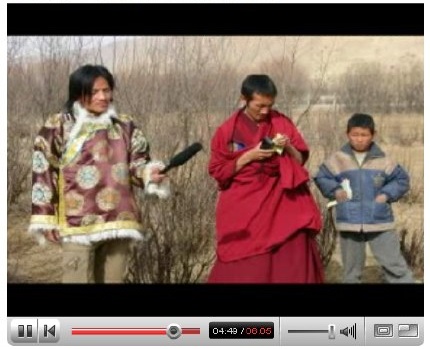
The Tibetan Endagered Music Project has its own website at YouTube with currently five videos.

Related: On the Digital Himalaya website you can listen to music by the Laya (Bhutan and Tibet)

SEE ALSO:

“A new approach to the collection of traditional Aboriginal music”

Multimedia Music Ethnography of Yodelling and Alphorn Blowing

How Media and Digital Technology Empower Indigenous Survival

watch the video on youtube

More and more Tibetan folk songs are disappearing. Led by anthropology professor Gerald Roche, the Tibetan Endangered Music Project (TEMP) uses digital media to capture tunes that are being lost. The volunteer-run program aims to put all the digital songs…

Read more

Infanticide: “We are fighting against anthropologists”

Babies born into some Indian societies in the Amazon are being buried alive, a practice that is being covered up by the Brazilian authorities and anthropologists “out of respect for tribal culture” according to the Telegraph. “We are fighting against doctors and anthropologists who say we must not interfere with the culture of the people”, Marcia and Edson Suzuki founder of a campaign group called Atini – Voice for Life.

Sounds quite unbelievable that one can justify killing humans this way. But the Telegraph quotes anthropology professor Erwin Frank from the Federal University of Roraima State in the Amazon who says: “This is their way of life and we should not judge them on the basis of our values. The difference between the cultures should be respected.”

Some societies consider that if a child has any deformity or disability, it does not have a soul and so – as an animal – should be killed. According to Dr Marcos Pelegrini, a doctor working in the Yanomami Tribe Health Care District, 98 children were killed by their mothers in 2004 alone.

According the comment below, Marcos Pelegrini never has given this information

>> read the whole story in the Telegraph

SEE ALSO:

Do anthropologists have anything relevant to say about human rights?

The Culture Struggle: How cultures are instruments of social power

Babies born into some Indian societies in the Amazon are being buried alive, a practice that is being covered up by the Brazilian authorities and anthropologists "out of respect for tribal culture" according to the Telegraph. "We are fighting against…

Read more

The Dictionary of Man: Will Bob Geldof and the BBC reproduce racist anthropology?

Bob Geldof is to team up with the British Broadcasting Corporation (BBC) on a project to digitally catalogue all known human existence. They want to create the “largest ever living record” of films, photographs, anthropological histories, philosophies, theologies, economies, language and art, as well as people’s personal stories, according to afp

Might sound good but reading Geldofs statements (“In an age of globalisation, we face the growing homogenisation of cultures”) and their plans to “capture all 900 of the separate groups of people anthropologists believe exist in the world”, one begins to doubt: It seems that Geldof and the BBC are going to reproduce old fashioned racist anthropology (“Völkerkunde”). Although they call it an “anthropological project”, they can’t have read much anthropology.

>> BBC: Geldof unveils earth series plans

>> afp: BBC, Geldof join forces to draw up a map of mankind

>> Guardian: Geldof plans the definitive record of mankind

UPDATE: Over there at Culture Matters, Joana Breidenbach comments:

Here we see again the widely popular notion of “cultures” as distinct, static and unchanging entities threatened by Western-led globalization.

It seems a pity that this outdated view should be perpetuated by the BBC who in its reportages so often manages to portray a very different image of the cultural dynamics in globalization: i.e. in which a new diversity is created by the encounter between global consumer goods, media, ideas and institutions with local ways of doing and thinking.

>> read the whole comment

SEE ALSO:

Is this anthropology? African pygmies observe Britains in TV-show

In Detroit and London: More African Villages in the Zoo

Geldof’s Live8 and Western myths about Africa

Bob Geldof is to team up with the British Broadcasting Corporation (BBC) on a project to digitally catalogue all known human existence. They want to create the "largest ever living record" of films, photographs, anthropological histories, philosophies, theologies, economies, language…

Read more

Ethnographic Database Project launched

Laura Fortunato from the Department of Anthropology at the University College London is writing to me telling about the Ethnographic Database Project. She is currently looking for anthropologists with fieldwork experience to take part in this project:

The Ethnographic Database Project (EDP) is a web-based tool for the collection of comparative ethnographic data. The EDP allows anthropologists to enter data about their field research using a set of standard codes developed for cross-cultural application; the codes relate to a society’s organization, kinship and marriage practices, subsistence economy, and pattern of sexual division of labor. The EDP is in the form of a web-based questionnaire, which can be accessed from any computer connected to the internet.

The EDP aims to complement widely-used comparative ethnographic datasets such as the Ethnographic Atlas and the Standard Cross-Cultural Sample by: (i) obtaining data directly from anthropologists who conducted field research in the societies of interest, (ii) using standard codes developed for cross-cultural application for all societies, (iii) expanding the range of societies for which coded ethnographic data are available.

Visit the EDP website where you also can view a sample version of the EDP.

Laura Fortunato from the Department of Anthropology at the University College London is writing to me telling about the Ethnographic Database Project. She is currently looking for anthropologists with fieldwork experience to take part in this project:

The Ethnographic Database Project…

Read more