search expand

Engaged research = Terrorism: Germany arrests social scientists

Germany arrested urban sociologist Andrej Holm because of his academic activities. He was accused of being member of a “terrorist association” called “militante gruppe” (militant group) who is suspected to be behind arson attacks against police and army vehicles.

Holm was arrested because his publications contain keywords and phrases, which are also used in the texts written by the Militante Gruppe (especially the term “gentrification”). The warrant also claims that Holm is intellectually capable of authoring the rather sophisticated texts of the militant groups, since he has a PhD in political science. This person is also said to be suspicious because »he works in a research institution and thus has access to libraries, which he can use inconspicuously for doing the research needed to produce the texts of the militant group«.

After lots of emails the protest against German authorities has become global. The American Sociology Association demands that the Federal Prosecutor immediately release Andrej Holm and the other imprisoned from jail at once:

We strongly reject the outrageous accusation that the academic research activities and the political engagement of Andrej Holm are to be viewed as complicity in an alleged “terrorist association”. No arrest warrant can be deduced from the academic research and political work of Andrej Holm. The Federal Prosecutor, through applying Article § 129a, is threatening the freedom of research and teaching as well as social-political engagement.«

Professor Jerome Krase from The City University of New York writes:

What is especially troubling to me as an Activist or Public Scholar is that Dr. Andrej Holm, Dr. Matthias B., Florian L., Oliver R. und Axel H. were investigated and arrested for the kind of activities that I and most other socially conscious social scientists routinely engage in.

Over the course of my career I have engaged in research and writing about Civil Rights for Nonwhite minorities, Affordable Housing, and most recently the rights of the newest immigrants in the United States and abroad.

If such work can so easily be presented as “potentially” (therefore actually) criminal then it must follow that critical academic activities of all sorts, including those that are only distantly related to political and social engagement can be horribly transformed, by the State, into crimes of subversion and terrorism.

I understand that we live in dangerous and difficult times but such menacing actions by those who are sworn to protect the rights of its citizens must be ever more cautious and reluctant to use its power to take those rights away and cast a chilling shadow across the scholarly community that historically has been a bastion against tyranny.

Academic Advisory Council, Attac Germany warns that “if this reasoning is accepted by society it will destroy the fundamentals of a critical public in a free society. If the reasoning is taken as evidence for the membership in a terrorist organization, critical science is put under general suspicion.”

The Open letter to the Generalbundesanwaltschaft (Federal Prosecutor) against the criminalization of critical academic research and political engagement has already been signed by many of the most known social scientists.

More information on the website http://einstellung.so36.net/en

SEE ALSO:

Richard Sennett and Saskia Sassen: The war on shapeless terror. There seems to be no rational basis for the arrest of a group of German sociologists, and the case highlights the fragility of our civil liberties (Comment is free, The Guardian, 20.8.07)

Pessimistic Views on Academic Freedom: A greater percentage of social scientists today feel that their academic freedom has been threatened than was the case during the McCarthy era (Inside Higher Education, 15.8.07 via Savage Minds)

RELATED EARLIER POSTS:

Bush, “war of terror” and the erosion of free academic speech: Challenges for anthropology

Blogging and Public Anthropology: When free speech costs a career

Fired from Yale, anarchist professor points to politics

USA: Censorship threatens fieldwork – A call for resistance

Engaged anthropologists beaten by the Mexican police

The dangerous militarisation of anthropology

Protests against British research council: “Recruits anthropologists for spying on muslims”

San Jose: American Anthropologists Stand Up Against Torture and the Occupation of Iraq

Get Out of the Library and Into the Streets – new book by David Graeber

Germany arrested urban sociologist Andrej Holm because of his academic activities. He was accused of being member of a "terrorist association" called "militante gruppe" (militant group) who is suspected to be behind arson attacks against police and army vehicles.…
Read more

Extremism: “Authorities -and not Imams – can make the situation worse”

“Muslim religious leaders are not only working with local authorities but are helping to decrease radicalisation”, stresses anthropologist (and blogger) Gabriele Marranci. During an International Conference on Extremism in London, key authorities were criticized for not listening to Muslim Imams who reach out to offer help. They were criticized for paint the Muslim community as un-cooperative at the same time according The Voice.

Marranci said:

“During my research, I found no evidence to suggest that the Muslim chaplains are behaving or preaching in a way that facilitates radicalisation. On the contrary, my findings suggest that they are extremely important in preventing dangerous forms of extremism. However, the distrust that they face, both internally and externally, is jeopardising their important function.”

Marranci researched on islam in prisions: How does being behind bars impact on Muslim identity and their experience of Islam? He interviews over 170 current and former Muslim prisoners in Scotland, Wales and England and lived with the families of former prisoners. His study Living Islam in prison: faith, ideology and fear showed that sometimes it is actions by the authorities-and not Imams- which can make a situation worse. Current efforts by the authorities to curb radicalism within UK prisons are having the opposite effect according to the anthropologist.

His study said, the Voice writes, Muslim prisoners are subjected to stricter security surveillance than other inmates. Marranci claimed that security policies within prisons – including restricting praying in a communal space or reading the Qur’an during work breaks – are exacerbating, rather than suppressing the radicalisation process.

>> read the whole story in The Voice

In a recent entry in his blog he gives us more details about his studies and concludes:

The terrorist threat, as well as the general representation of an ‘Us’ versus ‘Them’ Armageddon battle, is polarising, in a very dangerous way, prison life. On one side are the Muslim prisoners, with a minority of radicals but a majority of ordinary Muslims pushed towards the aforementioned because of the discrimination they suffer. On the other side are the non-Muslim staff and prisoners whom understandably develop resentment towards the terrorists, but which too easily becomes resentment towards the ordinary Muslim prisoners.

These circumstances maximise the possibility of attacks against Muslim prisoners, and consequently provide a fertile soil for successful radicalisation of Muslim prisoners.

Yet I have the impression that the Prison Service and the Government see ‘extremism’ as merely the product of ‘indoctrination’. Yet, as my research suggests, ‘extremism’ within prison should be tackled by rejecting over focused Muslim-centric security policies in order to develop an encompassing strategy against intolerance. (…) I have highlighted many times to the Prison Service that extremism and radicalism are not just Muslim issues. Within the prisons there are visible increases in right-wing ideologies and a high level of unnoticed intolerance.

The ‘War on Terror’, he stresses, is disintegrating the British Values: “Today we are ready to deport people towards their torture and death thanks to shameful political agreements with tyrants who shun our democratic values.”

>> read the whole post “Mr Barot’s disfigured face can radicalise Muslim prisoners more than his voice”

Marranci is currently transforming his research into a book provisionally titled “Faith, ideology and fear: Muslim identities within and beyond prisons”. It will be published by Continuum Books in summer 2008. You can download a speech about his researchheld at the House of Lords.

SEE ALSO:

New blog: Islam, Muslims, and an Anthropologist

Protests against British research council: “Recruits anthropologists for spying on muslims”

Doctoral thesis: Towards a transnational Islam

"Muslim religious leaders are not only working with local authorities but are helping to decrease radicalisation", stresses anthropologist (and blogger) Gabriele Marranci. During an International Conference on Extremism in London, key authorities were criticized for not listening to Muslim Imams…

Read more

New blog: Islam, Muslims, and an Anthropologist

The Anthropology of Islam and Jihad Beyond Islam are the most recent books by Gabriele Marranci. In January this year he has started his own blog Islam, Muslims, and an Anthropologist. He is also writing for the excellent Middle East blog Tabsir.

Gabriele Marranci explains:

By nature, academic publications, even when attempting to reach the general public, are not very widely read outside the ivory tower of academia. (…)For this reason I also started, with Prof. Daniel Varisco, and regularly contribute to, Tabsir.

I believe that anthropologists, as Franz Boas and Margaret Mead have taught us, should engage and contribute to their time by facilitating debate.

In his recent post Collateral damage in the Wars on Terror: between Afghanistan and Glasgow, he comments on the public discourse and press coverage of the recent car bombings in Britain that were linked to al-Qaeda:

Yet are these attacks really al-Qaeda-sponsored? It is too early to say, but I have the impression that this series of attacks were the work of some ‘amateurs of terror’.

(…)

Prime Minister Gordon Brown misleads us when repeating ,

“It’s obvious that we have a group of people – not just in this country, but round the world – who’re prepared at any time to inflict what they want to be maximum damage on civilians, irrespective of the religion of these people who are killed or maimed are to be.”

It’s obvious, I would say, that this is not what those people want; this is, in this case, the inevitable ‘collateral damage’. This group of people kills because they want to achieve their idea of justice and good; they are fighting their battle against ‘evil’ to affirm ‘good’; they are ‘gifting’ us with a purifying fire which will be able to bring joy and prosperity in the future. They are gifting their victims with paradise, they are terrorising us for what they think is right, though costly to achieve. So they say.

Yet are we not terrorising, killing and maiming Afghan civilians to achieve what we think is the right cause? Have we not killed, possibly tortured, illegally detained (i.e. kidnapped), thousands of innocent people, or asked rogue Middle Eastern dictatorships to do so, to achieve what, paraphrasing Mr Brown, is in the interests of a perversion of our western democracy?

During these years of research with different Muslims, having different ideas and beliefs, I have reached the conclusion that we, the homely people of all colours, cultures, faiths and nationalities have found ourselves between not just one ‘War on Terror’ but two. And here is the issue: Terror fighting terror, the only result can be an endless chain of death.

>> visit Gabriele Marranci’s blog

SEE ALSO:

Anthropological perspectives on suicide bombing

Anthropologists on the Israel-Lebanon conflict

“Discuss politics!” – How anthropologists in Indonesia engage with the public

More and more anthropologists, but they’re absent from public debates – “Engaging Anthropology” (1)

The Anthropology of Islam and Jihad Beyond Islam are the most recent books by Gabriele Marranci. In January this year he has started his own blog Islam, Muslims, and an Anthropologist. He is also writing for the excellent Middle East…

Read more

Five more interviews on cultural complexity!

One of my jobs consists in interviewing researchers in the research program Cultural Complexity in the new Norway. Five of these interviews have been translated into English, I’ve just put them online:

Traveling to Turkey to Understand Norway
Anthropologist Therese Sandrup is interested on focusing on the strong emotional connection the second generation in Norway has to their parents’ native country: “It is important to look at the migration process in its entirety. Certain actions and decisions are the result of a dialogue between the past and the present, the country of origin and the Norwegian context,” she says.

Doing Fieldwork Among Poets and Rebels in Paris
Anthropologist Cicilie Fagerlid had actually intended to study peaceful cosmopolitan existence in Paris. But a month after she had relocated there, riots broke out in the suburbs. This research fellow now wants to find out why France ended up in this situation – in large part by studying the poetry slam scene.

Does the Labor Movement Tackle Cultural Complexity?
In the 1970s, The Norwegian Confederation of Trade Unions (LO) struggled with integrating women and new occupational groups. Margrethe Daae-Qvale believes the same is now happening with immigrants. In connection with her Master’s thesis, she has interviewed immigrants who have been active in the trade union, together with central participants within LO’s forum for ethnic equality.

Gender Roles Among Christians and Muslims: Shared Problems and Shared Solutions?
Do Christians and Muslims face common challenges, or are they so distant from each other that communication becomes impossible? In order to answer these questions, the theologian Anne-Hege Grung has formed a dialogue group with Christian and Muslim women. They are meeting to discuss texts from the Bible, the Koran and Hadith.

Revealing Media Habits Among Norwegian-Iranians
In studying media habits among Norwegian-Iranian people, sociologist Sharam Alghasi wants to comment on the relationship between Norwegians and Iranians. “You cannot consider yourself to be Norwegian if you feel you are excluded from Norwegian society through the media”, he says.

One of my jobs consists in interviewing researchers in the research program Cultural Complexity in the new Norway. Five of these interviews have been translated into English, I've just put them online:

Traveling to Turkey to Understand Norway
Anthropologist Therese Sandrup is…

Read more

Thesis: How does EU influence the life of farmers in Finland?

farmers

Why see uncertainty as a hindering aspect of human experience, instead of an enabling one? In her thesis Good Lives, Hidden Miseries: An Ethnography of Uncertainty in a Finnish Village, anthropologist Susanne Ådahl from the University of Helsinki argues that there can be something called “good suffering”, a suffering which creates positive meaning and creative action:

There is a reason why people continue doing things, working, producing on the land, maintaining sociality and community although a lot of it goes against all economic logic. For farmers it is not only a matter of being engaged in practical action, but that the action has a quality of “meaningfulness” to it.

Her thesis is an ethnographic study, in the field of medical anthropology, of village life among farmers in south west Finland, based on 12 months of field work conducted 2002-2003 in a coastal village.

Ådahl asked people about their life histories, the meaning of the home, work, social solidarity and social interaction, notions of illness and well-being. She was primarily interested in finding out how people experience social change and what they do to deal with it. And by working with farmers she “came to understand the central symbols of farming life and the impetus that keeps these people going although outside forces are reducing their living space, both symbolically and literally”.

When she started her fieldwork Finland had been a member of the European Union for seven years, and farmers felt the EU had substantially impacted on their working conditions, she writes:

Perhaps one of the greatest losses they are experiencing is that of their autonomy, the freedom to decide over life which seems to be equivalent to a loss of honour, and an honourable way of dealing with the dependence on structures beyond their control. It is also a potential loss of the home. There was complaint of other pressures in life such as work related stress, the fast pace of life and strained inter-personal relationships. Informants expressed worry over the ingestion of artificial foods and other harmful substances in the environment.

Felt uncertainty in their lives is brought about by increasing social isolation, feelings of depression, anxiety, guilt and distress. A concrete sign of the structural changes that are taking place in society is the emptying of villages.

(…)

The introduction of on-farm inspections and with it the issue of doubt and distrust that is inherent in this practice is perhaps one of the hardest blows to farmers’ pride. They feel that a bureaucratic entity has penetrated into the sanctity of the home, transgressing boundaries of intimacy. Many also equate the present subsidy system with social welfare, living off a system, losing your independence. This has resulted in a loss of motivation to produce, because the reward for being a good farmer, one that strives to maximise his or her yields, is gone.

(…)

They feel that decision makers and representatives of the EU cannot understand, nor recognise the significance of local level knowledge, based in the reality of farming in Finland as well as the geographically specific areas of the country that “good farming practice” is based on.

In the midst of constraints and the demands to mould oneself to the social order there are also minimal forms of resistance, like writing “No EU” in bricks of contrasting colours on the roof of one’s barn. Or being active in a producers’ organisation, in municipal or party politics so as to influence the outcome of political decisions that impact on one’s life:

One of the most obvious forms of resistance is related to the “cancer talk” that people engage in. It is used as a political commentary of the state of affairs, of people’s fear of something foreign controlling their lives. It is a form of blaming society for making their living environment dangerous to dwell in and their food contaminated, and yet they keep on living in this environment.

So why can suffering be good and meaningful? The anthropologist explains:

For farmers it is natural to think that the importance of producing food makes their suffering meaningful, valuable and honourable. This positive, meaningful suffering produces wholesome food that feeds the nation and maintains our independence in terms of food security.
(…)
It is through working and being active in associations and other social activities that farmers can fulfil the central values of the farming life, those of continuity regardless of how economically unprofitable it has become to engage in farming especially for small holders. Farmers make the ambiguity of their lived realities understandable by referring to these core values that spring from the local context.
(…)
I believe that the central role of agency in the lived experience of human subjects emerges precisely because it is set against the backdrop of suffering, of the idea that those things which are at stake in one’s life are threatened.

>> download the thesis

Her reserach was part of the research project Ethnographies of Illness Experience in Contemporary Finnish Contexts that has published three medical anthropology papers online.

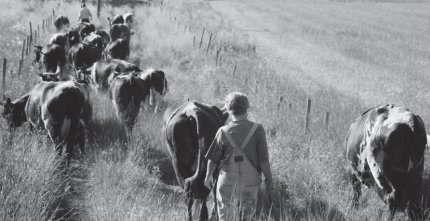
The picture was taken from her thesis.

SEE ALSO:

Local Foods – New issue of Open Access journal “Anthropology of Food”

Crop Diversity Continues Thanks to Modern, Traditional Practices

Thailand: Local wisdom protects hometown from the onslaught of globalisation

farmers

Why see uncertainty as a hindering aspect of human experience, instead of an enabling one? In her thesis Good Lives, Hidden Miseries: An Ethnography of Uncertainty in a Finnish Village, anthropologist Susanne Ådahl from the University of Helsinki argues that…

Read more