
search expand

Food and Religion: New issue of Anthropology of Food

Anthropology of Food is one of the few anthropological Open Access Journals. In their new edition, we’ll find five articles on food and religion in English (two in French), among them:

Michelle Lelwica: Redefining Womanhood (?): Gender, Power, and the “Religion of Thinness”
Although women who are devoted to losing weight do not constitute a “religious” group in the traditional sense of the word, the symbols, rituals, and beliefs surrounding their pursuit of thinness have come to function much like a religion.

Adele Wessell and Andrew Jones: Reading religion and consuming the past in the feast of Guadalupe
Food is integral to the religious expression and community identity of the fiesta, echoed in its translation as the feast day of the Virgin of Guadalupe. In this paper the meal served in the Casa de Comida will be used as a historical text, as a form of communication or representation of the community and its history. Attention is directed to the interdependence of indigenous and immigrant histories expressed in the preparation and consumption of meals, as well as to the legacies of colonialism inherent in the feast.

Meritxell Martín-i-Pardo: Colombo Cabri or vegetarian meal: wherein lies the power?
“Colombo Cabri or Vegetarian Meal” argues that certain foods are used to configure two competing sectarian Hindu groups in Guadeloupe, French West Indies. What are appropriately identified as “traditionalist” and “globalist” Hindus define a rhetoric for legitimating their different claims by appropriating or rejecting “colombo,” a curry of meats simmered in this sauce, as the ritual meal for the sect whose narrative rightly claims to define the correct path for the Hindu community on the island.

>> overview over all articles in Anthropology of Food nr5/2006

Anthropology of Food is one of the few anthropological Open Access Journals. In their new edition, we'll find five articles on food and religion in English (two in French), among them:

Michelle Lelwica: Redefining Womanhood (?): Gender, Power, and the “Religion…
Read more

Brewing Cultures: Craft Beer and Cultural Identity

beer

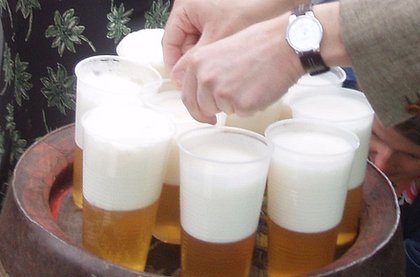
By studying beer cultures, you may learn lot about identity. In the United States, German-American identity is rarely marked. But given the association between Germany and beer, craft beer allows for the active negotiation of German-American identity, anthropologist Alexandre Enkerli writes in a draft of his paper Brewing Cultures: Craft Beer and Cultural Identity in North America, that he ‘s published on his blog.

“Craft beer” refers to barley malt beer brewed locally by a small commercial brewery. The “craft beer movement”, Enkerli explains, is oriented against the beer globalization. Slogans like “Think Global, Drink Local” are popular in the craft beer world.

Enkerli also discusses gender aspects:

Not only is the overwhelming majority of craft beer people male but masculinity and even virility are significant aspects of craft beer culture.

The negotiation of gender identity is an especially significant dimension of homebrewing, Enkerli writes. It often relates to the gender differentiation of food in general:

Historically, alewives and other brewsters have been responsible for domestic beer production. Contemporary (male) brewers often acknowledge the importance of women in the history of brewing. Yet the passage from a woman-centric domestic brewing practice to a male-dominated brewing industry and then to an overwhelmingly male craft beer culture rarely seems to represent a continuous process. It is as if male brewers, and especially homebrewers, were saying that despite their presence in the kitchen, they were still men.

Enkerli is both anthropologist and a craft beer enthusiast and has been homebrewer for several years.

>> read the whole paper

PS: The picture was taken at a Norwegian-German wedding. For the wedding, two barrels of Bavarian beer were transported by the couple from Bavaria to Norway by car. Enkerli’s point about negotion of German identity in the US might also be true for Norway.

beer

By studying beer cultures, you may learn lot about identity. In the United States, German-American identity is rarely marked. But given the association between Germany and beer, craft beer allows for the active negotiation of German-American identity, anthropologist Alexandre Enkerli…

Read more

Anthropologist: "The proper way of eating is with a spoon and a fork"

(Links updated 7.9.2020) A Montreal newspaper story has rapidly sent Filipino tempers rising around the world. Luc Cagadoc, a 7-year-old pupil, was punished by a lunchtime day-care monitor: “You are in Canada. Here in Canada you should eat the way Canadians eat,” the Quebecois educator allegedly said, and went on to observe that Luc “ate like a pig.” The reason: Luc insisted on eating with a spoon and fork as most Filipinos do.

“Educators and parents alike should find ways to work together to avoid traumatizing children who deserve more than to be made to feel inferior because of their parent’s culture”, the editor (I suppose) of the Philippine Daily Inquirer comments (text no longer online).

In a follow-up article called “Spoon Wars” (no longer online), anthropologist Michael L. Tan gives us more information about food, eating habits and cultural history (that’s the role anthropologists should play, isn’t it?):

For Filipinos, and most Asians, spoons were the greatest invention ever. Throw away the knife and the fork but never the spoon, which we use for soups, desserts, vegetables, even to cut meat.

Anyone with knowledge of culinary history can tell you the spoon was the first eating utensil to have been invented. Knives, well, they were originally invented as weapons, and then got reduced for the dining table. And the fork, the infamous fork that westerners insist is the main eating utensil? They come much later, introduced from the Middle East into southern Europe, but treated with disdain by the northern Europeans.

(…)

Etiquette changes all the time because they’re based on meanings we give to people, events, places. In earlier less civil times, meals could become quite violent so the last thing you needed were utensils brandished like weapons, which is why the Chinese resisted knives and forks and stuck to chopsticks.

(…)

But don’t worry, with 8 million Filipinos living and working in Canada and all kinds of other remote, savage lands, many infiltrating homes as nannies and cooks and housekeepers, we’ll teach the world that the proper way of eating is with a spoon and a fork.

Michael L. Tan is an engaged anthropologist. He publishes most of his columns in a blog called Pinoy Kasi. His older texts can be found at http://www.pinoykasi.homestead.com. His current texts are available here: https://opinion.inquirer.net/byline/michael-l-tan

(Links updated 7.9.2020) A Montreal newspaper story has rapidly sent Filipino tempers rising around the world. Luc Cagadoc, a 7-year-old pupil, was punished by a lunchtime day-care monitor: “You are in Canada. Here in Canada you should eat the way…

Read more

Anthropologists find out why we (don’t) buy organic food

(LINKS UPDAtED 4.1.2021) As part of its ongoing market research efforts, a Seattle-based company employs a dozen anthropologists and sociologists. Every one of them has a Ph.D. The researchers are accompanying consumers on their supermarket trips and peeking in their refrigerators and pantries during home visits, we read in the Seattle Post-Intelligencer.

As usual, anthropologists come up with surprising results to the marketers. Shopping is no economic but also an social activity. The most decisive factor in organic-food buying is not price.

Laurie Demeritt, the company’s president, sums up some results:

“It’s more about which product, what it means to the consumer and the value they attach. Here’s an example: We will be shopping with a woman and she stops to put organic strawberries in her shopping cart. The strawberries cost $2 more than conventionally grown strawberries. The question is, why?”

The answer in this case was the woman was buying those strawberries for her children, and she had heard and read that strawberries have some of the greatest amounts of pesticide residues. (…) Just a minute later, the same shopper is passing on organic broccoli and putting a conventional bunch in her cart. Why, the researcher queries? The organic broccoli is only 50 cents more per pound. Because the woman said she was only buying the broccoli for her husband and ‘he’s toxic already. She didn’t put the same value on the lack of pesticides.”

Similarly, organic milk has its own buying logic. Demeritt said low-income mothers consistently buy organic milk for their kids even if the price is significantly more, nearing twice as much in some instances.

>> read the whole story in the Seattle Post-Intelligencer

PS: Nearly at the same time two more articles on corporate anthropology appeared in the news How To Build A Better Product—Study People appeared in PCMag.com. It contains both many well known facts and some newer information, among others about INTELS research on “transnationals”. And in the Toronto Star: Buyer beware: You’re being watched. Anthropologists, sociologists and neurologists are feverishly studying how we shop

SEE ALSO:

Food company works with anthropologists for ad-campaign

Open Access journal “Anthropology of Food”

food and drink – news archive

Popular IT-anthropologists: Observe families until they go to bed

Ethnography, cross cultural understanding and product design

The emerging field of commercial ethnography

Designing for Couples: Product Anthropology?

(LINKS UPDAtED 4.1.2021) As part of its ongoing market research efforts, a Seattle-based company employs a dozen anthropologists and sociologists. Every one of them has a Ph.D. The researchers are accompanying consumers on their supermarket trips and peeking in their…

Read more

Local Foods – New issue of Open Access journal “Anthropology of Food”

Lots of interesting articles can be read in full-text in the new issue of the journal “Anthropology of Food”, edited by Virginie Amilien and Gunnar Vittersø at SIFO – Norwegian Institute for Consumption Research, f.ex about “coalho” cheese in the northeast of Brazil, José Muchnik, Estelle Bienabe and Claire Cerdant write: “This pressed curd cheese made with non pasteurized milk, typical of this region, “is not just a cheese” for the local consumers. It represents their culture, their way of life and their way eating.

Rachel Eden Black conducted ethnographic fieldwork at Porta Palazzo in Turin, which has one of the largest and oldest farmers’ markets in Italy. Farmers’ markets not only support the local production of food, but also help in the sharing of local knowledge of culinary traditions.

“France has Champagne, Norway has tjukkmjølk”, Virginie Amilien, Hanne Torjusen and Gunnar Vittersø write in their article From local food to terroir product? – Some views about Tjukkmjølk, the traditional thick sour milk from Røros, Norway.

>> overview over all articles in Anthropology of Food “Local Foods”

Lots of interesting articles can be read in full-text in the new issue of the journal "Anthropology of Food", edited by Virginie Amilien and Gunnar Vittersø at SIFO - Norwegian Institute for Consumption Research, f.ex about "coalho" cheese in the…

Read more