
search expand

The spectacle and entertainment value of living Indians in the museum

Last year we had debates about racism and neo-colonialism when the Zoo at Augsburg exhibited an “African village”. The same is happening right now in Kolmårdens djurpark – the largest zoo in Scandinavia: They have engaged Massai people who “dance, sing and jump” in the zoo (more in Norwegian).

Last Thursday, anthropologist Dustin Wax has reminded us in a paper of the long history of displaying indigenous people in the museums and zoos – living people, not dead people. Even famous anthropologists as Franz Boas and Alfred Kroeber have been involved in organizing “ethnographic zoos”.

How are indigenous people represented? As it was the case in the zoo in Augsburg and Kolmården, the exhibitions in museums focused on the (timeless) past. Not much seems to have changed:

The focus on the enactment of the past, coupled with the insistence that Indian culture was only “authentic” insofar as it was free from the “taint” of Western civilization, had the effect of presenting Indian culture as something static, unchanging, and doomed to disappear. There was no room in either the dominant evolutionary paradigm of the day or the germinal cultural relativism just beginning to take shape for Indian cultures that continued to exist and to adapt to the changing world around them.

Most organizers of these ethnographic shows had an evolutionary view of the world – in the sense that indigenous people are “less advanced” than “us”. They are “stone age people” and can be used to “illustrate the advancement of evolution of man”:

In the United States (…), the Indian became a symbol of the American land brought to heel by the expansion and dominance of the “civilized” Anglo-Americans—a symbolism brought to life and enacted for a self-congratulatory American public in virtually all of the world fairs and expositions hosted by American cities.

But these “Stone age tribes” are in reality no less modern than middle class Americans. So, anthropologists were horrified when they realised that people from Samoan cut their hair and adopt American garb during their lengthy cross-Pacific journey on their way to the zoo:

They were greeted with horror by the manager in charge of their exhibit at the Exposition, who quickly “put a halt to the ‘civilizing process’” (Rydell 1984: 67) and within a short while it was reported that “the Samoans [were] making a heroic and laudable effort to resume their natural state of barbarism” (Daily Inter Ocean, 14 June 1893, in Rydell 1984: 67).

Likewise, Boas’ Kwakiutl were performing rituals that at home were no longer practiced, and which had never been intended for the kind of display expected at the Exposition. Curtis Hinsley writes that “They were aiding Boas in his effort to recapture a presumed pristine, pre-Columbian condition” (350), a state of affairs that sat well both with Boas’ scientific predilection—later realized in his advocacy of “salvage ethnography”

>> read the whole paper: Representations of Indians in American Natural History Museums by Dustin Wax

Just a few days earlier, Kevin Friedman wrote about Ota Benga – a Kongolese was put on display in the monkey house at New York’s Bronx Zoo. He quotes from an New York Times article:

Visitors to the Monkey House that second day got an even better show. Ota Benga and an orangutan frolicked together, hugging and wrestling and playing tricks on each other. The crowd loved it. To enhance the jungle effect, a parrot was put in the cage and bones had been strewn around it.

>> read the whole post

SEE ALSO:

The Construction of Indigenous Culture by Anthropologists

Anthropological Days at the Olympic Games: An homage to imperialism, the exhibit of conquered peoples was designed to show how America would bring progress to savage peoples

In Detroit and London: More African Villages in the Zoo

Our obsession with the notion of the primitive society

Geldof’s Live8 and Western myths about Africa

Kurt Jonassohn, On A Neglected Aspect Of Western Racism: From the beginning of the 1870s to the end of the 1930s – the exposition of so-called exotic peoples in zoological gardens attracted a huge public

Last year we had debates about racism and neo-colonialism when the Zoo at Augsburg exhibited an "African village". The same is happening right now in Kolmårdens djurpark - the largest zoo in Scandinavia: They have engaged Massai people who "dance,…
Read more

Bush, “war of terror” and the erosion of free academic speech: Challenges for anthropology

Dean Saitta (University of Denver) is one of the four anthropologists in David Horowitz’s book The Professors: The 101 most dangerous academics in America. The reason? His involvement in a debate on the erosion of free public and academic speech in the US.

In his guest editorial in the August edition of Anthropology Today, he describes the consequences of Bush’s “war on terror” for academics and calls for action: Anthropologists, he writes, “need to step up and engage in more and better conversations about the university’s status as a site of critical, creative and civically engaged inquiry”:

The subsequent declaration of a ‘war on terror’ and the passage of the Patriot Act have threatened the civil liberties of many citizens, and brought new fears of government intrusion into our lecture halls and seminar rooms. (…)

As US troops settled into Afghanistan and Iraq the campaign against the academy intensified. Aided and abetted by a resurgent conservative student activism on campus, this campaign accuses the American professoriate of harbouring a pervasive and long-standing liberal bias – with ‘liberal’ variously understood as leftist, Marxist and anti-American.

The campaign’s single most militant crusader, Saitta writes, is David Horowitz. He is a source of advice on political strategy for the Bush administration. Since 2003, Horowitz’ organization Students for Academic Freedom (SAF) has mobilized conservative students and politicians in 20 states to propose an ‘Academic Bill of Rights’ (ABOR) for state-supported institutions. This bill is according to Saitta “clearly aimed at critics of President Bush and the war in Iraq”.

In his book The professors:The 101 most dangerous academics in America (published in february 2006), Horowitz reveals the pervasive ‘intellectual corruption’ of the American university by providing an alphabetized list of “some of the worst violators of professional obligations and standards”.

Four anthropologists are included. As Savage Minds already has noted, Diane Nelson of Duke University is another “dangerous” anthropology professor.

Many more anthropologists could have been included, Saitta stresses:

Horowitz has indicated in several of his writings and interviews that anthropology is one of the more intellectually corrupt disciplines within the social sciences (…), fraught with political correctness and partisanship.

All academics should be concerned about Horowitz’ crusade, he argues. It seems that a large part of the American public agrees with Horowitz in some way. The American public has – as a recent survey reveals – very strange understandings of what the university is and does:

Nearly 70% believe the university should, as its primary function, provide job training rather than cultivate critical thinking. Over 60% believe that professors should be fired for associating with ‘radical’ political organizations. Over 50% think that too much scholarly research today is irrelevant to the needs of society. Finally, nearly 40% believe that the political bias of professors is a serious problem on campus.

Therefore, American anthropologists are faced with at least three major challenges in Saittas opinion:

First, we need to demonstrate that (…) our obligation as university faculty is to teach a breadth of ideas, critically examine their social causes and consequences, boldly experiment with new ones and, from time to time, actively champion particular ideas that can advance what we know and change for the better (whatever we take ‘better’ to mean) how we live. If we make some of our publics uncomfortable in the process, then we’re probably doing something right.

(…)

The second challenge is to better justify and develop the sort of engaged pedagogy and scholarship that landed many of us on the ‘dangerous 101’ list. Horowitz’ model of appropriate pedagogy is hierarchical and elitist. It evokes an image of tweedy professors filling up empty-headed and easily indoctrinable students with what is presumed to be disinterested, value-free knowledge. (…) Significant research in higher education over the past several decades has shown (…) the utility of more philosophically self-conscious and collaborative approaches for cultivating critical powers of mind.

(…)

The third challenge is to show how anthropology’s unique ‘deep time’, cross-cultural and bio-behavioural understanding of the human condition can enrich the entire academic curriculum and inform wider public discourse. (…) [B]ecause of the qualities identified above, anthropology should be the linchpin of a liberal arts education and any truly informed approach to policy-making in a globalizing world.(…)
Anthropology’s particularist conversation about human rights (…) provides a useful counterpoint to the universalist rights conversations of other disciplines.

>> read the whole text: Higher education and the dangerous professor: Challenges for anthropology (760kb, pdf – published on his homepage)

Saitta and many other ‘dangerous professors’ have stepped up to challenge the errors in Horowitz’ book, and to clarify what academia is about and set up two websites and blogs: www.teachersfordemocracy.org/ and www.freeexchangeoncampus.org .

Dean J. Saitta has by the way an excellent homepage with lots of articles.

SEE ALSO:

Engaged anthropologists beaten by the Mexican police

Censorship of research in the USA: Iranians not allowed to publish papers

“Tribal Iraq Society” – Anthropologists engaged for US war in Iraq

“War on terror”: CIA sponsers anthropologists to gather sensitive information

Dean Saitta (University of Denver) is one of the four anthropologists in David Horowitz’s book The Professors: The 101 most dangerous academics in America. The reason? His involvement in a debate on the erosion of free public and academic speech…

Read more

New blog: Sarapen. Online anthropology on Filipino bloggers

(via Livejournal Anthropology Community) Jesse de Leon, Master’s student in Social Anthropology, has started blogging on his research on Filipino bloggers – a very interesting blog about migration, transnationalism, identity and internet research. In his second post he explains:

I’m what’s known as a 1.5 generation immigrant: someone who immigrated as a child old enough to remember the country they were born in. In my case, I immigrated to Canada from the Philippines when I was ten years old. I consider myself as having grown up in both countries. I know that if I had grown up entirely in the Philippines, I would be a different person than what I am today.

It’s therefore understandable that I’m interested in issues of migration, transnationalism, and identity. I’m particularly interested in what identity is like for other Filipinos who have migrated. Do they consider themselves as being completely Filipino? Or do they see themselves as being Canadians now (or American, or Australian, or so on)?

(…)

Now, this is all well and good, but lots of other people have examined these issues. What am I doing that’s new? Well, I’m investigating Filipino migration and identity, but I’m investigating them through blogs. Specifically, I’m looking at how Filipino bloggers talk about these issues. I’m also looking at how Filipino bloggers don’t talk about these issues.

>> visit Sarapen. Online anthropology on Filipino bloggers

His blog is hosted at edublogs.org – a free blog host that he recommends.

(via Livejournal Anthropology Community) Jesse de Leon, Master’s student in Social Anthropology, has started blogging on his research on Filipino bloggers - a very interesting blog about migration, transnationalism, identity and internet research. In his second post he explains:

I’m…

Read more

Brewing Cultures: Craft Beer and Cultural Identity

beer

By studying beer cultures, you may learn lot about identity. In the United States, German-American identity is rarely marked. But given the association between Germany and beer, craft beer allows for the active negotiation of German-American identity, anthropologist Alexandre Enkerli writes in a draft of his paper Brewing Cultures: Craft Beer and Cultural Identity in North America, that he ‘s published on his blog.

“Craft beer” refers to barley malt beer brewed locally by a small commercial brewery. The “craft beer movement”, Enkerli explains, is oriented against the beer globalization. Slogans like “Think Global, Drink Local” are popular in the craft beer world.

Enkerli also discusses gender aspects:

Not only is the overwhelming majority of craft beer people male but masculinity and even virility are significant aspects of craft beer culture.

The negotiation of gender identity is an especially significant dimension of homebrewing, Enkerli writes. It often relates to the gender differentiation of food in general:

Historically, alewives and other brewsters have been responsible for domestic beer production. Contemporary (male) brewers often acknowledge the importance of women in the history of brewing. Yet the passage from a woman-centric domestic brewing practice to a male-dominated brewing industry and then to an overwhelmingly male craft beer culture rarely seems to represent a continuous process. It is as if male brewers, and especially homebrewers, were saying that despite their presence in the kitchen, they were still men.

Enkerli is both anthropologist and a craft beer enthusiast and has been homebrewer for several years.

>> read the whole paper

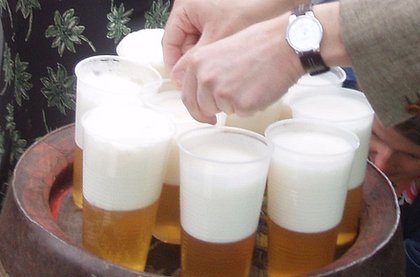
PS: The picture was taken at a Norwegian-German wedding. For the wedding, two barrels of Bavarian beer were transported by the couple from Bavaria to Norway by car. Enkerli’s point about negotion of German identity in the US might also be true for Norway.

beer

By studying beer cultures, you may learn lot about identity. In the United States, German-American identity is rarely marked. But given the association between Germany and beer, craft beer allows for the active negotiation of German-American identity, anthropologist Alexandre Enkerli…

Read more

“Anthropologists Should Participate in the Current Immigration Debate”

“There is ample need for anthropologists and other social scientists to contribute to the immigration debate by providing greater context to the discussion and by describing the effects that immigration policies would have”, JC Salyer argues in Anthropology News May 2006. Anthropologists and the AAA (American Anthropological Association) should counter the many false claims which depict immigrants as national security threats or as hoards depleting the nation’s economic, health care and educational resources, he writes:

While it is always difficult to translate anthropological work into publicly accessible statements, AAA members should support AAA taking immediate steps to assure that the knowledge gained from the valuable body of research conducted by anthropologists on the subject of immigration is not ignored during this crucial period. Whether AAA’s action should take the form of a statement, the creation of an annotated bibliography, or some more creative proposal is for AAA’s leadership to decide, but it would be a true shame if AAA chooses not to join this important public discussion at all.

>> read the whole text in Anthropology News May

Rose Wishall Ediger has attended two rallies in Washington DC — the seventh largest immigrant gateway in the US and home to immigrants from over 30 countries, she writes in another Anthropology News article:

I was struck by the religious and patriotic overtones of the rallies. Both drew on prayer and included regional religious leaders of diverse faiths. In fact, churches have been important to the movement’s organization, helping to kick it off when Cardinal Mahoney of Los Angeles stated that HR 4437 countered the Church’s teachings to “feed the poor and welcome the stranger.” But also there was a display of US patriotism at the second rally: a great many demonstrators wore red, white and blue—especially white, which organizers advocated as a symbol of peace. And instead of the homemade signs of the first rally, attendees at the second event overwhelmingly waved US flags.

These rallies call in , Rose Wishall Ediger’s view, anthropologists to address issues of “race,” “human rights” and “engaged anthropology.”:

While rally participants and the media compare the movement to the 1960s civil rights movement, the relationship between ideas of race, racism, and immigration are still surrounded by open questions. For instance, while there is widespread agreement that those falling into the diverse category of US immigrant—legal or not—face discrimination—there are also claims that immigrants fill occupations and class positions that natives do not. And, how does the competition for resources among and within various minority groups complicate civil and human rights issues?

(…)

An even broader question about immigration that we should consider is what does it say about global inequalities and how human rights are practiced and demanded of different governments, and how do global, transnational, and national public and private policies differentially affect the movement and well-being of people, and what might that mean in terms of social justice. And, finally, on a more personal note, how do our own consumer practices play into it?

>> read the whole article in Anthropology News May 2006

SEE ALSO:

Proclaiming the birth of a new civil rights movement: Mass demonstration against a tougher immigration policy

Immigration laws: More Global Apartheid?

"There is ample need for anthropologists and other social scientists to contribute to the immigration debate by providing greater context to the discussion and by describing the effects that immigration policies would have", JC Salyer argues in Anthropology News…

Read more