search expand

New Proposals – New Open Access Journal

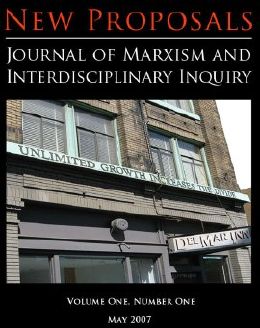
new proposals - cover Anthropologist Charles Menzies is the editor of a new open access journal called New Proposals: Journal of Marxism and Interdisciplinary Inquiry:

New Proposals is a journal of Marxism and interdisciplinary Inquiry that is dedicated to the radical transformation of the contemporary world order. We see our role as providing a platform for research, commentary, and debate of the highest scholarly quality that contributes to the struggle to create a more just and humane world, in which the systematic and continuous exploitation, oppression, and fratricidal struggles that characterize the contemporary sociopolitical order no longer exist.

The first issue was launched in May and focuses on marxist anthropology.

The journal has (of course) its own blog.

new proposals - cover

Anthropologist Charles Menzies is the editor of a new open access journal called New Proposals: Journal of Marxism and Interdisciplinary Inquiry:

New Proposals is a journal of Marxism and interdisciplinary Inquiry that is dedicated to the radical transformation of the contemporary…

Read more

Dissertation: Survival in the Rainforest

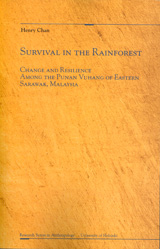
chan cover Are hunter-gatherer communities able to rely completely on the rainforest environment for their food, without any dependence on food traded from farming societies? How has their life changed as a result of settling down? How has the community responded to the drastic changes that have come with logging?

Anthropologist Henry Chan (University of Helsinki) answers these questions in his dissertation “Survival in the Rainforest. Change and Resilience among the Punan Vuhang of Eastern Sarawak, Malaysia” that has been published a few days ago.

For nearly all of their known history, the Punan Vuhang have lived as hunter-gatherers, writes the anthropologist. In 1968, however, they adopted cultivation. His research among the Punan Vuhang began in 1993 and continued through 1995, with a more brief follow-up period in November 2002. Chan is the first Sarawakian awarded the Asian Public Intellectual (API) Fellowship of the Nippon Foundation.

Based on memories of informants, and, where relevant, from participation-observation of present-day hunting-gathering activities, Chan has reconstructed their past economy, history and social organization.

He supports the argument that hunters-gatherers could survive without relying on farming societies for food. For several decades anthropologists and human ecologists have been divided in “The Hunter-Gatherer Dependency Debate”:

Ethnographic studies from the early 1960s of hunter-gatherers emphasized the economic and social advantages of hunting and gathering. This was a complete reversal of an earlier notion that hunter-gatherers are marginalized people on the perpetual verge of starvation, constantly pursuing food, and failing to develop forms of social organization associated with supposedly more advantageous means of production. (…) Lee and Marshall (1961) were the main proponents of a model that maintained that the environment sufficiently provides for the needs of hunter-gatherers.

(…)

Subsequent studies later challenged this model, leading to a series of debates that persisted into the 1990s. These debates pitted against each other two schools of thought commonly known as the “traditionalists” or “isolationists,” and the “revisionists” or “integrationists.” In contrast to traditionalists’ view of the ease in obtaining food, the revisionists documented the difficulty of some hunter-gatherer societies in obtaining carbohydrates. Further, the revisionists maintained that the perception of hunter-gatherers as isolated is erroneous and is an external view imposed on them by anthropologists. (…)

Most revisionists accept the world systems political model, first formulated by Immanuel Wallerstein (1974, 1979), as applicable to the analysis of past and present hunter-gatherers. They argue that the devotion of ethnographic attention to hunting and gathering is itself spurious, and that researchers should instead study how people relate to the forces of capitalism and colonialism.

His data, Chan writes, show that the rainforest is capable of sustaining a hunter-gatherer population:

The case of the Punan Vuhang lends some support to Sahlins’ “original affluence” theory that suggests hunting and gathering people are able to easily satisfy their needs and wants because they have few needs. In fact, of the things they need the most, food, the Punan Vuhang show little concern if no one succeeds in obtaining food for any particular day. They know that someone will get something the next day and share it with everyone else. So long as every hunter explores a field further away and is diligent, there are lots of little things to be found.

In addition to mastering the means by which a wide range of food could be obtained, coping with food scarcity also involved gaining an in-depth knowledge of the environment and its resources according to Chan:

Hunter-gatherers systematically combed the forest and kept in their memory the locations of sago groves, fruit trees and places that attract animals such as salt-licks and wallowing ponds. Armed with this knowledge, hunters brought their specially-bred dogs to hunt wild boars or used blowpipes to shoot tree-dwelling animals and birds. (…) Should an individual hunter fail to obtain game, he did not have to worry about going hungry, for the Punan Vuhang organized themselves so that successful hunters and gatherers shared their food with others.

But this prior situation of food sufficiency, from the past through 2001, was shattered as the Punan Vuhang entered the 21st Century:

In 2001, logging intruded into the remote rainforest and since then has drastically impacted the Punan Vuhang, both physically and socially, as it has left an altered, empty landscape littered with fallen branches and muddy soil. The Punan Vuhang feel frustrated and angered with this wanton destruction of their forest. They spend much time hunting in distant forests, but often return empty handed. Instead of sharing, successful hunters sell meat to loggers whose demand is insatiable.

Many Punan Vuhang men frantically search for scarce aloewood to sell before it is destroyed by logging. Consequently, they neglect their farms and they have to buy rice and sago starch from the logging camp’s grocery shop. Hence, with deforestation, it seems that they have now become truly dependent on outsiders for food. (…) Unable to bear such helplessness, many Punan Vuhang have resorted to alcohol and frequently become drunk.

>> download the thesis

UPDATE: See the comment by Eric Davis related to the Khmer: Hunting and Gathering Discussions

SEE ALSO:

“But We Are Still Native People” – Tad McIlwraith’s dissertation is online

Challenges popular notions on indigenous peoples: Alex Golubs dissertation on mining and indigenous people

How to survive in a desert? On Aboriginals’ knowledge of the groundwater system

chan cover

Are hunter-gatherer communities able to rely completely on the rainforest environment for their food, without any dependence on food traded from farming societies? How has their life changed as a result of settling down? How has the community responded…

Read more

Anthropological perspectives on suicide bombing

“On Suicide Bombing” is the title of a new book by anthropologist Talal Asad. In the introduction he writes:

For many non-Muslims in the United States, Western Europe, and Israel, the suicide bomber quickly became the icon of an Islamic “culture of death.” This led me to try to think in a sustained way about the contemporary mode of violence that is described by much of the Western media as “Islamic terrorism.” Is there, I asked myself, a religiously motivated terrorism? If so, how does it differ from other cruelties? What makes its motivation—as opposed to the simple intent to kill—religious? Where does it stand in relation to other forms of collective violence? How is the image of the suicide bomber, bringing death to himself and others, addressed by Christians and post-Christians?

He also examins the “clash of civilizations” thesis that purports to explain contemporary Islamic jihadism as the essence of contemporary terrorism, and he argue against the kind of history that assumes self-contained civilizations having fixed values. Asad also discusses state terrorism and violence exercised by the modern state:

I am simply impressed by the fact that modern states are able to destroy and disrupt life more easily and on a much grander scale than ever before and that terrorists cannot reach this capability. I am also struck by the ingenuity with which so many politicians, public intellectuals, and journalists provide moral justifications for killing and demeaning other human beings. What seems to matter is not the killing and dehumanization as such but how one kills and with what motive. People at all times have, of course, justified the killing of so-called enemies and others they deem not deserving to live. The only difference is that today liberals who engage in this justification think they are different because morally advanced.

>> read the whole introduction

By the way, Paradise Now is a great film about suicide bombers.

There are several articles by or about Talal Asad online, among others:

Interview with Talal Asad (Asia Source, 16.12.02)

Interview with Talal Asad: Modern power and the reconfiguration of religious traditions (Stanford University)

Talal Asad: A single history? Francis Fukuyama’s defence of the universalism of western values and institutions is challenged by modern global political realities (Open Democracy, 5.5.06)

Talal Asad: Reflections on Laïcité & the Public Sphere (Keynote address at the “Beirut Conference on Public Spheres,” October 22-24, 2004)

Talal Asad’s hour-long Stanford Presidential Lecture

"On Suicide Bombing" is the title of a new book by anthropologist Talal Asad. In the introduction he writes:

For many non-Muslims in the United States, Western Europe, and Israel, the suicide bomber quickly became the icon of an Islamic “culture…

Read more

Mary Douglas has passed away

(via Savage Minds) Mary Douglas has died aged 86. She was the most widely read British social anthropologist of her generation, Richard Fardon writes in an orbituary in the Guardian. If she had to be recalled for a single achievement, Fardon continues, “it would be as the anthropologist who took the techniques of a particularly vibrant period of research into non-western societies and applied them to her own, western milieu”.

Her book Purity and Danger “simply changed the way people saw their world and made sense of every day distinctions that we observed but failed to understand”, Daniel Miller writes in the blog Material Culture

A Sunday Times survey of “Makers of the 20th Century” in 1991 listed Purity and Danger among the 100 most influential nonfiction works since 1945; only four women and four anthropologists made the list, according to The Times

SEE ALSO:

Mary Douglas critical of the new anthropology

Mary Douglas and commercial ethnography

(via Savage Minds) Mary Douglas has died aged 86. She was the most widely read British social anthropologist of her generation, Richard Fardon writes in an orbituary in the Guardian. If she had to be recalled for a single achievement,…

Read more

“But We Are Still Native People” – Tad McIlwraith’s dissertation is online

Our fellow anthro-blogger Tad McIlwraith has successfully defended his dissertation “But We Are Still Native People’: Talking about Hunting and History in a Northern Athapaskan Village” that now can be downloaded from his website (The graduates in his year are the first who are able to request open access publication)

His dissertation is a study of hunting in the northern Athapaskan village of Iskut, British Columbia, Canada. Iskut hunting is a source of pride for Iskut people. Yet, hunting is sometimes stigmatized by outsiders with interests in the lands and natural resources of northern British Columbia. For some outside observers, he writes, modernization and acculturation are one-way processes. Traditions are better left in the past. At times, he found out, Iskut talk about hunting conveys those sentiments too. At other times, Iskut people strongly reject the stigma of labels like ‘impoverished’ or ‘nomadic’ that resonate in the words that have been written about Iskut people.

Tad McIlwraith indicates that the ethnographic inquiry into an Iskut culture was a profitable way to identify the importance of hunting to Iskut people and, thus, to offset the racism and stereotypes that are frequently associated with native lives.

He also argues that ethnoecological research and the Ethnography of Speaking both contribute useful methodological alternatives to Traditional Use Studies particularly when the documentation and interpretation of the varied expressions of hunting in Iskut Village is of concern.

>> download the dissertation

>> visit his blog

Our fellow anthro-blogger Tad McIlwraith has successfully defended his dissertation "But We Are Still Native People’: Talking about Hunting and History in a Northern Athapaskan Village" that now can be downloaded from his website (The graduates in his year are…

Read more