search expand

Kosher cell phones, kosher bus routes and kosher clothing: Israel’s Ultra-Orthodox economy

For Jews, not only food needs to be kosher, the New York Times explains in an interesting article about Israel’s Ultra-Orthodox.

There are even kosher mobile phones. You cannot send text messages with them, take photographs or connect to the Internet. More than 10,000 numbers for phone sex, dating services etc are blocked. Calls to other kosher phones are cheaper and on the Sabbath any call costs $2.44 a minute, a steep religious penalty. “You pay less and you’re playing by the rules. You’re using technology but in a way that maintains religious integrity.”

A whole economic system has evolved to meet their needs, as Tamar El-Or, an anthropologist at Hebrew University explains. She has studied ultra-Orthodox shopping patterns. “There are lines of cellphones and credit cards and Internet suppliers and software and DVDs and clothes and so many things produced or altered or koshered for them, because they have a certain organized power to get the producers to make what they want.”

We read about a bus company that has special routes for the ultra-Orthodox, so that men and women are segregated, sometimes in separate buses. There are shops where you can buy special clothing. Movies and television are forbidden by many rabbies – an exemption is made for children if the intentio is educational. So in a video and music store for the Ultra-Orthodox you can find a large stock of nature documentaries: “National Geographic videos are considered fine, so long, as that there is no human nudity or sexuality, or even sexuality from animals.”

>> read the whole story in the New York Times

As we learn in an article in Science-Spirit mobile use has always been allowed but “it has been difficult to find one that didn’t contain access to the Internet or feature instant messaging plans displaying ads for worldly goods and services.” So, Israel’s ultra-Orthodox rabbis responded by convincing companies to produce a no-frills mobile phone for their community.

The introduction of the kosher phone comes at a time of intense discussion about the community’s future and the practicality of remaining so separate from the rest of Israeli culture:

The Ultra-Orthodox constitute about ten percent of Israeli Jews, or about 600,000 people. (…) They live in their own neighborhoods, have their own school systems, and, as long as they remain in religious school, are exempt from the military service required of all other Israeli citizens (except the approximately 1.5 million Palestinian Arabs living in the state). Ultra-Orthodox families have an average of seven children and most of the men study religion rather than work, relying on stipends from the government. (…) But in recent years, driven by rising poverty, cuts in government stipends and their own expanding population, the ultra-Orthodox have slowly begun to increase their participation in the largely secular Israeli society.

>> read the whole story in Science Spirit

I’ve found one article by anthropologist Tamar El-Or online:

The length of the slits and the spread of luxury: reconstructing the subordination of ultra-orthodox Jewish women through the patriarchy of men scholars (Sex Roles: A Journal of Research, Nov, 1993)

See also Wikipedia on Orthodox Judaism

For Jews, not only food needs to be kosher, the New York Times explains in an interesting article about Israel’s Ultra-Orthodox.

There are even kosher mobile phones. You cannot send text messages with them, take photographs or connect to the…

Read more

“Arabs and Muslims should be wary of anthropologists”

News of anthropologists in the US. military starts circulating on one of the largest Muslim websites, Culture Matters reports. Anthropologist Donald Abdallah Cole says to IslamOnline.net that “Arabs and Muslims should be wary of western anthropologists”:

‘We should be wary of everything that is written about us, whether by local people or by foreigners. To be wary does not mean to reject. We need to read what anthropologists say about people in the developing world and what they say about Islam and Muslims,’ he explained.

‘We can expect to trust the reliability of professional academic anthropologists who are subject to peer review and evaluation. But for others who are not fully professional, we need to be more careful.’”

>> read the whole story on Culture Matters

This reaction is no surprise, especially when we remember that Britian has recruited anthropologists for spying on muslims.

A few weeks ago anthropologist Maximilan Forte wrote that if anthropology’s role as an instrument of empire can come back into sharper focus it is no wonder that anthropology is banished from universities in the ‘decolonized’ world”.

Over at Savage Minds, a dscussion is going on if all this focus on anthropology in the Iraq war is primarily a PR game to bolster the image that the military is doing something novel to correct the errors of the Iraq occupation.

News of anthropologists in the US. military starts circulating on one of the largest Muslim websites, Culture Matters reports. Anthropologist Donald Abdallah Cole says to IslamOnline.net that "Arabs and Muslims should be wary of western anthropologists":

‘We should be wary…

Read more

12 new interviews about cosmopolitanism, islam, modernity, street culture…

In case you’re wondering why this blog sometimes has not been updated for several days: One reason might be my job as a webjournalist for the research program Cultural Complexity in the New Norway (CULCOM).

Now, several of my interviews and summaries have been translated into English:

– Modernity means acceleration
Why do we all have so little time, even though we can actually work more effectively than we could previously? The reason is that acceleration- the continuous increase in speed- is the basic principle of our time. “Modernity’s entire history can be written as a history of acceleration,” says Hartmut Rosa. At the CULCOM seminar “Time and Modernity” the sociologist presented a new theory of modernity.

– This is the basis for a global ethic
They do not know one another and cannot speak to each other. Nevertheless, the old woman in the Moroccan village offers to help the dying woman from the United States. “In order to find common human values, we must go to the basic conditions for our existence – love and mortality”, said the philosopher Odin Lysaker, at the seminar “Shared values in a community with a multiplicity of values”.

Learning from People’s Struggle for Recognition
“The youth attack because society has violated them, and therefore they fight for ‘recognition’,” wrote the philosopher Odin Lysaker in a feature article on the youth protests in Copenhagen. Is it possible for us to understand conflicts better by reflecting over the fact that all people seek recognition?

Invisible Norwegianness
What representations of “Norwegianess” and “normality” are imparted when teachers teach about gender and sexuality in a multicultural classroom? While most studies about “the New Norway” focuses on minorities, Åse Røthing directs her focus at both the majority and the minority, the “Norwegian” and the “non-Norwegian.”

Exclusion Instead of Help
German politicians claim that they want to “save immigrant women.” But for researcher Urmila Goel, the bills proposing to combat arranged marriage are racist and exclusionary. In a new research project, Goel is going to look at how racist and heteronormative discourses work together and reinforce each other in the German debate on arranged marriage.

Moving toward a Cultureless Islam
An extravagant Pakistani wedding or a moderate Muslim celebration? What is Muslim and what is Pakistani? – It wasn’t long before I began to understand that that which permeates all of their discussions about identity is the search for an Islamic identity. They are very concerned with separating culture and religion, says Liv Bjørnhaug Johansen, who recently submitted her Master’s thesis on identity-work on a Norwegian-Pakistani webpage”)

Getting under the surface of the Koran school movement
Both researchers and Turkish authorities view them as fundamentalists. But actually they engage in totally normal religious activities. “It is important to render innocuous that which is harmless”, says the anthropologist Johannes Elgvin, who in his Master’s thesis takes issue with previous research on the Koran school movement.

Religion – an anchoring point for the nation?
Why are there so many debates on religion these days? – Religion is presented as making up part of an alleged core of both the self and the nation, says Lars Laird Eriksen. The sociologist is researching the role of religion in the construction of national identity in the Norwegian school.

Is Networking More Important than Education?
Immigrant women do not leave the workforce at a higher rate than Norwegian women when they have children. The younger generation is doing better than their parents” generation. But education is not as important for obtaining a permanent job as is commonly believed. In her Master”s thesis, sociologist Ida Drange gives us new insight into immigrant women on the job market.

We are all multicultural
Why do intelligent people have prejudices against lesbians and people from distant regions? Where does tolerance end for other ways of living?- I am interested in the boundaries of multiculturalism, said anthropologist Aleksandar Boskovic at one of CULCOM’s Monday seminars.

– More of a Street Culture than an Honor-based Culture
The African male youth along the Aker river in Oslo who sell hashish to researchers, designers and students are passing on an old tradition in the area. “To speak of an honor and feudal culture in connection with the violence along the river is misguided,” says sociologist Sveinung Sandberg. Together with sociology professor Willy Pedersen, this research fellow has studied Norway’s largest outdoor hash market.

From an ethnic to a civic identity?
In 1990, Lithuania was the first Baltic State to declare its independence from the Soviet Union. The Lithuanian anthropologist Vytis Ciubrinskas spoke at CULCOM’s Monday Seminar of a country where national identity has become less ethnic.

In case you're wondering why this blog sometimes has not been updated for several days: One reason might be my job as a webjournalist for the research program Cultural Complexity in the New Norway (CULCOM).

Now, several of my interviews and…

Read more

“No wonder that anthropology is banished from universities in the ‘decolonized’ world” (updated)

The debates about the militarisation of anthropology have recently made the front page of the New York Times and several other newspapers (f.ex. The Boston Globe) and blogs discussed the story.

Are more and more (American) anthropologists willing to collaborate with the military? If so, anthropology’s role as an instrument of empire can come back into sharper focus as an inherent problem of a Western way of knowing the world”, writes Maximilian Forte:

Yet, we have to admit that imperialism is a significant feature of a “discipline” that was made possible by colonial expansion and where once again anthropologists can find profit from imperialist missions in places such as Afghanistan and Iraq.

When this is added to the chorus of voices in anthropology that would like to diminish indigeneity, that disputes the very concept “indigenous,” that refers to the struggles of the colonized for rights in terms of “seeking special rights,” and that lords over indigenous physical remains as if other people’s bodies (specifically colonized bodies) were the natural property of anthropology – then it is no wonder that this “discipline” (the martial severity of this terminology is indicative and fortuituous in this case) continues to be banished from most universities in the “decolonized” world.

>> read the whole blog post: Anthropology’s Dirty Little Colonial Streak?:

Roger N. Lancaster writes about his experiences during his anthropological research in Mexico:

Invariably, one of the first questions I was asked when I tried to begin an interview was, “Are you here to spy on us?”

Even after full disclosure of my university employment, publications and current research design, I found myself blocked out of some potentially useful interviews. Headlines like “Army Enlists Anthropology in War Zones” (front page, Oct. 5) will make future research all the more difficult.

The identification of anthropology with military operations, intelligence gathering and “armed social work” augurs ill for the future of a discipline that studies populations distrustful of power — many of which have had unhappy past experiences with American invasion, occupation or support for corrupt dictatorships.

>> read the whole “Letter to the editor” in the New York Times

Daniel Martin Varisco does not want to take sides. Nevertheless he stresses that anthropologists’ primary task is not to teach anthropology or cultural awareness. The military interest in ethnography is invariably about gathering “intelligence”, he writes. “This is not about knocking on doors, but finding suspects.” “And the issue here”, he continuies, “is not about serving in the army, or judging those who do, but whether or not anthropologists can conduct research that could be used to the detriment of the people being studied.”

In his opinion, these questions are worth discussing further:

• Would an anthropologist want to be in a position where there might be a major conflict between his or her own conscience as a researcher and the military chain of command?
• Would it be possible to establish trust and rapport, so essential for ethnographic research, when clothed in fatigues and followed by a military escort?
• How much time would a researcher have in order to collect information and who would actually own the rights to that data?
• How many anthropologists have the required language and dialect skills to work in Afghanistan or Iraq?
• If asked by the military, would an anthropologist go under cover to get information?
• And, for the long term, how long will it be in the future before anyone trusts anthropologists in either “war on terror” theater?

>> read the whole article: Anthropo covertus: A Disputed Species

Of course, many anthropologists may refuse to collaborate with the military / CIA for political reasons (for some critics the CIA is a terror organisation and opposition to the US-led war is legitimate), but even these ethical and technical research questions might be a good enough reason to simply not to do any military related work.

UPDATE 2: Eric Michael Johnson who runs the blog The Primate Diaries criticises anthropologists who state that “anthropology can help the war effort”. In his opinion, this is “uncritical enthusiasm”. It shouldn’t be forgotten, he writes, that anthropology has long had a connection with militaristic expansion. >> read his article Anthropology Goes to War. Anthropologists in the war effort from “savages” to “terrorists”

His article consists of three parts. Especially interesting part 3: Anthropology and counterinsurgency in Thailand. The USA misused anthropology to undermine communist influence. Most anthropologists, he writes joined this counterinsurgency project out of both professional interest and a desire to help the Thai villagers.

In a detailed account of one counterinsurgency effort, migrating Hmong villagers were viewed to be “potential” insurgents and were forced to resettle to less fertile farmlands. The Hmong “were forced to steal food rather than starve,” which then developed into a “full-scale rebellion” once the Thai Border Patrol Police “responded.” The Thai government “deployed troops and helicopters and finally resorted to heavy bombing and napalm” to battle these “communists.”

>> read the whole article

>> Joseph G. Jorgensen and Eric R. Wolf: Anthropology on the Warpath in Thailand

UPDATE 1: On NPR: Montgomery McFate and Roberto Gonzales discuss the controversial idea of “academic embeds” at war >> listen to the radio program

SEE EARLIER POSTS:

Anthropology and CIA: “We need more awareness of the political nature and uses of our work”

Oppose participation in counter-insurgency! Network of Concerned Anthropologists launched

The dangerous militarisation of anthropology

Protests against British research council: “Recruits anthropologists for spying on muslims”

More and more anthropologists are recruited to service military operations

San Jose: American Anthropologists Stand Up Against Torture and the Occupation of Iraq and AAA Press Release: Anthropologists weigh in on Iraq, torture at annual meeting

The debates about the militarisation of anthropology have recently made the front page of the New York Times and several other newspapers (f.ex. The Boston Globe) and blogs discussed the story.

Are more and more (American) anthropologists willing to…

Read more

When Norwegians do business in Brazil, Lowrider Culture and 9 more anthropology theses (part 1)

(LINKS UPDATED 29.10.22) Norwegian anthropologists no longer hide their master theses in distant libraries. Most theses are now available online in digital archives. Last week, more than 20 new theses (among them 11 in English) have been put online at DUO, the digital library of the University of Oslo.

On this rainy Sunday, I’ll pick out two studies:

Doing busness in Brazil. An anthropological study of the interaction between Norwegian and Brazilian business people is the title of the theses by Anita Wold. She conducted fieldwork in a Brazilian family company that recently was acquired by a Norwegian company. Furthermore, she interviewed Norwegians working in Brazil and Brazilians working in Norwegian companies.

Her point of departure: The increase in international business has created a demand for books about cultural differences in business that are easy to grasp. But books and teaching material within the field called intercultural communication is dominated by quantitative studies. “I believe anthropological theory can provide a more fruitful analytical framework for understanding communication between people with different backgrounds and knowledge”, she writes.

She shows among other things that the dominating figures within the field of intercultural communication use a problematic perspective on cultural difference. For Hofstede (2001), Trompenaars and Hampden-Turner (1997) national identity is an imprint of values and a collective “software” in peoples’ minds that produces a distinctive national behavioural pattern. Through quantitative studies these researchers have found a small set of value-based continuums of interpretation such as individuality-collectivist, masculinity-femininity, power distance etc. (see for example Hofstede’s country profiles):

I found that most of the Norwegian managers find “the Norwegian leadership style” the best way of practicing leadership. The Brazilian leadership style is considered to be more authoritarian than the Norwegian, and few of the Norwegian managers seemed to be willing to adjust their own practice.

The Norwegians, as owners and managers, are in a position where they can define the use of management techniques and practices in the companies where they are in command. However, whenever Norwegians engage with customers in Brazil, they are not in a position to define the situation and therefore have to adapt to local practices and demands in order to sell their products.

In exploring the interaction between people with different backgrounds, I have argued against the perception of culture as it is postulated by Hofstede (2001), Trompenaars and Hampden-Turner (1997). In the present study I have argued that business practices are embedded in the local context.

Thus, in order to understand the differences encountered by the Norwegian and Brazilian business people I have demonstrated the importance of placing the practices in a cultural, historic and economic context.Thus, quantitative studies and universalistic assumptions of cultural differences fail to achieve a fruitful understanding of the contextual variations.

>> download the thesis

lowrider

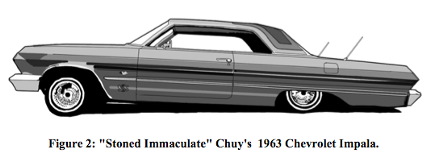
Martin Høyem has written the thesis I want my car to look like a whore. Lowriding and poetics of outlaw aesthetics. It as an extremely well written thesis and even fun to read. He captures the reader already on the first pages when he describes his first days in the field, looking for potential lowriders:

I never saw any lowrider cars in the streets, and this surprised me, since I had an impression—gathered from the material I studied before I left for the field—that the streets of LA would be packed with lowriders. I suddenly realized that my plan A of simply walking up to somebody with a lowrider asking to talk to them rested on a missing premise. I also realized I had no plan B.

At one of the first meetings with his informants, they asked him some questions:

“One thing first: Do you like Abba or Led Zeppelin?”
Chuy had presented me to everybody, in plenum, and asked that I talked a little about myself. (…) It was immediately clear to me what the right answer would be. “These guys aren’t Abba fans,” I thought to myself. And as Bourdieu points out: “Nothing more clearly affirms one’s ‘class’, nothing more infallibly classifies, than tastes in music.” (Bourdieu, 1984:18) (…) “I like Zeppelin,” I said. They all nodded and mumbled approvingly. “That was easy,” I thought.
(…)
Then one guy asked “What kind of car do you have?”
Not missing a beat—since I felt I was doing so well building credibility—I told them: “It’s a 1989 Cadillac Eldorado Biarritz. Two doors.” They didn’t like that. “Well at least it has two doors,” somebody mumbled.

For Martin Høyem it was important to contribute with new perspectives in the study of the lowrider culture:

As a result of the tendency in social studies within USA to threat themes in the light of ethnicity and gender, a major part of ethnographical studies portray the population groups they write about as exotic and describes them as physically and culturally isolated—as subcultures opposed to main-stream American culture. The same goes for descriptions of the lowrider culture, both in academic literature and in diverse types of popular culture.
(…)
The lowrider cars are traditionally described as products heavily influenced by the owner’s Mexican heritage. While there is obviously much to be said for these accounts, they often fall short of considering the class aspects in the judgment of aesthetical taste. I have pointed to data which illustrate how class background might be just as important, if not more, in an effort to analyze the cars and their owners place in the American consciousness.

Additionally, the outlaw mystique which clings to the cars and their owners is a social problem for the lowriders. (…) Perhaps the outlaw aesthetic in the lowriders play the same role as folklore did for the rise of the European romantic nationalism. Just like the scholars of that time gathered histories to demonstrate “connections with the cultural glories of supposed common ancestry” (Herzfeld 1996) the histories that are told through the outlaw aesthetic are stories seeking to establish an abstract common background.
(..)
Although the imagery tells stories of violent conflict solving, loose sexual morals, liberal use of recreational drugs and a strong focus on material values, the everyday reality for the majority of the people who parade this imagery is much more mundane; theirs is a life lived within a framework in agreement with the moral code of society.

>> download the thesis: I want my car to look like a whore. Lowriding and poetics of outlaw aesthetics

And here are the other nine new anthropology theses:

Anne Gry Venås: “School is for the lazy ones”. Local interpretations of children`s rights to education in a rural community in Guatemala

Matthew Whiting: Men & motors. Myth-making and the emulation of a past elite class

Brigt Hope: The function of the internet in the Moroccan public sphere

Marit Aune Bergstrøm: Struggling for respect and dignity. Strategies for shaping meaningful lives among persons with disability and their families in a community on the Mexican south-pacific coast

Hilde Johanne Bjugn Foss: The Hmong in the Twin Cities. Generational and gender differences in the perception of kinship, marriage and prestige

Katri Elina Matikainen: Transformative substances, knowledge and power. Affecting the course of events in a Gambian Mandinka village

Jonas Ursin-Holm Lea: Streets, skollies and coons in district six. On narratives and identity related to an area of forced removal in Cape Town, South Africa

Lene Cecilie Hellum: The face of the cowboy. Perspectives on myths and identities among Texan cowboys

Janne Waagbø: “Dancehall! – a serious thing!” Performing gender in Jamaican dancehall

UPDATE 1/10 Even more new theses in English! More in a later post.

lowrider

(LINKS UPDATED 29.10.22) Norwegian anthropologists no longer hide their master theses in distant libraries. Most theses are now available online in digital archives. Last week, more than 20 new theses (among them 11 in English) have been put online at…

Read more