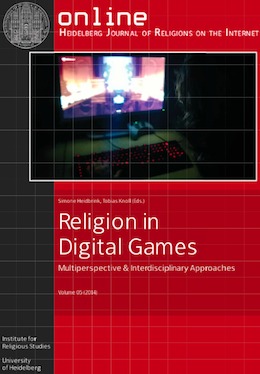
As universities generally are conservative institutions, Simone Heidbrink and Tobias Knoll start their introduction with an apology for leaving established paths:
When researching a rather new, unusual or controversial topic in nowadays academia it seems to be a new kind of “tradition” to apologize in great length for doing something the scholar thinks the readerships thinks he is not supposed to study (or something equally confusing along those lines), based on the assumption that it is scientifically unworthy, insignificant or plain nonsense. That was our experience with the topic at hand. (…)
In order to follow the apparently mandatory academic ritual of apologizing and legitimizing, we would herewith like to express our deepest regrets for publishing this special issue of Online – Heidelberg Journal of Religions on the Internet topics on “Religion and Digital Games. Multiperspective and Interdisciplinary Approaches”.
Religion plays a role in many games, as Simone Heidbrink, Tobias Knoll, Jan Wysocki show. This is also true for religious stereotypes that might be reproduced in “neglected media” like video games in more explicit forms – partly because these media are considered to be less relevant in cultural discourse and thus less subject to media critique.
They refer among others to Vít Šisler who in his research shows how Muslims are being stereotyped in different video games. The topic of the Middle East as war zone and virtual battleground has become even more significant in the post 9/11 era. Not only have the numbers of games with an objective of fighting terrorism increased significantly according to him. The stereotyping, the “othering” of the (virtual) Muslim counterpart have become even more racist as well.
"Second Life is their only chance to participate in religious rituals": This seven year old post about the research by anthropologist Tom Boellstorff on the virtual world Second Life came into my mind when I heard about the…
Anthropology emerged in a relatively high scientific level in the wider Middle East before it existed as a discipline in the West. Therefore, the label of colonialism often coupled to its emergence must be removed.
You won't find many anthropology departments at universities in the Middle East, and its reputation might not be the best. So therefore this article mind be a timely reminder that anthropology has not been a dubious invention by the West. Chaabani sees "the prestige and hegemony of some editors and publishers in some powerful countries" as "one of the factors that could inhibit the development of a real global anthropology".
Hassen Chaabani, who is is president of the Tunisian Anthropological Association, draws our attention to two scholars: Abu Rayhan al- Biruni, a Persian scholar (973-1048) and Ibn Khaldoun, a Tunisian scholar (1332-1406).
Abu Rayhan al-Biruni, he writes, "is considered as one of the greatest scientists not only of the 11th century but of all times". He is most commonly known as a mathematician, astrologer, and historian. But he has also been an anthropologist:
He founded the science of anthropology before anthropology existed as a discipline, and therefore he is considered as the first anthropologist. He was an impartial writer on custom and creeds of various nations and was the first Muslim scholar to study Indian populations and their traditions. In addition he wrote detailed comparative studies on the anthropology of religions and cultures in the Middle East, Mediterranean and especially South Asia. (…)
Living during the high period of Islamic cultural and scientific achievements, Al-Biruni placed a focus on modern anthropological interests including caste, the class system, rites and customs, cultural practice, and women’s issues (Akbar, 2009). Through this modern practice, Al-Biruni used the concepts of cross cultural comparison, inter-cultural dialogue and phenomenological observation which have become commonplace within anthropology today (Ataman K., 2005).
Biruni's tradition of comparative cross-cultural study continued in the "Muslim world" through to Ibn Khaldoun’s work in the 14th century, Chaabani writes:
Some of his books cover the history of mankind up to his time and others cover the history of Berber peoples, natives of North Africa, which remain invaluable to present day historians, as they are based on Ibn Khaldūn's personal knowledge of the Berbers. In fact, he presented a deep anthropological study of Berbers before anthropology existed as a discipline.
Chaabani also writes that the general idea of biological evolution was advanced more than 1,000 years before Darwin by the Iraqi thinker Amr ibn Bahr Al Jahis (800-868) in his book "Book of Animals".
Who was the first anthropologist? Really al-Biruni? A tricky question. Others might point to Classical Greece and Classical Rome, see more in Wikipedia: History of Anthropology (where al-Biruni is mentoned as well). The main point as I see it is that anthropology was developed in many parts of the world, and not only in the so-called West.
Anthropology emerged in a relatively high scientific level in the wider Middle East before it existed as a discipline in the West. Therefore, the label of colonialism often coupled to its emergence must be removed.
Here, Karen Brodkin, Sandra Morgen, and Janis Hutchinson show that there is still a racial bias in American anthropology. Their online survey among anthropologists of color in the US reveals that anthropology has “not done well when it comes to decolonizing their own practices around race”. A racial division of labor within departments, as well as a range of everyday practices recreate white public spaces. Works by minority scholars and their role in theory building are not reflected in the canon.
Inspired by her post, I downloaded and read the paper. Here we find several examples for that anthropologists of color (graduate students and faculty) often are treated as second class academics:
In sum, taken-for-granted practices of racially dividing labor mark anthropology departments as white institutional spaces. They include assigning diversity work to faculty of color, while giving it little value for tenure and promotion, and freeing white faculty from responsibility for it. Informal practices that train students of color for a paraprofessional track reinforce long traditions of treating members of subordinated communities as study subjects and native informants rather than as professional colleagues. The message is that minority anthropologists are not full professionals.
Here are some more quotes from the paper:
Several respondents experienced being actively sought after, only to discover that their most valued attribute was their appearance—so that their university or department could have the look of diversity. One who was so courted discovered that her appointment was tied “to a diversity-related administrative function with little budget or power.”
Those who are held institutionally responsible for the work of creating a more racially diverse faculty and student body are disproportionately minority faculty. As respondents described the amount of time they spent on this work and the consensus of their colleagues that it was their job, we came to think of it as “diversity duty.” –
A racial division of expectations also applies to teaching and advising. Departments often value faculty of color for their ability to teach students of color but not necessarily white students.
Students and faculty of color are often hypervisible as tokens of institutional political correctness but invisible as scholars in their work settings. More specific were reports of white faculty who treated students of color as research assistants and cultural brokers rather than scholars-in-training.
An important conceptual foundation of a secondary track for anthropologists of color is a common assumption that outsider status is the desired norm for anthropological research. This marks insider researchers negatively, most notably marking their knowledge as “folk” or “local” but not“scholarly . ”
Some respondents reported being “valued for my language and cultural insight, not for my intellect”. (…) Another [respondent] described a professor who “wished me to accompany him to Africa to be his go-between with the natives although this would have yielded no advantage to me and would greatly have delayed my ability to complete my program of study… . He wished to exploit me for his gain because of my minority ethnic status.”
(M)any respondents were told that the subject matter of their work, especially studies of U.S. communities of color and patterns of racism, do not belong in anthropology. Several were encouraged to leaveanthropology and move to ethnic studies.
Many departments remain attitudinally white in ownership and decision making about the discipline, undermining what Daryl Smith (2009) calls institutional “mattering and belonging . ” This happens through the continuing pattern of marginalizing the work and theoretical perspectives generated by scholars of color, as well as by seeing proper anthropology and ethnic studies as mutually exclusive. Both practices constitute anthropologists of color as less than full anthropologists. White ownership also happens when a predominantly white department collectively enacts mainstream U.S. forms of race avoidance in dealing with racial issues in departmental practice.
Respondents to our survey encountered resistance similar to that reported in 1973 to scholars of color actively shaping the directions of anthropological thought—and, notably , they mentioned hostility toward critical theoretical perspectives on taken-for-granted aspects of mainstream culture. One faculty respondent reflected, “Neither myself nor my grad school peers of color expected the extreme resistance for paradigm changes … we have all been pushed out of these colleges simply because of this resistance.”
Another [respondent] implicated class bias: “ Tenure requires having no life but [an] academic [one] and a class background that gives you a level of financial support to work.” (…) Class and race bias interact. Students of color are disproportionately from working-class backgrounds, and institutional blindness to the concomitants of class works against them.
Perhaps the biggest attitudinal barrier to ethnic diversification is a belief that being an anthropologist inoculates one against racism (as well as other varieties of social stereotyping). Many respondents urged developing a departmental discourse about race that includes reflexivity. Intersectional thinking is at the heart of reflexivity: for example, recognizing that not all minorities are male (or straight or working class) nor are all women white (or straight or middle class) opens up possibilities for making racial diversity the cutting edge of broader diversification. The lesson is to make critical discourses part of departmental discourse. (…) (D)epartments must hold white faculty equally responsible for improving racial diversity for it to be highly valued.
(T)he heart of our conclusion is embarrassingly obvious. It is this: the defamiliarizing insights and analyses generated from vantage points developed by anthropologists of color are better tools for diversifying departmental organization and culture (among other things) than hegemonic ones, and anthropology departments should embrace them instead of marginalizing them. Alternatively put, anthropology has made its mark on understanding cultures by taking seriously the points of view of those it studies. We suggest it needs to take seriously the points of view of those who are internal others to better understand and diversify itself as well as enhance its theoretical robustness.
Some of their findings are also reflected in an ethnography of American anthropology that I blogged about nearly two years ago: Reversed Gaze. An African Ethnography of American Anthropology by Mwenda Ntarangwi – see my post How racist is American anthropology?. I see now that I announced a second post about this book, but it never appeared, I hope I’ll have the opportunity to do that soon!
There has been some discussion on these issues (including the paper) in a post by Jason Antrosio at Savage Minds: Taking Anthropology, Introduction
In a blog post at AnthroNow, Manissa McCleave Maharawal draws our attention to an important article in the American Anthropologist that was already published in november 2011: Anthropology as White Public Space?
Here, Karen Brodkin, Sandra Morgen, and Janis Hutchinson show…
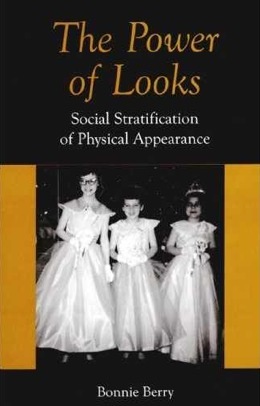
We are living in a visually biased society. Bonnie Berry has written a book about prejudice and racism based on looks. Antropologi.info contributor Tereza Kuldova has read the book. Here is her review.
Book review of The Power of Looks. Social Stratification of Physical Appearance by Bonnie Berry, Ashgate 2008
By Tereza Kuldova, PhD Fellow, Museum of Cultural History, University of Oslo
“When we consider the disparity in what we spend our money on, we find the depressing fact that, in the US, more money is spent on beauty than on education or social services. This fact shows the vacuousness of our society, but also may explain why we persist in the mainly pointless behaviors of buying beautifying products and services. If we are not educated, we may believe that physical appearance is more important than being learned, and we may rely on looks to accrue power instead of using our brains” (p.69).
The book The Power of Looks deals with one of those topics that impact all of us in our everyday lives every single day, one way or another. Namely our prejudices and conceptions of beauty and attractiveness and the ways in which we act on those and discriminate people based on their looks.
Bonnie Berry calls this phenomenon ‘lookism’, which is one of the many ‘isms’ we have to deal with in our world, such as racism, or colorism.
The book shows very clearly how the bias towards attractiveness and beauty creates profound social inequalities and determines our access to both social and economic power. It is not news that people who ‘look better’ have better chances to succeed, get jobs, pass oral exams and so forth. In the same way in which beautiful people are positively ‘discriminated’, those not beautiful enough are negatively discriminated.
This appearance bias, the beauty ideal created and supported and perpetuated by the media, advertising and cosmetic and pharmaceutical companies, creates a feeling in ourselves, a feeling of ‘not being good enough’, the result is anxiety (p. 57). We tend to constantly fix ourselves, be it through make up, clothes, plastic surgery, liposuction, teeth whitening (and more), in order to be perceived as ‘acceptable’ or ‘normal’, if not beautiful. Being perceived as ‘ugly’ or different often leads to social exclusion, isolation, economic, social and romantic discrimination as well as lack of access to social and economic power.
What distinguished The Power of Looks from other popular books on this topic, such as the Beauty Myth by Naomi Wolf or Beauty Junkies by Alex Kuczynski, is that it has a distinctively sociological take on the topic. This is a great advantage over the book Bonnie Berry published earlier, Beauty Bias, which was much more ‘popular’ and part of the same discursive realm as the books mentioned above. The Power of Looks has even two chapters on theory, method and possible approaches to the problem of social stratification based on our looks and to what she calls ‘social aesthetics’, from functionalism to symbolic interactionism. It is no doubt that this book can serve as a great introduction into the topic for students of sociology and anthropology.
For greater awareness about lookism
The most important aspect of this book in my view is however not its originality or its bravado of writing, but it is its message and the aim to build awareness about social stratification and discrimination based on looks. This is a message of acute importance in our world that is too often driven by media images of what is beauty and what it means to be beautiful, messages that fuel our continual sense of inadequacy and force us to recreate ourselves according to these images through consumption of products that often do very little to improve our looks. In the worst cases, these images, ideals and messages drive us under the scalpel where many have died. (See for instance this ABC news story Mother’s Death Highlights Dangers of Plastic Surgery).
The book is important in its focus on and analysis of these phenomena. And since it adopts a sociological approach, it not only builds our awareness about appearance bias and the way it shapes hierarchies and inequality, but it also gives us a conceptual apparatus to grasp these phenomena, to be able to conceptualize them, pinpoint them and talk about them. This is what I consider the greatest contribution of the book. And in line with the message of the book, I wish to draw your attention, in this review, to certain issues that the book raises and that I feel are interesting to think through and reflect about.
The topic of discrimination based on skin color is going through the whole book and it is interesting to think in this respect of the work of Nina Jablonski – Skin: A Natural History, which is a more evolutionary take on the topic of skin, yet definitely interesting – particularly the fact that from a biological perspective, white skin which is considered socially superior is in fact biologically inferior, in that it is easily prone to cancer and other environmentally caused damage. For more you can view a TED talk by Nina Jablonski here
Nina Jablonski breaks the illusion of skin color
Bonnie Berry also refers on many occasions throughout the book to facial and bodily disfigurement and what life can be like for those people in such a visually biased society. The awareness around this issue seems to be growing. Take for instance the popular show by a British fashion designer Wan Gok called Beauty and the Beast: The Ugly Face of Prejudice, which speaks directly to the topic of this book
For more on facial disfigurement see this video:
Skin lightening cream commercials – The intersection between racial ideology and capitalist consumer culture
The role of media and advertising in shaping our tastes, likes and dislikes has been already well documented. The interesting thing is how these commercials try to associate a whole universe of meanings with the products they are trying to sell us. The paramount example is the Indian Fair & Lovely commercial for the most popular Indian skin lightening cream. All of the company’s numerous advertisements follow the same logic which we will see in the example below. These commercials reflect and shape notions of beauty and therefore we should be aware of how they are constructed. Let us look at one of their commercials, as this might ‘flesh out’ the book for its future readers, since it tends to focus little too often on the structural and does not include many concrete examples.
Fair skin is in India often associated with higher status. Now watch how this is played out and reconfirmed in the commercial.
It begins with a father sitting and reading newspaper, then he asks for a tea with milk. His wife looks back at him with her sad big eyes and says that there is no milk, since there is no money. The father then goes on to complain: ‘I wish I had a son’ – meaning someone who would be able to provide for them. His daughter overhears the comment and starts crying, then the TV in her room features a Fair & Lovely facial cream commercial. At that moment she spots a newspaper job advertisement for an air hostess. She connects the two together (the same way as the audience is supposed to). After applying the cream, she is beautiful and fair, and therefore empowered. She gets the job and the surroundings suddenly turn glamorous, at the end she sits with her parents at what seems to be an airport coffee shop and her father with a happy face comments: ‘now we can get a tea, I guess’. The message is simple, beauty and fairness equals higher status, happiness and success. This nicely portrays the “the intersection between racial ideology and capitalist consumer culture” (p. 40).
It is not a coincidence in this respect that, as Bonnie Berry points out:
“South Korea, incidentally, has had, as part of the new economy of Asia, the largest group of aesthetic surgeons practicing in Asia in the 1990s, primarily doing nose and eyelid alterations. (…) These westernizing surgeries, as undertaken by the middle-class Japanese, Vietnamese and Koreans, may be more about signs of achieving middle-class status than achieving and “American identity”, confirming once again that the desire to look a certain way is motivated by the pursuit of economic and social network power” (p. 41, emphasis mine).
This last sentence is possibly the most important here. If you do not look certain way, if you do not conform to the beauty ideals or at least try hard to approximate them, you are prevented from acquiring social and economic power. As Bonnie says:
“For those of us who are not naturally attractive, which is most of us, we must spend time, energy, and funds to make ourselves as acceptable as possible if we want to capture social and economic power” (p. 51)
It is instructive to see how the problems of obesity are correlated with poverty and lack of access to social power:
“The thin ideal is also maintained by social network mobility. Notably, thin women are more likely to marry in an upwardly mobile direction. Heavier women marry men of the same social class or lower” (p. 45).
Another important topic is the surgeries people surrender to in the name of beauty and improvement.
Bonnie notes:
“There have been a growing social acceptance of plastic surgery and growing numbers of people engaging in it. The stigma is gone. Many of us are unhappy with our appearance and we greatly exaggerate to ourselves what we consider to be defects, with this dissatisfaction very likely culturally and socially generated. We compare ourselves to mass media images of beauty; indeed we want to look exactly like them, as it turns out. If full lips are in fashion, we can have them. High cheekbones? Tan skin? Blond hair? Blue eyes? Full lips? No problem” (p. 57).
In her book, Bonnie mentions French artist Orlan who has throughout her career experimented with surgeries and her own body. It certainly does raise questions. That all I leave up to you after watching this video
French artist Orlan: 'Narcissism is important'
Succumb to lookism?
As a conclusion, I wish to ask you a question together with Bonnie:
“Should we feel pressure to change and succumb to this pressure? Of course not. But until or unless we are no longer judged and stratified by our appearance, only the bravest of us will not ‘fix up’” (p.63)
“If history is any judge, based on social reactions to other ‘isms’, lookism will remain a discriminating social attitude and behavior, even as it declines in social acceptability. There are signs that appearance bias is being at least discussed. There is greater social awareness. There are a few public policies leveled against lookism. And there are social movement organizations that are making small inroads into consciousness raising and legislation. It will take a long time. Most major social changes do” (p. 125).
Among the books that encourage critical thinking about contemporary world, this one is of those you might like to read.
We are living in a visually biased society. Bonnie Berry has written a book about prejudice and racism based on looks. Antropologi.info contributor Tereza Kuldova has read the book. Here is her review.
They beat children and adults during apprehensions and in custody, they deny people with life-threatening medical conditions treatment, separate family members and confiscate their belongings.
“We were held with another woman who was coughing so badly that she threw up violently, over and over. The others in the cell called for help. An officer came over and said, ‘Que se muera!’ – ‘Let her die!’”
Now, anthropologist Randall McGuire draws our attention to a recently published report “A Culture of Cruelty” that documents the “systematic abuses of human rights” by U.S. Border Patrol along the U.S.-Mexican border.
This report demonstrates that the Border Patrol systematically abuses people in short-term custody and that existing policies and standards inadequately address a culture of impunity within the agency. Rather than these abuses being the work of a few rogue agents, the Border Patrol has become a rogue agency. The report draws on interviews with almost 13,000 deportees conducted over 2.5 years. (…)
Despite this fact, inadequate procedures exist within the Border Patrol for identifying and correcting systematic abuse. The abuses continue as part of United States border policy. The border wall forces migrants into perilous deserts and mountains.
Since 2008, the number of migrants crossing the border has fallen precipitously. But, the number of people dying in the desert has remained constant. The systematic abuses of human rights and the culture of cruelty in the Border Patrol directly reflect a border policy designed to maximize the risks to migrants’ health and lives.
The term “Illegal” serves to dehumanize people who, even though they are within the country without the approval of the US, are guaranteed human rights by the 14th Amendment: “…nor shall any State deprive any person of life, liberty, or property, without due process of law”.
They beat children and adults during apprehensions and in custody, they deny people with life-threatening medical conditions treatment, separate family members and confiscate their belongings.
“We were held with another woman who was coughing so badly that she threw up…