search expand

Paternalistic anthropology

Quote from an article about tourism in Papua New Guinea (reads more like advertising, though):

Tourism is good for PNG,” asserts Dr Nancy Sullivan, a Madang-based anthropologist with an abiding affection for Papua New Guineans. “It brings much-needed funds to these remote communities, encourages them to maintain a traditional lifestyle and prevents the young men, in particular, from having to seek work in the cities where they are subject to many dangerous influences.”

Paternalistic anthropology?

Nancy Sullivan owns an anthropology consulting company based in Madang, Papua New Guinea:

Nancy Sullivan Ltd. provides Ecotourism Consulting, Leadership Training Consulting and Social Science Consulting. We also prepare Participatory Rural Appraisals (PRAs) and Rapid Rural Appraisals (RRAs) tailored to a client’s needs, including economic, social, legal and project-specific investigations.

>> visit Nancy Sullivan Ltd’s website (lots of articles, reports and pictures)

[links updated 11.6.2015)

SEE ALSO:

Culture Matters: A new paternalism for Aboriginal Australia

Anthropologists condemn the use of terms of “stone age” and “primitive”

“Good story about cannibals. Pity it’s not even close to the truth”

Fieldwork in Papua New Guinea: Who are the exotic others?

Quote from an article about tourism in Papua New Guinea (reads more like advertising, though):

Tourism is good for PNG," asserts Dr Nancy Sullivan, a Madang-based anthropologist with an abiding affection for Papua New Guineans. "It brings much-needed funds to…

Read more

Akbar Ahmed’s anthropological excursion into Islam

“One of the most famous anthropologists in the world” was he called by Alan MacFarlane. According to the BBC he is “probably the world’s best known scholar on contemporary Islam”. Akbar Ahmed‘s new book Journey Into Islam: The Crisis of Globalisation is out and according to a review in The Blade he has “painted a fascinating picture of contemporary Islamic world”:

He is a master of simplification. He can take snarled strands of culture, religion, and traditions and through the reason and logic of an anthropologist, Islamic scholar, and historian, is able to untangle the complex jigsaw puzzle and present it in an easy to comprehend narrative.

But maybe this ability to simplify also represents a weakness as he seems to generalize too much? Ahmed’s book was “Book of the week” in The Guardian. Reviewer Edward Mortimer writes:

To a surprising extent he (Akbar) accepts Huntington’s premise that Islam and the west are still distinct civilisations. Only once does he abandon this construct and refer to “a world civilisation”, in which “people are now too close to and dependent on each other to afford the luxury of ignoring and excluding others”. The rest of the time he treats western and Muslim cultures as discrete entities, which need to be brought closer together.

Two weeks ago he said according to The Guardian:

“It’s not just 9/11. It started in the 19th century when the first clashes between the west and Islam took place. We’re seeing the same patterns being played out today.”

The book is based on a “anthropological excursion”: Ahmed Akbar and two students visited eight Islamic countries — India, Pakistan, Syria, Jordan, Turkey, Qatar, Malaysia, and Indonesia — to talk to a cross section of people about their attitudes towards America, their fears and their concerns according to The Blade:

Most of the people in those countries feel alienated from the West and believe that the war on terrorism is in fact a war against Islam being waged under the rubric of globalization. (…) This fear is partly based on the 500-year colonial era. The colonists ruled Muslim lands with two objectives; to exploit natural resources of the occupied lands and to civilize them by converting them to Christianity. The current push for globalization is, to many, the re-colonization of the Islamic world, albeit with a difference. This time the seeds of exploitation are hidden in the Trojan horse of globalization.

>> review in The Blade

>> review in The Guardian

>> Alan MacFarlane interviews Akbar Ahmed

Akbar has also started to blog (a bit) and has a professional website with links to articles and interviews.

Akbar Ahmed appears regularily in the media, see for example:

West ‘must stop looking at Islam through the lens of terror’ (The Guardian, 28.6.07)

Akbar Ahmed’s Call for Compassion: How has globalization changed the world in terms of religious tolerance and stereotyping? (The Internationalist, 4.3.07)

Interview with Prof. Akbar Ahmed (ABC News Austraia, 19.9.01)

‘It Is Time for Muslims to Reciprocate’ (Newsweek, 28.9.06)

Globalist Interview: Akbar Ahmed: Islam Under Siege (The Globalist, 20.6.03)

Conflict with Iraq: Akbar Ahmed (BBC, 2003)

Akbar Ahmed studies differences but seeks unity (Princeton University, 7.11.00)

Articles on Islam by Professor Akbar S. Ahmad (Islam For Today)

SEE ALSO:

New blog: Islam, Muslims, and an Anthropologist

Anthropological perspectives on suicide bombing

Protests against British research council: “Recruits anthropologists for spying on muslims”

Doctoral thesis: Towards a transnational Islam

Muslims in Calcutta: Towards a middle-class & moderation

What does it mean to be Muslim in a secular society? Anthropologist thinks ahead

Islam: Embracing modernity while remaining true to their traditions and core beliefs

Book review: Mahmood Mamdani: “Good Muslim, Bad Muslim”

Islam in Europe: Mainstream society as the provider of conditions

Interview with Arjun Appadurai: “An increasing and irrational fear of the minorities”

"One of the most famous anthropologists in the world" was he called by Alan MacFarlane. According to the BBC he is "probably the world’s best known scholar on contemporary Islam". Akbar Ahmed's new book Journey Into Islam: The Crisis of…

Read more

New blog: Islam, Muslims, and an Anthropologist

The Anthropology of Islam and Jihad Beyond Islam are the most recent books by Gabriele Marranci. In January this year he has started his own blog Islam, Muslims, and an Anthropologist. He is also writing for the excellent Middle East blog Tabsir.

Gabriele Marranci explains:

By nature, academic publications, even when attempting to reach the general public, are not very widely read outside the ivory tower of academia. (…)For this reason I also started, with Prof. Daniel Varisco, and regularly contribute to, Tabsir.

I believe that anthropologists, as Franz Boas and Margaret Mead have taught us, should engage and contribute to their time by facilitating debate.

In his recent post Collateral damage in the Wars on Terror: between Afghanistan and Glasgow, he comments on the public discourse and press coverage of the recent car bombings in Britain that were linked to al-Qaeda:

Yet are these attacks really al-Qaeda-sponsored? It is too early to say, but I have the impression that this series of attacks were the work of some ‘amateurs of terror’.

(…)

Prime Minister Gordon Brown misleads us when repeating ,

“It’s obvious that we have a group of people – not just in this country, but round the world – who’re prepared at any time to inflict what they want to be maximum damage on civilians, irrespective of the religion of these people who are killed or maimed are to be.”

It’s obvious, I would say, that this is not what those people want; this is, in this case, the inevitable ‘collateral damage’. This group of people kills because they want to achieve their idea of justice and good; they are fighting their battle against ‘evil’ to affirm ‘good’; they are ‘gifting’ us with a purifying fire which will be able to bring joy and prosperity in the future. They are gifting their victims with paradise, they are terrorising us for what they think is right, though costly to achieve. So they say.

Yet are we not terrorising, killing and maiming Afghan civilians to achieve what we think is the right cause? Have we not killed, possibly tortured, illegally detained (i.e. kidnapped), thousands of innocent people, or asked rogue Middle Eastern dictatorships to do so, to achieve what, paraphrasing Mr Brown, is in the interests of a perversion of our western democracy?

During these years of research with different Muslims, having different ideas and beliefs, I have reached the conclusion that we, the homely people of all colours, cultures, faiths and nationalities have found ourselves between not just one ‘War on Terror’ but two. And here is the issue: Terror fighting terror, the only result can be an endless chain of death.

>> visit Gabriele Marranci’s blog

SEE ALSO:

Anthropological perspectives on suicide bombing

Anthropologists on the Israel-Lebanon conflict

“Discuss politics!” – How anthropologists in Indonesia engage with the public

More and more anthropologists, but they’re absent from public debates – “Engaging Anthropology” (1)

The Anthropology of Islam and Jihad Beyond Islam are the most recent books by Gabriele Marranci. In January this year he has started his own blog Islam, Muslims, and an Anthropologist. He is also writing for the excellent Middle East…

Read more

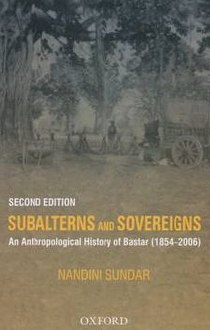
Book review: An Anthropological history of the Adivasis of Bastar

adivasi-cover According to Hindu-reviewer Jyotirmaya Sharma, anthropologist and sociologist Nandini Sundar has written an interesting book about the Adivasi in India. The book Subalterns and Sovereigns — An Anthropological History of Bastar (1854-2006) “tells a very complex and nuanced story of the ‘adivasis’ of Bastar being displaced by centralised models of “development”, losing, in turn, their rights over land, water and forests”:

The book is a very skilful coming together of anthropology and history. It exhaustively chronicles the story of Bastar from the time colonial administrative structures sought to impose “order” and “civilisation” on the ‘adivasis’ by imposing colonial prejudices and stereotypes to the present time when state-sponsored private vigilantism in the name of countering the Maoist movement threatens to wreck an entire way of life. It also details the way in which the ‘adivasis’ have resisted the colonial state in the past and a repressive state now.

But Sundar’s study is not an attempt to romanticise either the ‘adivasis’ or their history as one of “undiluted innocence or even heroism.”

>> read the whole review in The Hindu

On her own website, the anthropologist writes about her book:

Anthropologists are often accused of wanting to keep tribals or indigenous people as museum pieces. Subalterns and Sovereigns shows how misplaced this charge is, arguing that forested and hill areas like Bastar have never been outside the ‘mainstream’ of history, and that the flattening out of local politics to create the appearance of isolation and homogeneity is essentially a product of colonialism and post-colonialism. The choice today, as in the past, has never been one between ‘tradition’ and ‘modern civilisation’ or between ‘development’ and ‘backwardness’, but over alternative visions of democracy.

By exploring the expansion of the state in Bastar over the past century and a half, and resistance to the particular forms it has taken, this book has been part of redefining the way in which history and anthropology are thinking of tribal India.

For more info about the Adivasi see Wikipedia and Kerim Friedman’s posts about Adivasi and Adivasi Rebels

adivasi-cover

According to Hindu-reviewer Jyotirmaya Sharma, anthropologist and sociologist Nandini Sundar has written an interesting book about the Adivasi in India. The book Subalterns and Sovereigns — An Anthropological History of Bastar (1854-2006) "tells a very complex and nuanced story of…

Read more

Military – social science roundtable: Anthropologists help mold counterinsurgency policy

A few weeks ago I wrote about the deepening connections between anthropologists, military and intelligence agencies. Yesterday, Fort Leavenworth (USA) conducted a roundtable discussion among anthropologists and military veterans who have experience in Iraq and Afghanistan. Among the participants self-described “left-leaning” anthropologist and an associate professor at Kansas University; Bart Dean.

Dean said “the landscape today is beginning to turn for anthropologists’ relations with the military, which reached a low level of trust in the Vietnam War era”. “People will criticize me,” Dean said of his participation in the roundtable. “I will be viciously criticized. … But that’s OK. I like controversy.”

Both Dean ad his colleague Felix Moos acknowledged they are in the minority among their peers because they are working with the military. But Dean said anthropologists through World War II had a seat at the table when leaders planned military operations.

The military’s new counterinsurgency doctrine, produced last year at Kansas’ Fort Leavenworth, hinges on the government getting the consent of the people. By understanding the culture, the military can neutralize insurgents, the doctrine says.

Read more about the round table discussion:

Academics, soldiers team to examine war issues (Lawrence Journal & News, 22.6.07)

Leavenworth turns to anthropologists on Iraq (ap / Army Times, 22.6.07)

U.S. Army leaders turn to anthropologists to help solve war puzzles ap / Herald Tribune, 21.6.07)

SEE ALSO:

The dangerous militarisation of anthropology

Protests against British research council: “Recruits anthropologists for spying on muslims”

“Tribal Iraq Society” – Anthropologists engaged for US war in Iraq

San Jose: American Anthropologists Stand Up Against Torture and the Occupation of Iraq and AAA Press Release: Anthropologists weigh in on Iraq, torture at annual meeting

“War on terror”: CIA sponsers anthropologists to gather sensitive information / see also debate on this on Savage Minds

Anthropology and Counterinsurgency: The Strange Story of Their Curious Relations

Bush, “war of terror” and the erosion of free academic speech: Challenges for anthropology

A few weeks ago I wrote about the deepening connections between anthropologists, military and intelligence agencies. Yesterday, Fort Leavenworth (USA) conducted a roundtable discussion among anthropologists and military veterans who have experience in Iraq and Afghanistan. Among the participants self-described…

Read more