search expand

The end of one-way communication – Anthropologists help news providers and advertisers

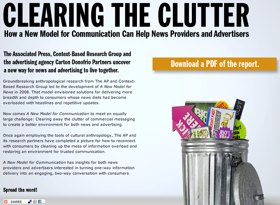
For the second time, Associated Press has engaged anthropologists in order to improve its services. The first research project, conducted by Context-Based Research Group, revealed that people – contrary to what AP believed – wanted more breadth and depth instead of short blasts of news. The new study shows that news consumers want a two-way conversation instead of one-way bombardment:

It is not just that people feel overloaded. As consumers, they long for a better way to communicate with information providers – news companies and advertisers alike. They want that communication to be two-way, transparent and honest. They seek a new relationship that is built on trust, not simply on the value of the content or advertising itself.

“You have to socialize the space before you can monetize it,” Robbie Blinkoff, principal anthropologist for Context, concluded. “The solution is not just to create more engaging content, but to create better environments for engaging with content.”

In the report, Blinkoff used Victor Turner‘s concept “Communitas” – something that APs Vice President Jim Kennedy Vice President called “an interesting bit of cultural theory”:

He called Communitas a time of egalitarian information sharing which can be harnessed to rebuild trust between information providers and consumers. He likened Communitas to the social networking phenomenon online, where consumers feel comfortable engaging with information among their friends and peer groups. (…) With Communitas, there is no such thing as one-way communication. There are only two-way conversations that inspire loyalty and trust, and those are key ingredients with the power to cut through the clutter of the Internet.

Both studies are based on ethnographic research methods. The researchers tracked and analyzed the behavior of individuals in their work and home environments.

AP seems to be fascinated by anthropological methods. “One of the keys to understanding how to address the situation”, AP writes, “has been the extraordinary insight enabled by the Context methodology”:

Context does ethnographic research, meaning it studies small groups of people up close to get at the root of their behavior. That “Deep Structure,” as Context calls it, opens up a view of how companies can respond to cultural changes that aren’t so obvious on the surface.

>> press release

>> download the research report “A New Model for Communication: Studying the Deep Structure of Advertising and News Consumption”

I found one more report on Context’s website called Grounding the American Dream: An Ethnographic and Quantitative Study on the Future of Consumerism in a Changing Economy where they “portray a society and culture going through a “rite of passage” and moving into an era where we measure the quality of our lives in social terms before economic ones”.

SEE ALSO:

How to get more young readers? Associated Press turns to anthropologists

The Internet Gift Culture

“Prosumers”: Consumer Anthropologist Uncovers Proof of New Species of Consumer

Exploring the honor culture of social media

Ethnographic study: Social network sites are “virtual campfires”

Digital Anthropology Report: Attitudes to technology = basis of future class divides

Popular IT-anthropologists: Observe families until they go to bed

For the second time, Associated Press has engaged anthropologists in order to improve its services. The first research project, conducted by Context-Based Research Group, revealed that people - contrary to what AP believed - wanted more breadth and depth…
Read more

Yes to female circumcision?

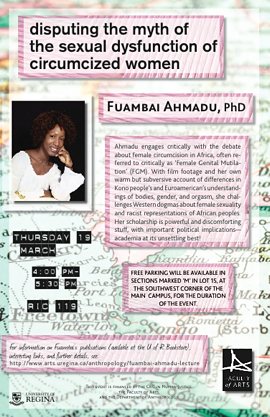
(Links updated 2.2.2021) Is it a good idea to fight against female circumcision? Not neccesarily according to Sierra Leonean-American anthropologist Fuambai Ahmadu.

In an interview in Anthropology Today , she attacks Western feminists, media and anti-Female Genital Mutilation campaigns and accuses them for presenting a one-sided, ethnocentric picture of female circumcision.

A great deal of what is regarded as facts is not true, she explains. Many people think circumcision is a “barbaric tradition” and “violence against women”. But Ahmadu does not see circumcision as mutilation. Circumcision is no notable negative effects on your health and does not inhibit female sexual desire either.

The problem with the representation of various forms of female circumcision as ‘mutilation’ is that the term, among other things, presupposes some irreversible and serious harm. This is not supported by current medical research on female circumcision.

But this research (Obermeyer, Morison etc) has not received any attention in Western media:

However, neither Obermeyer’s reviews nor the Morison et al. study have been mentioned in any major Western press, despite their startling and counter-intuitive findings on female circumcision and health. This is in contrast to the highly publicized Lancet report by the WHO Study Group on FGM, released in June 2006, which received widespread, immediate and sensationalized press coverage highlighting claims about infant and maternal mortality during hospital birth.

Supporters of female circumcision justify the practice on much of the same grounds that they support male circumcision, she says:

The uncircumcised clitoris and penis are considered homologous aesthetically and hygienically: Just as the male foreskin covers the head of the penis, the female foreskin covers the clitoral glans. Both, they argue, lead to build-up of smegma and bacteria in the layers of skin between the hood and glans. This accumulation is thought of as odorous, susceptible to infection and a nuisance to keep clean on a daily basis. Further, circumcised women point to the risks of painful clitoral adhesions that occur in girls and women who do not cleanse properly, and to the requirement of excision as a treatment for these extreme cases. Supporters of female circumcision also point to the risk of clitoral hypertrophy or an enlarged clitoris that resembles a small penis.

For these reasons many circumcised women view the decision to circumcise their daughters as something as obvious as the decision to circumcise sons: why, one woman asked, would any reasonable mother want to burden her daughter with excess clitoral and labial tissue that is unhygienic, unsightly and interferes with sexual penetration, especially if the same mother would choose circumcision to ensure healthy and aesthetically appealing genitalia for her son?

It is important to remove the stigma around circumcision, Ahmadu stresses:

It is my opinion that we need to remove the stigma of mutilation and let all girls know they are beautiful and accepted, no matter what the appearance of their genitalia or their cultural background, lest the myth of sexual dysfunction in circumcised women become a true self-fulfilling prophecy, as Catania and others are increasingly witnessing in their care of circumcised African girls and women.

In an article in The Patriotic Vanguard, she describes the term Female Genital Mutilation as “offensive, divisive, demeaning, inflammatory and absolutely unnecessary”:

As black Africans most of us would never permit anyone to call us by the term “nigger” or “kaffir” in reference to our second-class racial status or in attempts to redress racial inequalities, so initiated Sierra Leonean women (and all circumcised women for that matter) must reject the use of the term “mutilation” to define us and demean our bodies, even as some of us are or fight against the practice.

Anthropologist Carlos D. Londoño Sulkin comments Ahmadu’s talk in Anthropology Today and criticizes his colleagues:

My own sense, after listening to Ahmadu, is that many Euroamericans’ reactions to the removal of any genital flesh is shaped by parochial understandings and perfectly contestable biases and values concerning bodies, gender, sex and pain.
(…)
Many anthropologists, reacting against collectivist social theories and some of the less felicitous entailments of cultural relativism, have joined in the condemnation of female circumcision without first taking counsel from our discipline’s methodological requirement actually to pay attention to what the people we write about say and do about this or that, over an extended period. Listening to Ahmadu, I can no longer condemn the practices of genital cutting in general, nor would I be willing to sign a zero-tolerance petition.

>> Disputing the myth of the sexual dysfunction of circumcised women. An interview with Fuambai S. Ahmadu by Richard A. Shweder (incl. comment by Carlos D. Londoño Sulkin)

SEE EARLIER POSTS ON THIS TOPIC:

Circumcision: “Harmful practice claim has been exaggerated” – AAA meeting part IV

Male circumcision prevents AIDS?

(Links updated 2.2.2021) Is it a good idea to fight against female circumcision? Not neccesarily according to Sierra Leonean-American anthropologist Fuambai Ahmadu.

In an interview in Anthropology Today , she attacks Western feminists, media and anti-Female Genital Mutilation…

Read more

Where shamans understand colonialism as sickness

“I am here to save the people, to cure the people. In the city they are all sick, they are all domesticated. The shaman has to go together with disease.”

Anthropologist Anders Burman talks to Don Carlos, an Aymara shaman in Bolivia. According to Don Carlos, people are ill from Colonialism and in need of a cure.

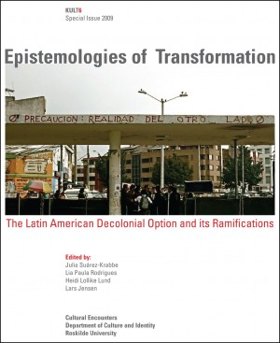
“In contemporary Bolivia, the concept Colonialism is used so frequently, and with such distinct connotations by such a diverse set of actors that it demands scrutiny”, the Swedish anthropologist writes in his paper Colonialism in Context An Aymara Reassessment of ‘Colonialism’, ‘Coloniality’ and the ‘Postcolonial World’ (pdf) that was published in the recent issue of KULT on postkolonial.dk.

Colonialism is according to Burman on the one hand considered a sickness and on the other hand the source of sickness. Most notions of illness held by Aymara shamans find their equivalents in notions of Colonialism.

As illness, as lived experience and as collective memory, Colonialism is still present in the Andes. To the indigenous peoples in Latin America it is a question of continuous Colonialism; the colonialists have not left. Although the Spanish colonial administration no longer holds power over their former indigenous subjects, Aymara people of the 21st century are subalternized and impoverished in a global system that still has colonial traits according to Burman.

Evo Morales’ victory at the polls in December 2005 did not change that, the researcher writes. There is an imminent risk of the new regime being “infected”.

>> read the whole paper

Burman has written a dissertation about this topic.

KULT is a postcolonial special issue series. It began in 2004 as the result of a desire to connect a series of discussion fields about postcolonial Denmark. The recent issue on Contemporary Latin American epistemologies has grown out of a network of Latin Americanists in Scandinavia and the Americas.

In one of the other papers in this issue, Madina Tlostanova and Walter Mignolo introduce what they call decolonial thinking, an approach that – they claim – differs from what postcolonial studies have been doing so far:

As a corridor between the academy and the Political Society, decolonial thinking is transdisciplinary (not inter-disciplinary), in the sense of going beyond the existing disciplines, of rejecting the “disciplinary decadence” (Gordon 2006) and aiming at un-disciplining knowledge (Walsh et. al 2002).

Decolonial thinking, in the academy, assumes the same or similar problems articulated in and by the “Political Society.” Knowledge is necessary to act in the political society. But this knowledge is no longer or necessarily produced in the academy. Living experiences generate knowledge to solve problems presented in everyday living. And this knowledge is generated in the process of transformation enacted in the “Political Society.”

Hence, decolonial thinking in the academy has a double role: a) to contribute to de-colonize knowledge and being, which means asking who is producing knowledge, why, when and what for; b) to join processes in the “Political Society” that are confronting and addressing similar issues in distinct spheres of society.

>> read the whole paper: Global Coloniality and the Decolonial Option

SEE ALSO:

Why was anthropologist and indigenous rights activist Miguel Ángel Gutiérrez Ávila beaten to death?

Rethinking Nordic Colonialism – Website Sheds Light Over Forgotten Past

Colonialism, Racism and The Five Major Challenges for Anthropology

New book explores female roots of shamanism

Bolivia: More and more indigenous influence on politics

Why anthropologists should politicize mental illnesses

Open Access to Indigenous Research in Norway

"I am here to save the people, to cure the people. In the city they are all sick, they are all domesticated. The shaman has to go together with disease."

Anthropologist Anders Burman talks to Don Carlos, an Aymara…

Read more

Correction (and Update): “Army-Anthropologists don’t call Afghans “Savages”

My most recent post Army-Anthropologists call Afghans “Savages” received a lot attention, so it might be necessary to write a new post after the debates in the comment field and via email.

It seems that the Sydney Morning Herald reporter misunderstood. The part about the The Zadran who are called “utter savages” and “great robbers” who live in a country that was “a refuge for bad characters” is not written by contemporary Human Terrain Team (HTT) army anthropologists. The quote is 90 years old!

As I was told, the HTT-report was quoting an old British ethnography “to highlight the terrible quality of historical documents on the area”.

If you google “Zadran” and “utter savages”, Google Book Search directs you to ‪Historical and political gazetteer of Afghanistan ‎Volume 6
by India. Army. General Staff Branch, Ludwig W. Adamec (1985).

Adamec compiled his data from a 1919 British ethnographic survey.

The HTT-report quoted this book extensively – but as I was told – in order to question such notions as the Zadrans as savages.

I hope this is correct. For there are other researchers who use the same sources less critically.

Googling “Zadran” and “Savages” directed me also a a kind of fact sheet about the Zadranby the Program for Culture and Conflict Studies, Naval Postgraduate School that states:

They are probably a very small tribe living in very small villages; some of them cultivate the little land they have, but they appear chiefly to depend on their flocks for subsistence. They live, some in houses and some in tents. It was said that they are “great robbers”, and their country was formerly refuge for “bad characters”.

Here, these 90 years old characteristics are presented as facts.

What kind of institution is the Program for Culture and Conflict Studies?

Here is an extract from their self-description:

The Program for Culture & Conflict Studies (CCS) conducts research in support of United States initiatives in Afghanistan.  Our research provides comprehensive assessments of provincial and district tribal and clan networks in Afghanistan, anthropological assessments of Afghan villages, and assessments of the operational culture of Afghan districts and villages. 

(But although they conduct “anthropological studies, none of their researchers seems to be an anthropologist)

Then I stumpled upon a comment by a former army HTS-anthropologist researcher in Afghanistan on the Open Anthropology blog. He writes:

“These insurgents are throwbacks to the Stone Age with very different ideas and convictions than we have. (…) Want to talk to them about gay rights, women’s rights, democracy, live and let live, respect for the rights of others, etc. with these insurgents? Go ahead!”

Maximilian Forte, editor of Open Anthropology, comments:

One of the things achieved by the new imperialism is an ideological expansion: the high civilizations and monotheistic religions, such as those of Islam, were the focus of Orientalism in the 1800s and much of the 1900s. So called “primitive tribes” were a concern of the kind of Savagism at the heart of early anthropology. What statements like yours do is to combine/confuse the two, and that is novel. Now there are no other civilizations, no competing ideas of complex society, it’s just “us” and the rest are “savages.”

There we have the term again! Savages!

UPDATE: I’ve found the book in question – the Historical and Political Gazetteer of Afghanistan, Volume 6, in our library and found out that the quote about those “utter savages” is even older. The book refers to Mountstuart Elphinstone, who lived between 1779 and 1859 and later became the Governor of Bombay. The whole quote goes like this:

Elphinstone says their manners etc resemble the Wazirs, and Broadfoot, those of the Kharotis, from which we must infer that they are utter savages, and, as Elphinstone says more like mountain bears than men.

According to the Gazeteer of Afghanistan, the Zadran “are of no importance whatever, and only in the case of the Dawar route being used to Ghazni…”.

And here from the preface of the 1985 version som general information about the Gazetteer of Afghanistan:

This work is based largely on material collected by the British Indian Government and its agencies since the early 19th century. In an age of Imperalism, Afghanistan became important as the “Gateway to India” and an area of dispute between the British and Russian empires. It is therefore not surprising that much effort was expended by various branches of the British Indian government to amass information regarding the country’s topography, tribal composition, climate, economy, and internal politics.

Thus, an effort which began with military considerations in mind has now been expanded and updated with maps and data complied by both Western and Afghan scholarship to serve the non-political purpose of providing a comprehensive reference work on Afghanistan.

SEE ALSO:

Cicilie Fagerlid: Ethnography under colonialism: what did Evans-Pritchard think of it all?

Sheds light on the collaboration between science and colonial administration in Naga ethnography

Jack Goody: “The West has never been superior”

Cooperation between the Pentagon and anthropologists a fiasco?

Anthropology and CIA: “We need more awareness of the political nature and uses of our work”

Military spies invade anthropology conferences?

The dangerous militarisation of anthropology

My most recent post Army-Anthropologists call Afghans "Savages" received a lot attention, so it might be necessary to write a new post after the debates in the comment field and via email.

It seems that the Sydney Morning Herald reporter…

Read more

Army-Anthropologists call Afghans “Savages”?

READ THE COMMENTS BELOW – AND THE UPDATE “Army-Anthropologists don’t call Afghans “Savages”

Do you want to know what anthropologists who work for the US military in Afghanistan write about the people America is at war with? I resist to believe it but according to the Sydney Morning Herald they call some Afghan societies “utter savages”.

Here is an excerpt from the report:

“The Zadran have been written up as a small tribe, but they are the biggest in the south-east. Their manners resemble the Waziris [who straddle the nearby border with Pakistan] and the Kharotis [also concentrated in the east], from which we may infer that they are utter savages. They live in small villages … they are great robbers and their country was a refuge for bad characters.”

Sydney Morning Herald correspondent David Brill who has travelled to Afghanistan’s south-east talked to an anonymous American analyst who refuses to endorse the report’s terminology and can’t believe what he is reading there.

Thomas Ruttig, a member of the Afghanistan Analysts Network, is also “shocked by the anthropologists’ assessment of the locals as savages” and says:

“I have been working in Afghanistan for 25 years. They might look like savages, but they have a sophisticated political understanding. ‘There is great hostility to the Americans, but it is not because the people are savages.”

The ”savage’s” point, and Ruttig’s, is that America’s military tactics have created so much local hostility that it has become difficult, if not impossible, for the locals to accept the US presence and what Washington calls “aid”. The “savages” told Ruttig that they had no option but to join a tribal uprising after a controversial civilian “casualty” (meaning the locals were killed by Americans)

>> read the whole story in the Sydney Morning Herald

A few days ago, anthropologist Hugh Gusterson explained Why the war in Afghanistan cannot be won (by the Americans, I assume)

PS: Maybe this issue makes more sense when we remember what the researchers in militarized institutions like the Centre for Studies in Islamism and Radicalisation write about “Americas enemy”.

UPDATE: Much new information: “Army-Anthropologists don’t call Afghans “Savages”

SEE ALSO:

Humain Terrain anthropologist attacked in Afghanistan has died

How the Human Terrain System anthropologists think

Cooperation between the Pentagon and anthropologists a fiasco?

Anthropology and CIA: “We need more awareness of the political nature and uses of our work”

“Anthropology = Smarter Counterinsurgency”

The dangerous militarisation of anthropology

Thesis: The limits of youth activism in Afghanistan

War in Iraq: Why are anthropologists so silent?

READ THE COMMENTS BELOW - AND THE UPDATE "Army-Anthropologists don't call Afghans "Savages"

Do you want to know what anthropologists who work for the US military in Afghanistan write about the people America is at war with? I resist…

Read more