
search expand

Ethnographic study: Social network sites are “virtual campfires”

cover

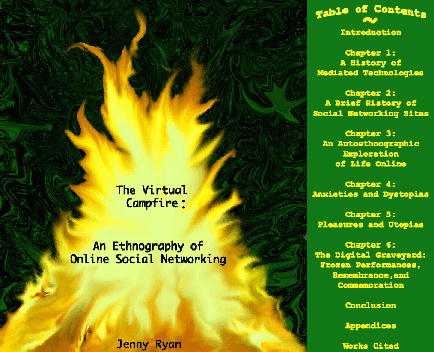
After five years participant observation, anthropologist Jenny Ryan has published her masters’ thesis about the social network sites Facebook, My Space and Tribe.net. She created a beautiful web version of her thesis at http://www.thevirtualcampfire.org/

In her thesis, she proposes that everyday involvement with these sites can be metaphorically represented as a “virtual campfire” that “bridges the gap between the place of the hearth and the space of the cosmos, potentially reversing what has been called “the disintegration of the public sphere” (Habermas 1962: 175).

She explains in her introduction:

Thousands of years ago, our early human ancestors gathered around campfires, creating communal hearths of warmth and light. There they might tell stories, converse about the day’s events, perhaps engage in shamanistic rituals involving plants, music and dance, or simply gaze silently at the flames in collective meditation.

Today, the fireplace in my family’s living room shares its centralizing power with the television, around which we gather with our laptops and cellphones by our sides. Our time spent together is increasingly mediated by new technologies, enabling new forms of storytelling, altering our processes of individual and collective identity formation, and extending the possibilities for creating and maintaining social relationships.

(…)

My central argument in this thesis is that online social networks can potentially serve as both places of the hearth and avenues to the cosmos. Over time, these sites function as personal records of one’s experiences and relationships. These archives are made up of a variety of forms akin to older modes of record keeping, such as address books, journals, diaries, photo albums, personal correspondences, and yearbooks.

Additionally, they serve as gateways to the greater milieu, enabling the circulation of information about the world and granting members the capacity to participate in various ways. For teenagers and marginalized groups, in particular, these sites can be safe spaces for exploring and experimenting with identity, as well as for connecting to new people and ideas.

Ryan plans to add interactive features to the website version of her thesis, maybe she’ll turn it into a wiki, she writes in her blog.

>> visit The Virtual Campfire

>> Jenny Ryan’s bog

SEE ALSO:

Cyberanthropology: “Second Life is their only chance to participate in religious rituals”

The Birth of a Cyberethnographer: The MU5 is to Blame

Interview with Michael Wesch: How collaborative technologies change scholarship

Why anthropologists blog: Blogs more interesting than journals?

Another way of doing fieldwork: Developing websites with your informants!

Ethnographic research on Friendster’s online communities

How internet changes the life among the First Nations in Canada

Ethnographic Study About Life Without Internet: Feelings of Loss and Frustration

The Internet Gift Culture

cover

After five years participant observation, anthropologist Jenny Ryan has published her masters' thesis about the social network sites Facebook, My Space and Tribe.net. She created a beautiful web version of her thesis at http://www.thevirtualcampfire.org/

In her thesis, she proposes that everyday…
Read more

New e-zine: American Ethnography

cover

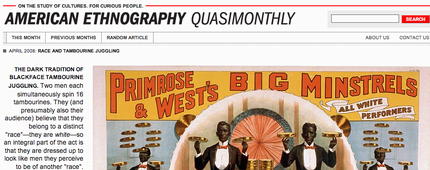
Anthropologist Martin Høyem has launched the e-zine “American Ethnography”, an “internet glossy on the study of cultures”:

We cover ethnography that relates to anything we would call America. We aim to present the tradition and practice of ethnography to people who didn’t know they could be intrigued by ethnography. The goal is to help increase the interest in how we all try to understand unfamiliar cultures. This, we think, could do the world good.

As he writes to me in an email, “it’s pretty new, so there isn’t a lot of material there yet, and most of what is there is old public domain texts (previously not freely available to the general public).” Most of the texts were previously published in the journal American Anthropologist.

Around twelve articles are online already, including portraits of some famous anthropologists and texts about the peyote-cult – a cactus that was eaten in rituals of native Indians. The most recent issue contains articles about race and tambourine juggling. Looks interesting!

>> visit American Ethnography

Høyem has previously written a thesis about American Lowrider Culture called I want my car to look like a whore. Lowriding and poetics of outlaw aesthetics, see also my post about the thesis: When Norwegians do business in Brazil, Lowrider Culture and 9 more anthropology theses.

Høyem is currently working at Pacific Ethnography – anthropology and design

UPDATE: The discussion about American Ethnography and copyright issues is continuing over at Savage Minds, see American Ethnography, the AAA, and the Public Domain

cover

Anthropologist Martin Høyem has launched the e-zine "American Ethnography", an "internet glossy on the study of cultures":

We cover ethnography that relates to anything we would call America. We aim to present the tradition and practice of ethnography to people…

Read more

Another way of doing fieldwork: Developing websites with your informants!

Indigenous communities have embraced the internet from early on. The website of the Oneida Indian Nation was set up before the website for the White House. Anthropologist Maximilian C. Forte has developped several websites in collaboration with indigenous organisations. Website development is a mode of action research, he explains in an interesting paper that is based on a recent presentation.

In his research on Caribbean indigenous resurgence, he began offline and later moved online, he writes. It started after he has signed a reciprocity agreement with the leader of the Carib Community in Arima. In return for access to the community, Forte would assist them with whatever technological, graphic, and writing knowledge he had.

Website development is no purely technical process:

The websites that were created represented, to a large extent, collaborative writing exercises, emerging from meetings, conversations, and interviews. Viewers would not have known that the launching of some of the websites were also occasions for parties in my apartment, with photographs, drinking, music, drinking, laughter, and much more drinking.
(…)
The result of these early experiences led to my creating various online fora with a wider embrace, such as the Caribbean Amerindian Centrelink – part directory, part listserv, part message board, part online publishing centre – and then one of the earliest and still existing open access, peer reviewed journals in anthropology and history, that being KACIKE.

Together with his indigenous partners (informants) he created the field. In contrast to traditional fieldwork, the researcher and his informants predate the site, they don’t arrive at it.

Web-based and Web-oriented ethnographic research, Forte explains, leads to “a series of moves from participant observation to creative observation, from field entry to field creation, and from research with informants to research with correspondents and partners”:

The Internet permits the co-construction of cultural representations and documentary knowledge, especially where the resource that is produced is the result of collaboration between those we traditionally sorted out as the researchers and the researched.
(…)
Those who were traditionally “the researched about” in offline settings, now have access to the works of researchers, can argue back (as they often do), and produce alternative materials in their own right. No longer is there a simple one-sided determination by the researcher over what research should be about, how it should be done, how it should be written or shown, and what its results should be-researchers are often called to account.

Among the persons and communities that have had access to the technology there has been considerable enthusiasm for the internet from early on. “The Internet may be for marginalized indigenous minorities what the printing press was for European nationalism”, Forte writes. “We are not extinct” has become the leitmotif of online self representations by Caribbean indigenous persons and a basis for online activism, especially among Taínos.

These online struggles have produced some noteworthy successes in gaining recognition and some degree of validation from the usual authorities according to the anthropologist.

>> read the whole paper by Maximilian Forte on his own blog “Open Anthropology”

SEE ALSO:

Interview with Michael Wesch: How collaborative technologies change scholarship

Open Source Fieldwork! Show how you work!

“We have a huge responsibility to give back to the places we study from”

Collaborative Ethnography: Luke Eric Lassiter Receives Margaret Mead Anthropology Award

Play as research method – new Anthropology Matters is out

Going native – part of the darker arts of fieldworkers’ repertoir?

How to save Tibetan folk songs? Put them online!

The Birth of a Cyberethnographer: The MU5 is to Blame

Indigenous communities have embraced the internet from early on. The website of the Oneida Indian Nation was set up before the website for the White House. Anthropologist Maximilian C. Forte has developped several websites in collaboration with indigenous organisations. Website…

Read more

“Visual Anthropology of Japan” and more new blogs

Visual Anthropology of Japan” is the name of the blog by anthropologist Steven Fedorowicz (Kansai Gaidai University). All of his students in his class with the same name are required to blog. He links to more than a dozen student blogs.

He explains:

The blog was set up in the Fall of 2006 when I began teaching the class “Visual Anthropology of Japan” at Kansai Gaidai University in Hirakata City, Osaka, Japan. Originally it was set up as a place where links to student project blogs were posted. Every semester the class, blog and student projects have changed, evolved and hopefully improved.

The blog is done in the spirit of collaboration, discussion, dialogue, open text and open access. It is my hope that people will check out my students’ blogs, leave feedback and advice and take part in the dialogue of visual anthropology in Japan.

Students have various backgrounds (both international and Japanese students), interests, levels and experience in anthropology. Their common goal is to explore how to represent Japanese culture through visual means, and their individual blogs serve as the medium where they present their work. Visual Anthropology of Japan also includes resources, announcements, photo essays and other information that might be of interest to a wider audience.

His own blog has blog posts with titles as Globalization Visual Anthropology Photo Essay: Japan in Hawaii, and Can you do visual anthropology with your cell phone? and Visualizing Terror in Japan.

In his most recent post, he asks:

What do all the photos in this post have in common? At least part of the picture is blurry. And why? The Japanese people pictured here are deaf. That means part of their body is being used to communicate while I was attempting to photograph them. Japanese Sign Language entails more than movements of hands and arms – it uses the entire body.

>> visit the blog “Visual Anthropology of Japan

It is getting crowdy in my blog overview, the antropologi.info Anthropology newspaper, so I’ve removed some inactive blogs. Links to blogger-blogs are corrected.

SEE ALSO:

Professor lets students blog their field experiences: More than 20 new blogs online!

On fieldwork: “Blogging sharpens the attention”

Paper by Erkan Saka: Blogging as a Research Tool for Ethnographic Fieldwork

New Ethnography: The Deaf People – A Forgotten Cultural Minority

Visual Anthropology of Japan" is the name of the blog by anthropologist Steven Fedorowicz (Kansai Gaidai University). All of his students in his class with the same name are required to blog. He links to more than a dozen student…

Read more

Plans to study anthropological online communities and Open Access movement

Anthropology of anthropology: How do anthropologists form online communities? How are open access publishing and other developments that have sprung up online changing community boundaries? Soon, an anthropologist will do fieldwork among us online anthropologists. http://nodivide.wordpress.com/ is the address of the blog by anthropologist Owen Wiltshire, grad student at Concordia University, Montreal, where he writes:

I am interested in collaborative research methods, and the growth of anthropology online. (…) I’m particularly interested in open-access journals, and feel that opening up academic publishing is an enormously important step for anthropology.

(…)

Delving into the interesting colonial history of anthropology, and into discussions of globalization and neoliberal economic injustice, it’s pretty easy to see how it makes sense to make anthropological work freely available to the world that it studies.

In this way I’ll be exploring ways to study online communities – in this case communities of anthropologists. Its an exciting time for anthropology online. I’ve been following anthropology blogs for a year now, and its amazing how fast its growing. Its quite inspiring, and I think reflects a very vibrant community thats just itching to work (and fight) with each other!

So while my research proposal is extremely vague, and I’ve been made aware of this, I’m absolutely confident that the internet, blogs, and the desire to liberate anthropological knowledge from the world economy are fueling a change in anthropology, and that within this excitement I’ll find an interesting “field” of study.

In an email to me he tells that he’ll be handing in a proposal in April and hopefully be doing fieldwork over the summer. He has already been investigating the ways faculty at Concordia University use the internet in classroom, and is working on getting access to an anthropological journal to investigate the publishing world “face to face”.

Owen Wiltshire worked as a web developer for a number of years prior to studying anthropology: “I’ve always followed developments in open source – so I’m excited to see how similar developments work their way into academic culture”, he writes.

>> visit Owen Wiltshire’s blog “Just another anthro blog”

SEE ALSO:

Interview with Michael Wesch: How collaborative technologies change scholarship

antropologi.info survey: Six anthropologists on Anthropology and Internet

Anthropology of anthropology: How do anthropologists form online communities? How are open access publishing and other developments that have sprung up online changing community boundaries? Soon, an anthropologist will do fieldwork among us online anthropologists. http://nodivide.wordpress.com/ is the address of…

Read more