
search expand

Oppose participation in counter-insurgency! Network of Concerned Anthropologists launched

(via Savage Minds) As a response to the growing militarisation of anthropology, a group of anthropologists (incl. David Price, Gustaaf Houtman and Kanhong Lin) has lauched the Network of Concerned Anthropologists: They encourage the development of an ethical anthropology and to oppose anthropologists’ participation in counter-insurgency.

In an email they ask us to sign a petition and spread the word.

The Department of Defense and allied agencies are mobilizing anthropologists for interventions in the Middle East and beyond. It is likely that larger, more permanent initiatives are in the works.

Over the last several weeks, we have created an ad hoc group, the Network of Concerned Anthropologists, with the objective of promoting an ethical anthropology. Working together, we have drafted a pledge of non-participation in counter-insurgency, which we have organized as a petition (see attachment). We invite you to become a part of this effort by taking the following steps:

1. Download and print the attached pledge (in .pdf format). Ask your colleagues to sign the pledge, and promptly send it to us via regular mail. Our address is Network of Concerned Anthropologists, c/o Dept. of Anthropology, George Mason University, 4400 University Drive, MS 3G5, Fairfax, VA 22030 (USA). If it is more convenient, email a .pdf copy of collected signatures and send it to us at concerned.anthropologists (AT) gmail.com.

2. Forward this message to your colleagues, and encourage them to sign.

3. Join our network by emailing us at concerned.anthropologists (AT) gmail.com. Be sure to include your name, title, and affiliation. We will add you to our email list.

4. Visit our web site at http://concerned.anthropologists.googlepages.com/home for more information and updates.

SEE ALSO:

The dangerous militarisation of anthropology

Protests against British research council: “Recruits anthropologists for spying on muslims”

More and more anthropologists are recruited to service military operations

“Tribal Iraq Society” – Anthropologists engaged for US war in Iraq

San Jose: American Anthropologists Stand Up Against Torture and the Occupation of Iraq and AAA Press Release: Anthropologists weigh in on Iraq, torture at annual meeting

“War on terror”: CIA sponsers anthropologists to gather sensitive information / see also debate on this on Savage Minds

Anthropology and Counterinsurgency: The Strange Story of Their Curious Relations

Bush, “war of terror” and the erosion of free academic speech: Challenges for anthropology

Military anthropologist starts blogging about his experiences

(via Savage Minds) As a response to the growing militarisation of anthropology, a group of anthropologists (incl. David Price, Gustaaf Houtman and Kanhong Lin) has lauched the Network of Concerned Anthropologists: They encourage the development of an ethical anthropology and…
Read more

Keith Hart and Thomas Hylland Eriksen: This is 21st century anthropology

(Links checked 8.9.2019) What holds humanity together? What are the hidden or unacknowledged features of mainstream society? These are the issues that 21st century anthropology should address, Thomas Hylland Eriksen writes in his paper The perilous identity politics of anthropology, Keynote lecture at the conference “21st century Anthropology” at the University of Oxford 28–29 June 2007.

“Obsessed with everything that divides humanity for a hundred years, anthropology could now be ready to return to the commonalities, that which holds humanity together”, the Norwegian anthropologist suggests.

And rather than studying down, we have to begin to study sideways and up. “The crowded field of minority studies”, he writes, “in no way matched by an equal interest in majority studies”:

A possible solution might consist in making a real effort to study the basic institutions of society – any society – essentially through ethnographic methods, in the same way as we should – again – begin to address the central intellectual questions of today, in the domains of development, democracy, rights, human nature and the environmental crisis. This is being done already, but in too modest a way to make an impact proper. (…) Anthropological studies of everyday life in a modern society, municipal politics, diplomacies, government corporations, schools, hospitals and even military academies exist, but most of them focus too much on culture and too little on the features of the social organisation, in its formal as well as informal aspects.
(…)
Anthropology should confidently locate its focus of enquiry to the centre of society, using ethnographic methods not so much to create wonderment and surprise, but to reveal hidden or unacknowledged features of mainstream society. In this way we would be able to generate knowledge which is not only truthful, but also relevant and – dare I say it – useful. (…) Just as our predecessors took on the central institutions in their small-scale societies, we should now do the same thing in large-scale societies.

>> read the whole paper “The perilous identity politics of anthropology” (Link updated)

Nearly at the same time, Keith Harth published his paper Toward a new human universal. Rethinking anthropology for the twenty-first century, a lecture he is going to hold at the Center for 21st century studies, University of Wisconsin-Milwaukee on the September 7th.

Keith Hart argues in a similar way. In his opinion, “the task of building a global civil society for the twenty-first century, even a world state, is an urgent one and anthropological visions should play their part in that”:

The solution to anthropology’s problems cannot be found in increased specialization, in the discovery of new areas of social life to colonize with the aid of old professional paradigms or in a return to literary scholarship disguised as a new dialogical form. It requires new patterns of social engagement extending beyond the universities to the widest reaches of world society.

This in turn requires us first, to acknowledge how people everywhere are pushing back the boundaries of the old society and second, to be open to universality, most versions of which have been driven underground by national capitalism and would be buried forever if the present corporate privatization of intellectual life is allowed to succeed.

(…)

So, given the precariousness of contemporary anthropology as an academic institution, the issue of its future needs to be couched in broader terms than those defined by the profession itself. (…) Rather I have sought inspiration in Kant’s philosophy and in the critique of unequal society that originates with Rousseau. ‘Anthropology’ would then mean whatever we need to know about humanity as a whole if we want to build a more equal world fit for everyone.

>> read the whole paper “Toward a new human universal. Rethinking anthropology for the twenty-first century” (link updated 19.7.12)

SEE ALSO:

More and more anthropologists, but they’re absent from public debates – “Engaging Anthropology” by Thomas Hylland Eriksen (1)

Interview: “Anthropology Is Badly Needed In Eastern Europe”

Working towards a global community of anthropologists

For an Anthropology of Cosmopolitanism

“Discuss politics!” – How anthropologists in Indonesia engage with the public

Get Out of the Library and Into the Streets – new book by David Graeber

“Anthropology needs to engage in an activist way”

The dangerous militarisation of anthropology

Protests at Yale: When Walmart’s management principles run an anthropology department

(Links checked 8.9.2019) What holds humanity together? What are the hidden or unacknowledged features of mainstream society? These are the issues that 21st century anthropology should address, Thomas Hylland Eriksen writes in his paper The perilous identity politics of anthropology,…

Read more

Engaged research = Terrorism: Germany arrests social scientists

Germany arrested urban sociologist Andrej Holm because of his academic activities. He was accused of being member of a “terrorist association” called “militante gruppe” (militant group) who is suspected to be behind arson attacks against police and army vehicles.

Holm was arrested because his publications contain keywords and phrases, which are also used in the texts written by the Militante Gruppe (especially the term “gentrification”). The warrant also claims that Holm is intellectually capable of authoring the rather sophisticated texts of the militant groups, since he has a PhD in political science. This person is also said to be suspicious because »he works in a research institution and thus has access to libraries, which he can use inconspicuously for doing the research needed to produce the texts of the militant group«.

After lots of emails the protest against German authorities has become global. The American Sociology Association demands that the Federal Prosecutor immediately release Andrej Holm and the other imprisoned from jail at once:

We strongly reject the outrageous accusation that the academic research activities and the political engagement of Andrej Holm are to be viewed as complicity in an alleged “terrorist association”. No arrest warrant can be deduced from the academic research and political work of Andrej Holm. The Federal Prosecutor, through applying Article § 129a, is threatening the freedom of research and teaching as well as social-political engagement.«

Professor Jerome Krase from The City University of New York writes:

What is especially troubling to me as an Activist or Public Scholar is that Dr. Andrej Holm, Dr. Matthias B., Florian L., Oliver R. und Axel H. were investigated and arrested for the kind of activities that I and most other socially conscious social scientists routinely engage in.

Over the course of my career I have engaged in research and writing about Civil Rights for Nonwhite minorities, Affordable Housing, and most recently the rights of the newest immigrants in the United States and abroad.

If such work can so easily be presented as “potentially” (therefore actually) criminal then it must follow that critical academic activities of all sorts, including those that are only distantly related to political and social engagement can be horribly transformed, by the State, into crimes of subversion and terrorism.

I understand that we live in dangerous and difficult times but such menacing actions by those who are sworn to protect the rights of its citizens must be ever more cautious and reluctant to use its power to take those rights away and cast a chilling shadow across the scholarly community that historically has been a bastion against tyranny.

Academic Advisory Council, Attac Germany warns that “if this reasoning is accepted by society it will destroy the fundamentals of a critical public in a free society. If the reasoning is taken as evidence for the membership in a terrorist organization, critical science is put under general suspicion.”

The Open letter to the Generalbundesanwaltschaft (Federal Prosecutor) against the criminalization of critical academic research and political engagement has already been signed by many of the most known social scientists.

More information on the website http://einstellung.so36.net/en

SEE ALSO:

Richard Sennett and Saskia Sassen: The war on shapeless terror. There seems to be no rational basis for the arrest of a group of German sociologists, and the case highlights the fragility of our civil liberties (Comment is free, The Guardian, 20.8.07)

Pessimistic Views on Academic Freedom: A greater percentage of social scientists today feel that their academic freedom has been threatened than was the case during the McCarthy era (Inside Higher Education, 15.8.07 via Savage Minds)

RELATED EARLIER POSTS:

Bush, “war of terror” and the erosion of free academic speech: Challenges for anthropology

Blogging and Public Anthropology: When free speech costs a career

Fired from Yale, anarchist professor points to politics

USA: Censorship threatens fieldwork – A call for resistance

Engaged anthropologists beaten by the Mexican police

The dangerous militarisation of anthropology

Protests against British research council: “Recruits anthropologists for spying on muslims”

San Jose: American Anthropologists Stand Up Against Torture and the Occupation of Iraq

Get Out of the Library and Into the Streets – new book by David Graeber

Germany arrested urban sociologist Andrej Holm because of his academic activities. He was accused of being member of a "terrorist association" called "militante gruppe" (militant group) who is suspected to be behind arson attacks against police and army vehicles.…

Read more

New website: Anthropologynet.org – “the worldwide community of anthropologists”

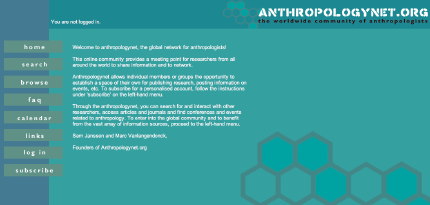
anthropologynet.org front page

A group of anthropologists from Leuwen University, Belgium, has just launched anthropologynet.org, a new website that aims to be a “worldwide community of anthropologists”: Anthropologists can register and look for other members sharing the same (or different) topic of research and publish papers. There is also a calendar.

It does not look very web2.0 but the site has just been launched so we can look forward to the further development of anthropologynetorg.

The website is edited partly by Marc Vanlangendonck who has recently launched Omertaa – Open access journal for Applied Anthropology

>> visit www.anthropologynetorg.net

Two years ago, European students have created MASN – Moving Anthropology Network

SEE ALSO:

World Anthropologies Network: Book and papers online – Working towards a global community of anthropologists

anthropologynet.org front page

A group of anthropologists from Leuwen University, Belgium, has just launched anthropologynet.org, a new website that aims to be a "worldwide community of anthropologists": Anthropologists can register and look for other members sharing the same (or different) topic of…

Read more

“Audio podcasting won’t take over the world”

Podcasting – publishing mp3-interviews on websites – has become more popular in the social sciences, including anthropology. But as Paul Ayres writes in an article for ALISS Quarterly, the journal of the Association of Librarians and Information professionals in the Social Sciences, content producers have already started to move on to video.

Audio podcasting won’t take over the world, he explains:

Audio as a format has a number of limitations. It can be inefficient, as it takes 10 minutes to listen to a 10 minute audio file, plus time to download it as well. Much of this information could be summed up in a short piece of text that is easier to scan and retain. Plus, some content does not lend itself to being read out loud, such as complex URLs or detailed instructions.

In the Higher Education context, providing only the audio of a lecture leaves out PowerPoint slides, data, charts or diagrams that may illustrate a point and it also limits the presenter to a chalk and talk approach, which excludes problem based learning techniques and active learning strategies, which require interaction in the lecture theatre or classroom.

Information Professionals may find audio only user education assets very limiting. With an increasing number of online services available, screencasts that offer commentary on a video walkthrough of a service, website or database, will give a visual cue and a more meaningful learning experience to students.

So users and content producers have already started to move on to video and it’s clear that audio podcasting won’t take over the world. Awareness of podcasts has only increased marginally in the last 18 months, and some say that it suffers from the “try me” virus effect, where something may be cool or interesting to sample, but not be engaging enough to return to.

>> read the whole article “Podcasting and Audio in the Social Sciences”

SEE ALSO:

Anthropology podcasts receive much attention

The Future of Anthropology: “We ought to build our own mass media”

Video by anthropologist Michael Wesch: How collaborative technologies change scholarship

Savage Minds: Visual anthropologist Jean Rouch on YouTube

Anthropological Films online

Podcasting - publishing mp3-interviews on websites - has become more popular in the social sciences, including anthropology. But as Paul Ayres writes in an article for ALISS Quarterly, the journal of the Association of Librarians and Information professionals in the…

Read more