
search expand

Doctoral thesis: Towards a transnational Islam

Young muslims are moving from an Islam based on the culture of their homeland to an increasingly transnationally embedded Islam of Muslims from many different countries and cultures. That’s one of the findings in the doctoral thesis by Norwegian anthropologist Christine M. Jacobsen that is now no longer available online. (UPDATE 26.3.2020)

Contributing to an emerging “anthropology of Islam in Europe”, she writes, her thesis is concerned with exploring continuities and discontinuities in religious identities and practices in a context of international migration and globalization. She has conducted fieldwork among youth and students who participate in two Islamic organizations in Oslo.

The situation of belonging to a minority group, she writes, means that young Muslims cannot take their religion for granted, and that they must engage in the redefinition of identity/difference and of Islamic traditions. And in this redefinition, young Muslims increasingly aspire to engage directly with Islamic texts in order to “choose” which position or interpretation to adhere to. They increasingly engage in discussion and debate on issues that were previously mainly an area of scholarly debate.

In order to make this thesis relevant to the broader comparative field of studies of Islam in Europe, Jacobsen draws on insights from studies of young Muslims elsewhere in Europe.

She criticizes the prevailing methodological nationalism in studies on immigrants and migration (the paradigm of the nation-state as the principle organizing unit of society). She writes:

Discussions about integration often ignore distinctions related to e.g. class, generation, gender, and urban processes, and tend to reify the distinction between “Us” (the Norwegian society representing Norwegian values) and “Them” (being the foreigners that must be integrated). Often, such discussions proceed without questioning the premises upon which our understanding of “integration” depends, and the way in which integration is part of a nation-making process.

In research that is based in political-administrative and methodological nationalist perspective, immigrants and the cultural and religious forms they represent tend to be constructed as “social problems” and “deviance” that need to be solved and brought into order through governing processes (Lithman 2004).

An example is the issue of arranged marriage:

Depending on the perspective adopted, arranged marriage might appear as an issue of deviancy among immigrants or as a part of how a majority of mankind organizes its social life. The consequences for anthropology as cultural critique are obviously important. When immigrants and the social and cultural forms they represent are constructed as “social problems” and “deviance”, they can neither allow worthwhile and interesting critiques of “our own society”, nor enlighten us about other human possibilities, to paraphrase Marcus and Fischer.

Within this nationalistic perspective, Islam is usually approached in terms of how it hinders or facilitates the “integration” of “Muslim immigrants” into “Norway” (or other European societies, “the West”). Studies of Muslims in Europe based on what Lithman calls “wonderment over society” seem to be less frequent, she writes:

When framed within the perspective of a nationalist methodology, this endeavour necessarily must result in ethnocentrism. Furthermore, this perspective has certain consequences not only for the description of the social and cultural aspects involved in migration, but also for its moral evaluation and as a basis for policy making.

She prefers “methodological relativism”:

Even though it is impossible to exclude all value-assumptions from research, I find striving towards considering different practices and traditions on their own terms worthwhile. If not, it is difficult to grasp the meaningfulness of social and cultural practices to the people that engage in them, or to see them as alternative ways of organizing human life, rather than just as deviance from a norm.

>> Download the thesis Staying on the straight path: Religious identities and practices among young muslims in Norway by Christine M. Jacobsen (BORA, Bergen Open Research Archive)

For those who read Norwegian: I’ve interviewed Christine M. Jacobsen a few weeks ago, see Doktorgrad på unge norske muslimer: På vei til en transnasjonal islam

LINKS UPDATED 26.3.2020

SEE ALSO:

Andreas Wimmer and Nina Glick Schiller: Methodological nationalism and beyond: Nation building, migration and the social sciences (pdf)

Why the French Don’t Like Headscarves

Muslims in Calcutta: Towards a middle-class & moderation

What does it mean to be Muslim in a secular society? Anthropologist thinks ahead

Islam in Morocco: TV and Internet more important than mosques

Lila Abu-Lughod: It’s time to give up the Western obsession with veiled Muslim women

Young muslims are moving from an Islam based on the culture of their homeland to an increasingly transnationally embedded Islam of Muslims from many different countries and cultures. That's one of the findings in the doctoral thesis by Norwegian…
Read more

Why the French Don’t Like Headscarves

(LINKS UPDATED 11.1.2021) “Why the French Don’t Like Headscarves: Islam, the State and Public Space” is the title of a new book by American anthropologist John R. Bowen. For nearly three years ago, the French government banned headscarves and similar clothing that indicates religious affiliation from public schools.

Bowen writes in the introduction:

French public figures seemed to blame the headscarves for a surprising range of France’s problems including anti-Semitism, Islamic fundamentalism, growing ghettoization in the poor suburbs, and the breakdown of order in the classroom. A vote against headscarves would, we heard, support women battling for freedom in Afghanistan, schoolteachers trying to teach history in Lyon, and all those who wished to reinforce the principles of liberty, equality and fraternity.

He explains:

France has a long-standing tradition of state control and support of religious activity despite its modern laws concerning secularity. We often have the misconception that the state stays out of religious affairs. In fact, the French government pays the salaries of all teachers in private religious schools, it organized a national Islamic body, and it and city governments put a lot of money into building churches and mosques.

But because the Republican political tradition that developed out of the French Revolution of 1789 targeted the privileges of the Catholic Church, many French citizens developed a certain allergy to religions’ symbolism in public, and particularly in schools, a battleground between the Church and the Republic.

From that research, he’s working on another book, titled “Shaping Islam in France,” to be published in 2008, which will examine how French Muslims strive to build a base for their religious lives in a society that views these practices as incompatible with national values.

>> read the whole article on the website of Washington University in St.Louis

>> John R. Bowen: Muslims and Citizens. France’s headscarf controversy (Boston Review February/March 2004)

>> John R. Bowen: Pluralism and Normativity in French Islamic Reasoning (pdf)

>> John R. Bowen: Beyond Migration: Islam as a Transnational Public Space (pdf)

>> John R. Bowen: Does French Islam Have Borders? Dilemmas of Domestication in a Global Religious Field (pdf)

SEE ALSO:

Lila Abu-Lughod: It’s time to give up the Western obsession with veiled Muslim women

France: More and more muslims observe Ramadan

(LINKS UPDATED 11.1.2021) "Why the French Don't Like Headscarves: Islam, the State and Public Space" is the title of a new book by American anthropologist John R. Bowen. For nearly three years ago, the French government banned headscarves and similar…

Read more

Fieldwork reveals: Bush administration is lying about the “war on terror” in the Sahara

“The US is sending troops to the Sahara desert of west Africa to open what it calls a new front in the war on terror”, the Guardian reported three years ago. “The ‘official truth’ about the ‘war on terror’ on the Sahara-Sahel is a ‘lie’”, anthropologist Jeremy Keenan writes in Anthropology Today December and argues that in this situation, anthropologists have to act as independent witnesses and have to refuse collaborating with intelligence agencies and government bodies.

Keenan has been – according to himself – the sole ‘external’ or ‘foreign’ witness to a sequence of events associated with the US administration’s ‘global war on terror’ that many Tuareg believe has irreversibly transformed the central Sahara and Sahel, as well as their lives and livelihoods. Keenan has done research in the central Sahara for more then 30 years. He writes:

As a result of more or less continuous and at times microscopically detailed field research, much of which has been undertaken by and in collaboration with local Tuareg in Algeria, Niger, Mali and Libya, and with Toubou in Chad, we now know that all the incidents used to justify the launch of this new front in the ‘war on terror’ were either fiction, in that they simply did not happen, or were manufactured by US and Algerian military intelligence services.

(…)

How and why did such a monstrous deception take place? The ‘how’ is simple. First, the Algerian and US military intelligence services channelled a stream of disinformation to an industry of ‘terrorism experts’, conservative ideologues and a compliant media, whose prevailing ‘cut and paste’ culture has made them the perfect mouthpiece for an administration that operates through the Orwellian concept of ‘reality control’ and ‘proof by reiteration’. The result is that several thousand articles have turned the great ‘lie’ into the ‘official truth’.

Second, if a story is to be fabricated, it helps if the location is far away and ‘beyond verification’. The Sahara is the perfect place – larger than the United States and effectively closed to public access.

As we know, the CIA has started sponsering anthropologists to gather sensitive information in their so-called “war on terror”.

Here, anthropologists have a key role to play, Keenan writes:

The role of the anthropologist in such situations (as in all his/her work) must be to provide field-based information that can counter the propaganda emanating from the ever growing (and now increasingly privatized) intelligence and other war agencies. At the very least, the anthropologist must be the witness, the recorder, perhaps the interpreter and, where necessary, the author of the ‘truth’.

In the present critical juncture, anthropologists have a key role to play in the ‘war on terror’: to remain located outside the corrupting sphere of intelligence agencies and government bodies and to act as independent witnesses and reporters. This requires considerable courage, not necessarily because of dangers in the field situation, but because access to the field, on which the anthropologist’s professional career often depends, is likely to be terminated.

Even more serious for anthropologists in American universities is that such actions, especially in the prevailing‘McCarthyist’ climate of the Bush-Cheney administration, may increasingly lead to self-censorship as the result of threats to employment prospects.

The risks are not so high in ‘old Europe’. But there is no certainty that similar pressures as those in the USA will not be brought to bear on anthropologists and other academics in the UK. After all, it was only in October that the Foreign and Commonwealth Office’s offer of £1.3 million to the Economic and Social Research Council (ESRC) and Arts and Humanities Research Council (AHRC)45 attempted to inveigle academics, anthropologists in particular, to help it in ‘combating terrorism by countering radicalisation’.

In this duplicitous incident, the Association of Social Anthropologists (ASA) played a key role in getting the project cancelled, at least for the time being. With such potential threats to anthropologists greater now than at any time in the past, it is imperative that our professional associations publicly recommit themselves to the protection of all anthropologists from any such pressures and threats.

The text is not available online (for subscribers only. But Keenan has written on this issue here as well:

Jeremy Keenan: Bush’s Imaginary Front in the War on Terror (AlterNet, 28.9.06)

More information:

Saharan peoples are falsely accused of terrorist acts (ESRC Science Today, June 2004)

Jason Motlagh: The Trans Sahara Counter-Terrorism Initiative: U.S. takes terror fight to Africa’s ‘Wild West’ (Global Research, San Francisco Chronicle, 30.12.05)

Anthropology Today editor Gustaaf Houtman comments:

If anthropologists, as a particularly exposed branch of academia, are to have any value at all in the ‘war on terror’, we must, to adopt a Quaker maxim coined in Nazi Germany, ‘talk truth to power’. But talking truth is clearly not enough. We must, first, be wary of ‘spin’ and find new and more appropriate ways to converse with government agencies without compromising our academic independence. And second, we must ensure we are actually heard. So let us engage the world of popular communications to our best ability on issues that matter.

UPDATE:

The dangerous militarisation of anthropology

SEE ALSO:

San Jose: American Anthropologists Stand Up Against Torture and the Occupation of Iraq and AAA Press Release: Anthropologists weigh in on Iraq, torture at annual meeting

“War on terror”: CIA sponsers anthropologists to gather sensitive information / see also debate on this on Savage Minds

Anthropology and Counterinsurgency: The Strange Story of Their Curious Relations

Bush, “war of terror” and the erosion of free academic speech: Challenges for anthropology

USA: Censorship threatens fieldwork – A call for resistance

Two Books Explore the Sins of Anthropologists Past and Present

Embedded anthropology? Anthropologist studies Canadian soldiers in the field

“Tribal Iraq Society” – Anthropologists engaged for US war in Iraq

"The US is sending troops to the Sahara desert of west Africa to open what it calls a new front in the war on terror", the Guardian reported three years ago. "The ‘official truth’ about the ‘war on terror’ on…

Read more

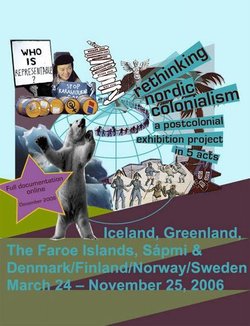
Rethinking Nordic Colonialism – Website Sheds Light Over Forgotten Past

plakat 56 artists, theorists, politicians, and grassroots activists from all over the world participated in the project that took place in Iceland, The Faroe Islands, Sapmi, Norway, Sweden and Finland. They exchanged colonial and postcolonial experiences and strategies, examined why this past has been forgotten and how it continues to reproduce itself as waves of intolerance, xenophobia, and nationalism.

A week ago the (impressive!) website of this project (which has also been published on DVD) has been launched in Oslo. You can spend hours and days, reading the papers, watching videos and movies, looking at exhibitions, listening to presentations.

In the introduction Frederikke Hansen and Tone Olaf Nielsen explain:

The colonial history of the Nordic region is a dark chapter that seems to have slipped the memory of many of the Nordic populations. Although it continues to make itself very much felt in the region’s former colonies, this history is alarmingly absent in the collective memory of the once-colonizing Nordic countries.

With Rethinking Nordic Colonialism: A Postcolonial Exhibition Project in Five Acts, we aim to shed light over this history. Not only do we hope to explain why this past has been forgotten in some parts of the region. We also want to show how this history continues to structure the Nordic societies today, and how our contemporary problems of intolerance, xenophobia, and nationalism have their roots in this past.

I’ll come back with more blog posts about this website

>> visit Rethinking Nordic Colonialism

SEE ALSO:

An exhibition and a movie: The French, colonialism and the construction of “the other”

Anthropology and Colonial Violence in West Papua

“A postcolonial urban apartheid”: Two anthropologists on the riots in France

The Five Major Challenges for Anthropology

plakat

56 artists, theorists, politicians, and grassroots activists from all over the world participated in the project that took place in Iceland, The Faroe Islands, Sapmi, Norway, Sweden and Finland. They exchanged colonial and postcolonial experiences and strategies, examined why this…

Read more

For free migration: Open the borders!

Given the continuing massive disparities in wealth between Europe and Africa, immigration is unlikely to stop anytime soon. Remittances sent by migrants are the second most important income source for many countries in the south. Border control is expensive and ineffective. So why not open the borders? Free migration for all?

In his blog On distance, Anthropologist and journalist Joshua Craze discusses some arguments for free migration – to be published in Cafe Babel.

One of the most prominent lobbies to back the idea of opening up all our frontiers is the free-market right:

Free marketeers point out that in 2005 over a third of Europe’s regions were facing a declining labour force. Immigration, they argue, fills this need, and it also fills skills shortages (in both low and high skilled jobs) that will allow our economy to grow.
(…)
Such proposals may seem like a further extension of the dominion of the market: it would be businesses who effectively control the borders they have long since bypassed. However, in another sense such proposals are essentially a vanguard action; they preserve existing notions of citizenship, and immigration follows the model of the German guest worker, or gastarbeiter. (…) They priveledge capital’s need for labour and do not address the humanitarian problems of immigration. As Max Frisch noted of the Turkish gastarbeiter: ‘We called for a workforce, but we got humans.’

The political left forms the other part of the open borders movement:

Raffaele Marchetti argues that we shouldn’t think about open borders in terms of how it can benefit us, but in terms of the universal right to free movement. Why should Europeans be allowed to holiday wherever they want while Africans cannot even come to Europe to work?

Such a proposal has a number of humanitarian advantages. You stop people trafficking and the attendant loss of life and human rights violations, as people would be able to enter the country legitimately. Then there is the massive financial cost of maintaining Fortress Europe which would be saved. A recent report by the International Organisation of Migration shows that five OECD countries spent two-thirds as much on border controls as they did in official development assistance. Removing this boundaries would also mean removing the massive humane cost of people trying to scale the wall and cross the sea to get to Europe.

>> read the whole text by Joshua Craze

Strangely enough, I’ve written a piece about the same topic at the same time (in Norwegian), inspired by an article about a new book by political scientist Jonathon Moses (Norwegian University of Science and Technology). In International Migration: Globalization’s Last Frontier he argues for free mobility.

He adds an economic and historic perspective and shows that free migration helps fighting poverty in a much more effective way than free trade (and development aid).

On his website you can download – among others:

Exit, vote and sovereignty: migration, states and globalization
Increased mobility is shown to improve the responsiveness of governments to citizen demands. In a world characterized by relatively free mobility for other factors of production (and their owners), labor/voters appear to be handicapped by being prisoners of territory.

The Economic Costs to International Labor Restrictions: Revisiting the Empirical Discussion

Two (Short) Moral Arguments for Free Migration

For a good summary for see also Kevin H. O’Rourke (2003): The Era of Free Migration: Lessons for Today

Both Kevin H. O’Rourke and Jonathon Moses remind us of the fact that borders are a relatively new phenomenon and therefore claims for open borders are not unrealistic. According to the book Norsk innvandringshistorie (Norwegian immigration history), the Norwegian government decided in 1870 that borders are outdated, something that belong to despotic regimes.

But O’Rourke stresses in The Era of Free Migration: Lessons for Today the important role of the national state. Labour market regulation (e.g. minimum working ages, the prohibition of night work, limits on the working day or factory inspections) and social insurance (e.g. accident compensation; or unemployment, sickness or old age insurance) are neccessary, otherwise native workers’ living standards would inevitably be eroded by mass immigration (wage dumping / social dumping)

SEE ALSO:

Research: How migration fights poverty

Migration and development – a report from Tonga

Raffaele Marchetti: Migration needs global regulation based on the principles of free movement and universal justice

Liza Schuser: Keeping alive the possibility of a free migration, “open borders” policy is an investment in everyone’s future

Chukwu-Emeka Chikezie: Africans’ initiative, symbolised by diaspora remittance flows, is the key to liberation (part of a larger debate at Opendemocracy.net)

More Global Apartheid? (The South African system came to an end just as the rest of the world was reinventing it in new forms.)

Why borders don’t help – An engaged anthropology of the US-Mexican border

“Anthropologists Should Participate in the Current Immigration Debate”

See also more articles by Joshua Craze in Cafe Babel and SaudiDebate

Given the continuing massive disparities in wealth between Europe and Africa, immigration is unlikely to stop anytime soon. Remittances sent by migrants are the second most important income source for many countries in the south. Border control is expensive and…

Read more