search expand

UK Riots: Let’s talk about class and oppressive states

The notion that there is democracy in the West, while there is none in the “rest” might be one of the most powerful and dangerous myths of our time. In reality, democracy is a contested concept everywhere in the world, not only in Egypt or Tunesia, but also in Britain.

London riots 2KOLDERZ - they will not control us

from Rap responds to the riots: ‘They have to take us seriously’ (Guardian 12.8.11)

Two months ago Maha Abdelrahman said on a conference in Cairo about the global context of the Egyptian revolution:

– What I think is happening is that people from Egypt, Tunesia, Russia, Greece, UK and many other countries are discovering that they are natural allies, engaged in a common purpose.

– We’re not in the middle of a revolution, but we might be in the midth of an important phase where revolutionary development on a global scale is taking place and the limits of the global neoliberal capitalism are being brought to light.

Darcus Howe, a 68-year-old West Indian writer, civil rights activist and resident of South London, told a shocked BBC anchor Fiona Armstrong in front of burnt down houses:

– I don’t call it rioting. I call it an insurrection of the masses of the people. It is happening in Syria, it is happening in Clapham, it’s happening in Liverpool, it’s happening in Port-au-Spain, Trinidad, and that is the nature of the historical moment.

Much is said and written about the riots in England. The discourse itself is highly interesting. The political establishment and its allies in mainstream media quickly dismissed the riots in England as a brainless, unpolitical, and criminal act by a “partly mentally disturbed underclass”. They treated the rioters and activists in an strikingly arrogant, patronizing and classist way. The BBC interview with rights activist Darcus Howe is a good example:

London Riots. (The BBC will never replay this. Send it out)

The BBC sounded in their coverage of the riots like Mubarak’s state television during the Egyptian revolution, says Egyptian blogger and activist Mostafa Hussein:

“BBC is making it sound like young people have a single aim and that’s to loot and vandalise. Nothing or very little on why they are doing so.”

These reactions show clearly what’s at stake in Britain, Joe Hoover and Meera Sabaratnam write in their post Reading violence- what’s political about the London riots. The reactions confirm the fact, that Britain is a hierarchical society where the rich oppress the poor:

This is a solid, deep form of alienation built up not overnight, or over the last two years in response to cuts (shame on you Ken Livingstone) but one which is built into the fabric of the broad political settlement of the last decades and reflected in the city’s divisions between rich and poor, between black, brown and white, between young and old.

The riots rest on a conviction not just that the barriers are there, but that they are solid walls, through which none will pass. The reactions to them as ‘mindless violence’ simply confirm this fact. It is not that people are rioting because they don’t have jobs, but because they must believe, ultimately, gloomily, grimly, that there is nothing for them in their future.

While the mass protests in Egypt and the rioting in England cannot be equated (“Egyptians and Tunisians took revenge for Khaled Said and Bouazizi by peacefully toppling their murdering regimes, not stealing DVD players.“not by stealing DVDs”, Mosa’ab Elshamy comments), the contexts in which they occurred are similar: growing inequalities due to neoliberal policies and an inceasingly oppressive state that does not care for its citizens.

SocProf from the Global Sociology blog writes:

So, whatever the initial reason for the uprising in Tottenham, it is clear that many of the countries where austerity policies are being imposed from above on the general population are facing socially explosive situations.(…)

SocProf lists examples from Israel, Chile, Greece, Spain and the “Arab Spring”:

What we see is the global civil society rising up against what is clearly exposed as the alliance of the corporate sector (…) and Western governments (…).

In this process, the governments turn repressive against oppositional voices. Several examples (including from the UK) are provided that show how dissent is criminalised

The message is clear: dissent will not be tolerated as the whole anti-terror apparatus is used not against terrorists but against cyber-dissenters and protesters.

Clapham Junction Speaker (London Riots 2011) Part 2 Why the London Riots happened?

Why the riots are political – a good summary

As reaction to the riots, Cameron considers – in similar way as his friend Mubarak (source) earlier this year – to shut down social network sites like Facebook and Twitter and sms services as well for “those suspected of planning criminal acts”.

He talked like a dictator when he replied to criticism from rights groups: He will not let “phony concerns about human rights” get in the way of the “fight back” against the riots, he said. In the macrumors forum, he was called David “Mubarak” Cameron. It is no longer uncommon to equate the UK with (former) Middle East dicatorships. The story San Francisco Cops Jam Cell Phones to Prevent Protest is introduced this way: “It’s not just the London police and Middle East dictators who try to curb unrest by clamping down on communications networks.”

When we link the current riots in England with the so called Arab Spring, we would see other things than “midlessness” at stake, suggests sociologist Joost Van Loon on Space and Culture:

Suddenly, criminals would become legitimate protestors fighting against an oppressive state who have turned democracy into a puppet show.

Anthropologist Sean Carey criticizes the reactions of the politicians as well:

Mindlessness would create randomness, but the events unfolding are far from being random. Instead, I would argue that what we are witnessing is a significant symbolic statement about the way power – the power of life and death exercised by police officers as well as the power to consume – is arranged in British society.

The riots are said to have started with a protest against the controversial killing of Mark Duggan by the English police during an anti-gun crime operation. Yet no commentator links the incredible number of riots in different cities to that particular incident, notes anthropologist Gabriel Marranci.

And when somebody, as Darcus Howe in the mentioned BBC interview is trying to address this issue, he is cut off and silenced. “We cannot talk about this now. We don’t know what has happened. We have to wait for the police inquiry”, the BBC news anchor said.

Al Jazeera gives an account of the events:

On Saturday, hundreds of people gathered outside the Tottenham police station, peacefully calling for “justice” for Mark Duggan, a man killed by officers three days prior. Police stood in formation, separating the community members from the station they were guarding, until a 16-year-old woman reportedly approached an officer to find out what was going on.

According to a witness account, some officers pushed the young woman and drew their batons. “And that’s when the people started to retaliate. Now I think in all circumstances, having seen that, most people retaliate,” said the witness.

Tottenham riots - the truth

Witness account

“When the rioters themselves are asked, they will say that they are abused by police, harassed by them, and nobody’s done a thing about it”, says Richard Seymour PhD candidate at the London School of Economics to Al Jazeera. There have been 333 deaths in police custody between 1998 and 2010 in Britain. Large, peaceful protests in response to these killings were more or less ignored, he said. Not a single officer has been prosecuted.

As a result, Duggan’s killing crossed a threshold for young people, angry with the systems that have left them behind, and tired of non-violent protest that goes without much response.

By the way, in an article in the Danish newspaper Information, Rune Lykkeberg reminds us on a book that was reviewed in all major English media only two months ago: Chavs: The Demonization of the Working Class by Owen Jones. This book “exposes class hatred in modern Britain”, the reviewer in the Independent explains. “In the public domain of news and culture, within the arc of some 30 years, a once-proud working class has been residualised into a violent, degenerate, workless mob.”

Class and classism are under-researched topics in mainstream anthropology.

More riot-links:

Mapping the riots with poverty (Map by the Guardian 10.8.11)

From the Arab Spring to Liverpool? (Al Jazeera, 11.8.11)

London rioters resent media image of hooded teen thug (Reuters – Ahram Online 11.8.11)

Some thoughts on the London “riots”: Foucault’s genealogy of neoliberalism and “police as a public service” (Anthropoliteia: the anthropology of policing, 12.8.11)

Martha Nussbaum: Democracy at risk from emphasis on ‘useful machines (The Australian, 12.8.11)

Maia Green: News from the UK (Savage Minds, 10.8.11)

What’s Worse? Looting or Invading? (Robin Beste, Consortium News / Stop The War Coalition 15.8.11)

SEE ALSO:

Anthropologist uncovers how global elites undermine democracy

Thesis: Neoliberal policies, urban segregation and the Egyptian revolution

Ethnographic study: Why the education system fails white working-class children

“A postcolonial urban apartheid”: Two anthropologists on the riots in France

Riots in France and silent anthropologists

Criticizes “scholarly and political indifference toward the workers’ lives”

Ethnographic study of anti-corporate globalization movements

– Use Anthropology to Build A Human Economy

The notion that there is democracy in the West, while there is none in the “rest” might be one of the most powerful and dangerous myths of our time. In reality, democracy is a contested concept everywhere in the world,…
Read more

“How can I contribute to a better world?” Anthropologists on the Oslo terror attacks – an update


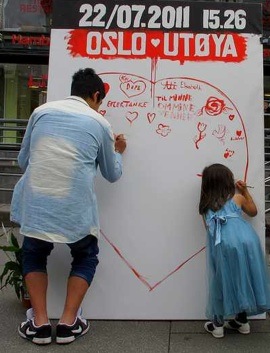
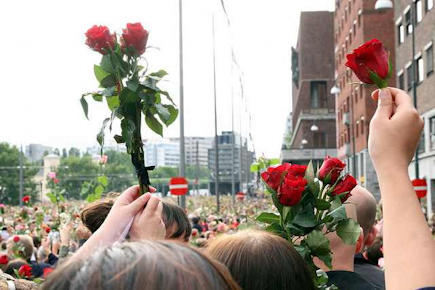
Love instead of hate: Norway’s reaction after the terror attack. Photo: Erik F. Brandsborg, Aktiv I Oslo.no, flickr

Many new comments by anthropologists have appeared since my first post on the terror attack in Oslo. Here is a quick overview:

Cicilie Fagerlid: Slow attempts at making sense: Oslo 22/7, 30.7.11:

What good is it to devote my professional life to understanding nationalism, belonging, community cohesion, conceptions of difference and the like when I have done nothing to prevent the worst thinkable acts of violence to take place in my own country? Especially since I think – or I’m sure – that I’ve felt there was a need for worry (but of course, not to this unconceivable degree…). For several days now I’ve been thinking about how I can contribute. How can I contribute in the best way with my knowledge (of living with difference in Europe), my concern (for the future of us all) and my devotion (to work for a better world)?

Simone Abram: ‘Evil can murder a person, but never defeat a whole people’ (Savage Minds 26.7.):

Responses to the tragedy this weekend have included the massed flying of flags, using flag symbols as facebook identifiers, and so forth. (…) The tying together of national symbols with talk of love reinforces a sense of moral good associated with the Norwegian nation, and reappropriates the nation from racist nationalism. But in this endless tussle between a nation of care and an exclusive people, it seems that racism is the shadow-concept of nationalism. Nationalism is alive and well, and racism continues to creep along in its underbelly.
(…)
In a country where Social Anthropology is one of the more popular subjects for study at university, and where anthropologists retain a high media profile, the persistence of racist ideologies and acts and their resistance to rational argument raise difficult questions.

Sindre Bangstad: The Hatred in Our Own Eyes (Excerpt translated into English by stalinsmoustace 27.7.11):

Norway has produced Europe’s first anti-Muslim terrorist. It seems, however, that the public narrative about him and his actions will not accurately emphasise what is said concerning the direction Norway as a society has taken in the Islamophobic era.

No matter how many bombing raids Norwegian pilots conduct in Muslim countries, no matter how many innocent civilians are killed by Norwegian soldiers in the same countries, and regardless of how much the public debate about Muslims and Islam in Norway has been wallowing in the gutter, one thing is clear: We will not face the hatred in our own eyes.

(see also an article by him Fighting words that are not fought, written a month before the attack about Norwegian mainstream anti-Muslim discourse)

Thomas Hylland Eriksen: Anders Behring Breivik: Tunnel vision in an online world (Guardian 25.7.11):

Norway’s extremists don’t tend to gather in visible ‘rightwing groups’. But online, they settle into a subculture of resentment. (…) The fact that Breivik was Made in Norway, a homegrown terrorist with a hairdo and an appearance suggesting the west end of Oslo, and not a bearded foreign import, should lead not only to a closer examination of these networks, but also to a calm, but critical reflection over the Norwegian self-identity itself.

Thomas Hylland Eriksen and Jostein Gaarder: A Blogosphere of Bigots (New York Times 28.7.11):

The racism and bigotry that have simmered for years on anti-Islamic and anti-immigration Web sites in Norway and other European countries and in the United States made it possible for him to believe he was acting on behalf of a community that would thank him.

Martijn de Koning: Radicalization Series V: Freedom Fighters, Conflict and Culture Talk (Closer, 27.7.11):

It is important I think to see how his ideas (but not his actions) not only are derived from bloggers and politicians but also who they resonate with and are grounded on a grassroots everyday level. I also think the Netherlands can give some clues to that and is relevant here since Breivik partly derived his inspiration from Wilders’ Freedom Party ideology.

Johannes Wilm: 29/07: Terror in Norway – more democracy or more surveillance?:

Nice. So even though the only terror attack so far came from the anti-Islamists, PST (Norwegian FBI) does not see much of a threat in them, whereas they believe that Islamists continue to pose the main problem in Norway it seems.

UPDATE: Thomas Hylland Eriksen sums up in a guest post at anthropologyworks:

It was only a matter of hours between the blast in central Oslo and my most extensive and exhausting engagement with international media since I started out as an anthropologist in the 1980s. Between Friday night and Wednesday, I spoke on radio, on television (via a mobile phone), to newspapers and magazines from China to Chile, and wrote articles for nearly a dozen publications in five countries.

My priorities shifted in a matter of hours. Our holiday house was turned into a makeshift media centre, and the computer was online almost 24/7.

Interesting article about biased terror research in the age of neoliberalism by Charles Kurzman: Where Are All the Islamic Terrorists?, The Chronicle Review, 31.7.11

The more that non-Muslims fear Islam, the more security threats are hyped, the more attention my colleagues and I get. I am in the awkward position of undermining the importance of my own field. My research finds that Islamic terrorism has not posed as large a threat as reporters and the public think.

Check also the most recent round-up by Erkan Saka and my first post: Terror in Oslo: Who cares about Christian right wing extremism?

SEE ALSO:

Racism: The Five Major Challenges for Anthropology

What is terrorism? Selected quotes from “On Suicide Bombing” by Talal Asad

How to challenge Us-and-Them thinking? Interview with Thomas Hylland Eriksen

For an Anthropology of Cosmopolitanism

– Highlight the connections between people!

Love instead of hate: Norway's reaction after the terror attack. Photo: Erik F. Brandsborg, Aktiv I Oslo.no, flickr

Many new comments by anthropologists have appeared since my first post on the terror attack in Oslo. Here is a quick overview:

Cicilie…

Read more

Thesis: Neoliberal policies, urban segregation and the Egyptian revolution


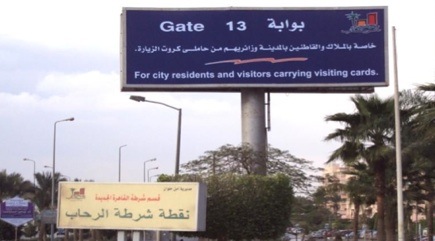
Gated communities: Access denied for outsiders. Photo: Safaa Marafi

While Cairo’s slum areas are growing, the richest layer of the society is enjoying a luxury life in privately guarded communities in safe distance from the lower classes. Hosni Mubarak’s neoliberal dream of segregation seems to have come true. But during the Egyptian revolution some of the young people have started to tear down the walls of their gated communities.

Safaa Marafi from the American University in Cairo (AUC) tells us in her well-written anthropology thesis the story of the giant segregation projects of the Mubarak regime. She has conducted fieldwork in Al-Rehab, one of those gated communities constructed on desert land, where the middle- and upperclass isolate themselves, shop in luxury malls, use private door-to-door limousine services and send their children to private schools or universities.

It’s a thesis about how neoliberal policies threaten the cohesion of a society.

The development of gated communities was part of Egypts neoliberal policies under Mubarak. In the late 1990s, Egypt underwent a process of structural adjustment guided by international financial organizations (Worldbank, IMF etc), which led to further privatization and liberalization of the economy. The most visible outcome has been land speculation, Marafi expains:

This segregation began when the Egyptian Ministry of Housing sold massive amounts of desert land, situated at the margins of Cairo, to private corporations. Approximately 320 private corporations purchased portions of this land and planned projects for a potential 600 thousand housing units (Denis 2006:52). This expansion process resulted in the construction of numerous gated communities in the suburbs of greater Cairo.

The Neoliberal Dream of Segregation

The Mubarak-government and its “clique of businessmen” were driven by a “neoliberal dream of segregation” – a term coined by sociologist Mona Abaza:

The neoliberal dream of segregation can be defined as a political-economic agenda adopted by the Egyptian government, which fostered and supported rich local and foreign investors in building gated communities in Cairo‘s suburbs. By constructing these enclaves for the richest layer of Egyptian society, these development projects created a physical segregation in Cairo‘s urban fabric. This segregation is evidenced by the way the residents of these hinterlands are protected by private security systems, walls and/or fences, gates, and private security guards.

“Neoliberal policies”, Marafi writes, “have encouraged class-based urban segregation, leading to polarization in the urban fabric.” The adoption of neoliberal polices turned the state into a private territory, where wealth is monopolized by political elites and businessmen.

Moral panic towards the lower classes

This segregation is not only related to space but also related to the mind.

Living in this gated communities intensifies the mood of moral panic felt towards the other – people from lower classes. “This is”, the anthropologist explains, “because they believe that their community is labeled as a rich one and therefore may be a target of potential criminals. State and media contributed to the fear of the other. Not only the marketing campaigns of gated communities seek to convince potential buyers that outside of the gates, fences, and walls of these closed venues lies a dangerous world. The consequence is a “culture of fear”.

Many residents, especially in recent times, moved to Rehab for class and safety reasons. They wanted to isolate themselves from the other. But soon they had to realise that they cannot live without “the uncivilized others”. They are dependent on them. For who shall clean their houses, deliver food, and patrol the streets to protect them? The supposed enemy and security threat is living among them!

Culture of fear

The residents feel a need to apply extra security measures. Despite these measures taken by the participants, the private security department of Al-Rehab, and the public police, the participants‘ fears are not alleviated, Marafi writes.

Security cameras, intrusion alarms, extra secure locks, as well as guard-dogs, can all be observed in the community. In addition, there are some shops which sell extra-large security lamps to be attached onto the roofs of villas.

In many villas, the use of such lamps as security tools makes the villas look more like military buildings at night, rather than family residences.

In addition, surveillance real and fake cameras are among other security methods implemented by other participants. Fake cameras are sold in at least one of the most popular electronics shops in the souk of Al-Rehab.

Some residents don’t even trust the security guards. Nora is one of them. Private security, she points out, relies on guards, and as they are humans they might fall asleep while on the job. Moreover, Nora claims that there are some cases where private security guards collaborated with criminals.

The private security guards themselves are aware of the distrust felt by the residents. Security guard Hanafi tells about Sara:

Madam Sara drives every night and checks the kiosks of the security guards located around her villa. If she does not find a security guard in any of these kiosks, she takes a picture of the empty kiosk with her camera and sends the picture to the security department. The security department trusts her word over the security guards and punishes those guards who were not in their positions or patrol areas. Also, she reports to the security department if she finds any of the security guards falling asleep, and she also takes pictures of them as evidence.

Being protected creates a sense of superiority

The anthropologist has noticed that classist phrases are used frequently. Being protected by private security guards and systems creates a sense of superiority.

When for example Nora explains why she moved to Rehab, she stresses that she wanted her son to live in a “clean neighborhood” when he gets married. Mohandessin, where they lived previously, “became old-fashioned”, populated by lower classes and “polluted”. In Rehab, on the contrary, reside “clean people”, their neighbors are “respectful” and “civilized people”.

Marafi comments:

The prejudicial connotations of these elitist, classist notions of newness, civilization, cleanness and decency indicate a desire for urban segregation and a keeping of distance from “the other”: the dirty, polluted, and uncivilized.

Security measures are also used to show wealth and status (“conspicouos consumption”). Some of the residents design security bars using branded logos, such as Versace. Others paint their security bars in different colors, such as white, to differentiate themselves from others (“aesthetic security”).

It is obvious to see primarily the poor as victim of neoliberal policies. Safaa Marafi suggests a different view:

While slums are stigmatized by poverty, gated communities are labeled by their richness. It is not that one group should be victimized over the other, but they both ought to be understood as victims of the implementation of the neoliberal segregation policy.

Breaking the walls

But her thesis has a somehow “happy ending” (depending on your world view of course), caused by the 25th January Revolution.

While the political participation of the residents previously has been rather low and there was a “noticeable sense of detachment” from any involvement with earlier protest movements, things have been slowling changing:

In the beginning of this unexpected revolution, none of my participants showed interest in joining the peaceful protests. (…) Yet, as I learned, a few of Al-Rehab‘s youth are active agents in this revolution. The neoliberal segregation plays a role in detaching many, but not all, of the residents of Al-Rehab. The youth especially were the ones participating in the political sphere. (…) Optimistically, this tells us that some of the youth of Al-Rehab want to be part of the world outside their gated community.

Safaa Marafi sent me a video from the youth celebration in Rehab after the announcement of the resignation of President Hosni Mubarak on 11th February 2011. “The quality is is not that good”, she admits, “but its content is very important as it shows how the youth of the gated community are breaking the walls of their gated community and want to be part of the outside world”.

[video:flow:http://www.antropologi.info/blog/anthropology/media/rehab]

Her thesis can be downloaded here on antropologi.info:

Safaa Marafi: The Neoliberal Dream of Segregation. Rethinking Gated Communities in Greater Cairo. A Case Study. Al-Rehab City Gated Community (pdf, 2.7MB)

An earlier version is available at the digital archive of the AUC (DAR)

SEE ALSO:

Ethnographic Research: Gated Communities Don’t Lead to Security

“The insecure American needs help by anthropologists”

Why borders don’t help – An engaged anthropology of the US-Mexican border

Criticizes “scholarly and political indifference toward the workers’ lives”

– Use Anthropology to Build A Human Economy

Saba Mahmood: Democracy is not enough – Anthropologists on the Arab revolution part II

Cautioning Against Security Fundamentalism

Gated communities: Access denied for outsiders. Photo: Safaa Marafi

While Cairo’s slum areas are growing, the richest layer of the society is enjoying a luxury life in privately guarded communities in safe distance from the lower classes. Hosni Mubarak’s…

Read more

Terror in Oslo: Who cares about Christian right wing extremism?

While politicians and social scientists have directed all their attention towards “islamist” terror groups, right-wing extremist milieus were able to grow unnoticed.

Memorial Art. Photo: Agnar Kaarbø, flickr

(draft / see update 31.7.11) Oslo like a war zone, nearly 100 people killed in the worst attack on Norway since World War II: How could this happen? Two days after the attack, the web is filled with comments and analyses. But I have to consult international media to find a discussion of the, I suppose, most important issue: Right-wing extremist and islamophobic attitudes have become mainstream, but nobody cares – neither politicians nor social scientists. Instead, all their attention is directed towards “islamistic” groups as the major threat to the West.

“Europeans have spent so much time and effort in banning veils, minarets and preventing the construction of mosques that they have forgotten their own native cancer”, writes anthropologist Gabriele Marranci on his blog.

“We can no longer ignore the far-right threat”, argues Matthew Goodwin in the Guardian. Terrorist Anders Behring Breivik is “not a Norwegian oddity, but symptomatic of a growing culture of politically motivated violence across Europe”. It “is important to note that some of Breivik’s core concerns have also played a prominent role within Norwegian and European politics more generally.”

Nicolas Kulish provides us the details in his New York Times article:

Friday’s attacks were swiftly condemned by leaders from across the political spectrum in Europe. Germany’s Chancellor Angela Merkel was particularly sharp in speaking out against what she called an “appalling crime.” The sort of hatred that could fuel such an action, she said, went against “freedom, respect and the belief in peaceful coexistence.”

Yet some of the primary motivations cited by the suspect in Norway, Anders Behring Breivik, are now mainstream issues. Mrs. Merkel, President Nicolas Sarkozy of France and Prime Minister David Cameron in Britain all recently declared an end to multiculturalism. (…) While the parties themselves generally do not condone violence, some experts say a climate of hatred in the political discourse has encouraged violent individuals.

Therefore it is somehow correct when Ahmed Moor writes at Al Jazeera that Breivik did not act alone. He “acted within a cultural and political context that legitimises his fearful and hate-infested worldview.”

In this context, it is not surprising that the first speculations about who might be responsible for the attack centered around muslims. When I watched the BBC few hours after the attack, islam was the main topic.

Gabriele Marranci has observed the same in Italy:

Immediately the newscasters told us that it may be an Al-Qaeda attack in revenge of Norway’s marginal role in Iraq and Afghanistan, and the more recent Libyan air campaign. Islamic terrorism has hit Europe again. Immediately a flurry of comments about the high number of Muslims living in Oslo appeared – yet these were quickly substituted, upon confirmation that the culprit behind the bloodshed was a tall blonde man, with comments about the danger of ‘converts’.

Generally, the words ‘terrorist’ and ‘Christian’, he adds, are infrequently used together. Shooter is now the preferred word for Europeans committing terrorist actions as part of their political or religious beliefs.  

“Tragic Day for Norway; Shameful Day for Journalism”, summarizes Shiva Balaghi in the magazine Jadaliyya. Among others, she mentions the New York Times that “let the story become one of Muslim terrorists wreaking the worst destruction on Norway since World War Two”:  

As it turns out, the worst attack on Norway since Hitler’s invasion was actually carried out by a neo-Nazi. This attack was about Europe’s own ghosts.

The Colbert Report: Norwegian Muslish Gunman’s Islam-Esque Atrocity: CNN: – Nordic looking terrorist? Maybe it was a good disguise

If those journalists and analysts had been paying attention, they would not be surprised at all about this attack, writes Juan Cole:

Europol reports have long made it clear that the biggest threat of terrorism in Europe comes from separatist movements, then from the fringe left, then from the far right.

But, as it is noted on the blog Cultural Meanings, “the Islamophobic current in Europe and North America is so strong that it seems very difficult to swim against it.”

These views have also made it into academia. Two years ago I wrote about the Centre for Studies in Islamism and Radicalisation at the University in Aarhus, Denmark that views “Islamism” as “the primary enemy of the democratic world”.

Looking at the guide Terrorism: Anthropological Perspectives by Rutgers University Libraries shows similar bias. When they recommend “relevant subject headings” that you can use to find books on the topic “Terrorists Groups and Incidents”, then it is Al-Qaeda and Hamas.

The syllabus Anthropology 255: Terror and Violence in Anthropological Perspective at Washington and Lee University (Spring 2004 by Sascha L. Goluboff), while also providing examples from Ireland, deals mostly with Islam and the Middle East.

Far right extremism is a complex topic, as the case in Oslo shows. Breivik was “far from what we might term a traditional rightwing extremist”, Matthew Goodwin writes. Within the Far Right, the researcher has observed broader changes:

Rather than oppose immigration and Islam on racial grounds (an argument that would attract little support), the emphasis shifts on to the more socially acceptable issue of culture: Muslims are not biologically inferior, but they are culturally incompatible, so the argument goes. The aim is to open modern far right groups up to a wider audience.

As I also noticed during a public debate with racists in Oslo, the belief that they are engaged in a battle for racial or cultural survival is quite common.

“It is not simply about jobs or social housing”, Goodwin stresses. It is a profound sense of concern that a set of values, way of life and wider community are under threat, and that only the most radical forms of action can remove this threat.

In his manifesto that was put online before his attack, Breivik also calls for suicidal operations in service of the larger cause. He claims to be a follower of the Knights Templar – a medieval Christian organisation involved in the Crusades, and sometimes revered by white supremacists.

The Labor Party (Arbeiderpartiet), is the main target for this war, as it is commonly seen by these ”antiislamists” as ”worse than the Quslingparty in the WW2″ according to Torbjörn Jerlerup who presents Breiviks worldview in his text Antiislamists with World War Two rethoric and iconography.

I’ll close this post with wise words by Wilfred Hildonen who on his blog writes:

It is about time to realise that to be born and to have grown up within a certain geographical area, do not bestow us with a certain kind of personality; that being human is something universal, which implies that all of us carry both heaven and hell within and that we all are capable of inconceivable evil at the same time as we can show up an incredible degree of compassion and kindness. It doesn’t matter whether we are Muslims or Christians, Jews or French or Greek, Somalis or Norwegians.


He reminds us on the possibly explosive power of words:

Some of us will perhaps have to realise that we too, are responsible for our thoughts, our words and our attitudes. These form the basis for the deeds of the future – evil deeds included. Most of us will perhaps not be influenced, but someone, somewhere, will be. Words, thoughts and attitudes carry an explosive energy within and should therefore be treated with consideration. We should consider what we do think and say and our attitudes as well. Not because we shall be political correct, but because what we say and think today, may have unexpected consequences tomorrow. 

(to be continued)

UPDATE 26.7.11 (via Erkan Saka’s round-up) Thomas Hylland Eriksen has written an in my view rather depressing (others might say a rather realistic) comment at OpenDemocracy: Norway’s tragedy: contexts and consequences. “The first consequence and the main message to Norwegian society is thus that citizens can never again be or feel entirely safe”, he argues. “We doubtless woke on Saturday morning to a slightly more paranoid, slightly less pleasant society. A society where we have become aware of our fundamental vulnerability.”

He also wrote a text for the Guardian Anders Behring Breivik: Tunnel vision in an online world and the New York Times (together with Jostein Gaarder) A Blogosphere of Bigots where he highlights the role of the role of the internet in fragmenting the public sphere. Norway’s extremists don’t tend to gather in visible ‘rightwing groups’. But online, he writes, they settle into a subculture of resentment:

Perhaps one lesson from this weekend of shock and disbelief may be that cultural pluralism is not necessarily a threat to national cohesion, but that the tunnel vision resulting from selective perusal of the internet is.

UPDATE 31.7.2011: Many new comments by anthropologists have appeared, see new post “How can I contribute to a better world?” Anthropologists on the Oslo terror attacks – an update

While politicians and social scientists have directed all their attention towards “islamist” terror groups, right-wing extremist milieus were able to grow unnoticed.

Memorial Art. Photo: Agnar Kaarbø, flickr

(draft / see update 31.7.11) Oslo like a war zone, nearly 100 people…

Read more

Criticizes “scholarly and political indifference toward the workers’ lives”

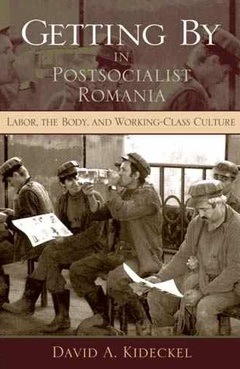
Mass media and intellectuals have typically portrayed them as aggressive, uneducated, and morally spoiled. In his recent book, anthropologist David A. Kideckel challenges these views and lets the Romanian working class speak for themselves.

“Most east and southeast European scholars tend to avoid labor and workers in postsocialist science, a topic that Kideckel embraces”, writes Simona C. Wersching in her review in the Monthly Review.

Kideckel points out the scholarly and political indifference toward the workers’ lives, their physical states, and embodied perceptions. Workers are only visible when they appear threatening and protest.

In Getting By in Postsocialist Romania. Labor, the Body, and Working-Class Culture, he provides according to Wersching “refreshing perspectives” about life coping strategies of two distinct working-class groups in Romania, the miners of the Jiu Valley and the industrial workers of the Nitramonia factory in Făgăraş/Transylvania:

Kideckel’s contribution pays particular attention to workers’ words and thoughts about themselves, their work, their families, their societies, their fears, and their dreams, and highlights the diverse legal and illegal practices of “getting by” (a se descurca) in this changing world after 1989.

Health, living standards, and consumption possibilities have deteriorated. Postsocialist pressures on labor and bodies produce “frustrated agency”. These problems have according the anthropologist nothing to do with ‘socialist legacies’ or ‘culture’, but should be understood as responses to “neo-capitalism”, “a system that reinterprets the main principles of capitalism in a new way and that promotes social injustice much more than does the Western model from which it derives”:

Kideckel interprets the workers’ words as typical preoccupations of workers confronted with the “effects of the forced diet of neo-liberalism” (p. 8), such as changing and uncertain status of property due to privatization, inequalities, instrumentalization, commodification of basic social relations by the market democracy, weak state structures that allow the existence of mafia and corruption, the misusage of funds and foreign assistance, the decline in agricultural markets, the return to subsistence farming, and emigration. Kideckel connects the effects of neoliberalism to his critics’ notion of “transition” as an academic representation of triumphalist politics.

Kideckel, who conducted his first fieldwork in Romania in 1974, also claims that the workers’ “selective perception of the past” (when workers had high status) and their present feeling of alienation from society at large, create a feeling of frustration that hinders effective agency.

>> read the whole review

SEE ALSO:

Durham Anthropology Journal: How “post-socialist” is Eastern Europe?

Doing fieldwork in Eastern Europe – New issue of Anthropology Matters

– Use Anthropology to Build A Human Economy

Ethnographic study: Why the education system fails white working-class children

Available for download: Alex Golubs dissertation on mining and indigenous people

Fieldwork as cab-driver: “An amazing other world”

Financial crisis: Anthropologists lead mass demonstration against G20 summit

Mass media and intellectuals have typically portrayed them as aggressive, uneducated, and morally spoiled. In his recent book, anthropologist David A. Kideckel challenges these views and lets the Romanian working class speak for themselves.

"Most east and southeast European scholars…

Read more