search expand

Ethnologie- und Kunststudierende stellen riechende Strassen aus

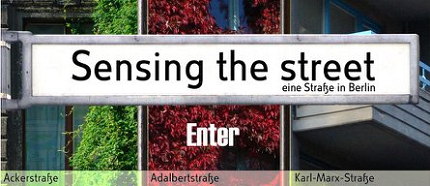
Das Ausstellungsprojekt “Sensing the street” erforscht die Sinnlichkeit von Straßen. Studierende der Ethnologie und Kunst zeigen, wie die Ackerstraße riecht, die Adalbertstraße tönt und die Karl-Marx-Straße sich anfühlt, schreibt die taz:

“Sensing the street” heißt das interdisziplinäre studentische Ausstellungsprojekt, das drei Straßen unter die sinnliche Lupe nimmt. Drei Semester lang haben Studierende des Instituts für Europäische Ethnologie an der Humboldt-Universität (HU) und des Instituts für Klangkunst der Universität der Künste (UdK) zusammen geforscht und experimentiert: Wie fühlt sich Berlin an? Diese Frage wollen sie anhand der Ackerstraße, der Kreuzberger Adalbertstraße und der Neuköllner Karl-Marx-Straße beantworten.

Die drei Straßen stehen exemplarisch für typische Berliner Erfahrungen: Teilung, Wiedervereinigung, wirtschaftlicher Niedergang. “Künstlerisch-ethnologische Verdichtung” nennt der Ethnologie-Professor Rolf Lindner die Methode, mittels derer seine Studierenden die besondere Stimmung einer Straße wiedergeben.

>> weiter in der taz

>> Webseite der Ausstellug

UPDATE: Der Tagesspiegel berichtet ueber die Ausstellung: So schmeckt die Großstadt

Das Ausstellungsprojekt "Sensing the street" erforscht die Sinnlichkeit von Straßen. Studierende der Ethnologie und Kunst zeigen, wie die Ackerstraße riecht, die Adalbertstraße tönt und die Karl-Marx-Straße sich anfühlt, schreibt die taz:

"Sensing the street" heißt das interdisziplinäre studentische Ausstellungsprojekt, das drei…

Read more

“You can’t understand America without understanding the world”

Nice interview with anthropologist Alan Klima in University paper The California Aggie about anthropology in general.

For example the anthropologist’s answer to the question how he became interested in anthropology:

I was always interested in social theory, thinking about what is going on in the world and at one point in college I realized that there are all of these different ways of thinking, ways of doing things around the world – that there is no way you could really understand humans and society and history without understanding all of the variety in the world.

So I guess I was eventually very interested in U.S. society and social problems and had a lot of thoughts about that and realized that you can’t really understand these things unless you understand the tremendous variety in the world.

Or his definition of anthropology:

Sociocultural anthropology is the study of all alternative world knowledges. Political knowledges, religious knowledges, scientific knowledges, medical knowledges – that there are a lot of different ways to think about things.

The situation of anthropology in the US:

I think for most professors in the U.S., that you’re sort of a class of people that’s not very well respected in the wider society, and often your voice doesn’t count in a direct way, unlike in other countries in the world, where if there’s an issue the television might come to the university and ask professors what they think. But that doesn’t happen so much in the U.S.

Or look at his his comparision of anthropologists with garbage collectors when he is asked if anthropologists can change the world:

I also think of it (work as anthropologist) as sometimes as similar to people who collect the garbage. They are not changing the world, but if they didn’t do it, things would get really messy. Somebody’s got to do that. Somebody’s got to be in the academy thinking all kinds of experimental and critical thoughts and sharing that with students and thinking that over with students. If we didn’t have that, things would be a lot worse. I can’t really say that I or any of the other professors are totally changing the world for the better.

>> read the whole interview in The California Aggie

SEE ALSO:

Why anthropology fails to arouse interest among the public – Engaging Anthropology (2)

Interview: “Anthropology Is Badly Needed In Eastern Europe”

Keith Hart and Thomas Hylland Eriksen: This is 21st century anthropology

The Five Major Challenges for Anthropology

“Anthropology not less scientific than physics”

Nice interview with anthropologist Alan Klima in University paper The California Aggie about anthropology in general.

For example the anthropologist's answer to the question how he became interested in anthropology:

I was always interested in social theory, thinking about what is…

Read more

How anthropological research can reduce the paper usage in offices

(Links updated 14.2.2025) Another example of anthropologists in product development: As a consequence of anthropological research, Xerox is developing a new kind of paper where the printed information simply disappears within about 16 hours, allowing the paper to be reused.

Why this? Xerox-anthropologist Brinda Dalal, an anthropologist at Xerox, found out that 21 percent of copier documents ed up in the recycling bin on the same day they are produced. In most offices, paper is used as a medium of display rather than storage. Paper is only only printed out or copied when needed for meetings, editing and annotating, or reading away from a computer. The result is, of course, an enormous quantity of waste paper and environmental problems.

>> read the whole story on ZDNet

Actually, the New York Times wrote about this self-erasable paper one year ago. They called anthropologist Brinda Dalal for “garbologist”. She told, she was surprised by the results: “Nobody looks at the ephemeral information going through people’s waste baskets.”

>> Some papers by Brinda Dalal

SEE ALSO:

Tagging and Folksonomies: Xerox Scientists Apply Insights From Ethnography

Timo Veikkola – The Anthropologist as Future Specialist at Nokia

Popular IT-anthropologists: Observe families until they go to bed

“The science of ethnography is an ideal tool to designing mobile phones”

Anthropologists find out why we (don’t) buy organic food

Ethnography, cross cultural understanding and product design

(Links updated 14.2.2025) Another example of anthropologists in product development: As a consequence of anthropological research, Xerox is developing a new kind of paper where the printed information simply disappears within about 16 hours, allowing the paper to be reused.…

Read more

Dissertation: Imam’s influence on Muslims overestimated

Participants in the debate on Islam often overestimate the authority and influence of imams. The role of the imam is especially limited when it comes to so-called “second and third generation immigrants”. This is the conclusion reached by anthropologist Welmoet Boender in her dissertation Imam in Nederland, for which she was awarded her doctorate at the University of Leiden on Tuesday, according to expatica.com:

Boender’s research shows that not only the imam in the mosque defines appropriate standards and values and behaviour for the faithful, but television sheiks, internet imams, friends and family members and (translated) books also play a role. (…) In the public debate the imam is often seen as an instrument to integrate Muslims in Dutch society. (…) In light of the limited role that imams play for many Muslims, he will most likely fall short of this task.

>> read the whole story on Expatica.com

The dissertation is not online (yet?). I have not found any information in English. For those who do read Dutch, the blog Closer by Martijn de Koning of course provides more information in his post Imam in Nederland – Welmoet Boender.

I’ve found an older texts by Welmoet Boender though Imams in the Netherlands: An Impression.

SEE ALSO:

Doctoral thesis: Towards a transnational Islam

Islam in Europe: Mainstream society as the provider of conditions

How Islamic cassette sermons challenge the moral and political landscape of the Middle East

Islam in Morocco: TV and Internet more important than mosques

Doctoral Thesis: Is Islam Compatible with Secularism?

Extremism: “Authorities -and not Imams – can make the situation worse”

New blog: Islam, Muslims, and an Anthropologist

What does it mean to be Muslim in a secular society? Anthropologist thinks ahead

Book review: Mahmood Mamdani: “Good Muslim, Bad Muslim”

Participants in the debate on Islam often overestimate the authority and influence of imams. The role of the imam is especially limited when it comes to so-called "second and third generation immigrants". This is the conclusion reached by anthropologist Welmoet…

Read more

14th Nordic Migration Researchers Conference

14.-16. november 2007, Bergen (Norway)

The Nordic Migration Researchers Conferences have established themselves as a major contact point not only between Nordic researchers in the field of international migration and ethnic relations, but also between these and international scholarship generally.

The theme for the Nordic Migration Researcher Conference points to issues of sovereignty, demarcation, distinction, exclusion and discrimination, but also to issues of transience, communication across distinction, and acceptance. Aspects of ‘the global turn’ and the Europeanization of Europe, not least as manifest in migration and migrant populations, have brought border and boundary issues to the forefront not only in social science and humanities scholarship, but also placed them with exceptional prominence on the political agenda.

More information: http://imer.uib.no/14Nordic/index.htm

14.-16. november 2007, Bergen (Norway)

The Nordic Migration Researchers Conferences have established themselves as a major contact point not only between Nordic researchers in the field of international migration and ethnic relations, but also between these and international scholarship generally.

The theme…

Read more